Portugal

Jo’s Monday walk : Luz de Tavira to Fuseta

I’m often asked if it’s possible to enjoy the Algarve and its natural beauty without the use of a car.  My walk today gives you one example of how to do just that.  In much of the Eastern Algarve the railway tracks run quite close to the shoreline.  As well as a hands free ride through pleasant countryside and that age old delight of peering into passing gardens, you can hop off the train and pursue a gentle walk.  After my brief absence, I’m taking it slowly.

The place I’ve chosen to start is Fuseta, a very laidback town 10km east of  Olhão, with an active fishing fleet and a natural harbour.  You can easily while away an hour or two here and I’ll give you some thoughts on how later, but first let’s catch that train.  There are two railway stations in Fuseta, though I’ve only just discovered tiny Fuseta ‘A’.  It’s at the top of a hill, behind the restaurants at the western edge of town.  If this doesn’t appeal, Fuseta-Moncarapacho, the main station at the eastern end of town, will serve you just as well for the purposes of this walk.

It’s only a couple of stops from Fuseta to Luz de Tavira, a sleepy little spot if ever there was one.  Dismounting from the train you cross directly over the railway tracks.  A word of warning- there is no official gated crossing, but it’s a very flat area and you can see far along the track in both directions, so please do look both ways.  Safely over, turn right at the first corner and follow a leafy lane, passing a couple of country homes.  Prickly pear and almond blossom will vie for your attention in this early stage of the year.

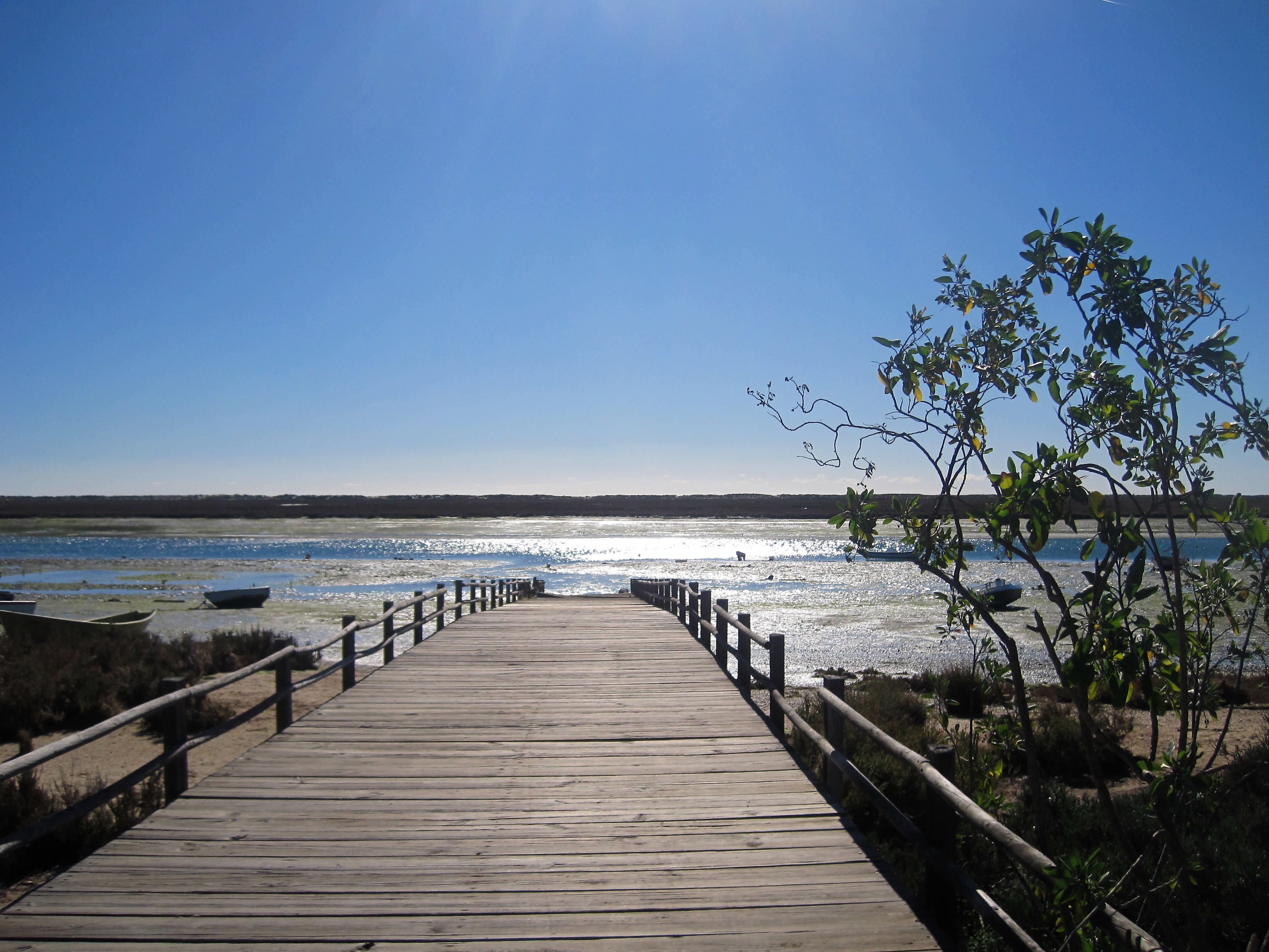
Bear left and soon a glimmer of water will appear on the horizon.  You are joining a stretch of the Ecovia Litoral, a cycle track which threads its way along the Algarve coastline, but which in many places makes for relaxed and enjoyable walking.
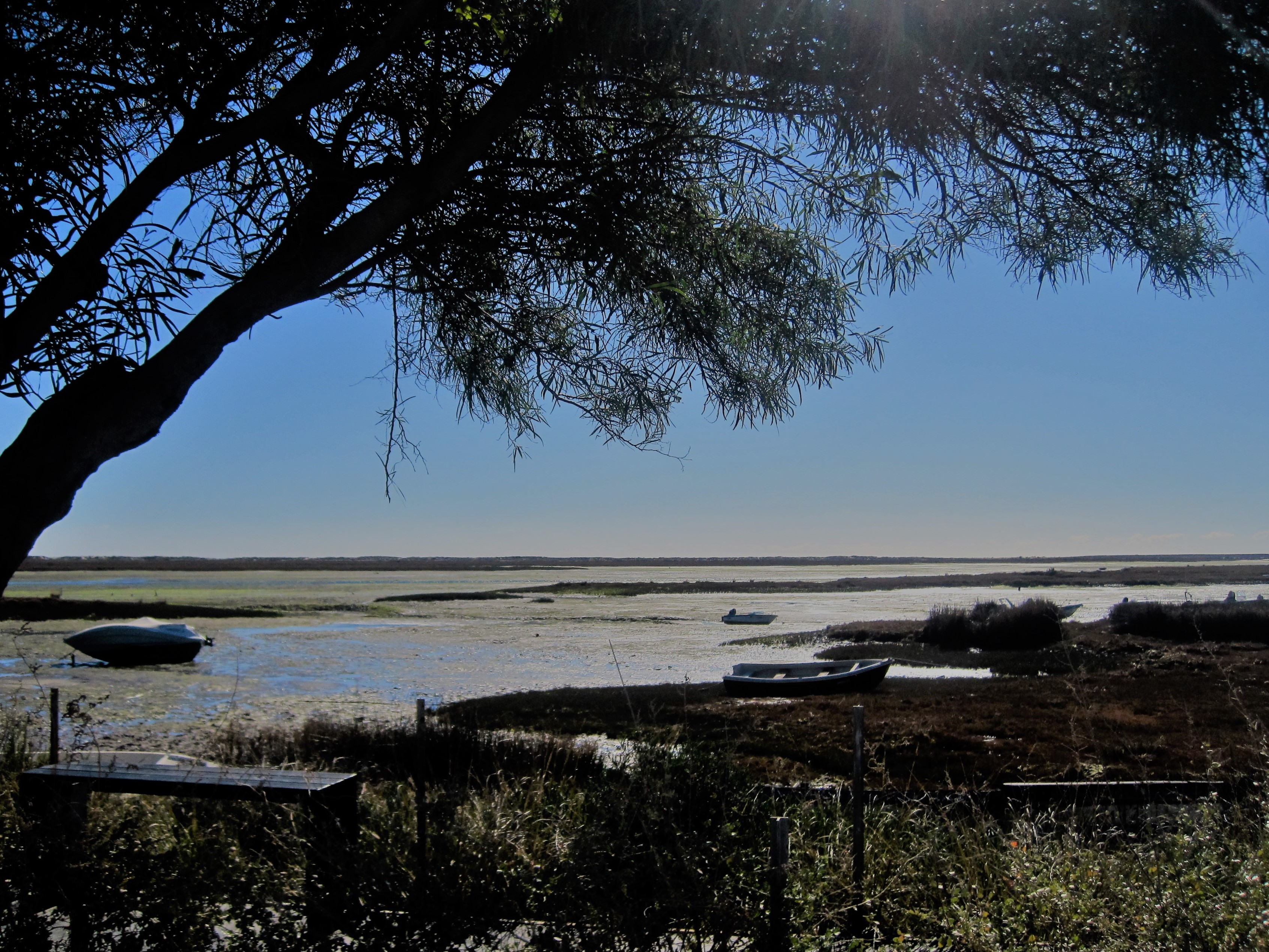
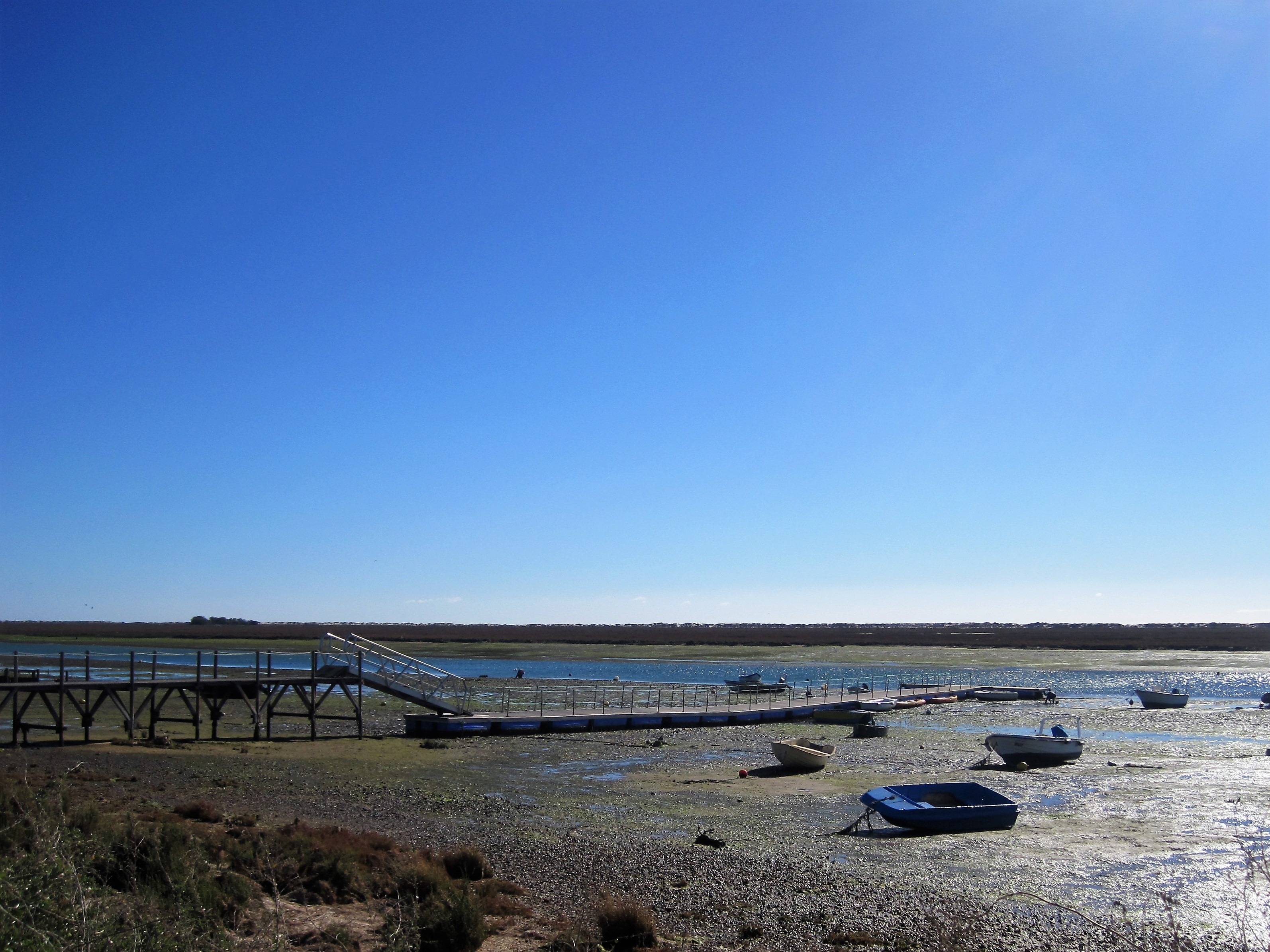
Often times the boats are marooned on these tidal mud flats, beautiful in their ugliness.  If you are lucky the tide might be in.  In any case, the sea will glitter in the distance.  The ruins of a defence tower, Torre d’Aires, are largely ignored, lost in the pellucid landscape.

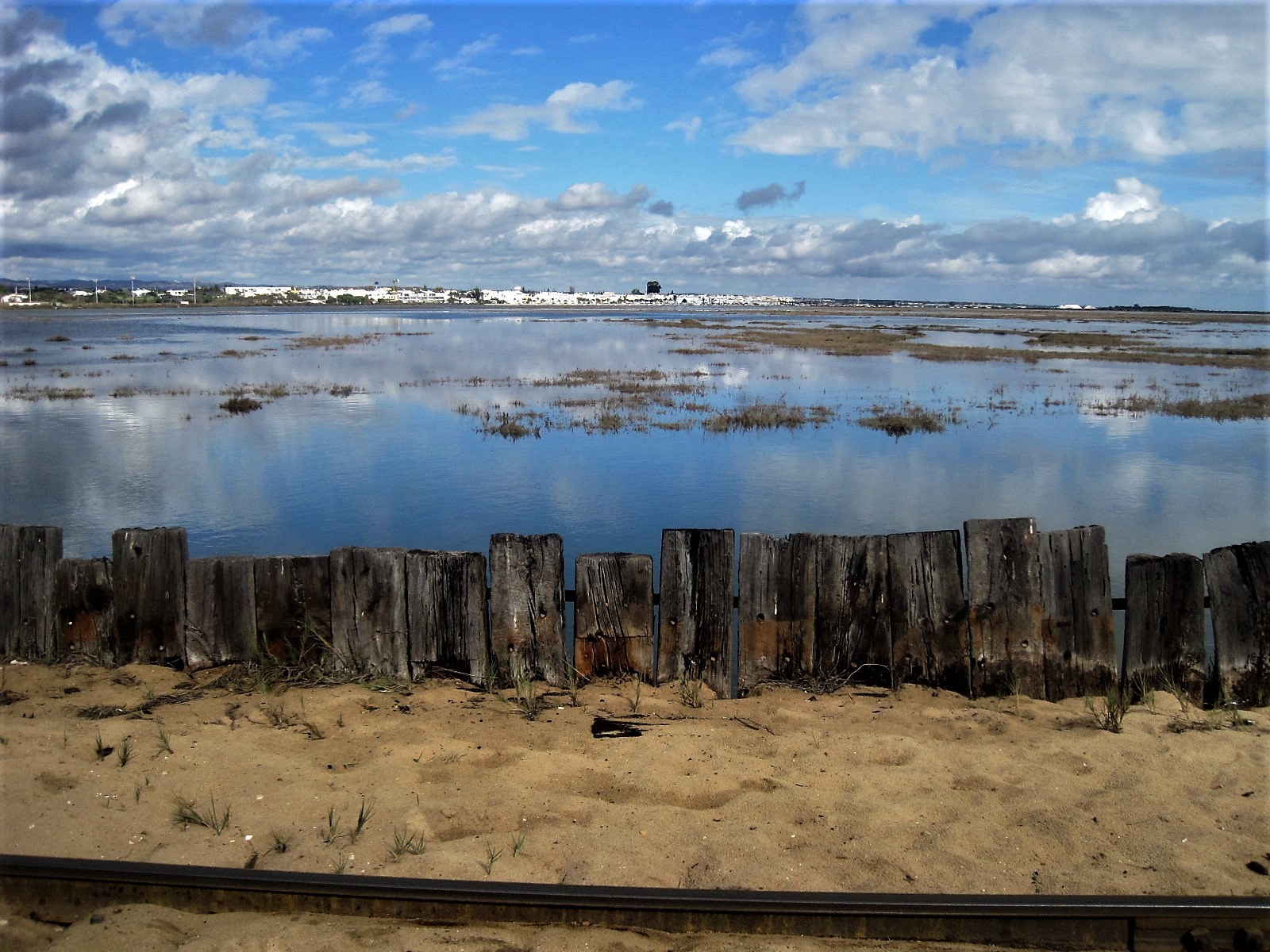
Along this shoreline, an elevated bungalow with a lovely tumble of garden calls to me, though my more pragmatic other half reminds me that mosquitos will be a severe nuisance in summer.  This is the heart of the Ria Formosa Nature Reserve, and a winter haven for migrating birds.

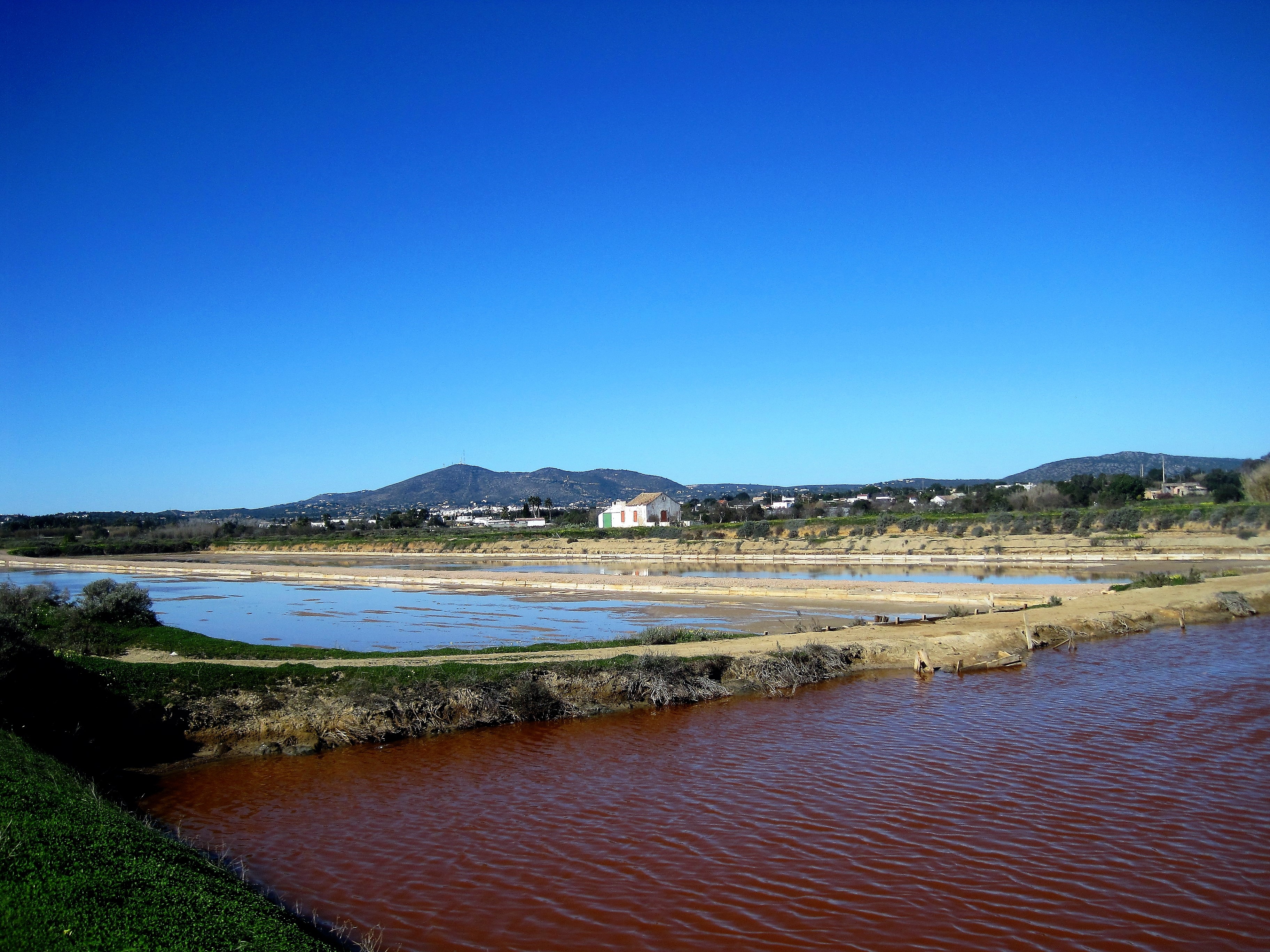
Just past the midway point to Fuseta you will find a cafe, O Conquistador.  Virtuously I did not sample them (I was to have a substantial lunch at the end of my walk) but the cakes did look extremely appealing.  Following an arrow the path now crosses through the salt marshes, with Fuseta and a towering mound of salt on the horizon and butter yellow oxalis rippling at your feet.

I am delighted to observe, busily guzzling in the briney water, a large flock of flamingos.  Their overhead flight makes a lovely ending to my walk.

And no, I didn’t manage to capture them, unless you wish to see a very blurred tail feather or three.  But I can share that I ate at Crispins, almost impossible to miss as you walk back into town.  The quayside makes a pleasant after dinner stroll, leading as it does to an expanse of river beach.  Grab a bench and gaze out to sea, or watch the locals playing boules behind the green.  In warm weather you can ferry across to Armona and an endless expanse of beach.  Make sure to carry water with you as you are unlikely to find it at this end of the island.

Feeling like something a tiny bit more strenuous?  You can climb up through the narrow streets, for a closer look at Igreja Matriz, the Mother Church.  Notice the red lighthouse in the bell tower.  Legend has it that many years ago, during a mighty storm, the women of Fuseta lit an enormous bonfire in the churchyard, the highest point of the village, to guide their fishermen husbands home.  The men were guided safely back by the distant light and the image of Our Lady of Carmel, on June 16th, an event still celebrated every year.

It has its gritty areas but Fuseta is quite an interesting town.  This video gives a fairly realistic view of it.

I hope you enjoyed my walk.  I do try to include the details you would need if you found yourself in the area, but I can highly recommend Becky’s blog as a walking resource.  Based at  Olhão, she covers much the same territory as I do, with the very useful addition of an interactive map.

Sorry that I’m overdue in sharing some of these walks, but I do like to step back from the blog sometimes, especially here in the Algarve.  I don’t stop walking but I do just relax into glorious scenery and good companionship.  Many thanks to you all for your patience and support.

……………………………………………………

Did you know that Drake is a steadfast Liverpool supporter? :

Night in anticipation

You need plenty of fuel in weather like this, but Jackie never has a problem :

Bundling up

No place like home, for Kathrin :

Monheim am Rhein : A walk through my home town

Lisa gives us a history lesson and some beautiful views (and warm sunshine!) :

Holidays in Haifa

While Lady Lee lives the high life!

Puerto Princesa, Palawan

Miriam shares a charming place and a snippet of Australian history :

Old Chiltern Town

Marsha has a tendency to cheat a bit, but look out for those Monarch butterflies :

Plan your Travel Itinerary to include the California Central Coast

Nobody does a garden justice quite so well as Jude.  As a bonus, two gems, one old, one new :

Garden Portrait: Scotney Castle

Garden Portrait: Polesden Lacey

Yikes!  It was snowing at home when I received this from Elaine :

A wintery walk beside Loch Achray

And Irene’s post looked even colder!  Go and say  ‘hi’ and warm her up :

To the Top of a Dune

If that’s not cold enough for you, Hiking Maine is sharing some stunning ice formations :

An amazing Winter Hike on the Cathance River Trail in Topsham

Finishing here in the Algarve, Becky shares one of her passions :

The Olhanese architectural promenade

I hope to share another walk with you next Monday but I’m not making a full return to blogging just yet.  Take care of yourselves, and enjoy your walking, whenever and wherever you can.


Spot the theme?

I’m interpreting the Weekly Photo Challenge to suit myself this week.  On Monday’s chilly walk I suggested that I still have a few warm Algarve images to share, and here they are in  Variations on a Theme

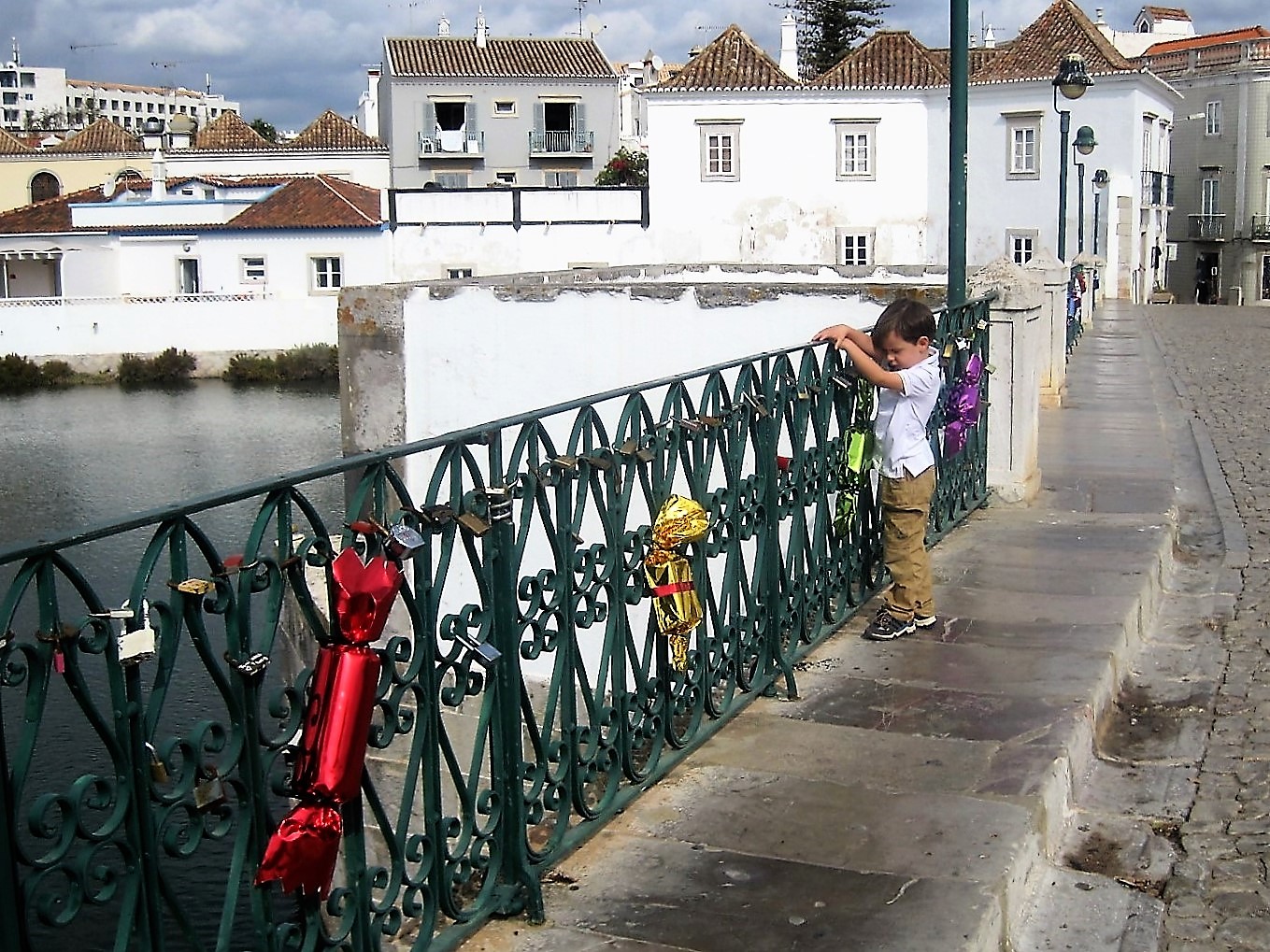
Those of you who know me will have spotted that the theme is Tavira.  I’m heading there this weekend and this will be my last post for a while.

I couldn’t leave without one more tribute to Paula.  She works hard and still manages to bring us Thursday’s Special each week.  Two views on the same subject.  What do you think?  Take care, till next time.

Silence in the Salt pans

Couldn’t you just lose yourself in this silence?  The end of another hot day in the Algarve, and the sun sinking gracefully into the salt pans.  The scene was so different when I walked out to Quatro Aguas earlier in the day.

A different quality of silence and not so easy to savour.  Almost harsh.  I like the gentler, reflective tones, when you can daydream a little.

How does silence look to you?  We had a different silence again here in the UK this morning, with a soft blanket of snow.

Jo’s Monday walk : Lisbon… one last time

“Let me take you by the hand, and lead you through the streets of…” Lisbon… one last time.  I’m sure Ralph Mctell won’t mind.  I’ve always loved this song but the YouTube video is harrowing.  There’s a dark side to cities that rarely appears on here, but I know you don’t have to wander far from tourist heaven to find it.

You can walk this walk from top to bottom, or bottom to top.  I’ve done it both ways.  I can only suggest that you take your time, and stop off for coffee whenever the fancy takes you.  And I can definitely promise you cake.

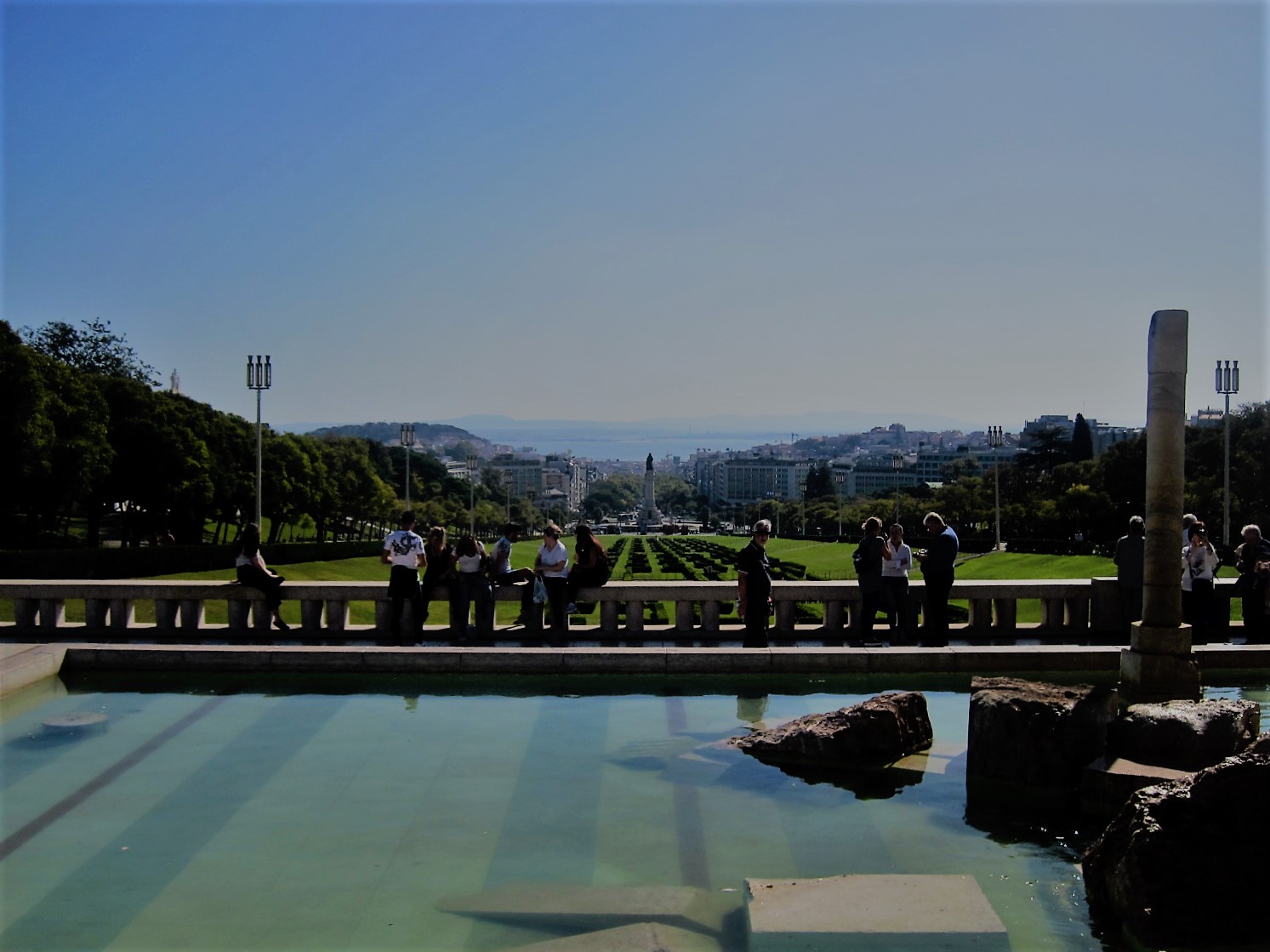
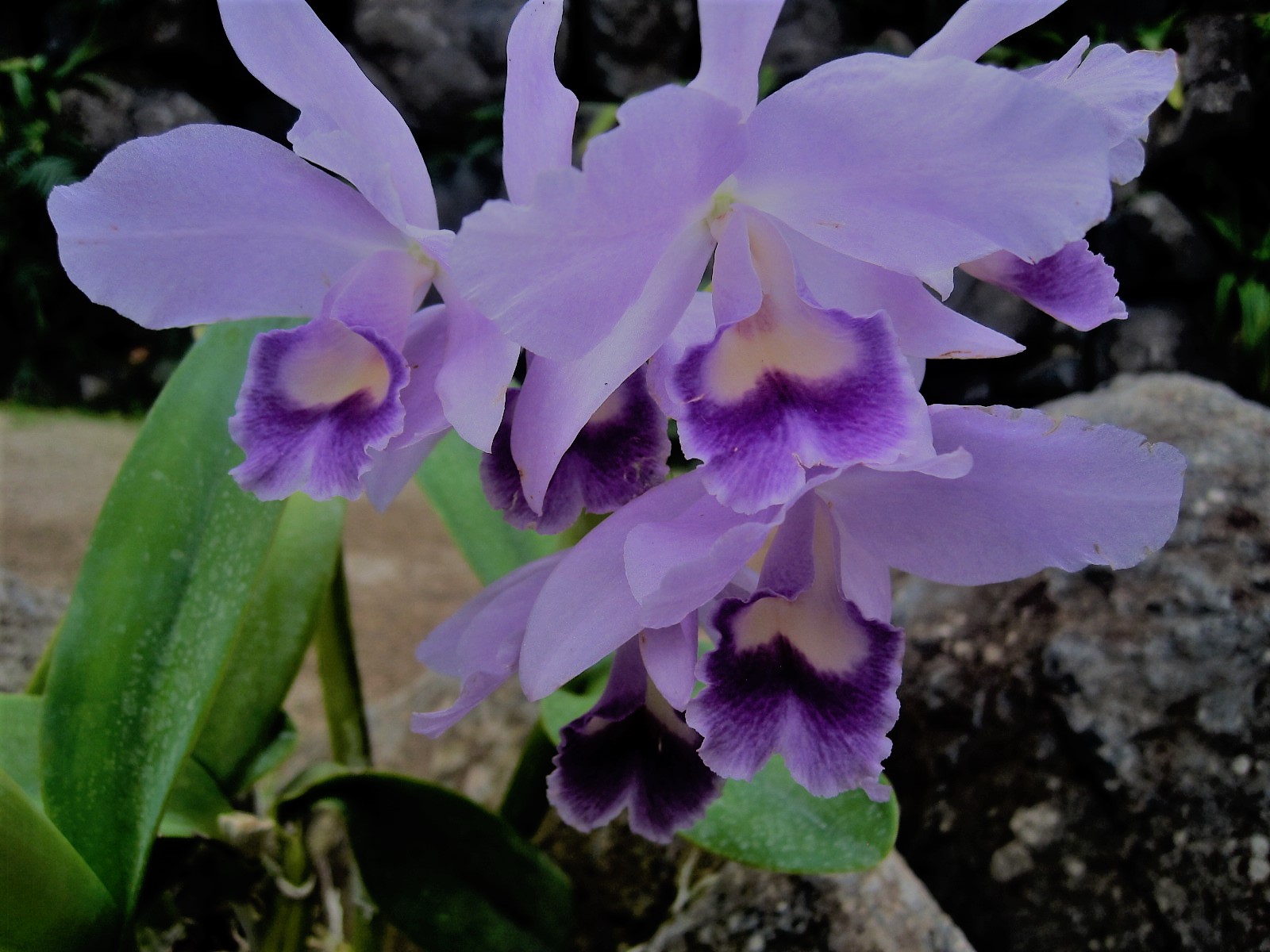
Here we are, at the top of Parque de Eduardo VII, looking down on the panorama of Lisbon.  Close by you will find the bus station, which was my final destination that day.  You have choices of where to linger.  I never did make it into the Calouste Gulbenkian museum, but I did let myself be sidetracked by the estufa fria (cold greenhouse) in Edward’s park.
I shan’t even attempt to name names, except for one specimen I received a cutting of from the family in Kraków.  It’s thriving still on my windowsill.

That last one is a Tradescantia Spathacea and it can be found in Belize, Guatemala and the south of Mexico.  And on my windowsill.

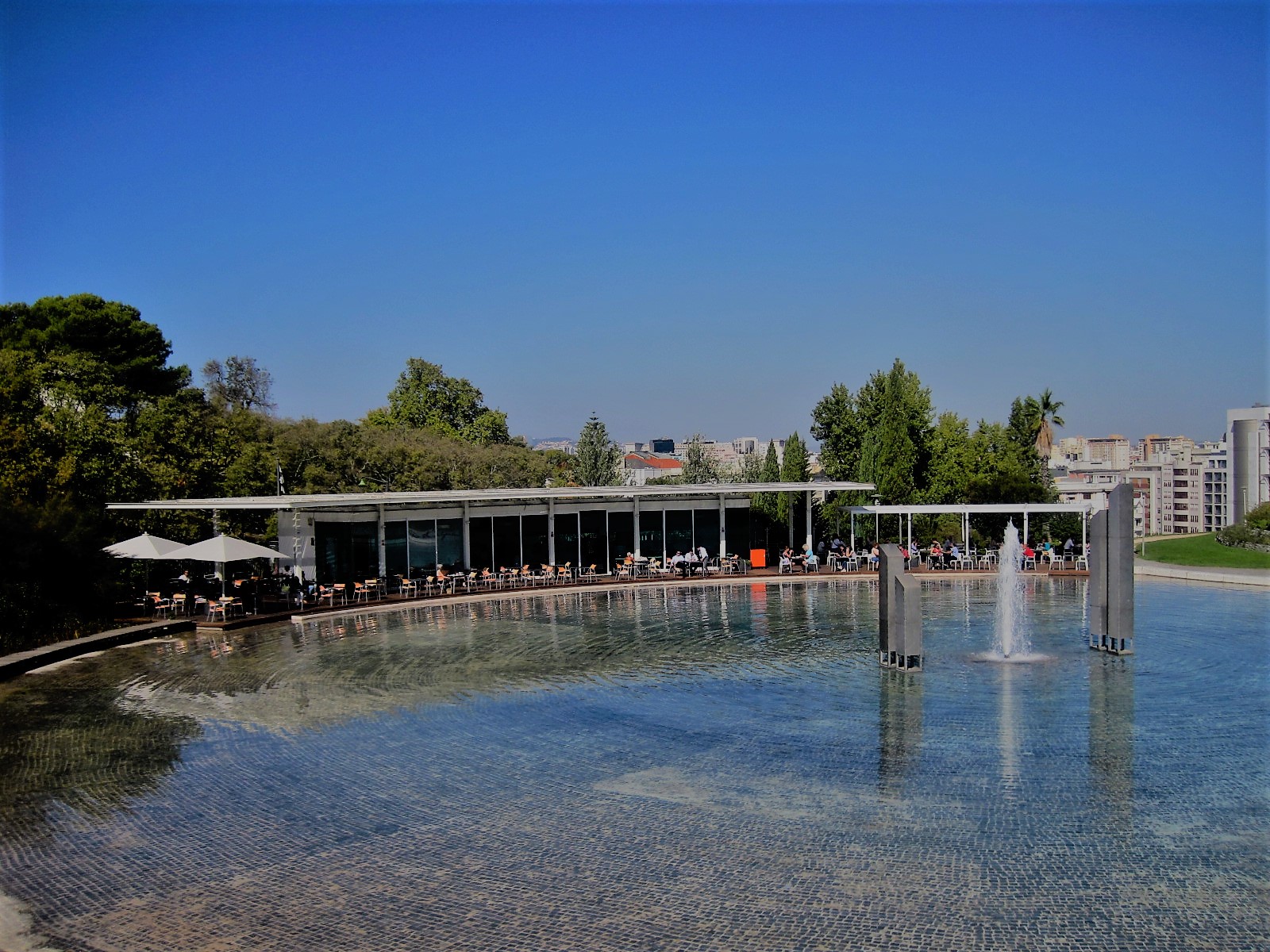
The simple joy of flowers.  So, we’re still at the top of the park but, if you should feel the need for a cuppa, I know the very place.  Linha d’Água.  Otherwise it’s a gentle stroll down through the park, pausing to admire the restored Pavilhão, and a few azulejos, of course.

Cross busy Praça do Marques de Pombal and you’re on the Avenida da Liberdade.  Follow the patterned pavements all the way down to Rossio, or Praça de Dom Pedro IV, as it’s properly known.  The whole character of the walk changes here as you are on the edge of the Baixa, the lower part of the city.  Its tall, narrow streets are named for the gold, silversmiths and other tradesfolk for whom this was once the commercial centre.

If you didn’t stop for a drink before, or even if you did, this is another good area.  A Brasileira and Café Nicola have both stood the test of time.

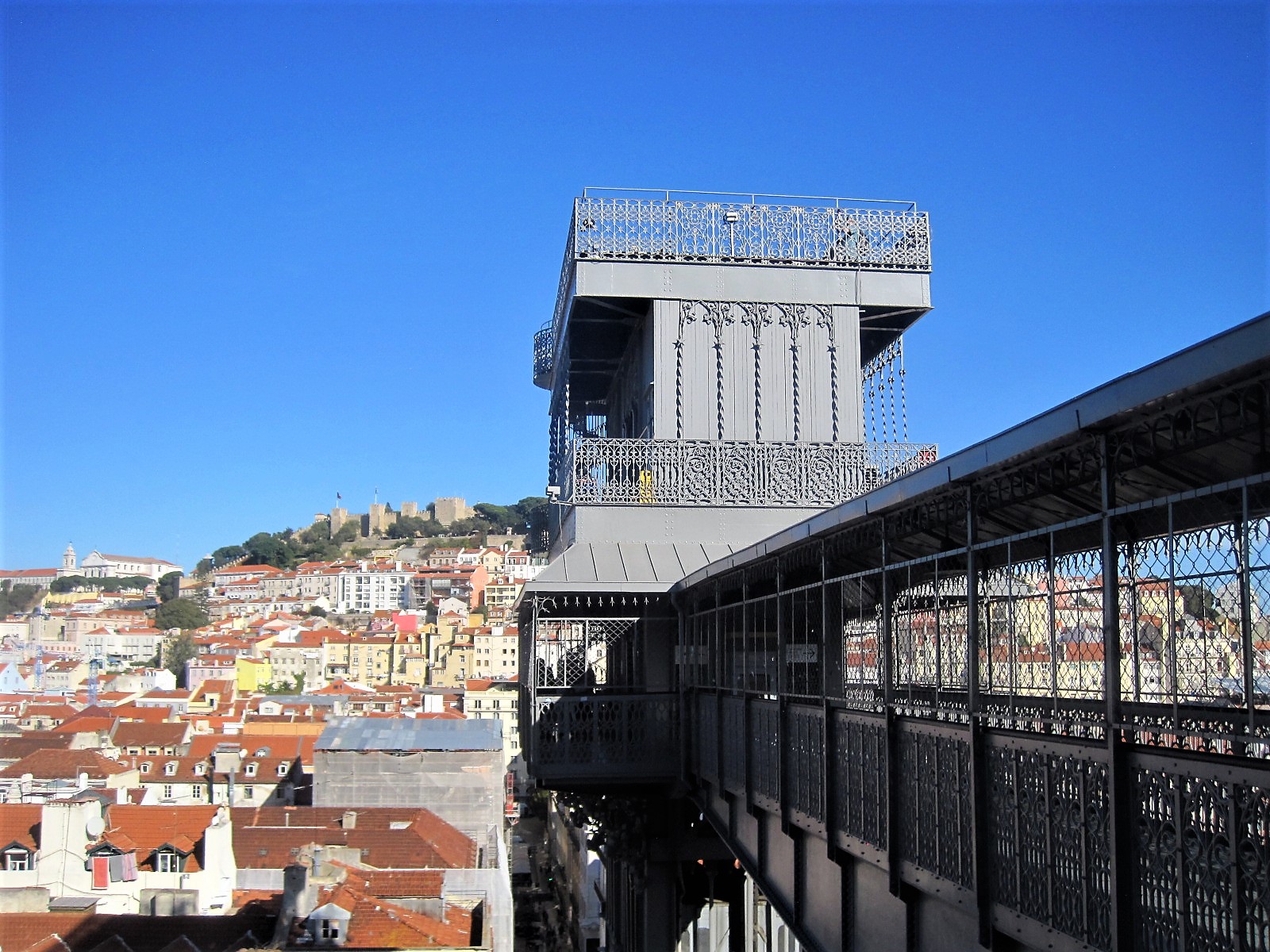
Refreshed, it’s time to go upwards a little.  If the queues aren’t too bad you might want to use Elevador de Santa Justa.  Otherwise it’s a steep climb up to Largo do Carmo and the beautiful ruined Convento.  Sadly, I had no time to enter.

The views out across the city, towards Castelo de São Jorge, are as good as any you’ll find in Lisbon.  You can make your way past the exit from the Elevador and down to a terrace full of recliners.  Not a bad place for a cocktail!  And an internal lift will carry you back down to street level.

Now I have to make my way all the way back to the bus station.  Better leave you with that promised cake, as I journey home to the Algarve.

It’s been a long series of posts, but I hope it’s given you some idea of how lovely a city Lisbon is.  I’m returning to the Algarve soon but I will share one more Monday walk before I go.  Not sure where it will be, just yet.

As usual I’d like to thank you all for your company and your contributions.  Please find a little time to read these.  I do appreciate it.  If you’d like to join me with a walk, next week will be your last chance for a while.  Details are on my Jo’s Monday walk page.

…………………………………………………………………

Nothing like a bit of company to make a good walk great, is there, Jude?

Readymoney Cove to Fowey

Funnily enough this is somewhere Jude and I have been, together!  Thanks, Anabel!

Edinburgh: a Canongate walk

I’d like to introduce you to a lady called Martha.  She’s walking on one of my old stomping grounds :

Best walks in London : Thames Path west, Richmond to Hampton Court

That white stuff just won’t go away!  Pity poor Jackie in Toronto :

Les Feves Au Lard

And you can almost hear the ice crackling on Drake’s post!

Added white atmosphere

But of course it’s a very different story in Australia.  Let Pauline introduce you to the Scribbly Gum Moth.  Yes, really!

A walk round my patch

This is a very delightful photo walk with Aarti :

Photowalk in Bosque El Olivar

And who doesn’t love a walk with views like this?  Not Sunny Days in Seattle :

Hiking : Oyster Dome

Finally, something completely different, from Kat  :

In the Footsteps of the Samurai : Walking the Nakasendo Way

Good variety, I’m sure you’ll agree.  The forecast’s not good for this week but I hope to get out and about.  If not, I’ll be watching the Australian Open tennis.  Enjoy your week, however you spend it!

Present meets past?

I wanted somewhere suitably elegant to end my daughter’s visit to the Algarve, and they don’t come any more elegant than the Estói Palace.  In A palace in warm sunshine, back in November 2014, I suggested that it might make a good venue for afternoon tea.  Do you remember it, Paula?  Long overdue, I think.  The sun was just sliding down the sky when we got there and the terrace looked so inviting.

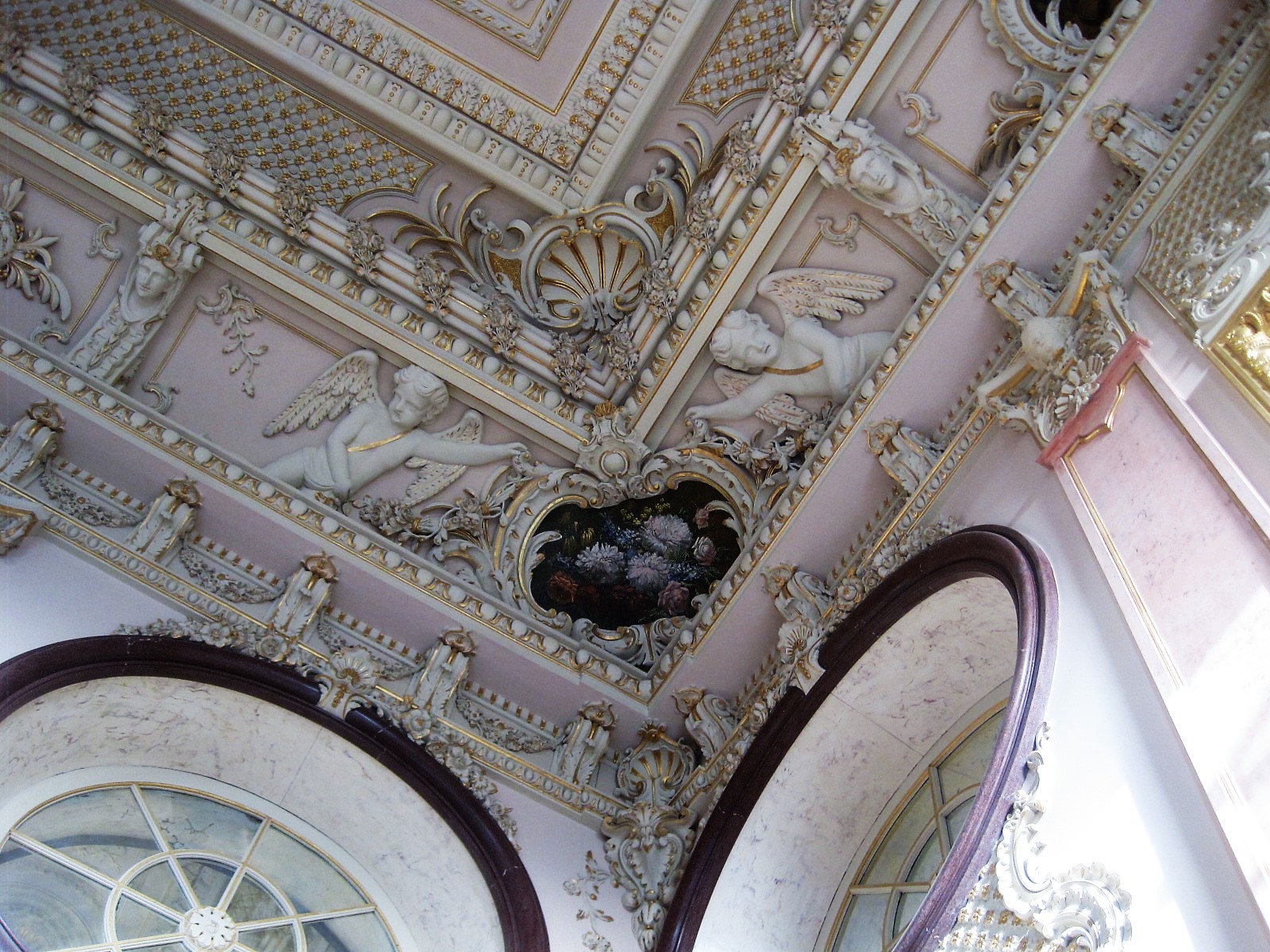
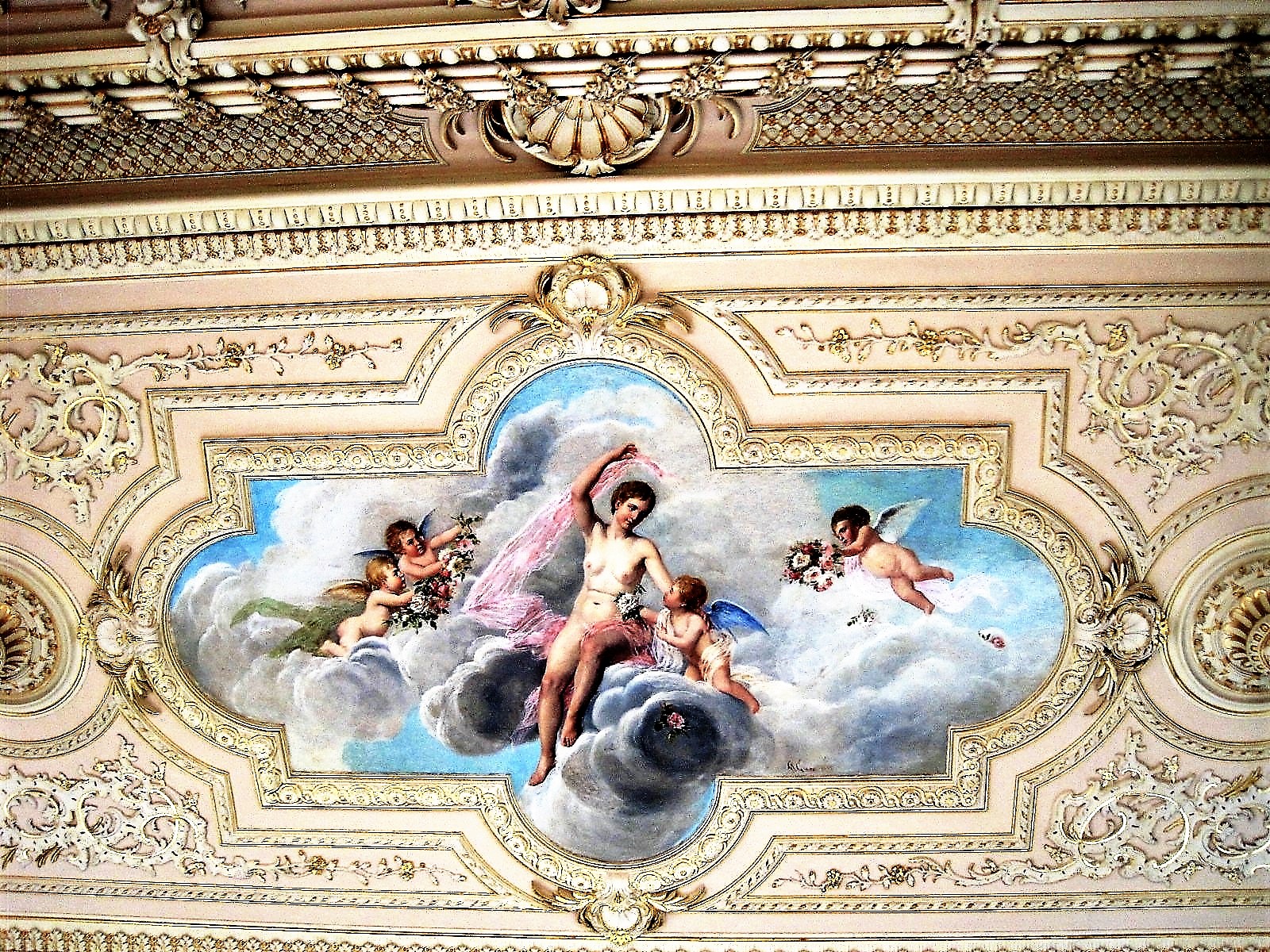
What a study in opulence this place is.  No need to introduce you to azulejos after Monday’s post but I can never resist sharing a few more beauties.

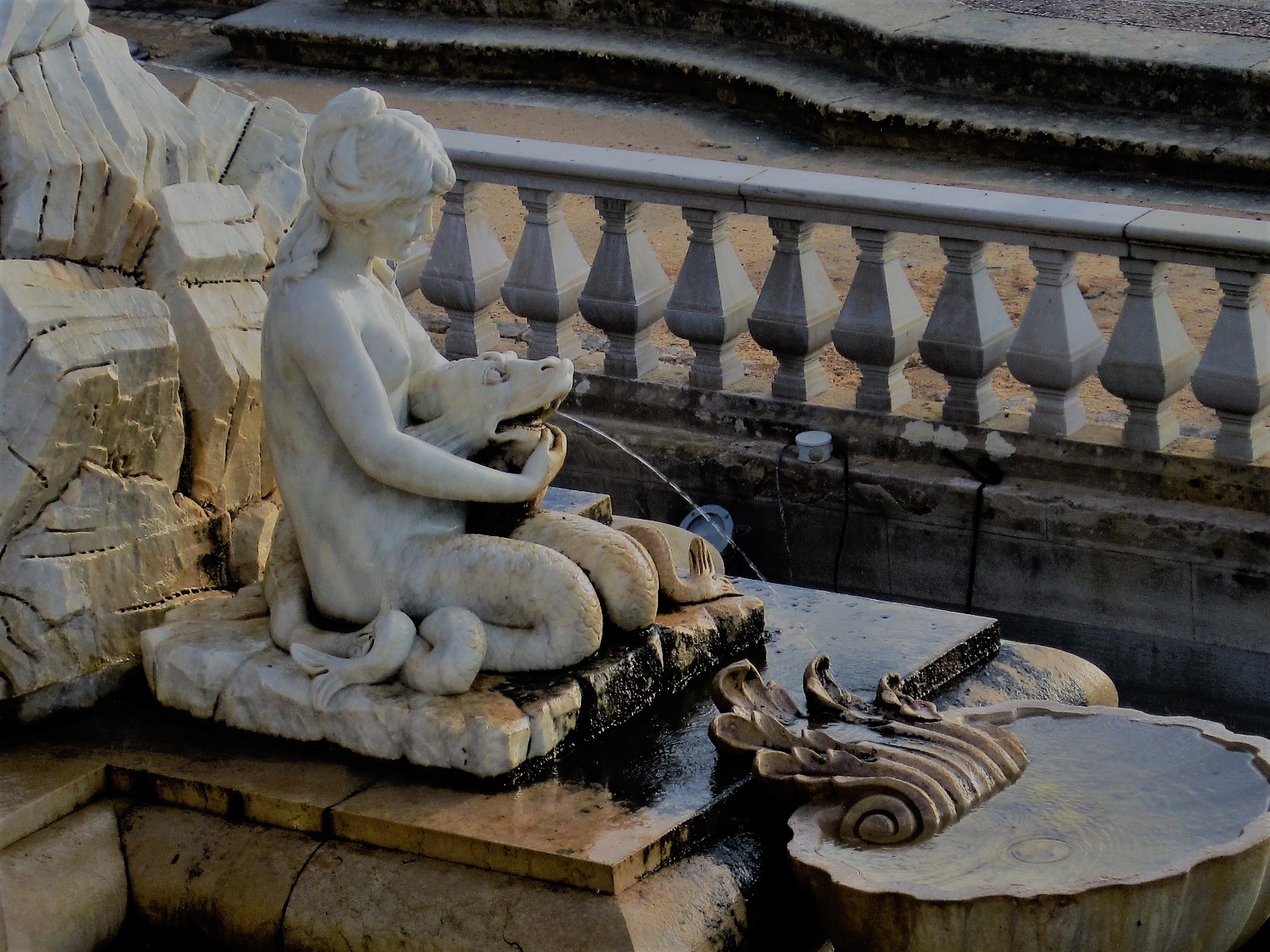
More restoration work had been carried out since my last visit.  The small summerhouses were a picture, with their vibrant stained glass and painted walls and ceiling.  The grotto was open and my son-in-law, who has a particular interest in ironwork, studied the details with interest.

Enough of admiring our reflection.  It’s time to go indoors for refreshment.  Truth be told, it really couldn’t compete with the decor.

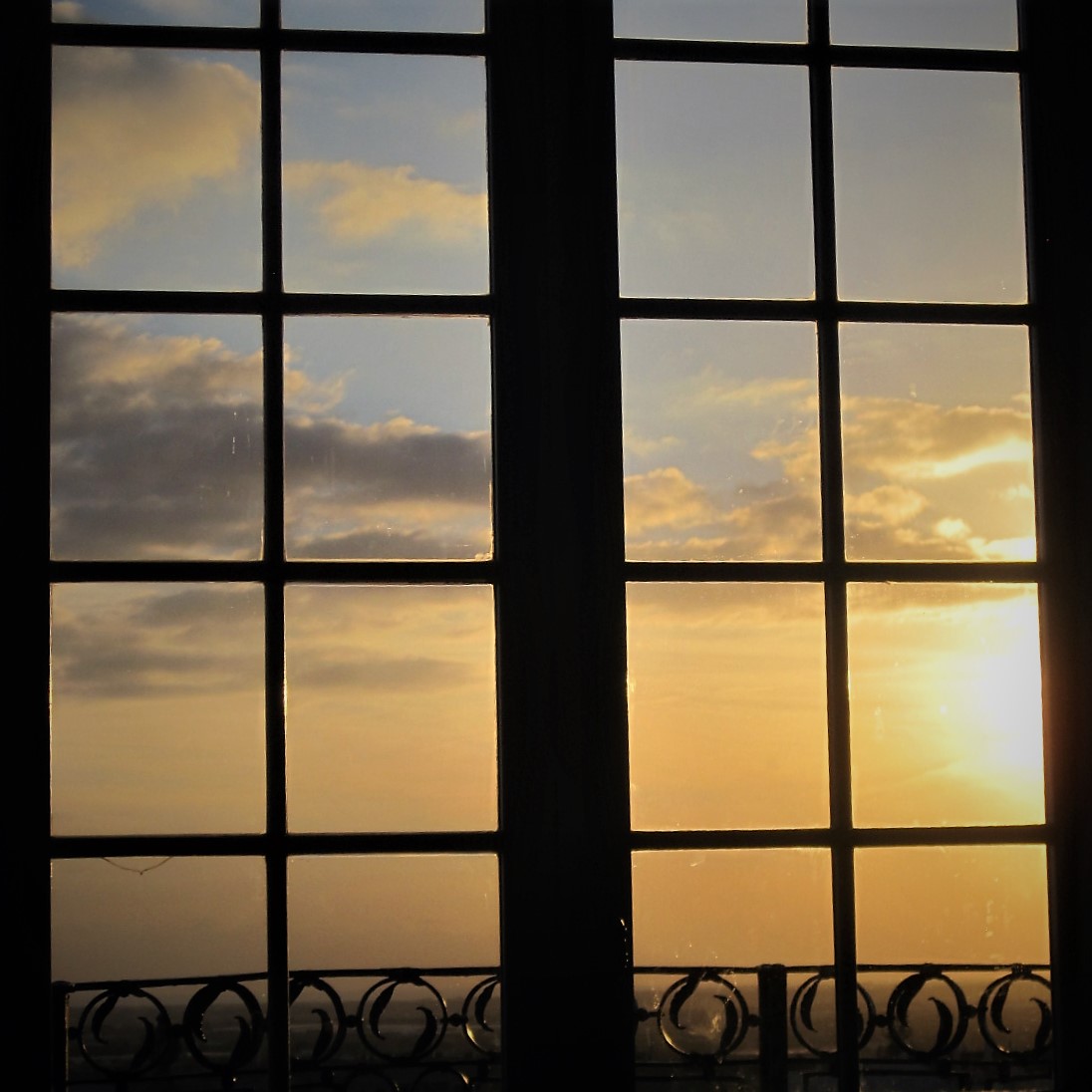
Does that window look familiar, Becky?  You’ll be happily ensconced in your Algarve life by now.  I’ve taken liberties with your Past meets Present.  I’m sorry!  You did such a nice job on the Palacio not long ago.  Paula- I thought you might like an update for Traces of the Past?

Oddly enough, the waiter said they only had cheesecake.  Ah well!  Cake’s cake, isn’t it?  There wasn’t a crumb left when son-in-law had finished.

Jo’s Monday walk : In search of Tiles

There were two main reasons for my visit to Lisbon last October.  I’ve already shared with you the first- the Jerónimos Monastery.  This is the second- the Museu Nacional do Azulejo.  It’s not normally recommended to walk there, but it’s not a great distance, and there’s a very nice restaurant when you arrive.  So, why not?

My start point was Praça do Comércio, always an interesting space, where Lisbon fronts the water.  Some people can sleep anywhere, can’t they?

I even found a tiny strip of beach, but let’s not get distracted.  The road threads along the riverfront, beneath Alfama.  Roadworks were a bit of a nuisance, as was a chap on a bench, who misdirected us for the price of a euro.  That’s cities for you!  I had it in my head that along the way I might stop off at São Vicente de Fora, for the cloisters, a coffee, and a view.  Don’t try it on foot!  A tuk-tuk ride would be a much better idea.

Google Maps showed that it was only 1.2 miles from the Praça to the museum, but I found myself hugging shade as it was remarkably warm for late October.  Interesting rather than scenic is how I would describe the route, as we passed the cruise terminal and then Santa Apolónia railroad station.  At a bridge spanning railway and docks, a tourist bus sped past.  And then, amazingly, there it was!

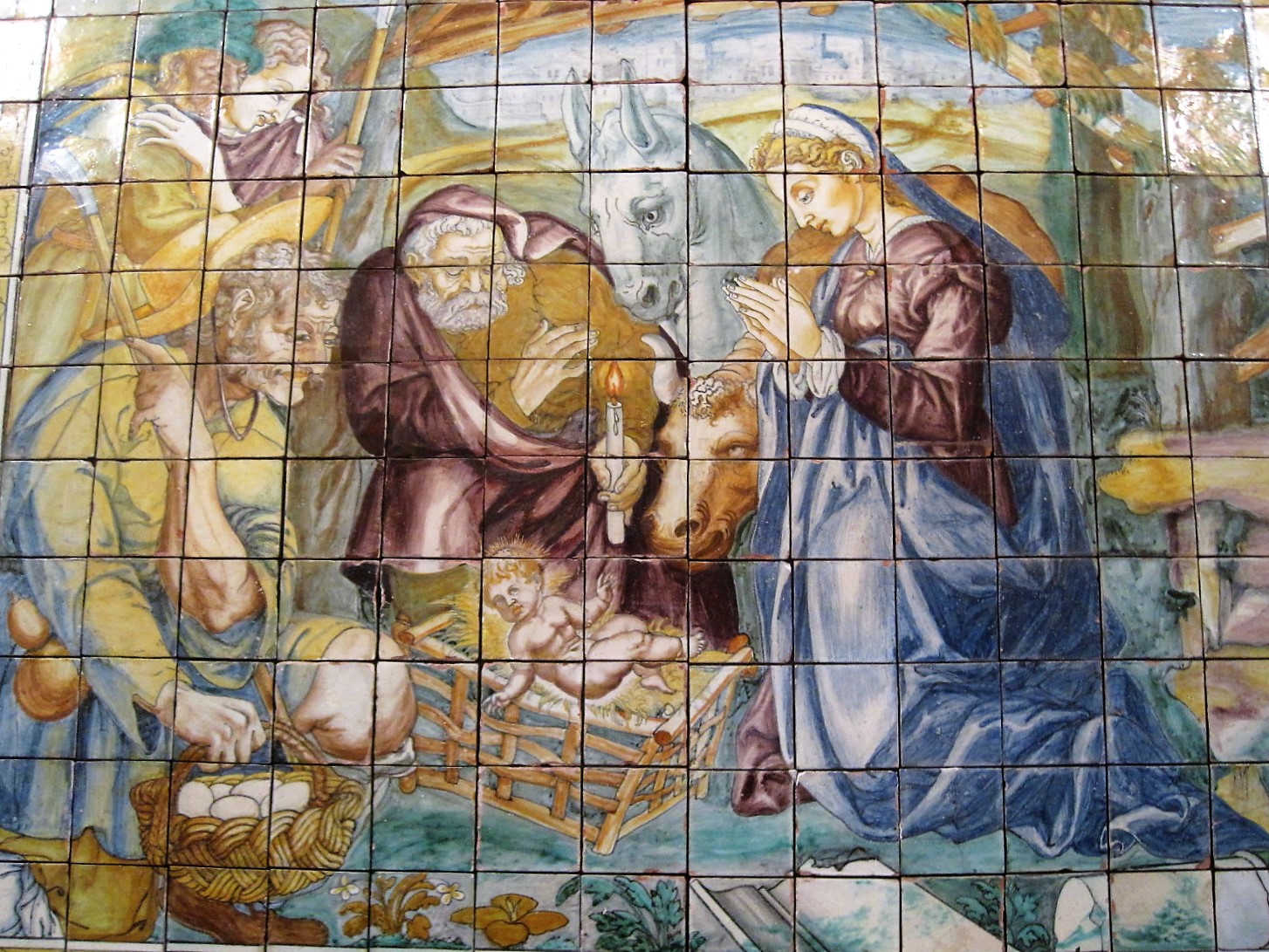
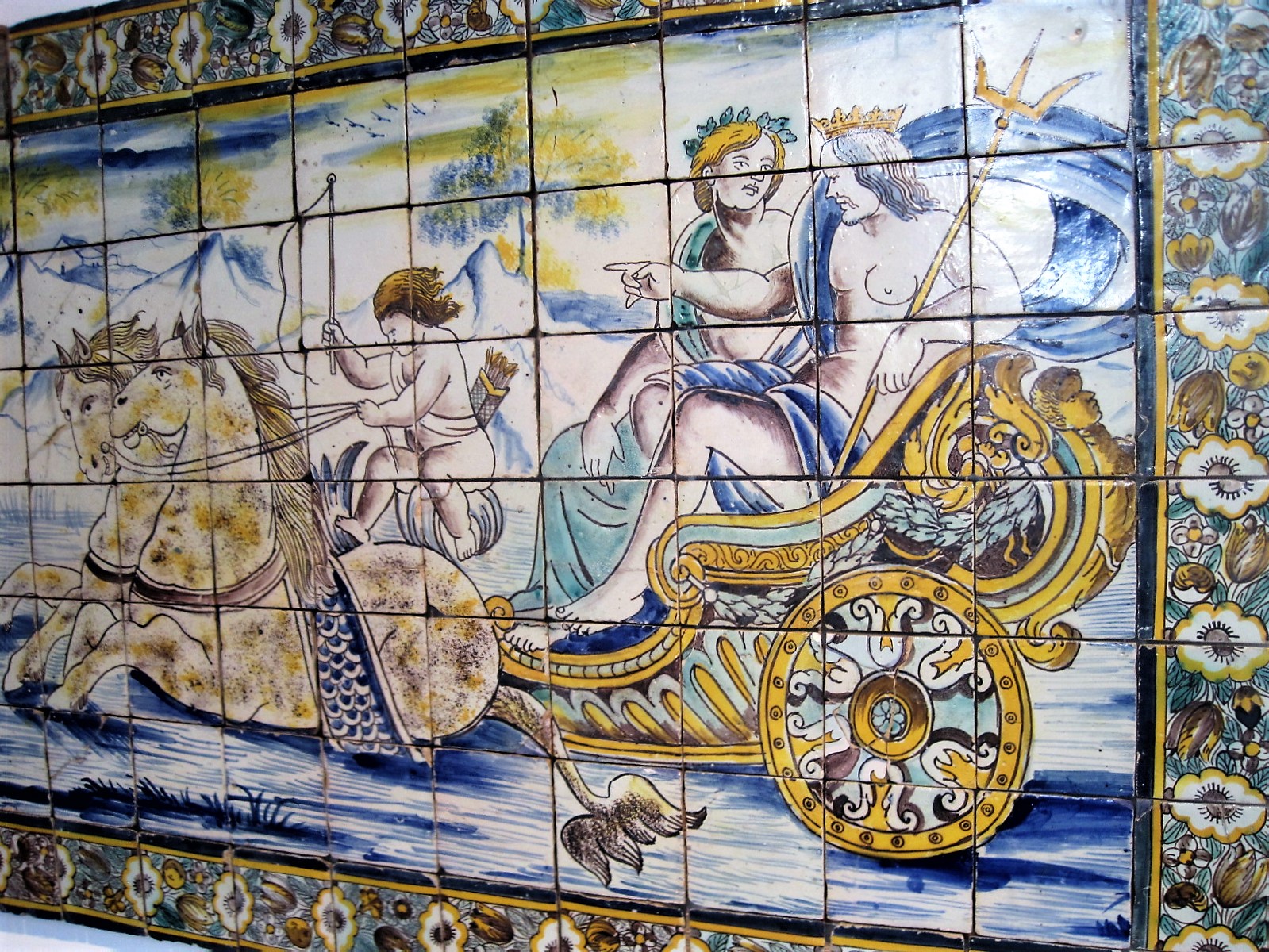
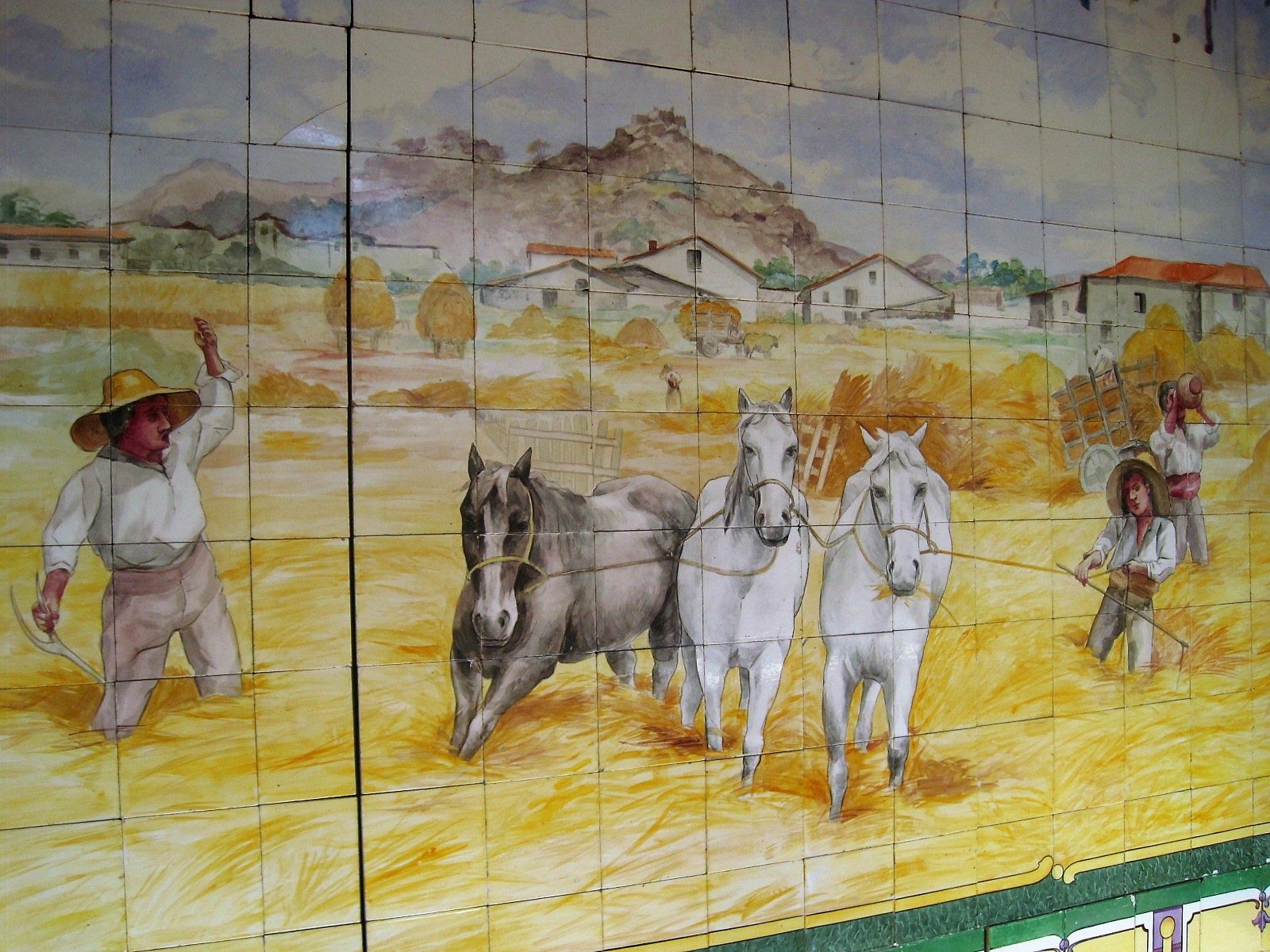
What a wonderful use for an old monastery.  Tile lovers, you are in for a treat!  The convent of Madre de Deus was founded in 1509 by Queen Leonor.  Over time, many azulejo panels were stored there, and in 1957 it was decided to have an exhibition commemorating 500 years after Leonor’s birth.  The Calouste Gulbenkian Foundation undertook the restoration work needed.  When the exhibition ended, in Jauary 1958, a wealth of tiles were available and it was proposed to transfer the Ceramic Section of Lisbon’s Museu Nacional de Arte Antiga to the building.  It was finally opened to the public as a museum in the 1970s.

First things first!  It was into the restaurant for some recovery time with delicious salads, in a prettily tiled setting, or a leafy outdoor courtyard if you preferred.  Fully fortified, it was time to tackle three floors of azulejos.

The museum surrounds the courtyard and cloisters, and has an incredible collection of azulejos, dating from 16th century to present day.

The magnificently restored church is incorporated into the museum.  You will be advised not to miss it and I could easily see why.  The decor includes rich, gilded woodwork, fine paintings and, of course, azulejo panels.

Time to climb to the next level.  There are interesting distractions along the way, but if you really can’t manage it then there’s a lift.

The azulejos change style and era on the next floor.  I tried to keep track of the accompanying details but it was too difficult.  Much easier to simply admire.  The museum website has an App to help you identify the pieces.

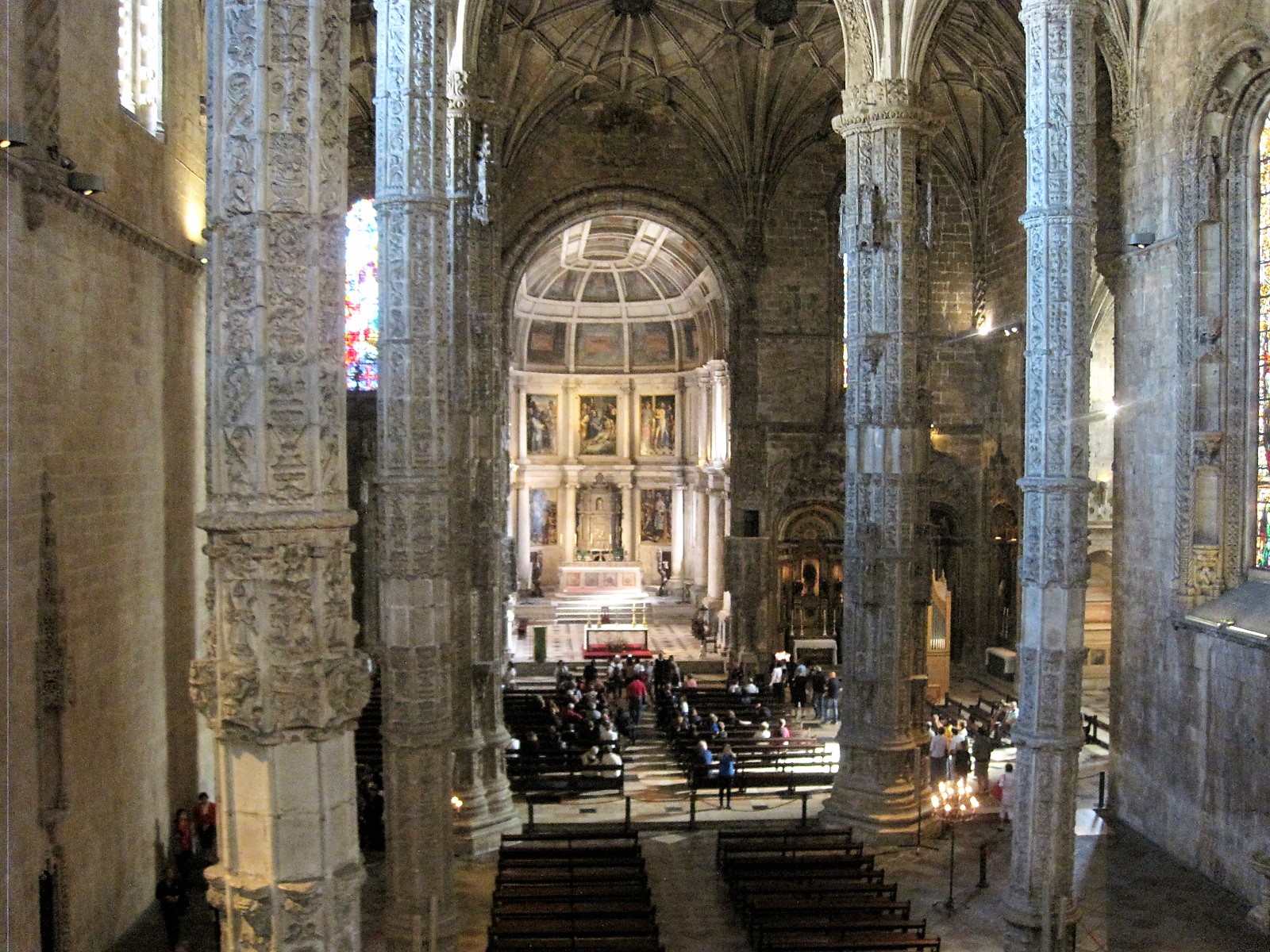
One of the most thrilling aspects of my visit to the Jerónimos Monastery was the moment when I stepped through a doorway to find myself looking down into the body of the church.  The same thing happens with Madre de Deus on the second level of the museum. I love the feeling of omniscience.  A seat in the Gods.

There is just one more level.  The exhibition culminates, at the top of the building, with an amazing 40 metre panorama of Lisbon, dating from 1730.  I have to admit, my eyes were starting to glaze over by the time I’d looked my fill.

The good news is that you don’t have to walk all the way back to the centre.  There’s a bus stop directly outside the museum and in 10 minutes you can be whizzed back to Rossio, and a different world.

Thanks for your company again this week.  It’s much appreciated.  I hope you can join me with a walk of your own soon.  Details are on my Jo’s Monday walk page.  Meantime please do enjoy these :

……………………………………………………………………………

Powder white, fresh snow makes for the most beautiful scenery.  Thanks, Drake!

The white track

I think Pauline might be grateful for a handful or two :

Hiding from the heat in the gallery

Becky will be enjoying this in a week or so’s time :

Another glimpse of the Guadiana

You could get the impression that Jackie doesn’t do anything but eat!

Cold Turkey

And Woolly?  He’s visiting War Graves again :

Jo’s-Monday-Walk-Wk48_Prowse-Point

An old friend takes us on a hike, California style.  Thanks, Kongo!

March to the Sea

Ending with something simply splendiferous!  Don’t miss this from Jude :

Heligan by Night

Whatever the week has in store, I hope you enjoy it.  I’m off out with my English walking group today.  See you soon!


Mosteiro dos Jerónimos – Lisbon

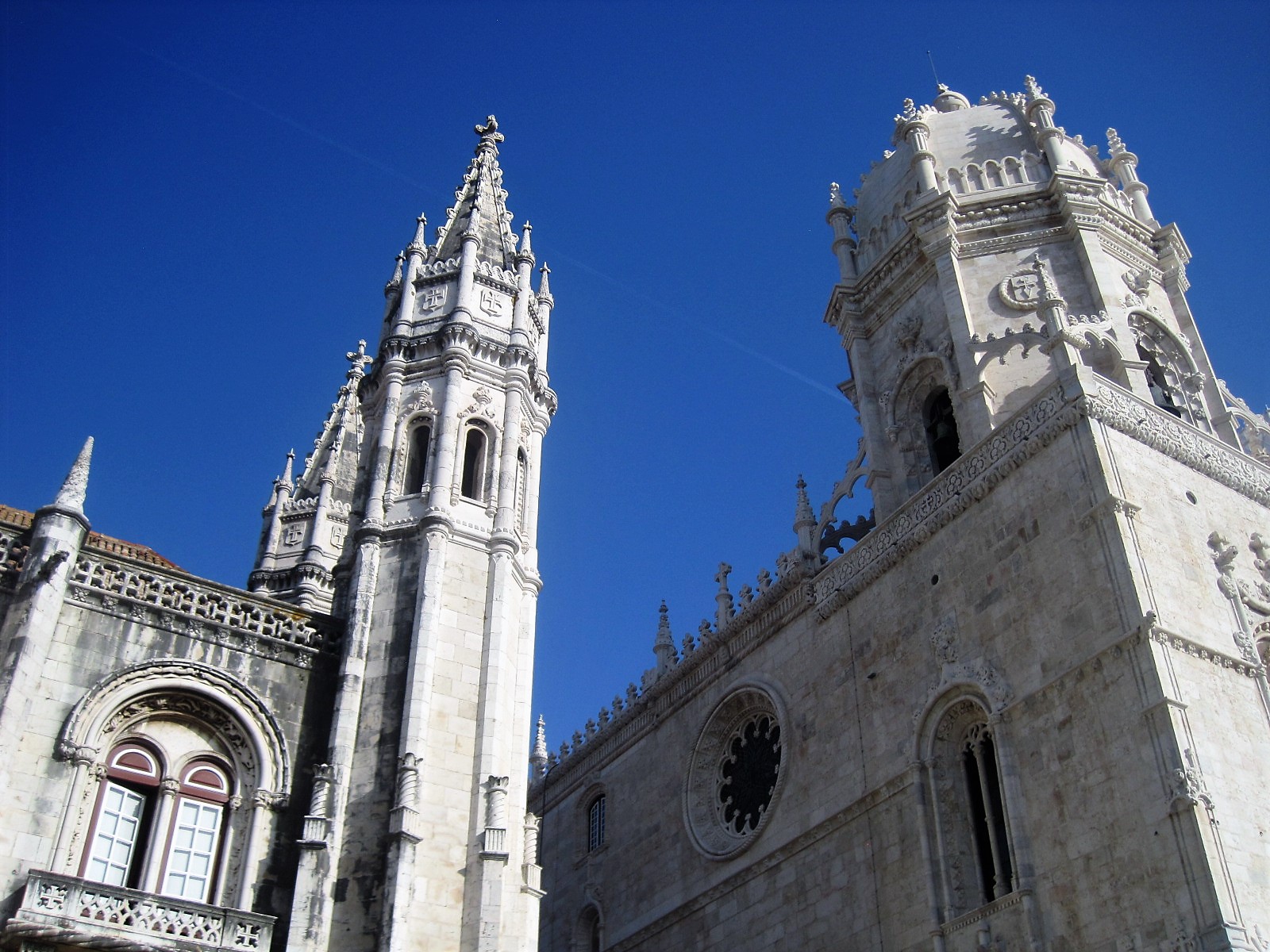
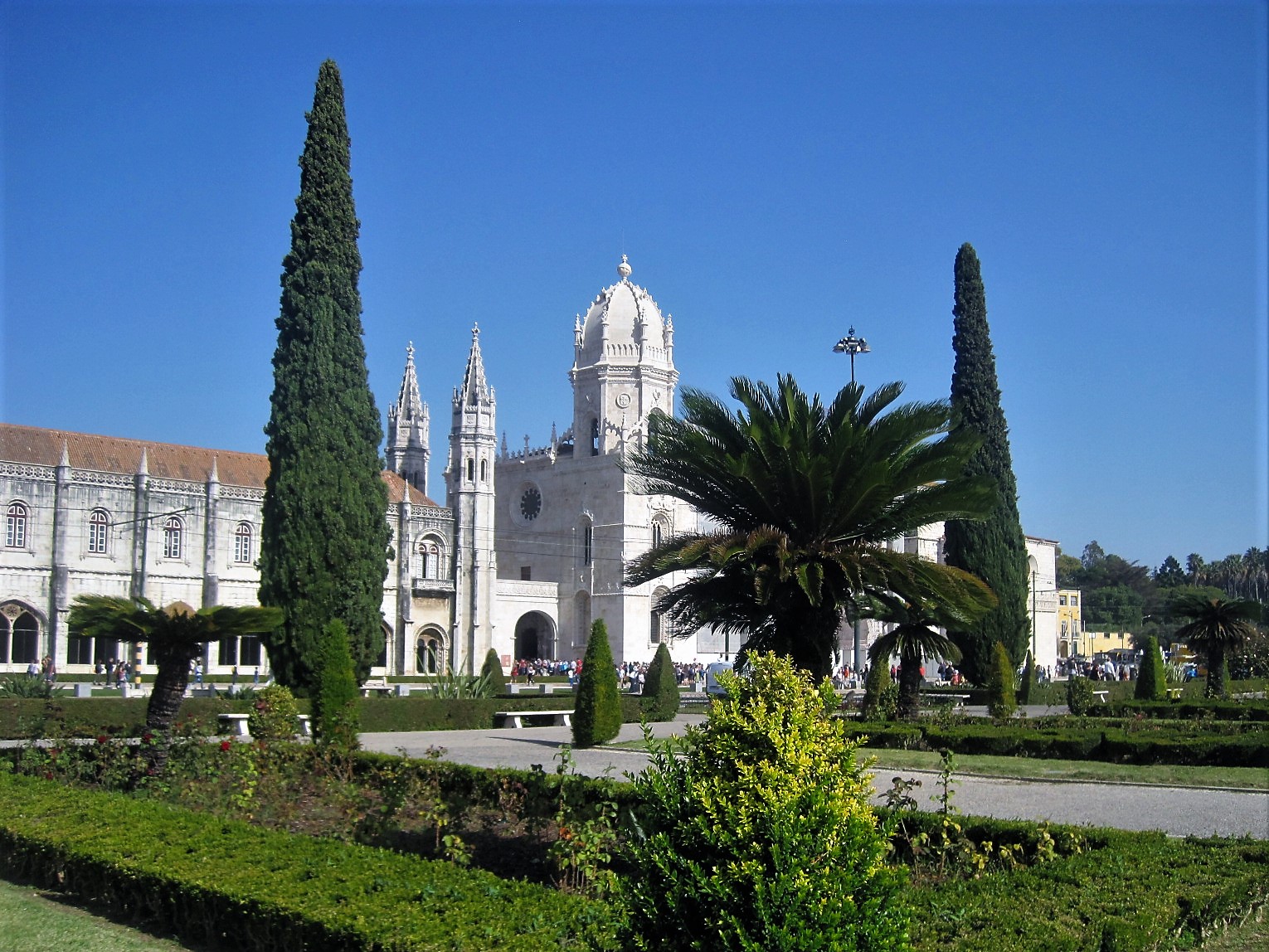
If you came on my Monday walk to Belém, in Lisbon, you will have guessed that this is the Monastery of Jerónimos.  Not hard to see why it is a UNESCO World Heritage site, but I hope you will join with me in celebrating its beauty.

My expectations were high, for this was the third time I’d come to Lisbon, hoping to visit the monastery.  They say God works in mysterious ways, and it’s not for us to understand.  I was happy simply to stand in the midst of all this glory.

A church dedicated to Santa Maria de Belém was the forerunner to the monastery.  This stretch of the River Tagus provided a safe harbour and anchorage for shipping back in the 15th century, and the monks of the Order of Christ gave assistance and spiritual guidance to seafarers.  The church was already in a state of disrepair when Vasco da Gama and his men spent the night before their voyage of discovery in 1497, praying.

King Manuel 1 sought a dispensation from the Vatican to construct a monastery on the site, and building began in 1501.  Completion was to take 100 years.  The elaborate style of architecture, involving knots, anchors and all things maritime, came to be known as Manueline, the work originally being funded by the spice trade.  Manuel chose the Order of St. Jerome, known as Hieronymites, to occupy the monastery, tasking them with praying for his eternal soul.  It was to be a final resting place for him and his successors.  The religious order was not dissolved until 1833.

This slideshow requires JavaScript.

The first room that you enter is the monk’s dining hall.  Fortunately I can simply share a few azulejos, as Becky presents you with all the details in 500 years old this year.  You will be wowed!  I walk through the cloisters agape.  There is nowhere I can look that doesn’t delight me.  When I’ve almost looked my fill, I mount the stairs to look down on the courtyard.

An incredible moment arises at the top of the stairs.  You step into a chamber arching high above you.  As you perceive the body of Christ on the cross and the stained glass Madonna, you notice people gathered at a stone balustrade.  Stepping forward your eyes light up!  You are looking down into the body of the church.

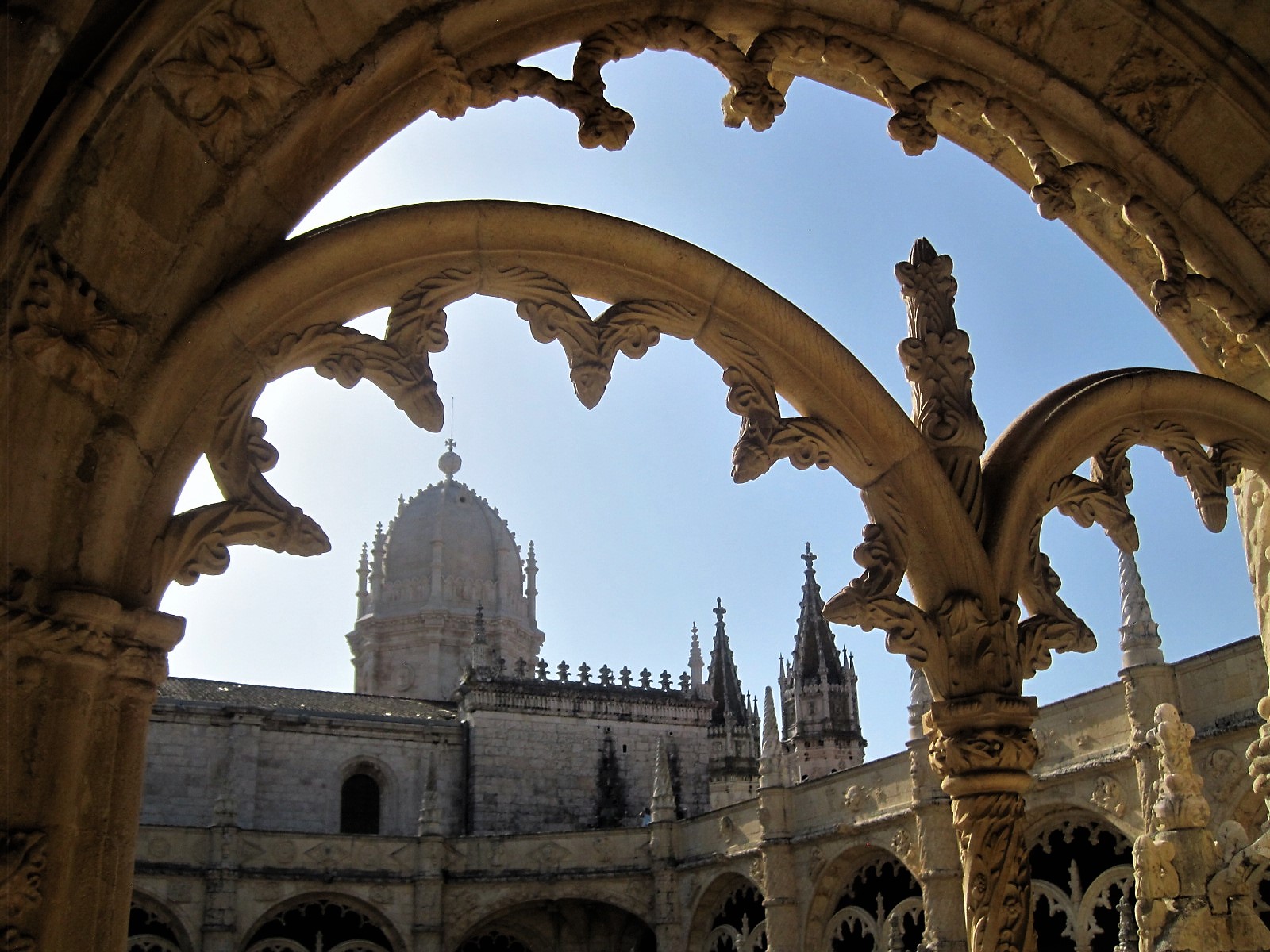
Back into daylight,  the gargoyles and faces, intricate knots and flowers combine to seduce.

Until finally my mission is accomplished and, with sensory overload, it’s time to leave.  The monastery was secularised and handed over to a charitable institution in 1833.  The many twists and turns since then can be read on the monastery website.

It’s that time of year and the Weekly Photo Challenge suggests that you might want to share your 2017 Favorites.  For me the last post that I wrote is invariably my favourite, but I do have one particular image that sings out to me from this post.  I wonder if you can guess which it is?  It simply remains to wish you all a blessed Christmas, and good health and happiness in the New Year.

Jo’s Monday walk : Beautiful Belém

Did you know that the name Belém derives from the Portuguese for Bethlehem?  And that makes it a very suitable subject for this time of year, doesn’t it?  Just 6km from the centre of Lisbon, it’s a distance I’d normally regard as walkable but, eager to get there, I squeezed myself onto a reluctant bus.  No tram for me!  My last visit to Lisbon ended in tears when my purse was pickpocketed whilst waiting for the famous no. 15 tram.  This time I was determined to make it to the Jerónimos Monastery.

And when I did, the disappointment of that failed visit was completely swept away.

I’ll bring you back to the incredible beauty of the monastery later this week, but for now I think we should do some walking.

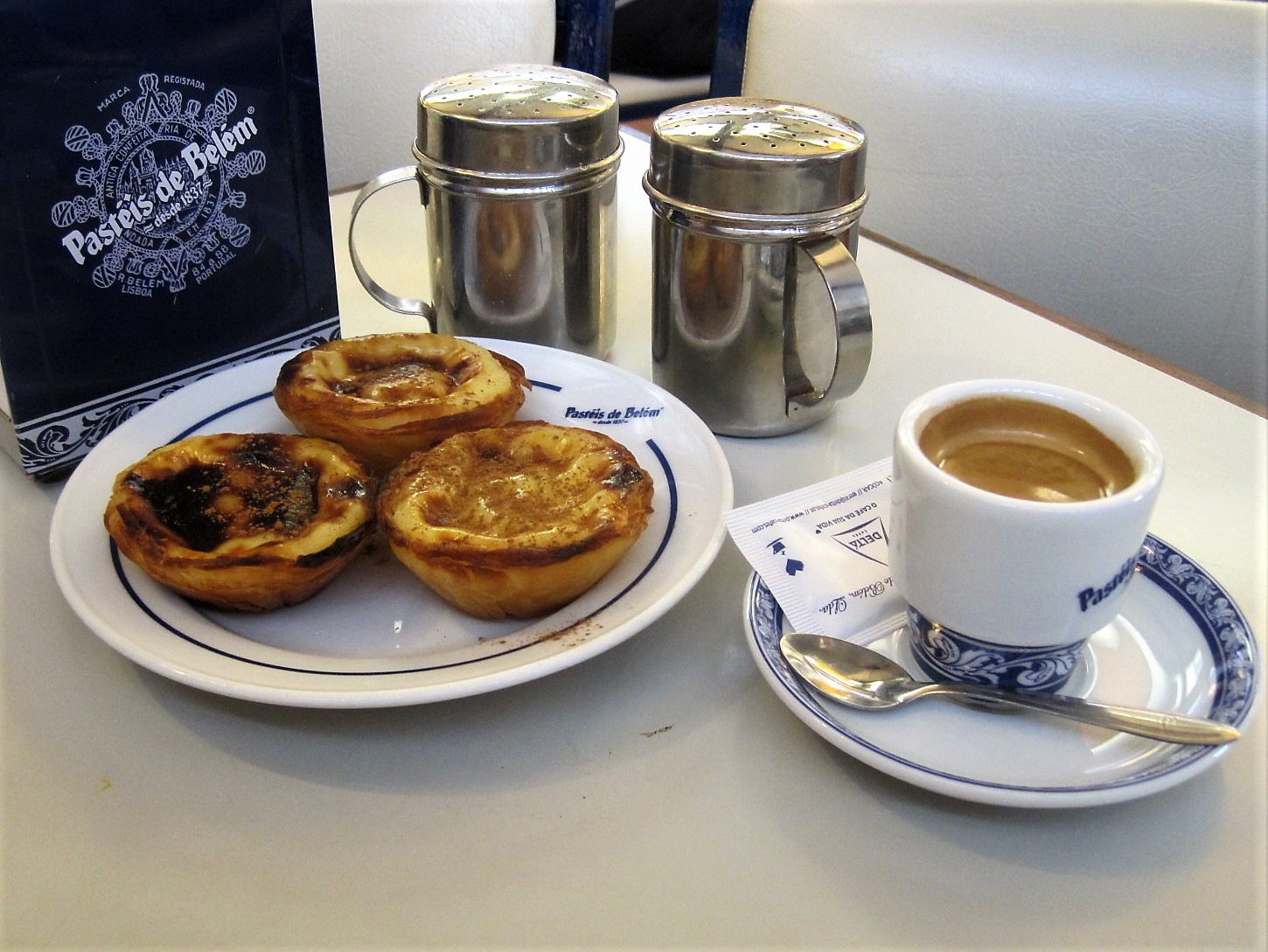
Much too soon to loiter over a pastel de nata!  We need to get going to stay ahead of the tour buses.  I promise you can have one or two later.  It is the festive season, after all!  Not sure what to make of this street art.  Genius or madness?

Rua de Belém, the main street, is a strip of historical buildings dating back to the earthquake of 1755.  This and Ajuda were the areas least affected by the devastation, and many of the survivors who lost their homes were temporarily installed here in tents and shacks.  The King and his ministers set up court nearby and, with the construction of Ajuda National Palace, brought trade to the area.  With the French invasion of 1807 the royal family fled to Rio de Janeiro, and Belém gradually evolved into an industrial zone.  Tanneries, textiles, glass makers and metal stampers were among the factories established.

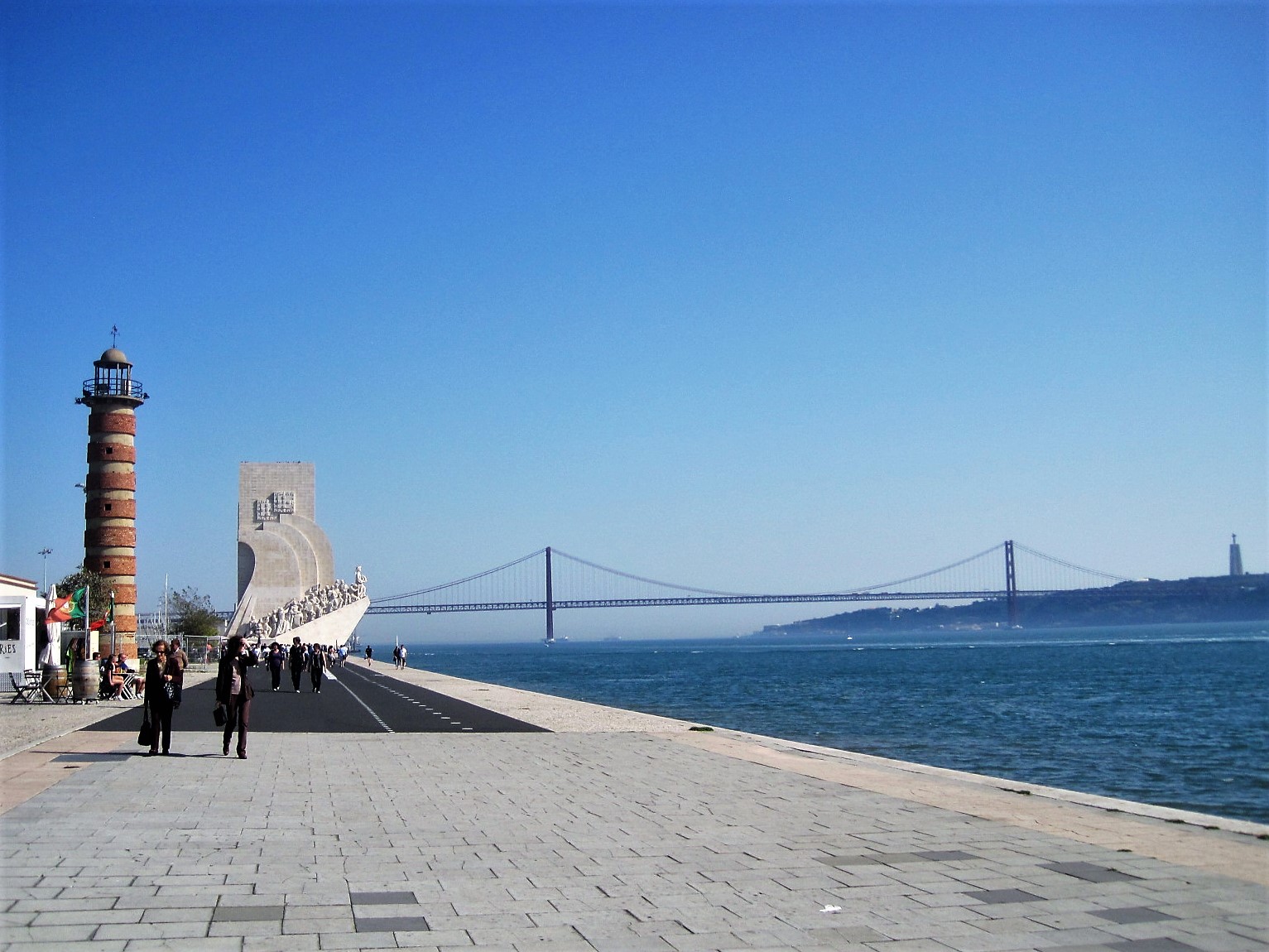
At the heart of Belém lies the Praça do Império, with gardens and fountain laid out during World War II, and beyond it a magnificent sweep of waterfront, culminating in the iconic Torre de Belém.  As you can see, it’s a popular spot.

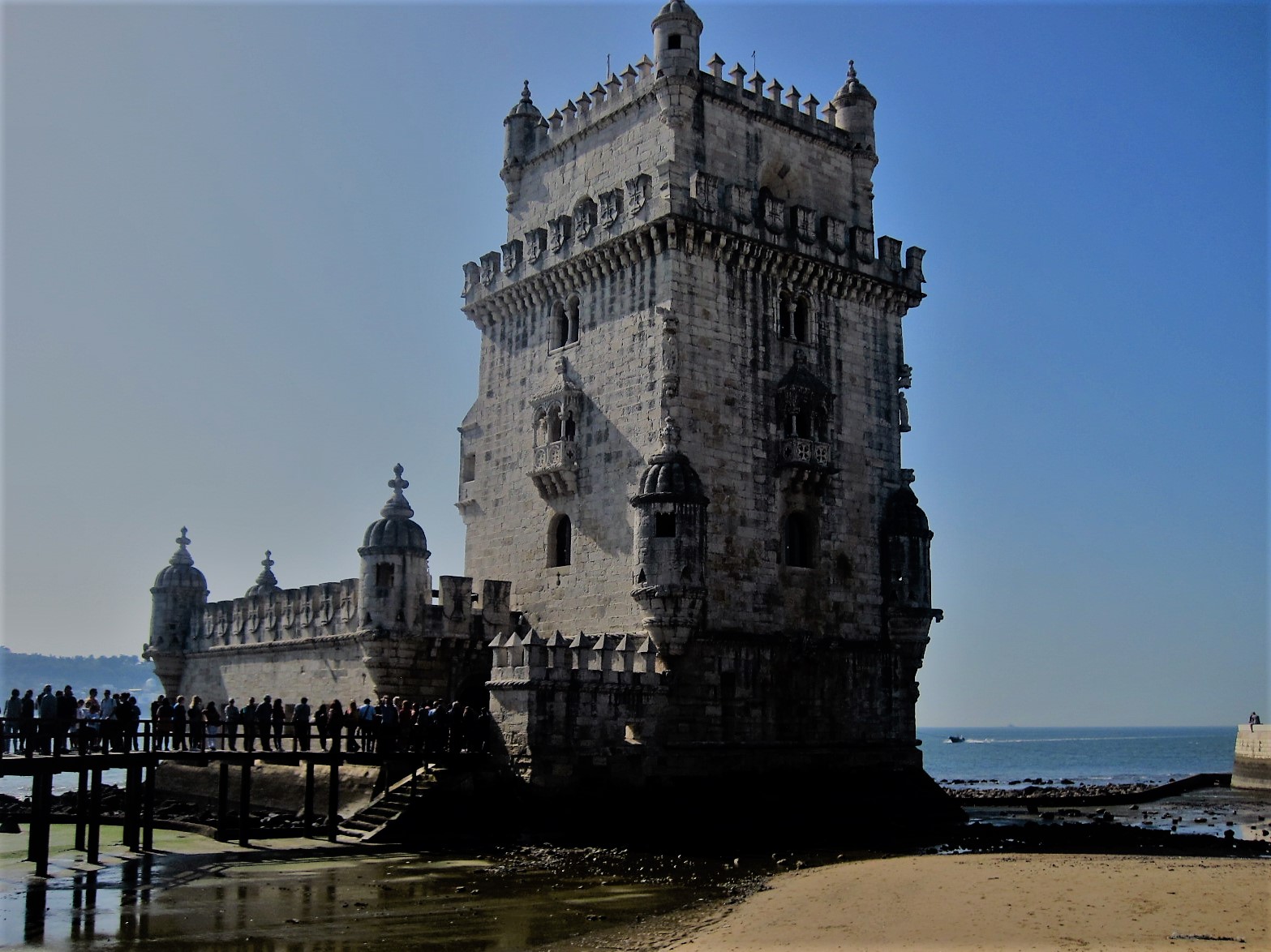
The tower was built in 16th century.  Delicate as it looks, it was intended as part of the defence system at the mouth of the Rio Tejo, together with fortresses at Cascais– which we saw last week- and Caparica, south of the river.  A UNESCO World Heritage site, as is the monastery, it has a colourful history.  The two photos below are from a previous visit to Belém in 2005.

From here you can easily stroll along the riverfront as far as Ponte 25 de Abril, with any number of diversions en route.

You might think that not a lot of walking goes on.  It’s definitely an area devoted to fun in the sun, but looking ahead I’m excited!  The last time I was here I did not know that you could climb these structures.  Not only the lighthouse, but Padrão dos Descobrimentos.

The Monument to the Discoveries, as we see it today, was formally opened in 1960 to commemorate the voyages of exploration which departed from here as far back as the 15th century.  Trade was established with countries as far away as India.

You know what comes next, don’t you?  There was almost no queue for the lift that takes you most of the way up.

Did you spot Michael, in the blue t’shirt, sitting patiently waiting below?  He thinks it’s pastel de nata time.  Just another couple of shots!

Patience should be rewarded, I’m sure you’ll agree.  What a place!  I was astounded.  400 seats and choc full of character.  But best of all….

I don’t suppose many of you will feel like a walk on Christmas morning, so may I take this opportunity to wish all my walking friends a peaceful and happy Christmas.  I have enjoyed your company so much and I hope you’ll continue to walk with me in the New Year.

Not many walks to share this week.  Everyone’s busy, but spare a minute or two to say hello?  As always, many thanks to readers and walkers alike.  Details of how to join in are on the Jo’s Monday walk page.

…………………………………………………………………………………….

Let’s start with Tammy’s interesting tour in my part of  the world.  Watch out for the Fisherman!

North Shields Heritage Walk : Fish, Ships and Lighthouses

Jackie with a bit of seasonal spice this week?

Spicing things up

Why the battlefields of the Western Front are important to Woolly :

Jo’s-Monday-Walk-Wk46_Courcelette

And an excellent bit of sketching along the way, from Pauline and Jack :

Cliff top walk in the sun

That’s it for now.  Hope you enjoyed it.  Remember to breathe- it comes around every year.  Merry  Christmas!

Six word Saturday

I’m starting to see squares everywhere!

From dusk till dawn.  All part of life’s rich pattern.  Have you joined in with Becky’s Square Sky in December yet?  There’s still time.  Maybe you could combine it with Six Words?  Debbie won’t mind.  Happy Saturday, whatever you get up to!

Scaling the heights (2)

Campolide is not an area of Lisbon that sees many tourists.  On a mission to find Aqueduto das Águas Livres, as usual I walked, disregarding the guide book advice to catch a bus.  It didn’t look far on the map.  The locals I asked assured me it wasn’t far.  But finding it involved a lot of interesting uphill and roundabout, as you can see from the gallery.

I already had some idea of what I was looking for because we’d passed beneath it on the coach into Lisbon.  Finally, perseverance paid off.

But the garden scarcely revealed a clue of what I was about to experience.

Aqueduto das Águas Livres was a monumental undertaking, designed in the 18th century to bring water to the parched city of Lisbon.  The main course of the aqueduct covers 18km, but the whole canal network extends almost 58km.  Construction began in 1731, the centrepiece a total of 35 arches spanning the Alcantara valley, conceived by Custodio Vieira, the tallest being 65metres high.  Opened in 1748, while still incomplete, amazingly it withstood the devastating earthquake of 1755.

Fascinating, don’t you think?  I thought I’d already used the title Scaling the Heights before, and so it proved, when I managed to Ascend to considerable heights, early this year in lovely Florence.  I do enjoy a good view.