I see tonight. I wish I may, I wish I might…” Cheating on many fronts to bring you the New Year fireworks from Tavira -the first lights of the year 🙂 and join in with January Light and Six Word Saturday. Have a happy weekend!
Something to always bear in mind when walking around our salt marshes is that they are tidal. In a spirit of adventure, just after Christmas, I set out to explore the stretch between Fuseta and Olháo, entirely overlooking this fact. In my defense, I was following the Algarve Cycle Trail and hadn’t envisioned that crossing water would be an issue. On a glorious, sunny morning, I caught the train to Fuseta A (there are 2 stations in this small village, and the other one isn’t Fuseta B!) A right turn will take you past the former fishermen’s houses and onto the coastal path.
Out in the bay the former coastguard station looks on without comment. It’s a calm and peaceful scene, many people having not yet returned from the holiday. Birds wander, pecking and poking in the shallows, completely undisturbed when the occasional cyclist passes by. The railway line also follows the coast, with minimal impact. The colours of the heather are a lovely contrast in this sometimes dowdy landscape.
As often happens, a signpost throws confusion into the calm, either direction appearing to lead to Olháo. The longer of the two, though interesting, doubles back on itself, but not before I have spotted the nesting storks, a rather endearing frog and a hoopoe.
Now it may seem a little early, but the sun is very warm and a decision is needed. The perfect place to make it presents itself, a small restaurant, ‘O Farol’. Does anyone mind a cake stop? His and hers, of course! Mine is the almond tart.
Decision made, we head in the general direction of the coast, hoping to be able to continue around the bay to Praia dos Cavacos. And as luck would have it, we’re able to tiptoe around the edge of the sand and reach a boardwalk that looks quite new. The surrounding buildings are unconventional, and ornamented with some rather wonderful artwork.
We are never out of touch with the quiet salt pans, which breathe life into this landscape. You may have thought it all going swimmingly (bad choice of words 🙂 ) but a slight hiccup is just around the corner.
The railway track, which has followed us so patiently, decides to leap a gully full of water. We shake our heads. It’s too big a leap for human legs. A family of cyclists approach from the direction of Olháo. When they passed this way earlier the tide was out. Bravely they hoist their cycles and cross the precarious track. The alternative for us is a very long walk, so we grimace and hasten across the gap. My heart is thudding. If a train should suddenly appear… but minutes later we are in the heart of the nature reserve known as Quinta de Marim.
The plan was to skirt this park, and stay close to the campsite at Olháo. But it’s simply a relief to be across the water.
The tidal mill is a beautiful sight at high tide. It has not been operational since 1970, but the equipment still looks ready for action. I clamber up to the roof and look out across the water, to the low-lying barrier island, Armona.
The sun is low in the sky as we finally reach Olháo. The contemporary theatre, itself a converted mill, stands in sharp contrast to the crumbling facades of neighbouring buildings. Oblivious, the birds cavort on a high wire above. Soon all trace of Christmas will be gone.
For us, it’s time to catch a train home. If you should happen to repeat this walk, be very aware of the tide times. And meanwhile, many thanks for accompanying me on the adventure that is the new year.
Not too many walks to read as you get back into a routine. Join me any time here on Jo’s Monday walk. The welcome is always the same.
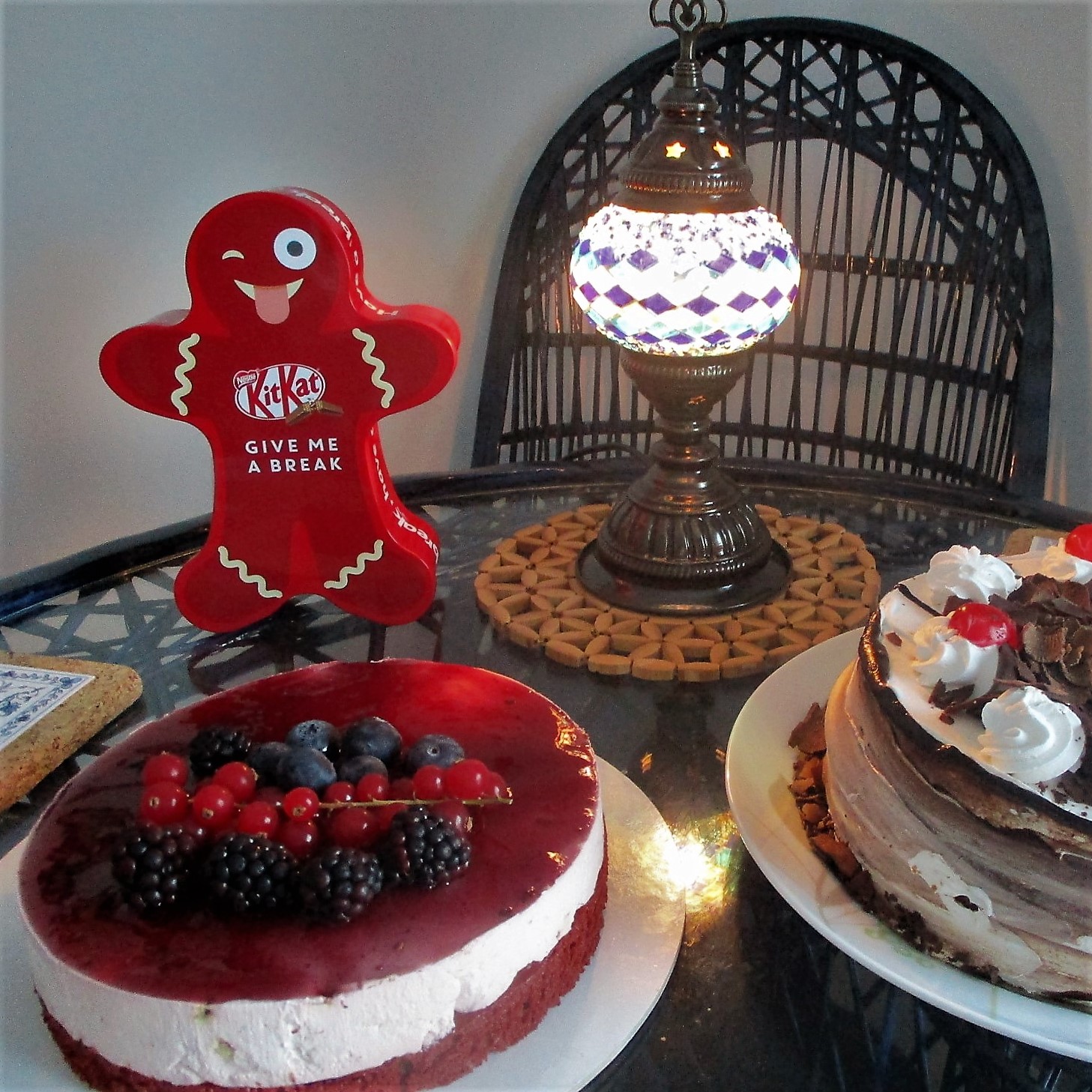
Becky’s asking us to ‘Shine a light‘ this January. Square, of course! My image owes much to Jude, who asked to see my lamplight. So, from my house to yours, a very Happy New Year, filled with love and light!
I’m back in the Algarve for my last walk of the year. Santa’s been, and I couldn’t ask for more. It’s been an amazing year! I’m taking you back into those hills that I love, to a tiny village called Benafim. We are joining a group of choir singers for one of my nicest ever walking experiences.
The landscape is beautiful, with Rocha de Pena looming quietly in the background. We meet our small group, mostly Portuguese, with uncertain smiles- an opportunity to practise the language- and set off through the village. One of the group is carrying a toddler on his back, and an elderly gent relies heavily on his stick, so we know the pace will not be fast. There are a couple of Scandinavians, who chat easily with us in fluent English.
Christmas is just around the corner and we observe the signs of celebration in the village. It’s not a long walk, just 6.2km to the next village, Alte, but the gradient is steep in places. Our guide is well aware of the limitations of the party, and stops at intervals to point out plants of interest. Medicinal herbs and remedies, and one that was used in these hills before soap was widely available. It’s warm, but with plenty of cloud cover. There’s little shade up here in the heights. We are following a short stretch of the Via Algarviana, which reaches end to end, the length of the Algarve. We puzzle over some symbols on a rock- a message we don’t understand.
At the outset, we were asked if we would like a meal after the walk. We are walking with some members of a choral group called Ossónoba. Afterwards they will perform in the church in Alte, and we will be ‘very welcome’ to join them. It seems like too good an opportunity to miss.
All are working up a healthy appetite when finally the rugged path levels, and we gaze down into a valley. Alte is not far away, and it’s all downhill from here. In the village, the sight of Singer sewing machines doubling as picnic tables makes me smile.
A hint of Autumn? Yet it feels more like Spring. We have been wondering how we will get back to Benafim, but this problem is easily solved. A minivan takes the drivers back to collect our cars and bring them to Alte. The rest of us proceed to the hotel, squeezing into the minivan with the excitedly chattering, choir members. An elegant table awaits.
High on a hill, above the village, Hotel Alte is obviously used to hosting parties. As we wait, a coach pulls into the car park and disgorges the rest of the choir, smartly attired in black and white. Our walking friends disappear off to the toilets, emerging transformed. The choir are 40 strong! Three of them sit at our table, and proceed to talk about their life, while we dine, very well indeed. Meal over, we are treated to a rousing number, to stretch those vocal chords, before they all pile back onto the coach. The best voice? Our richly baritoned, minivan driver!
Is it any wonder that I love this village? Still to come is the Christmas concert. I had never been inside the church, so yet another treat in store. The choir sings its heart out, in several languages; first surrounding us in the body of the church, and then from the gallery above.
Just down the road, Baltazar cocks an ear in his stable, and we drive contentedly home into the sunset.
Grupo Coral Ossónoba travel around Portugal (and occasionally abroad) performing. Our walk together was a collaboration to promote the Via Algarviana. Needless to say, we hope to take part in another, in the New Year. We had a wonderful time.
I hope you all had a wonderful Christmas, but even more than that, I hope that the year to come is kind to us. And maybe you’ll join me in another Jo’s Monday walk? You’ll be more than welcome.
……………………………………………………………………………………
I’m sure Jackie ate her share of festive food, aren’t you?
Our hotel room looked directly out on Leeds Cathedral. On Christmas morning the bells rang out, inviting us to celebrate a special birth. I hope you had a beautiful time, too. Happy Six Word Saturday!
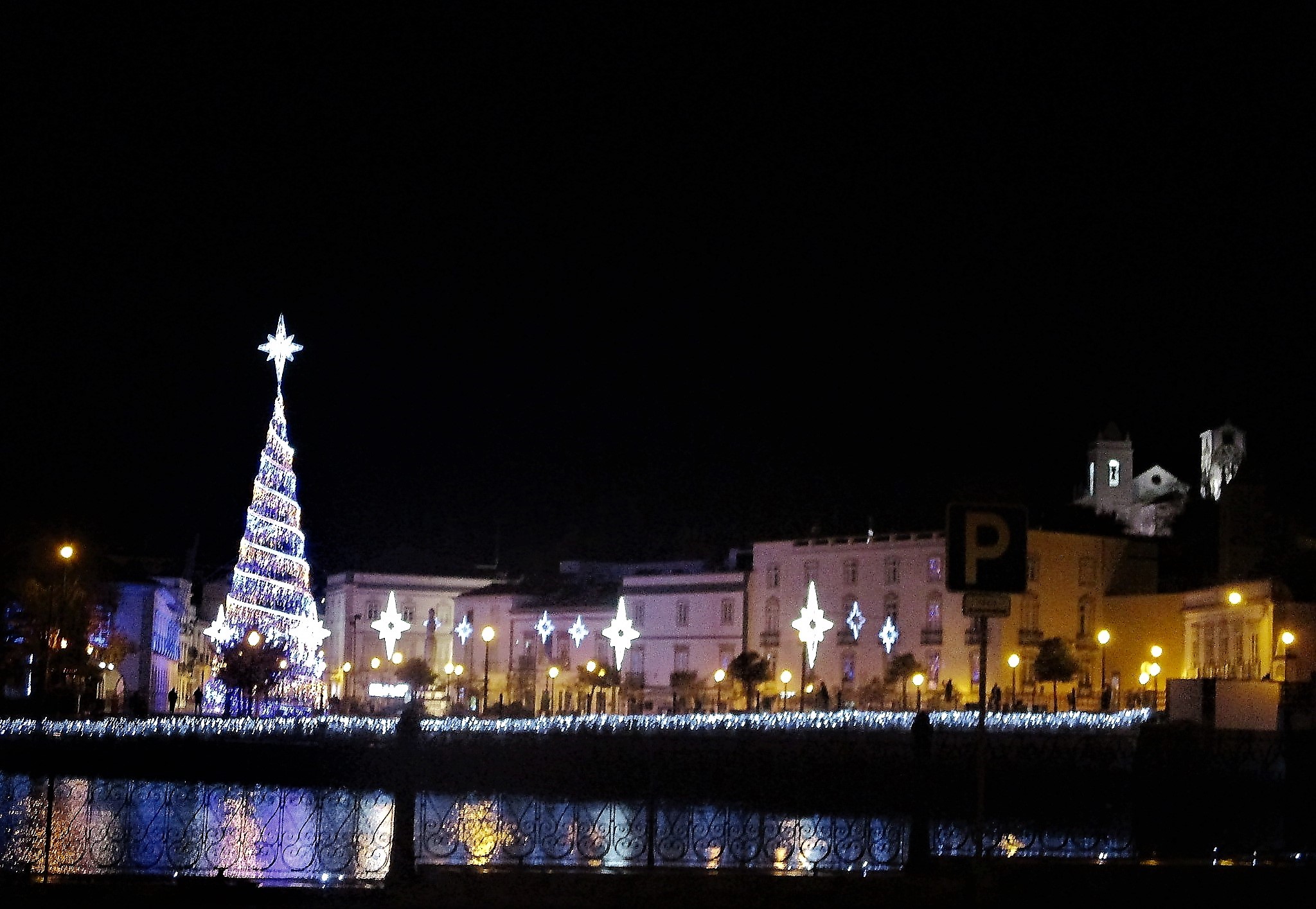
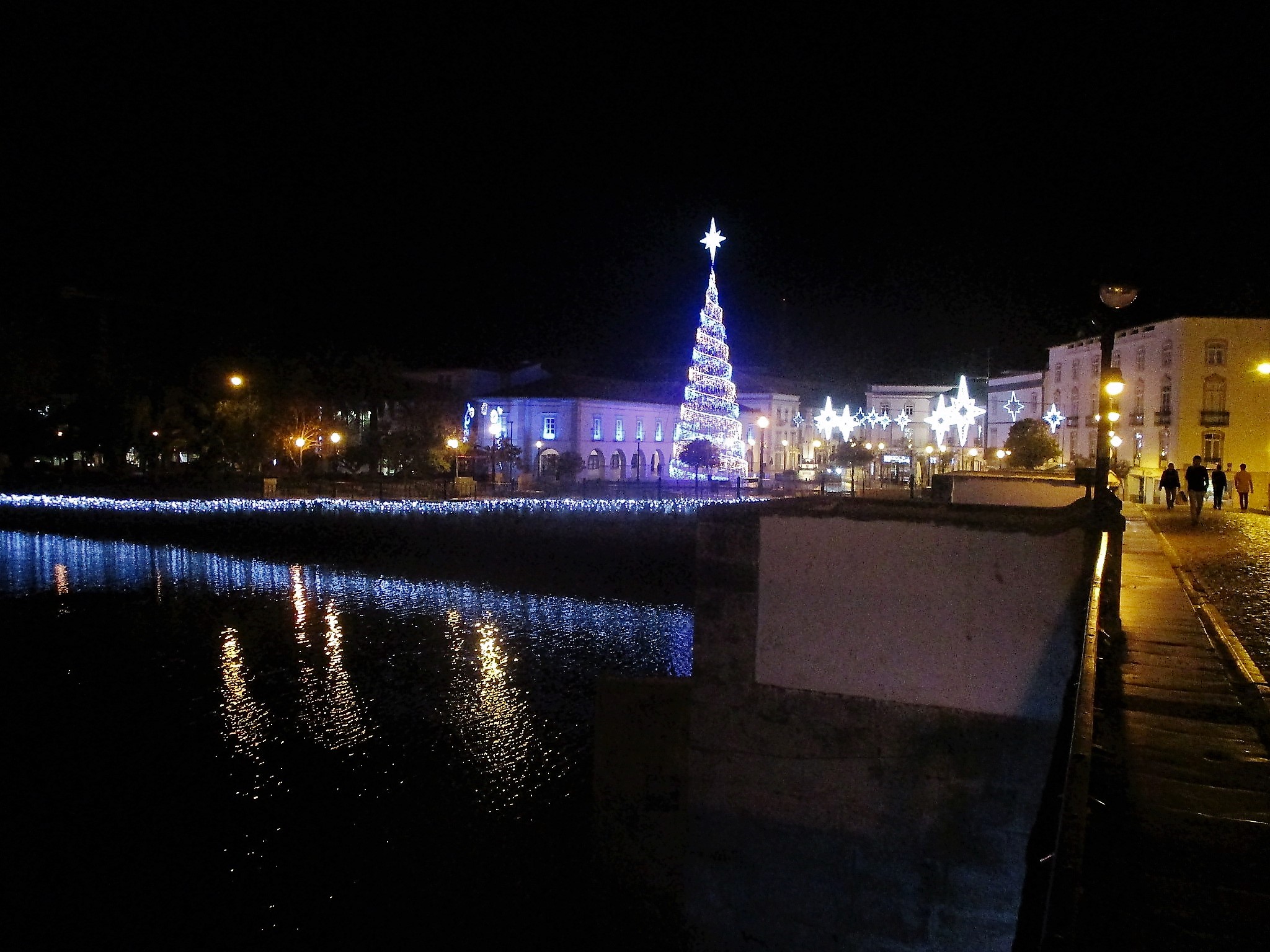
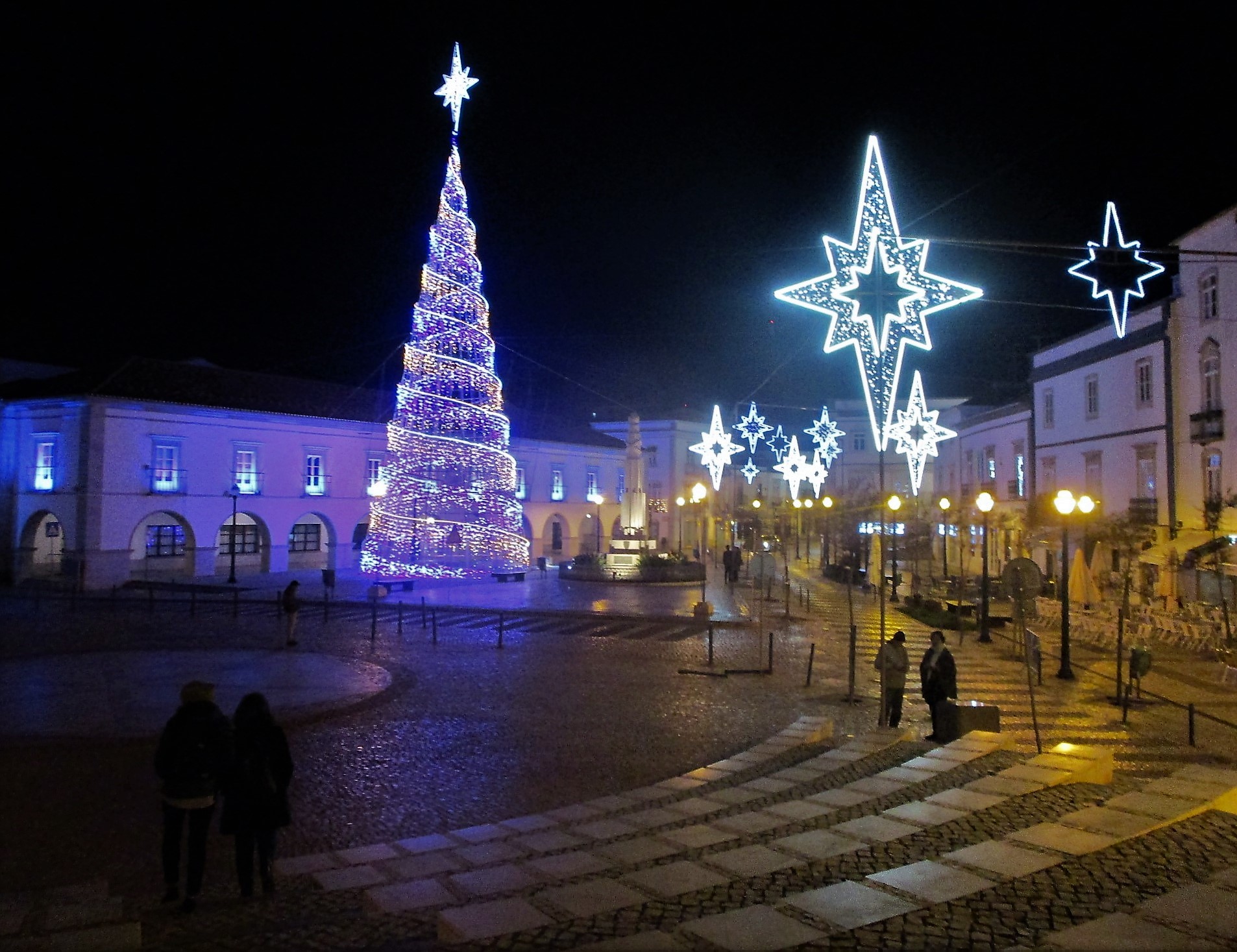
I know you don’t have much time for walking this week, but I thought you might like a little stroll with me? Tavira is looking very pretty on an evening. Come and see the lights! We needn’t walk far.
Ponte Romana and the riverside are strewn with blue lights. The Military Bridge is finally being dismantled, after 29 years as a ‘temporary’ structure. That’s how things are around here. Things take time! But the end result is usually worth it.
It does leave a question mark over this New Year’s Eve firework display. In recent years the fireworks have been launched from the Military Bridge. Maybe they will use a barge on the river.
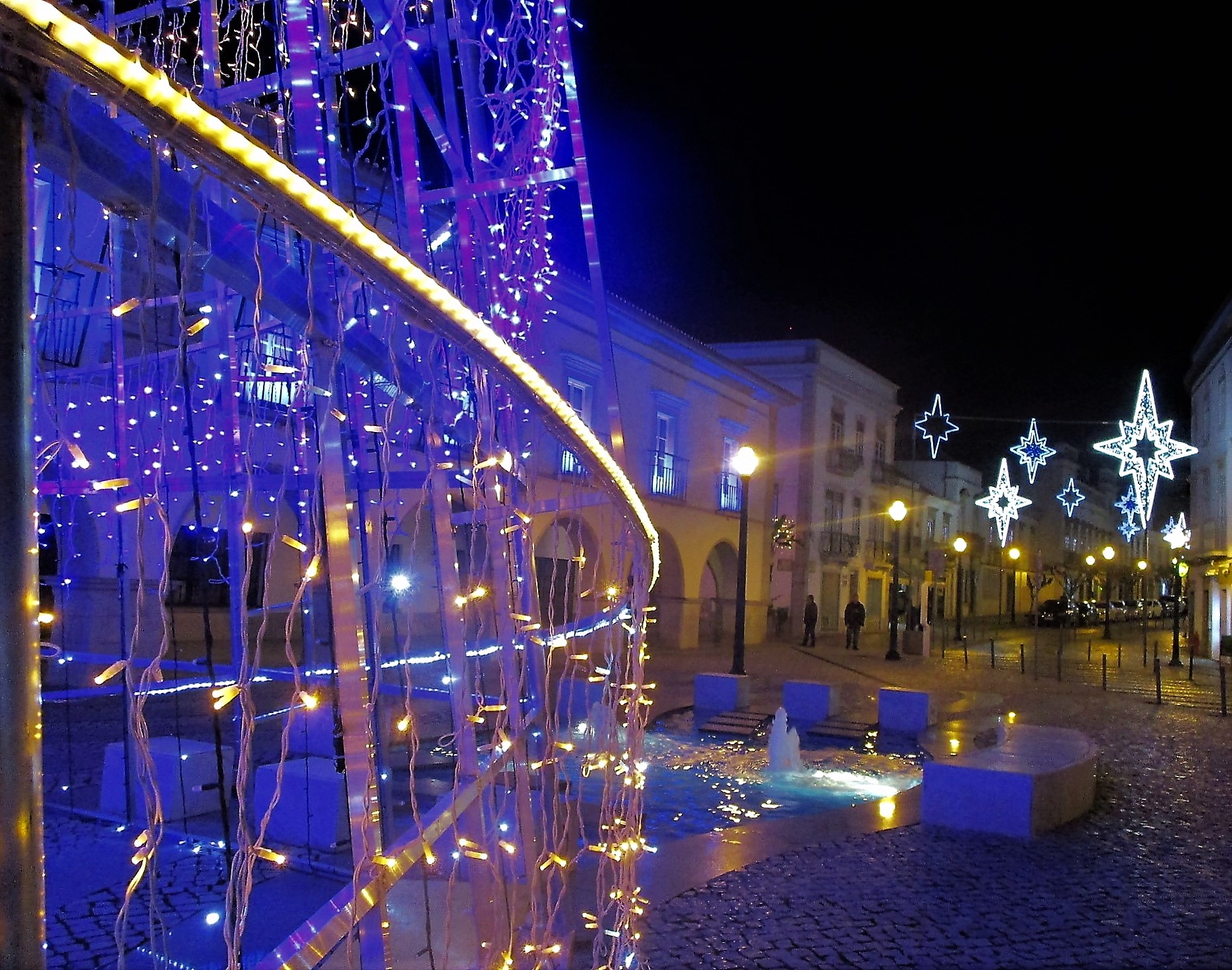
The fountain wasn’t here when we first came to Tavira. We’ve seen a few changes. In the austerity years the Christmas trees were simple wooden structures. Now we sparkle and shine, and things are looking up.
Round the corner, couples pose in a shining star. Last year we had a giant bauble, which now takes pride of place in Faro marina.
In the run up to Christmas there have been carol concerts, both in the old Mercado and in many of the churches.
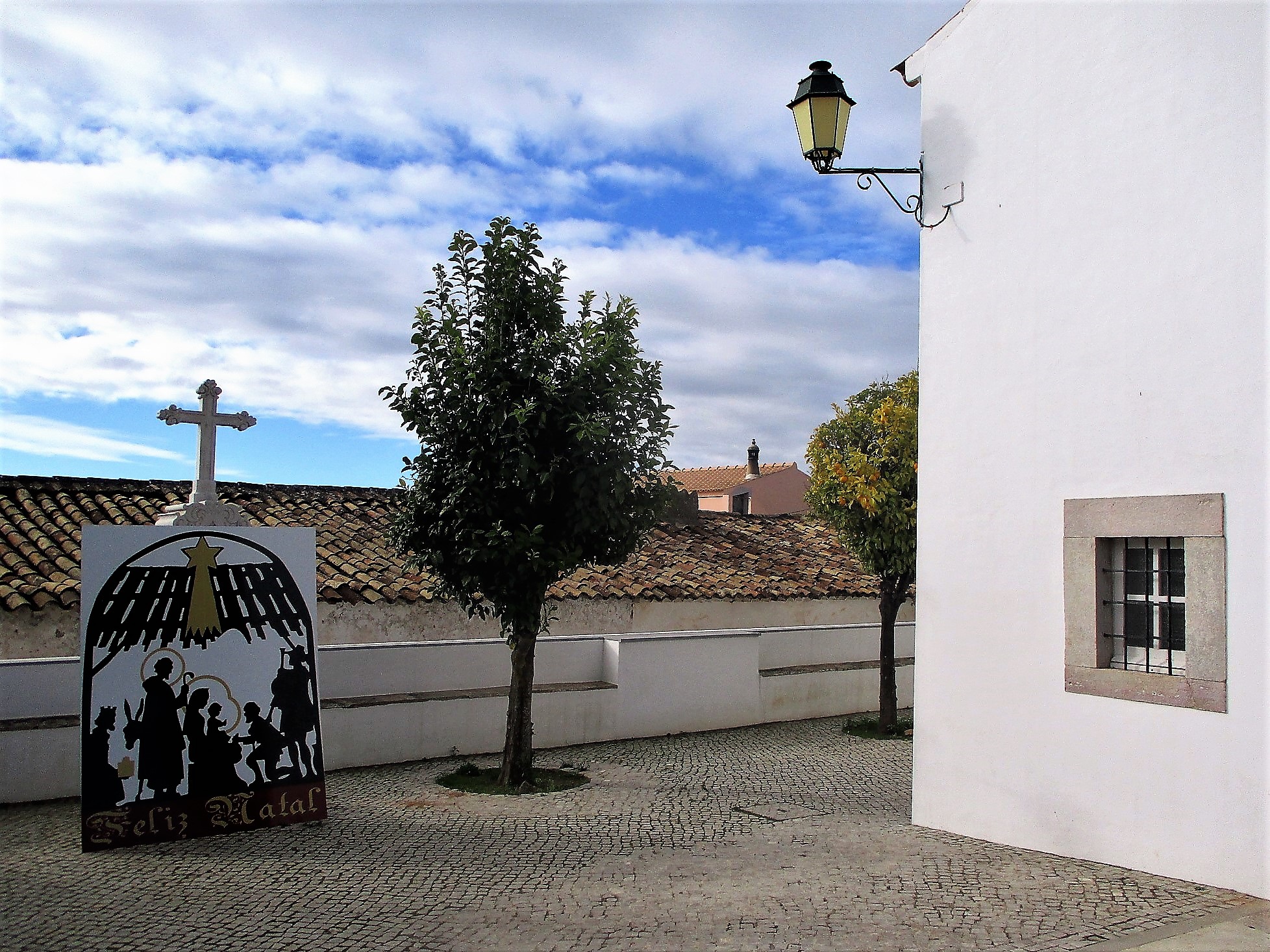
Much needed rain arrived, putting a bit of a dampener on scurrying shoppers, and delaying our visit to the bombeiros Nativity scene. Three days later, blue skies inevitably returned and the town was bathed in warm sunshine once more.
I shall be sad to leave, but I’m off to England today, to share a few Christmas hugs. You’ll scarcely miss me before I’m back, on Thursday. I hope that, wherever you are in the world, you get your share of hugs this festive season. Wishing you joy always (and cake!)
Not many shares this week, but all are very welcome. Join me soon, on Jo’s Monday walk.
…………………………………………………………………………….
Debbie always astounds me with her photography. This one is a beauty- please don’t miss it!
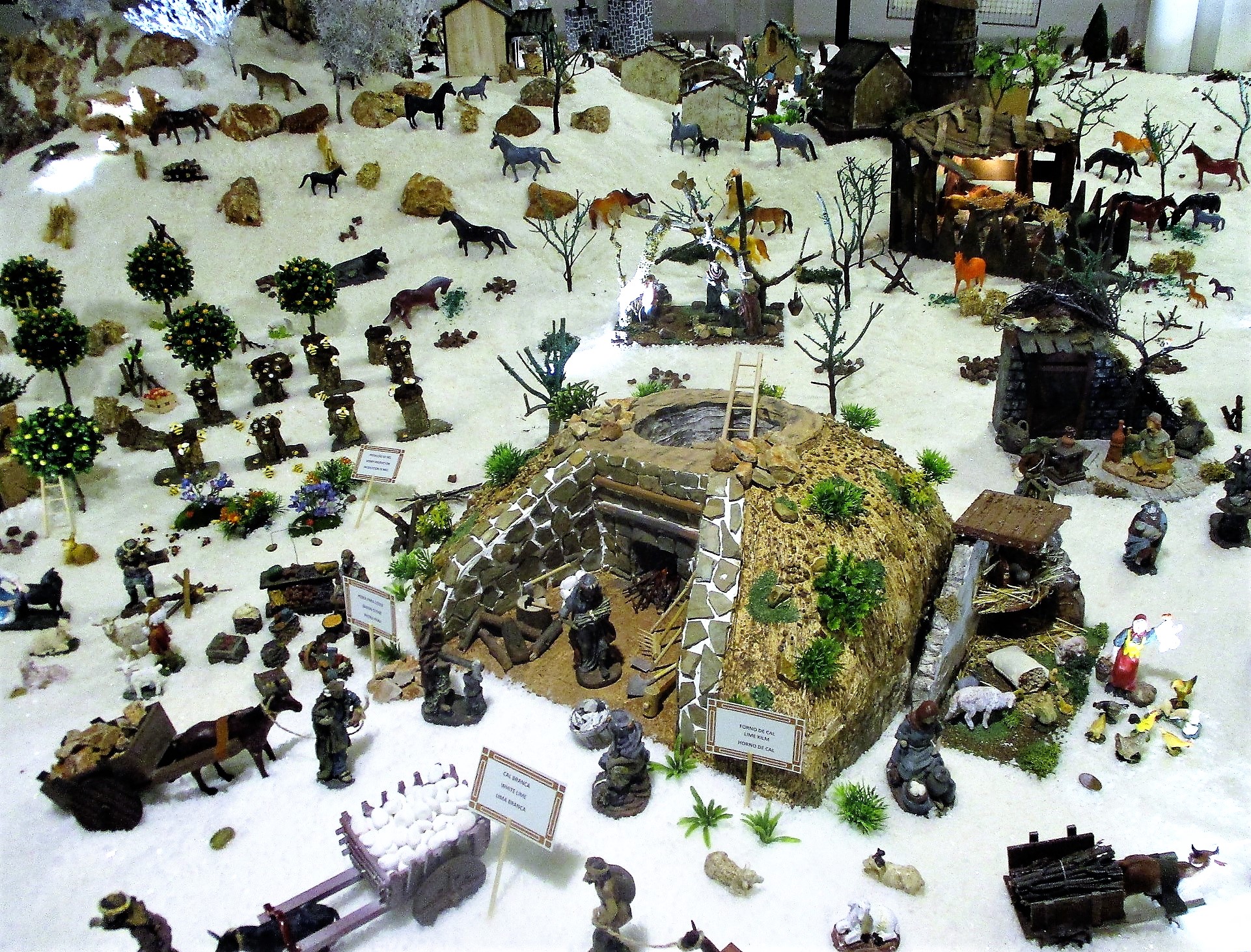
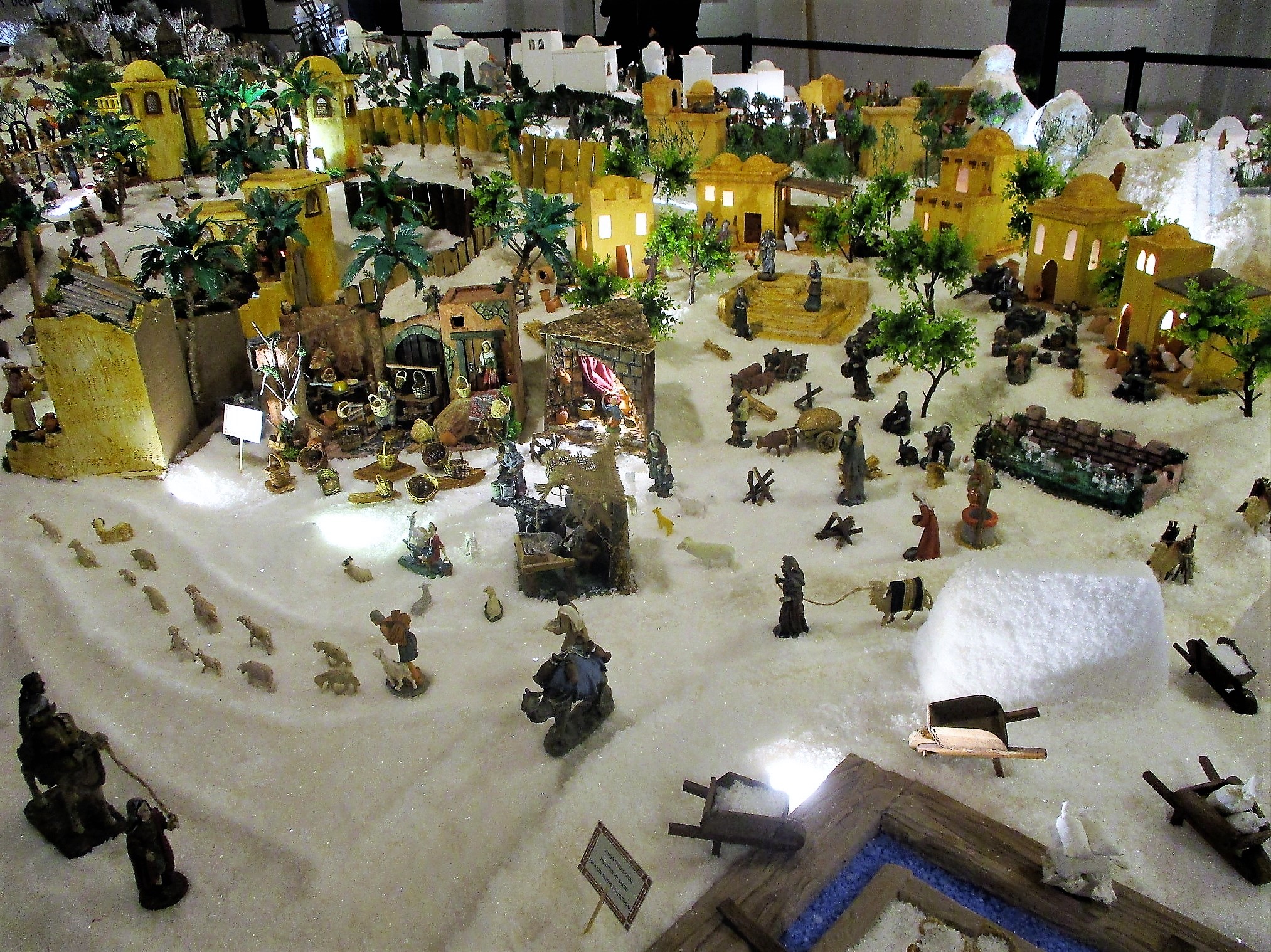
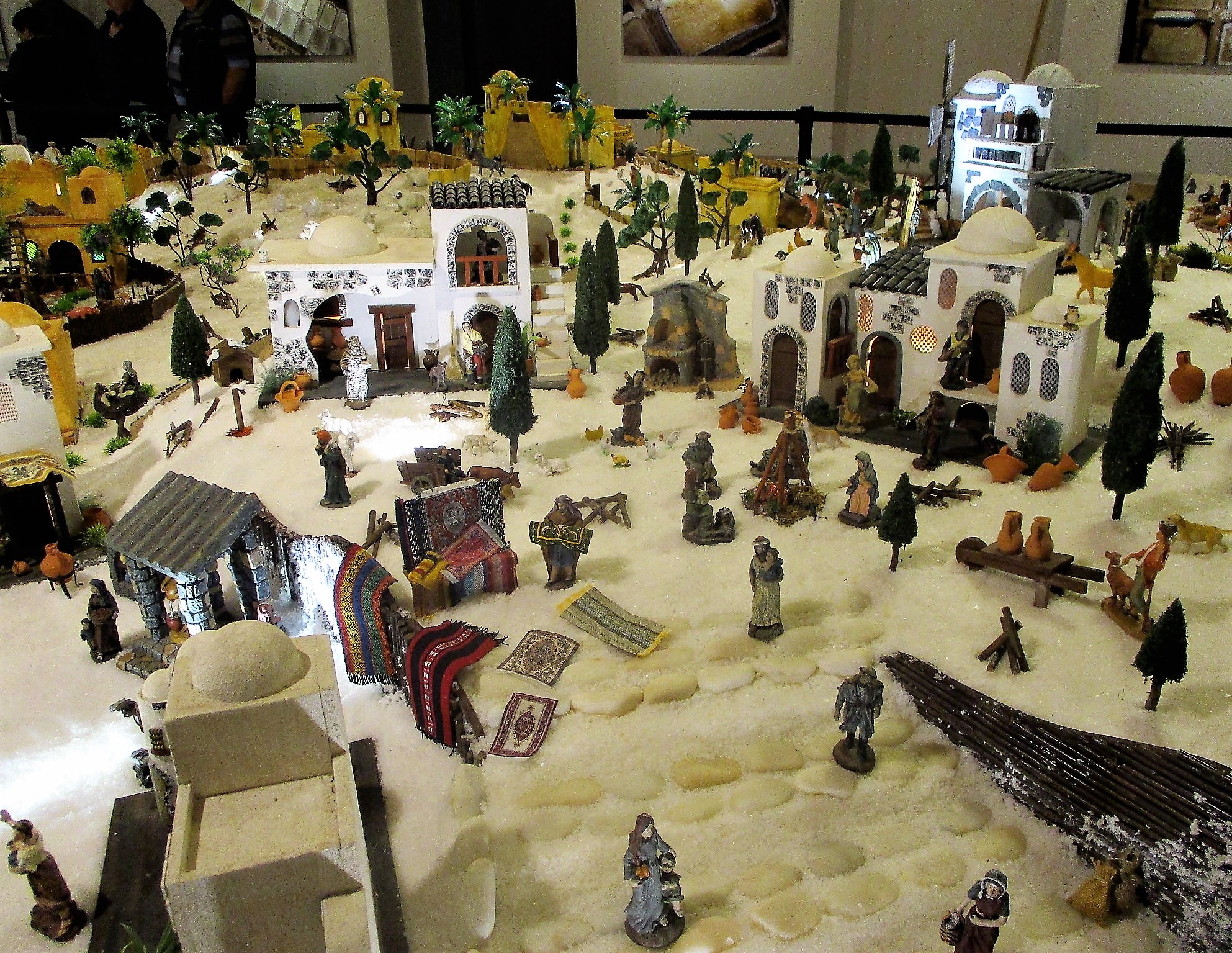
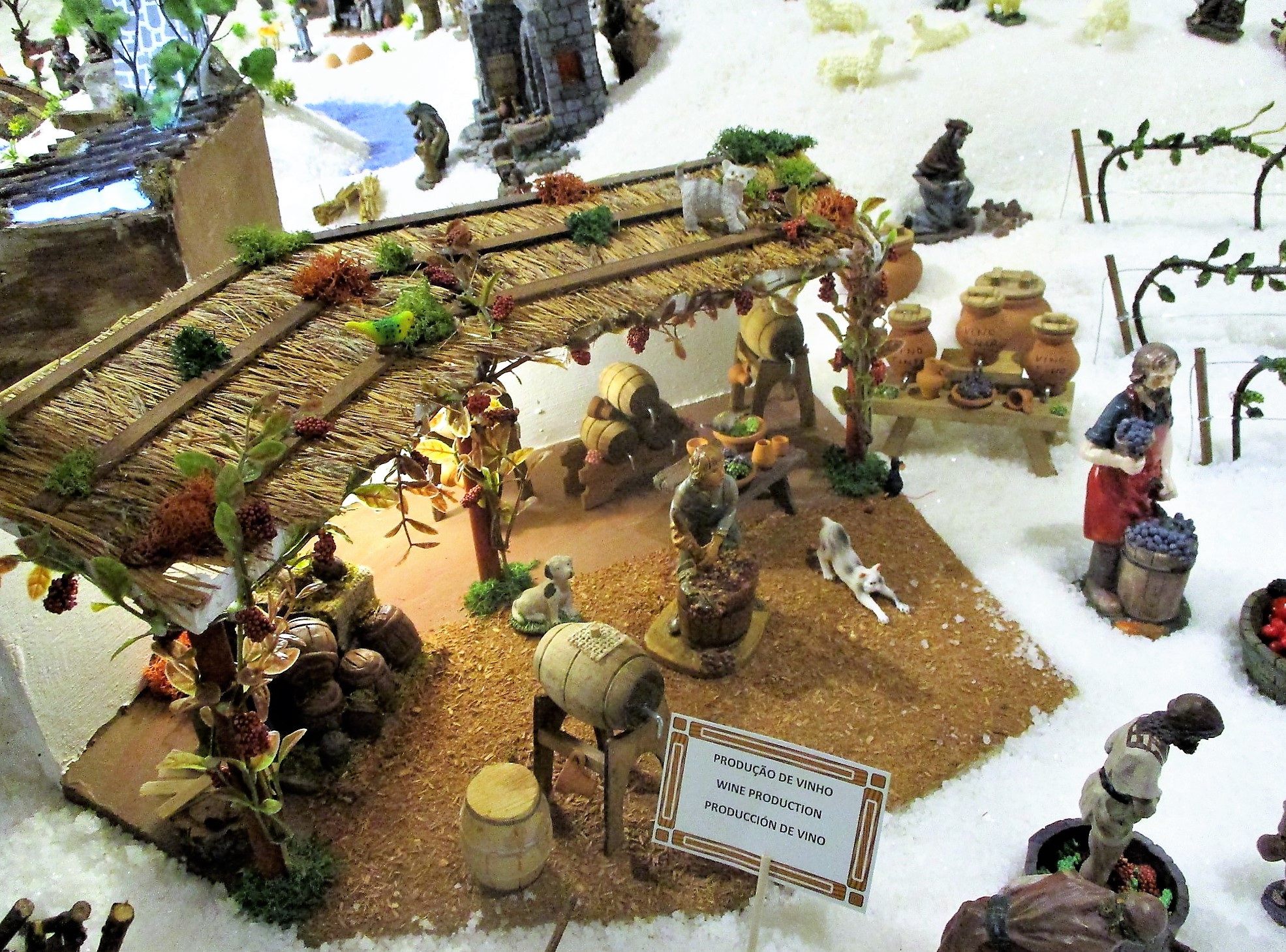
The only kind of ‘snow’ I’m fond of- a bed of salt crystals, making a backdrop for the Presépio do Sal, in Castro Marim. Every year, throughout Portugal, Nativity scenes take pride of place in towns and villages. In this small Algarve village, more than 7 tons of locally produced salt form the basis of the scene. This has been an exceptional year for salt production, and the Nativity is a wonderful tribute to the salt pans and their workers.
At weekends there are story times for children and music concerts. You have until 6th January to visit if you are in the area. I’m happy to add this post to Amy’s Lens-Artists theme, On Display, this week, with wishes to all for a Christmas full of joy.
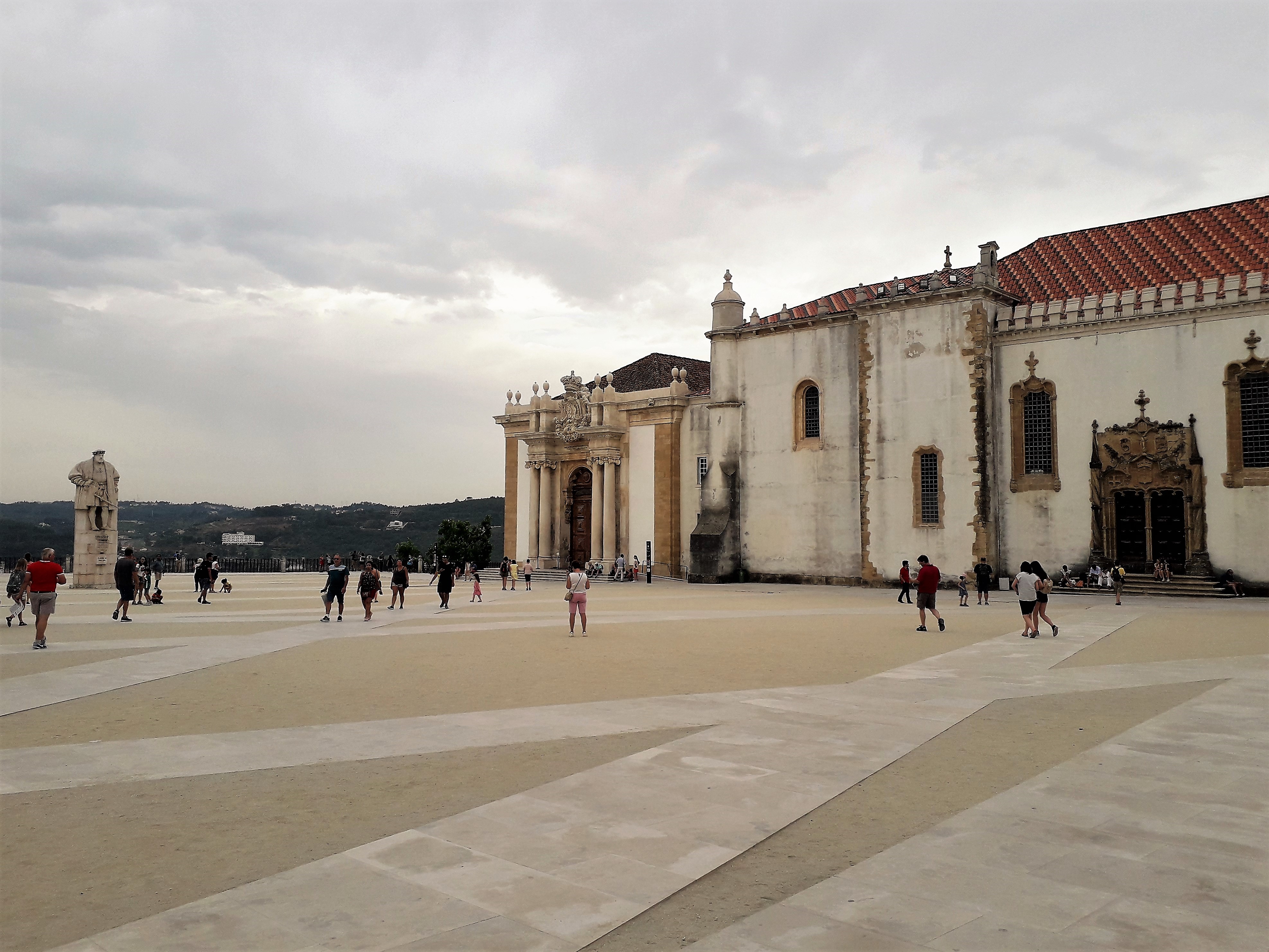
Central to the University of Coimbra lies a vast square, looking down from which you have the city at your feet. To reach it you have a steady climb, up through winding streets. On a fine day, a magnificent view will be your reward. Sadly, our skies were grey and misted with a fine drizzle, but we were celebrating a birthday and determined to enjoy it. A 45 minute train ride had brought us here, from Aveiro, out on the coast.
In Roman times Coimbra was known as Aeminium. An aqueduct and traces of mosaic discovered in this area date back 2,000 years. The first Muslim occupation of the Iberian peninsula took place between 711 and 715, and Coimbra surrendered in 714. Many of the street names survive from that period, and the alcáçova, or fortified palace, where the governor of the city lived, formed the basis of the Royal Palace of the first kings of Portugal. During this time the high part of town was walled and fortified. Coimbra was reconquered by the Christians permanently in 1064, becoming the capital of the first Portuguese dynasty, in the ever complicated history of this country, in 1131. It remained so until 1255, when the seat of power was transferred to Lisbon.
It was almost by chance that we came upon the Sé, or Old Cathedral, in Largo da Sé Velha. Built in the Romanesque style, on the site of a temple dedicated to Santa Maria, from the outside the cathedral resembles a small fortress. Steep steps lead to the main portal, beyond which a hush descends. My eyes alighted on huge seashells, the like of which I had never seen. Labels proclaim them Tridacma shells, from the Indian Ocean. The alcoves on either side of the nave feature compelling spotlit portraits, while the walls gleam with 16th century edged Múdejar tiles from Seville.
The Gothic cloister, begun around 1218, is the oldest in Portugal. Unintentionally it’s a green space for small children at play. Leaving the cathedral, it’s an upwards slog to the University complex. Robed nuns paid us scant attention, going about their business within the solid walls.
If I knew anything at all about Coimbra it was that the University was beautiful, and had been designated a UNESCO World Heritage site in 2013. Founded in Lisbon by King Dinis, in 1290, it alternated between the two cities till it was definitively established in Coimbra in 1537. It is one of the oldest in Europe, and was the only one in the Portuguese-speaking world until 1911. The life of the city revolves around the state-run university.
We purchased a composite ticket for the Palace and the Joanine Library. The latter had to be viewed on a specific time slot so we headed first to St. Michael’s Chapel, where we gaped upwards at the painted, arched ceiling and astounding baroque organ. Just time for a coffee before descending the Minerva stairs to patiently await our turn.
Finally we were shepherded into cool chambers with dense walls and arched ceilings, not quite sure at what tomes we were looking. This was just a preliminary. The gasps came later. With over 200,000 books, mostly in Latin and pre-18th century, the Joanine Library (named for King Joáo V) is recognised as the most sumptuous university library ever made. The 72 shelves, arranged over 2 floors in 3 rooms, are minutely decorated with Chinese motives. I had thought the library in Trinity College, Dublin amazing, but this one defied description. Nor were we allowed to take photos, conservation being necessarily important. The books have an unusual ally- a colony of bats who entertain themselves at night by feasting on wayward insects. This was one of those occasions when I was glad I’d purchased a full colour souvenir brochure. As I explained last week, I’ve lost all except one of my photos from this visit to Coimbra. I’ve used my husband’s photos throughout this post, but I managed to find a video to give you a brief glimpse inside the library. It barely does it justice.
Still awed at what we’d seen, we continued around the Palace and out onto the balcony for misty views down to the river. During the Middle Ages Coimbra was divided into an upper city, where the clergy and aristocracy lived, and a lower city for merchants, artisans and labourers, down beside the River Mondego. Since 1772, the Botanical Garden has wrapped a green cloak around the skirts of the city, combining the beauty of nature with education and research.
A cobbled path leads from the rear of the gardens down to the riverside, where fountains play majestically across the water, reminding me of Geneva. A footbridge spans the river, and playing fields line its banks. We crossed to the far shore to look back at the city, before returning to the station. Take a more comprehensive look at Coimbra, with Julie Dawn Fox. She lives not far away, and has many suggestions for walking throughout Portugal, too. And incidentally, if you can’t face the climb, there is a bus that will take you up to the University grounds.
Not so many walks this week. People are busy with Christmas preparations. I hope to have another Jo’s Monday walk next week but I’ll understand if you can’t join me. Even though I promise to bring cake!
…………………………………………………………………………………….
Janet made me smile with this title and I’ve been singing it ever since!




















 restlessjo
You must be logged in to post a comment.