Family

Six word Saturday

A Wedding Invitation and a Hug

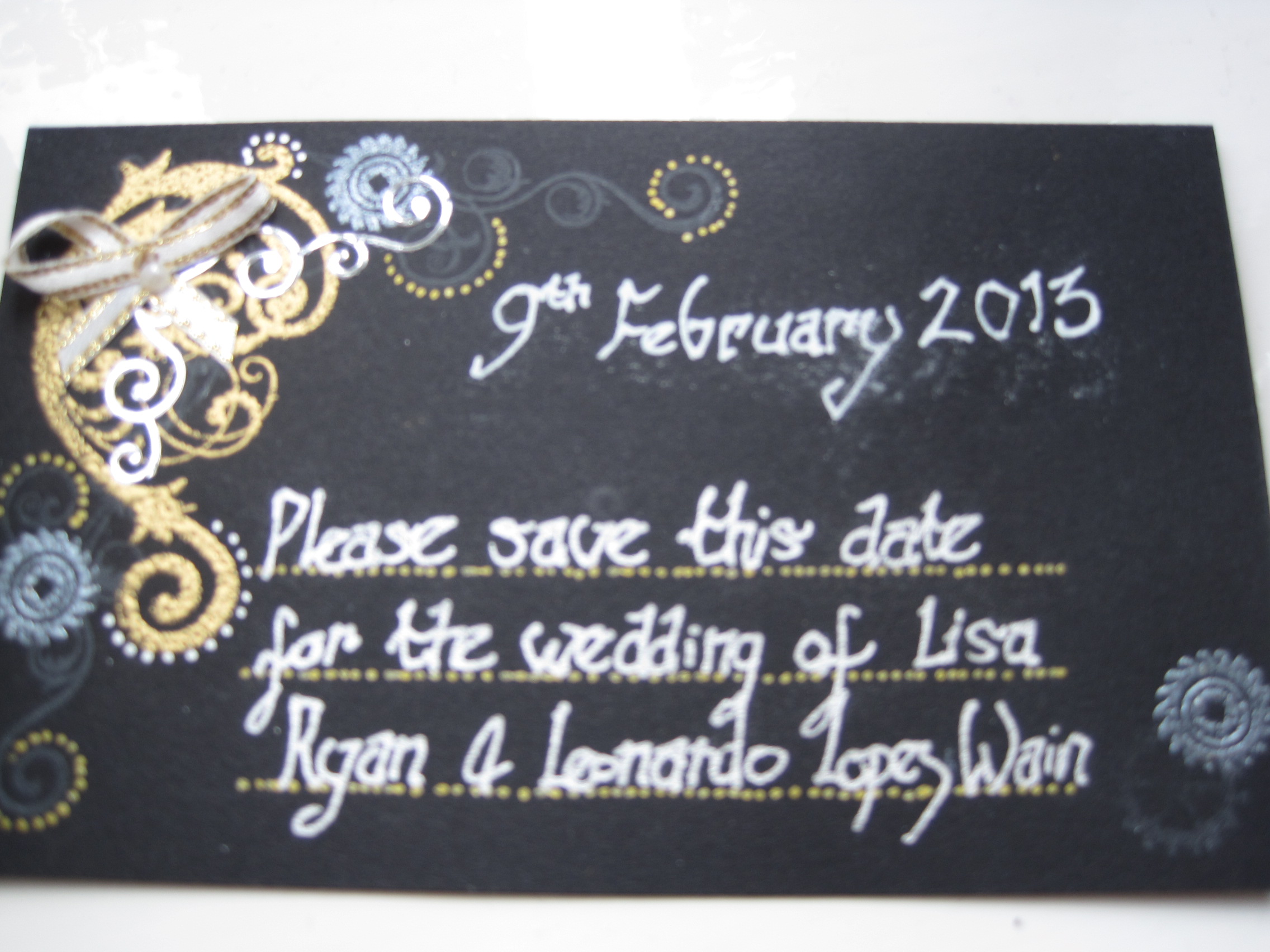
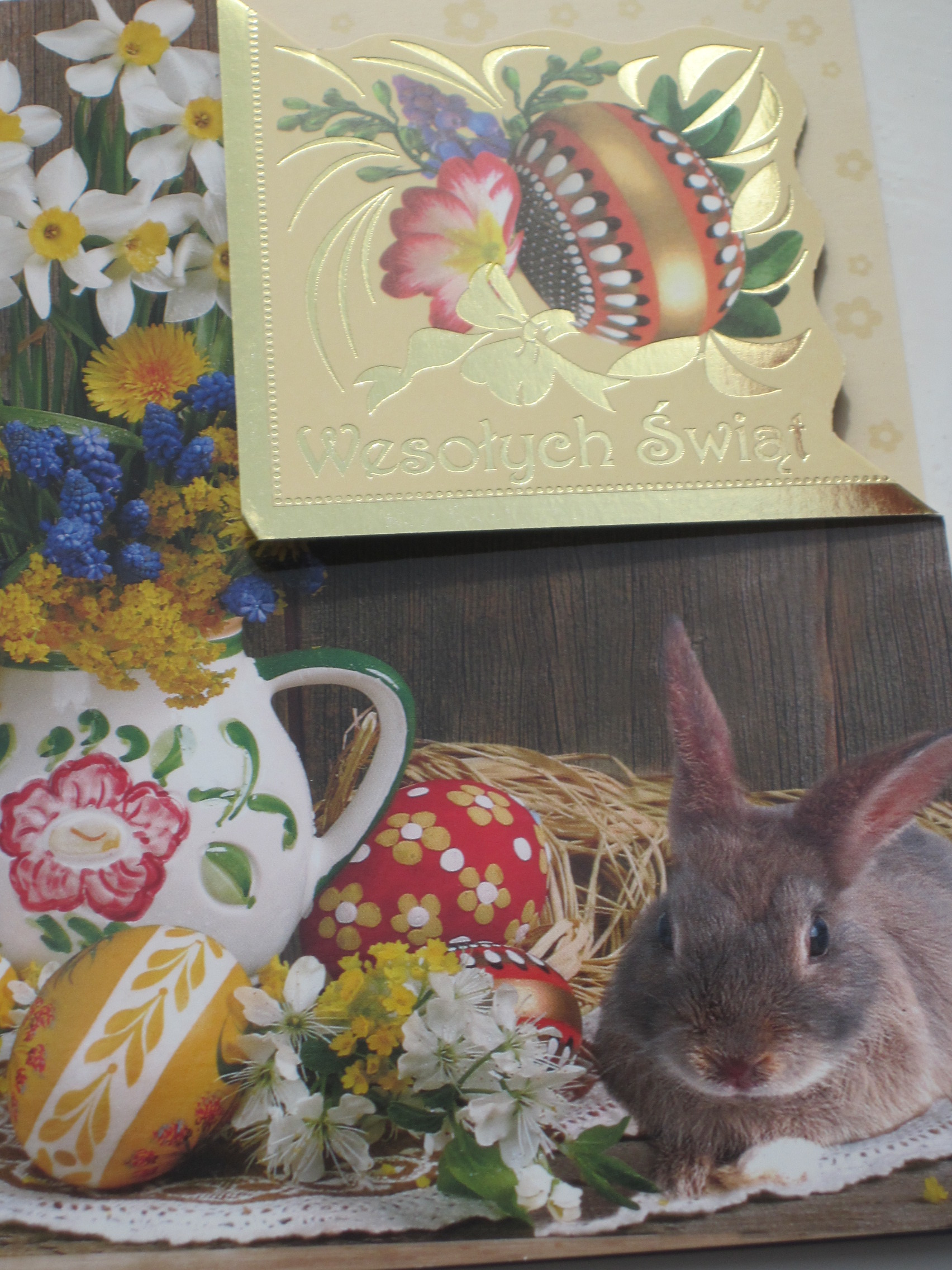
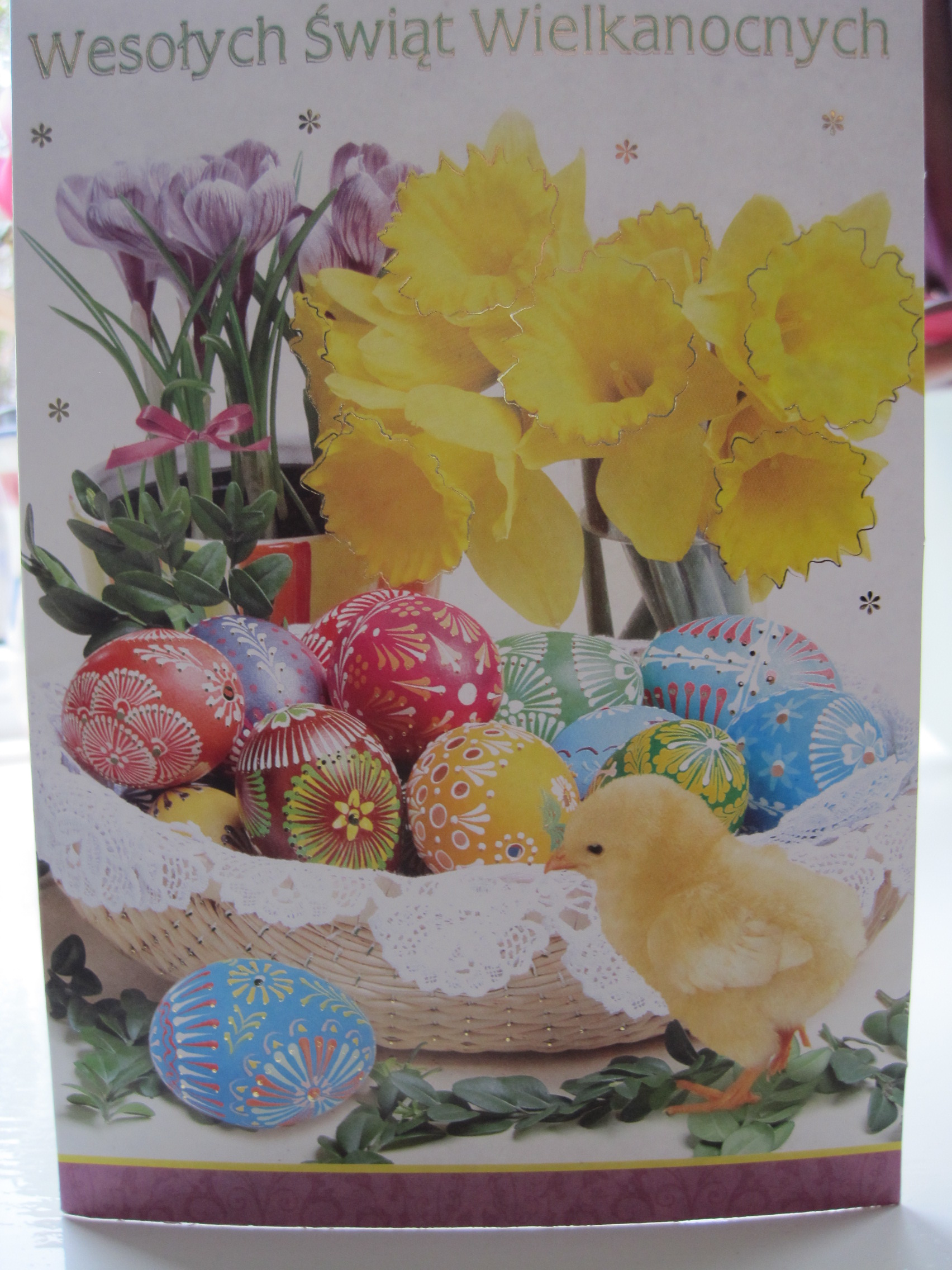
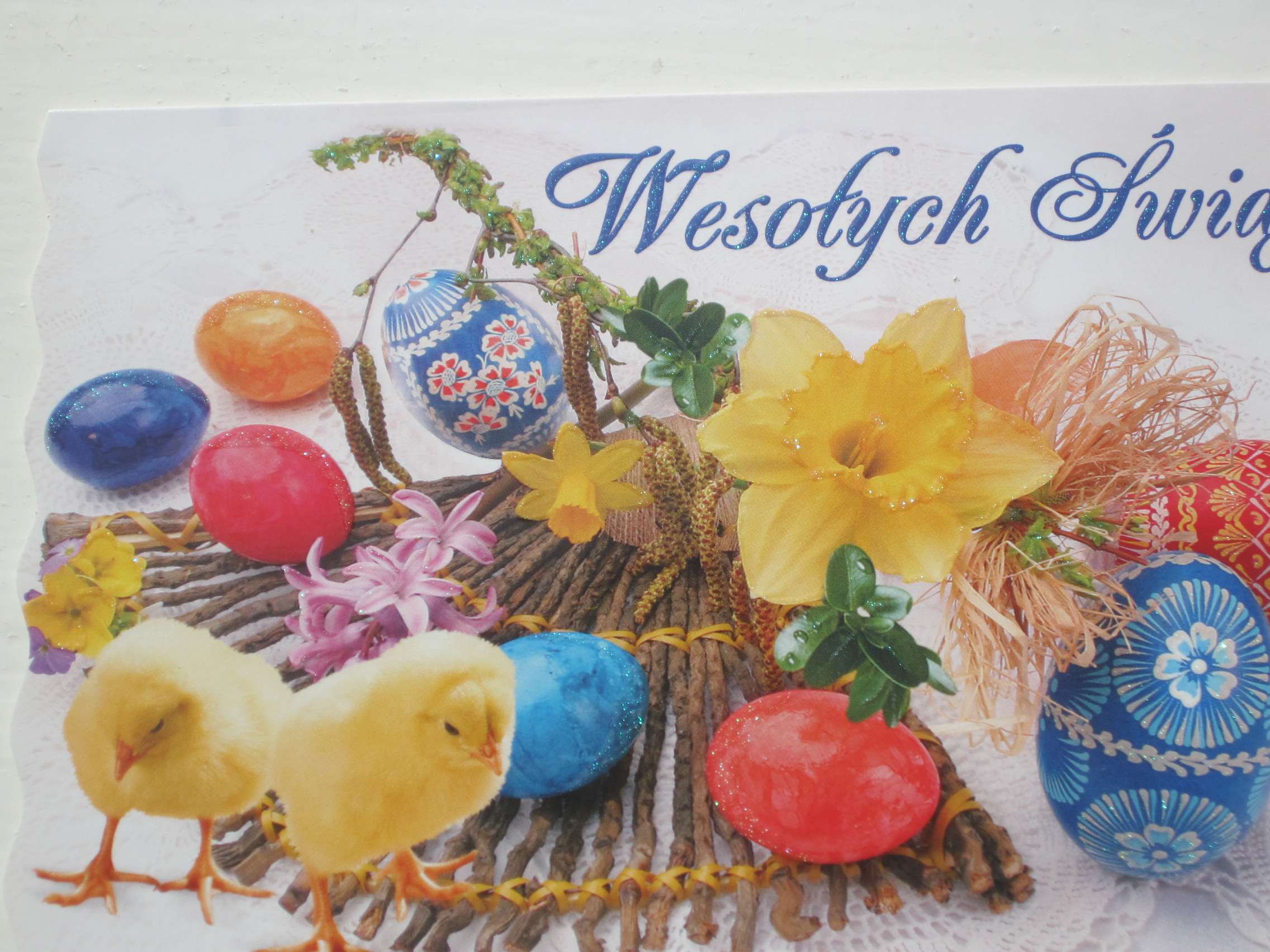
It’s no secret that I have a talented and very artistic daughter.  Her cards often arrive late, but are always a pleasure to receive.  The Easter card shown above brought particular joy because out of it slipped a small black invitation card.

 Lisa has led an often troubled life and has had much to overcome.  I am enormously proud of her, and can hardly wait for this most special of occasions.  Slight doubts though, as to what the mother of the bride wears to a Steampunk Wedding?  The honeymoon will be in Venice, for Carnavale, lucky girl.  To attend is a lifelong dream of hers.  I wish them all the love and luck in the world.

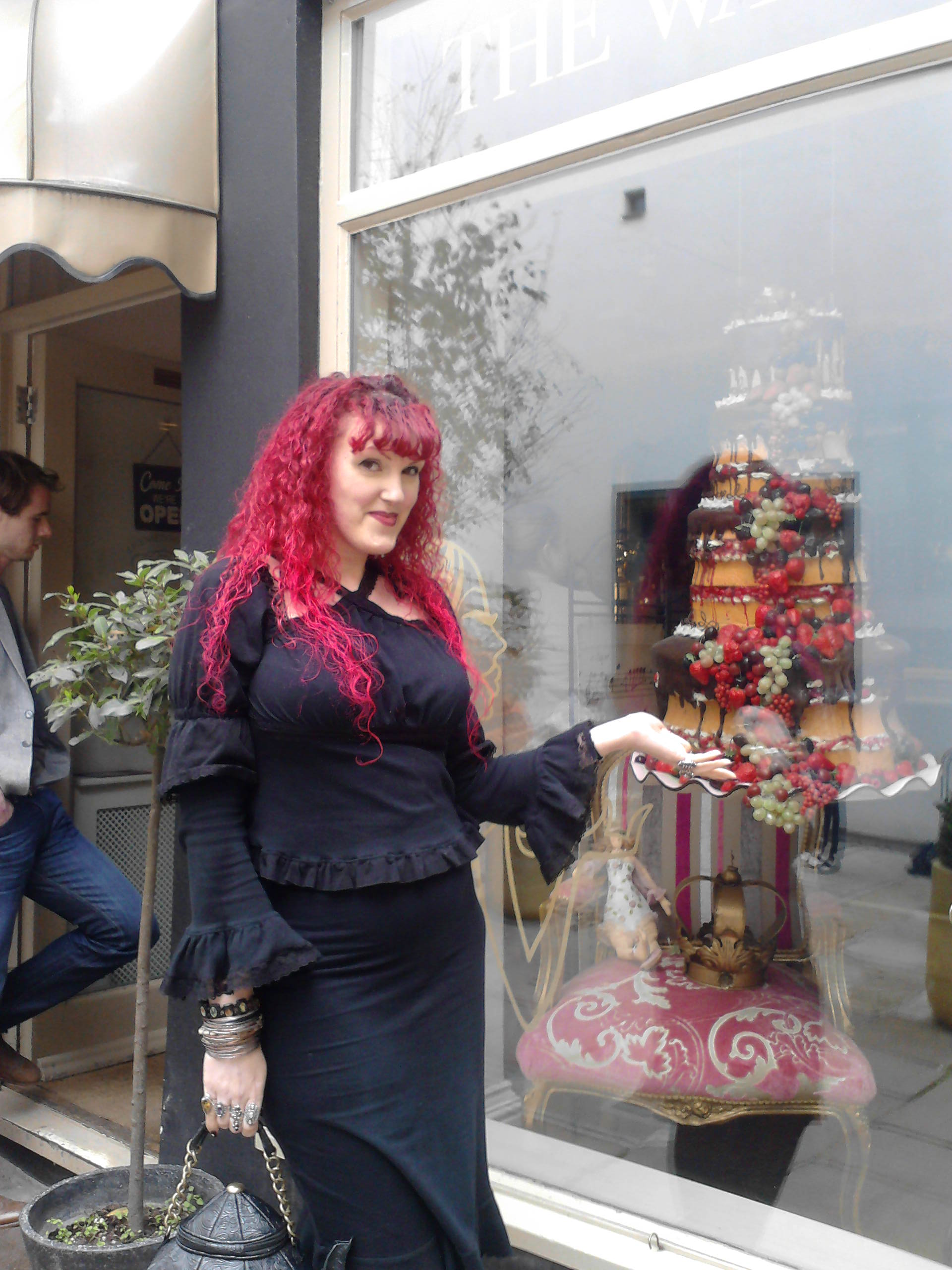
Lisa, my tea and cake girl, at home in Nottingham

As if this wasn’t enough to gladden my week, I have also been awarded a Hug from Francine in Retirement.   I’ve long been an admirer of Francine’s blog so was truly humbled to receive this nomination.  Not being sure of blog etiquette in this matter, I need to point out that I had previously been nominated for the Hug Award by Alyson Sheldrake of The Thought Palette.  On that occasion I wrote A hug a day in acceptance of the award, and nominated a couple of blogs.  I plan to extend that nomination today to:

Ana at 1001 Scribbles

Patti of Read Me

Elisa at Fun and Fabulousness

Sonel at Sonel’s Photographic Corner

All of these blogs give me enormous pleasure.  I should also say thank you to Conny on A Hope for Today who originated the Hug Award.

Please join me next week on Cate’s Six word Saturday and we’ll see just what the week’s brought.  You could even have a little fun and play too?

Six word Saturday

Happy Easter

to one and all

Joyful Easter

Happy Easter

Happy Easter

Happy Easter

Happy Easter

Happy Easter

Easter blessings

Happy Easter

Happy Easter

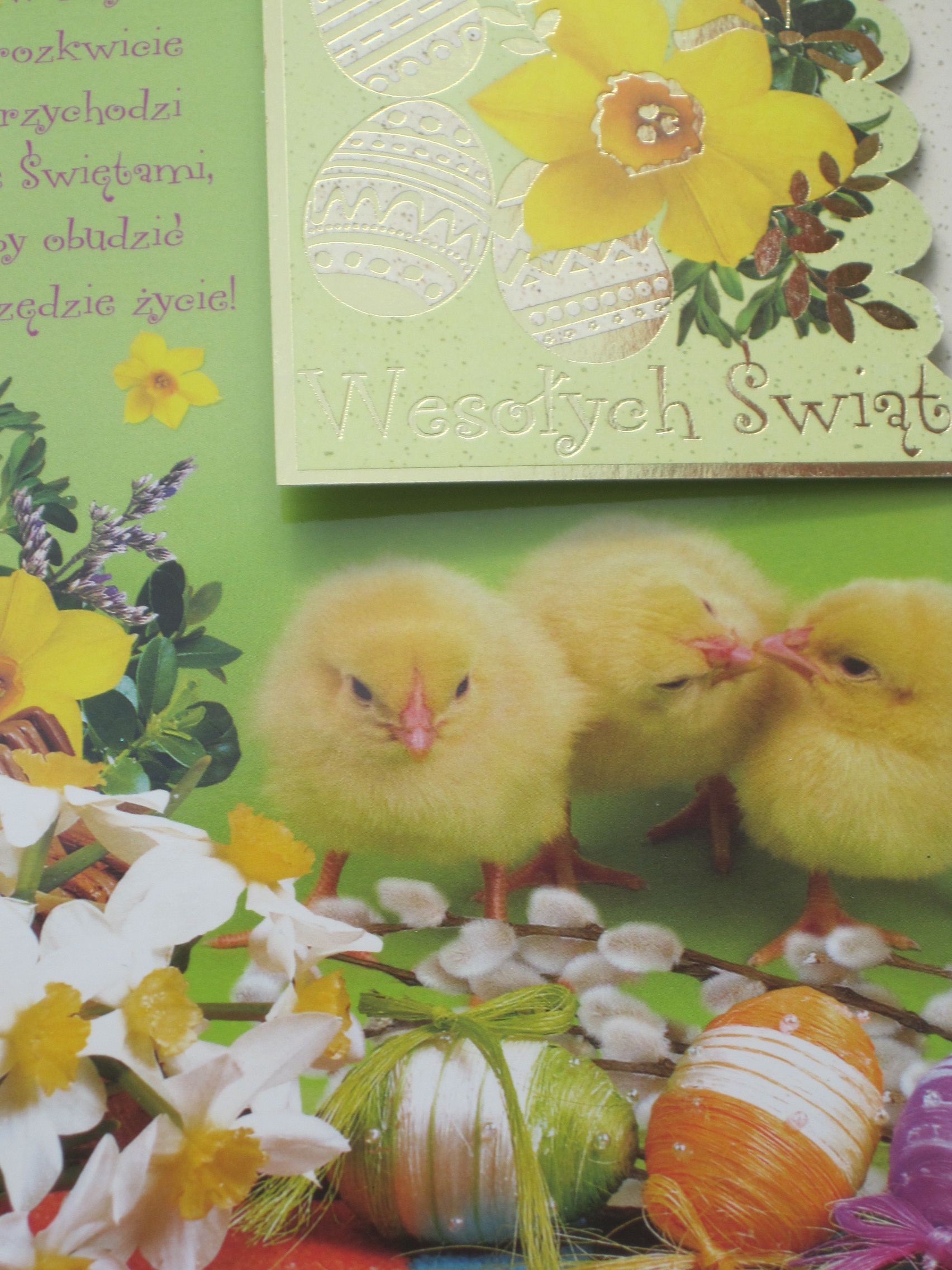
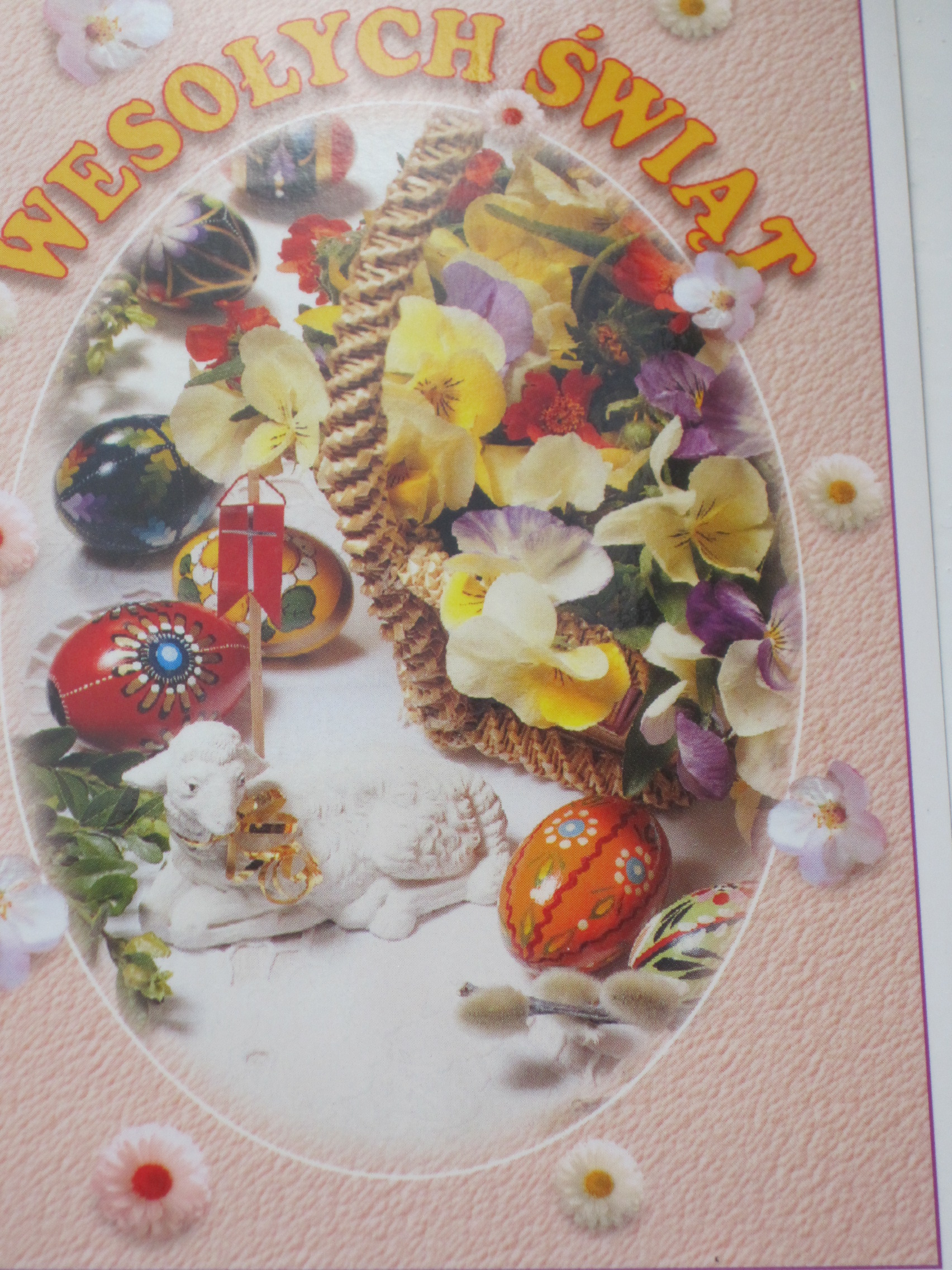
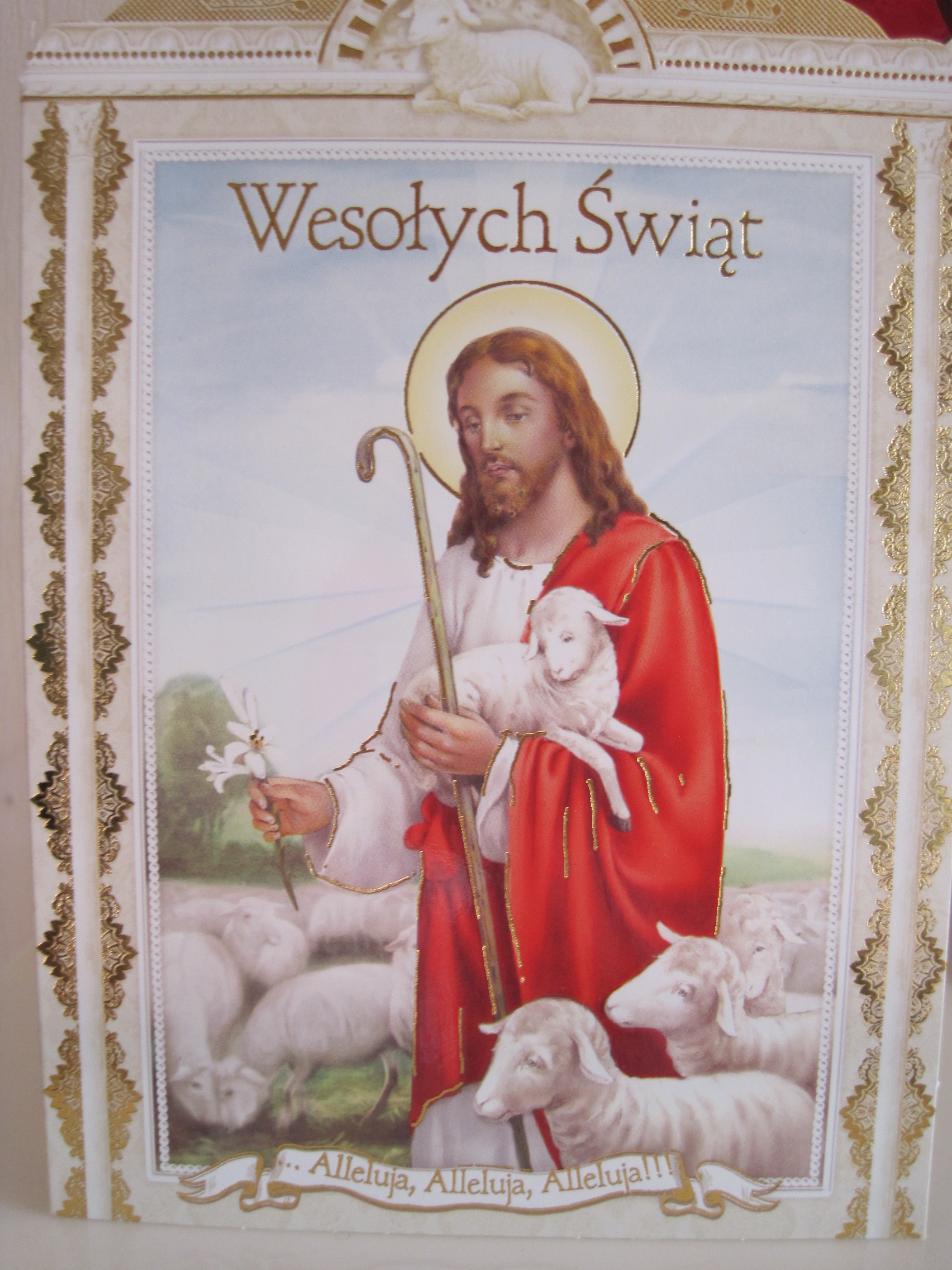
So many ways to say have a happy and joyful Easter.  Thought I’d share with you some of the cards from my Polish family.  They are especially poignant this year because on 31st March, my Uncle Włodek’s wife Janina died, quite suddenly, of cancer.

This post is to celebrate the memory of Janina, who, in the precious few years I knew her, sent me some beautiful cards.  God bless and keep you always.

Have a peaceful, joyous Easter!

Don’t forget to come back and play Cate’s Six word Saturday next week.

K is for Kraków

I just know I’m going to struggle with this post.  I have so much affection and admiration for Kraków, and so many happy memories that keeping to a readable length may well prove impossible.

Woodcut of Krakow from the Nuremburg Chronicles,1493- from Wikipedia

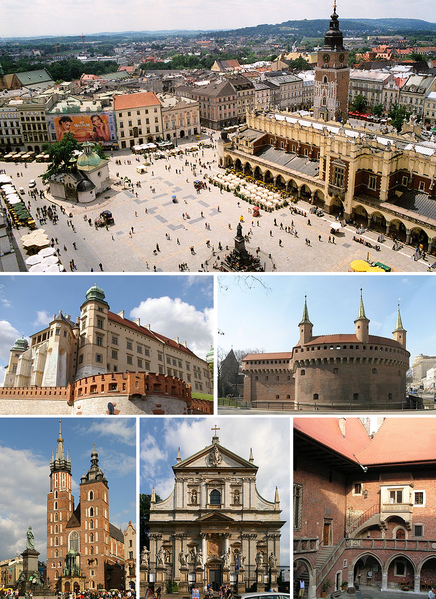
Polish cities have had to be masters of the art of survival.  Nowhere is this better illlustrated than in Kraków, Poland’s ancient capital and seat of its kings for more than 500 years.  I was in love with this city from the first time I walked, arm in arm with my Aunt Anna, into Spring sunshine-filled Rynek Główny, the magnificent market square at the heart of Stare Miasto, the old town.

Rynek Glowny- from Wikipedia

I did not know then of the acid rain inflicted on the city by the post war communist regime.  The construction of Nowa Huta, the largest steelworks in Europe, on the city’s outskirts was intended to humble a proud, cultured city by grafting on a new working class.  If anything, it worked to strengthen anti-communist feeling, so that when opportunity presented itself, the steelworkers were quick to join Solidarity and agitate to overthrow their oppressors.

Kraków’s elegant buildings were little damaged by World War 2, since Hitler chose the city as his base of operations in Poland.  Yet a mighty struggle was needed to reverse the damage to the city and its inhabitants by the toxic chemicals from Nowa Huta.

None of this is apparent in today’s Kraków.  As I gazed in awe at the opulence and vast space of Rynek Główny, crowned by the Cloth Hall, Sukiennice, I was aware only of the gentle pressure of Anna’s arm.  I’m trying to discount the presence of the cameras that followed us- Dad’s story had attracted media attention back home.  https://restlessjo.wordpress.com/2011/10/24/exploring-the-polish-connection/ Flower stalls, candles and corn plaits filled the square with vibrant colour.  It was almost Easter and traditional circular bread rings were on sale.  My cousin Adam is a baker and it proved essential to sample these.

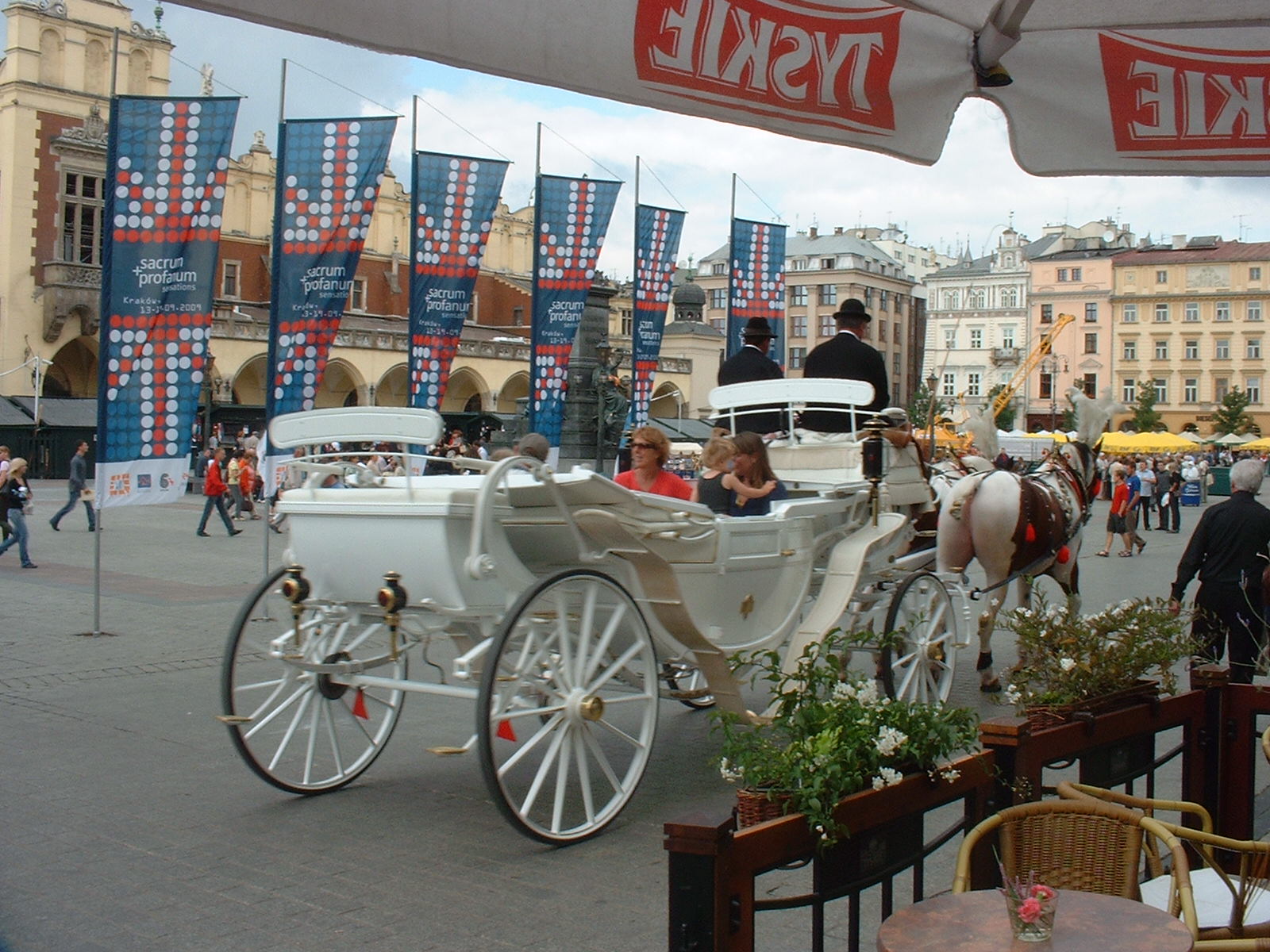
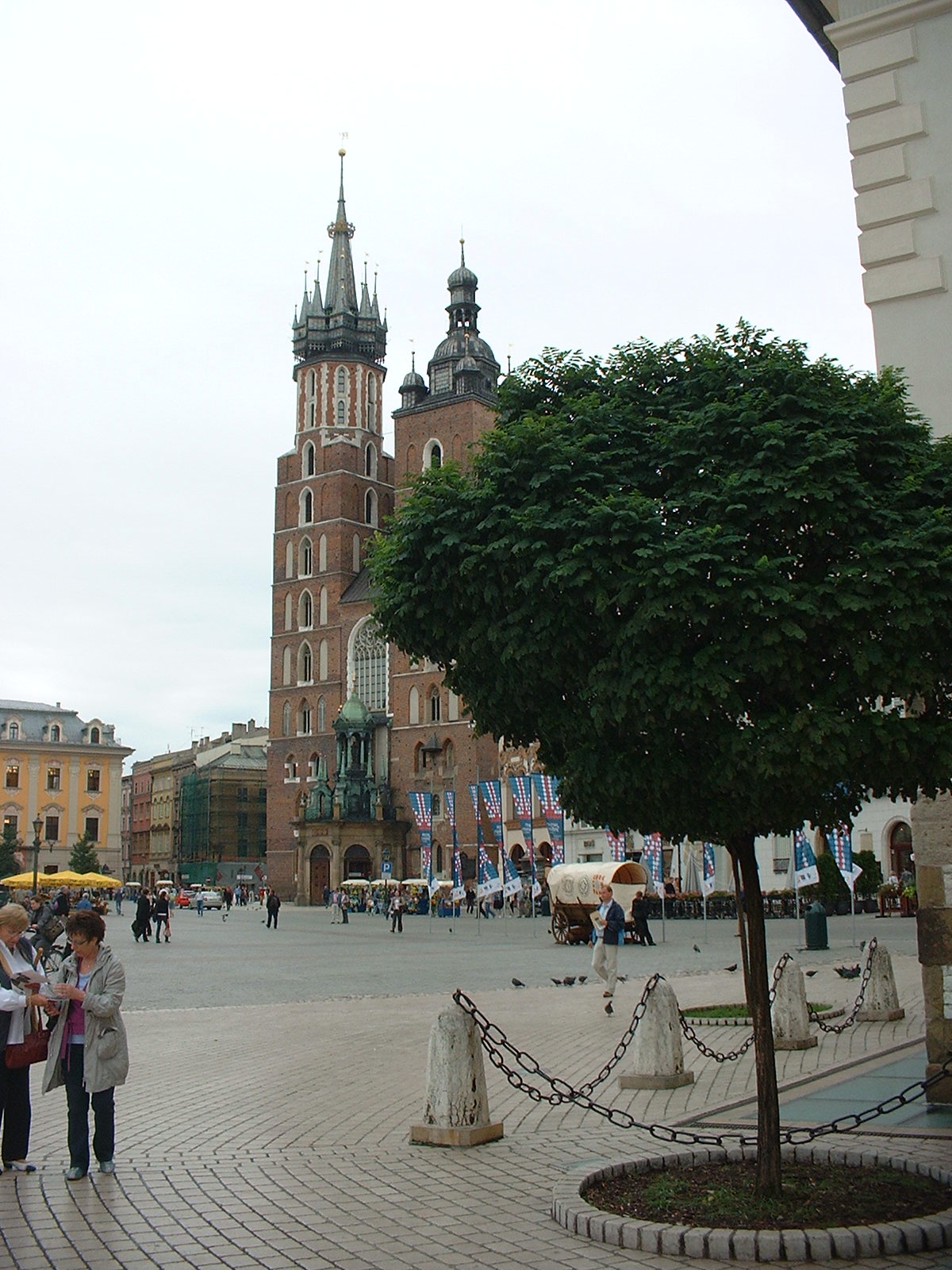
That day we didn’t linger, but I’ve returned many times since to Europe’s largest medieval market square.  I find it magical, with the gentle clop of horses’ hooves as the costumed drivers steer their carriages through strolling tourists.  Always, as the hour chimes, a cluster of people gaze skywards at the tallest tower of the Mariacki Church, St. Mary’s.  Legend has it that during a Tartar raid on the city in 1241, the watchman tried to sound the alarm from this tower.  He was cut short from his trumpeting by an arrow through the throat.  An hourly tribute to this moment ends mid phrase, then the trumpeter waves cheerily to the crowd, and lives to repeat his performance.

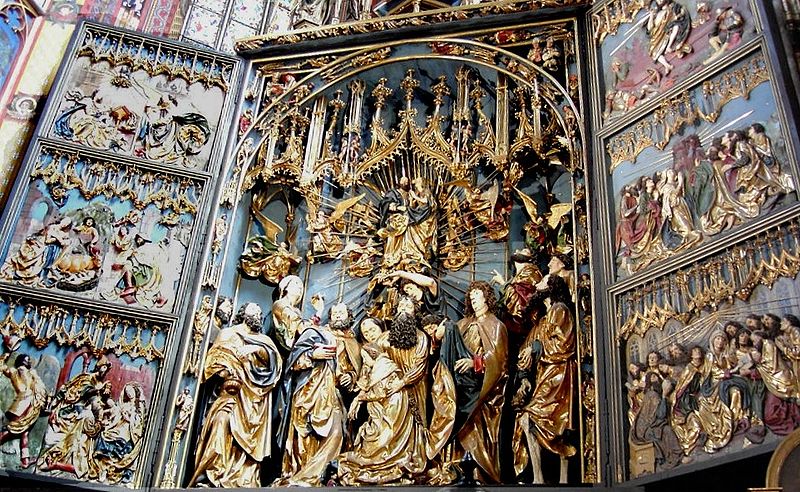
An altogether different performance takes place inside the Mariacki Church at noon each day. (Sundays and saints’ days excluded)   I found the cobalt blue ceiling with its panorama of stars and local artist Jan Matejko’s painted friezes truly beautiful, but it’s the opening of the high altar that draws the crowds.  Carved by Nuremberg craftsman Veit Stoss, from 1477 to 1489, it’s one of the finest examples of Gothic art in Europe.  The outer of the gilded limewood polyptych illustrates the life of the Holy Family.  With great pomp and ceremony the outer panels are drawn back to reveal six superbly colourful scenes from Christ’s life, while “sleeping” Mary is watched over by the Apostles.

Veit Stoss altar- from Wikipedia

You need to purchase a ticket to witness the opening.  A small ticket office in the adjacent square Pl. Mariacki opens shortly before each unveiling.

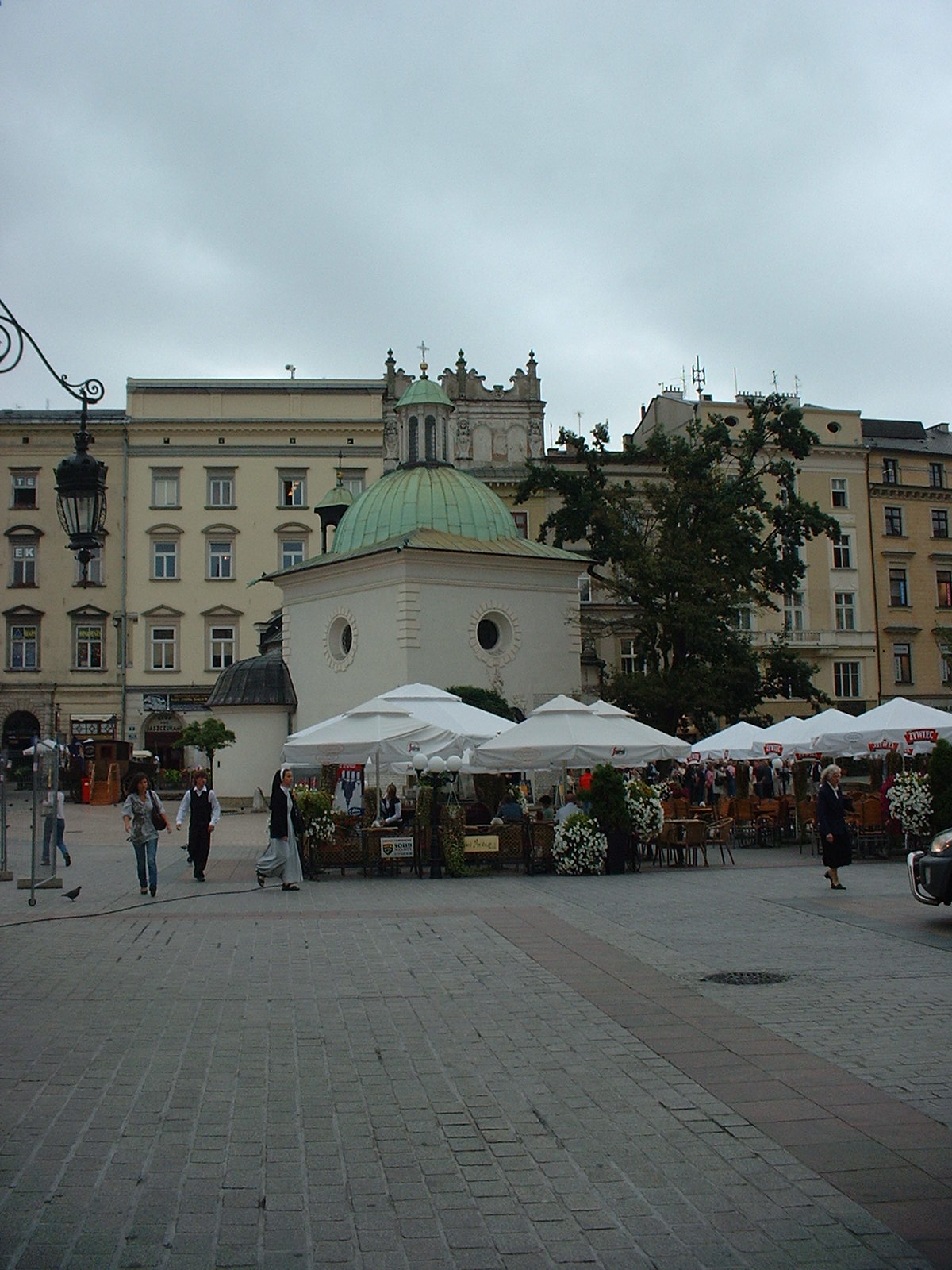
Back in Rynek Główny, the contrast with tiny St Adalberts, the oldest building in the square and the first church to be founded in Kraków, couldn’t be greater.  It’s serenely peaceful inside, and in the basement the original 10th century foundations are still visible.

St Adalbert's Church

The flamboyance of medieval Sukiennice constantly draws the eye.  It has to be the prettiest indoor market I have ever seen.  Inside the stalls are laden with amber and sparkly things, craftwork and woollens.  Heraldic shields sit high on the whitewashed walls, a reminder that the richest of cloth merchants once worked here.  In the cafes, under the arcades, writers and artists once met.  Now tourists are catered for, with inflated prices.  I prefer to sit at the edge of the square, looking in on an ever changing scene.

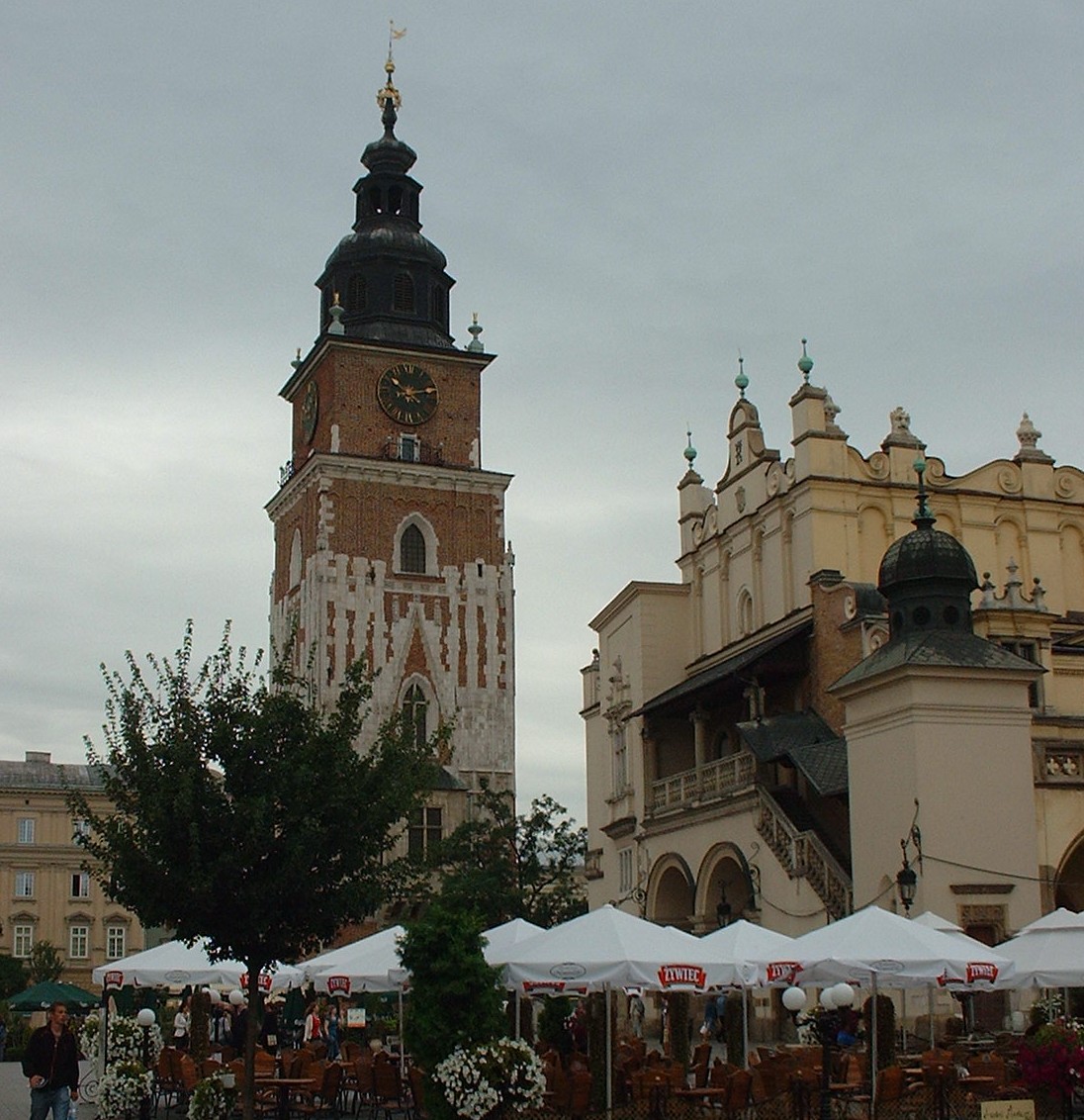
A bird’s eye view of the square can be obtained from the Ratusz, the lofty tower all that remains of a 14th century Town Hall.  It now houses a Tourist Information office, with useful maps detailing the many restaurants and places of interest.

Ratusz and Sukiennice

Twice I have eaten cake at no 15, Hotel Wierzrynek, Kraków’s oldest and most famous restaurant.  Charles de Gaulle, Steven Spielberg, Yehudi Menuhin- and me!  The grandest restaurant I’ve been in, other than London’s Ritz. www.wierzrynek.pl

Much simpler, but quite delicious, I found Chimera, at 3 Sw. Anny, just off the Rynek.  A pretty enclosed courtyard, offers buffet style with lots of choice, or you can eat in the classier basement restaurant if you can afford more than student prices. www.chimera.com.pl

Just around the corner lies Collegium Maius, part of the Jagellonian University, where Copernicus allegedly studied in the 16th century.  It surrounds an imposing courtyard.  Guided tours can be booked from a ticket office as lovely as any I have ever seen.

Collegium Maius

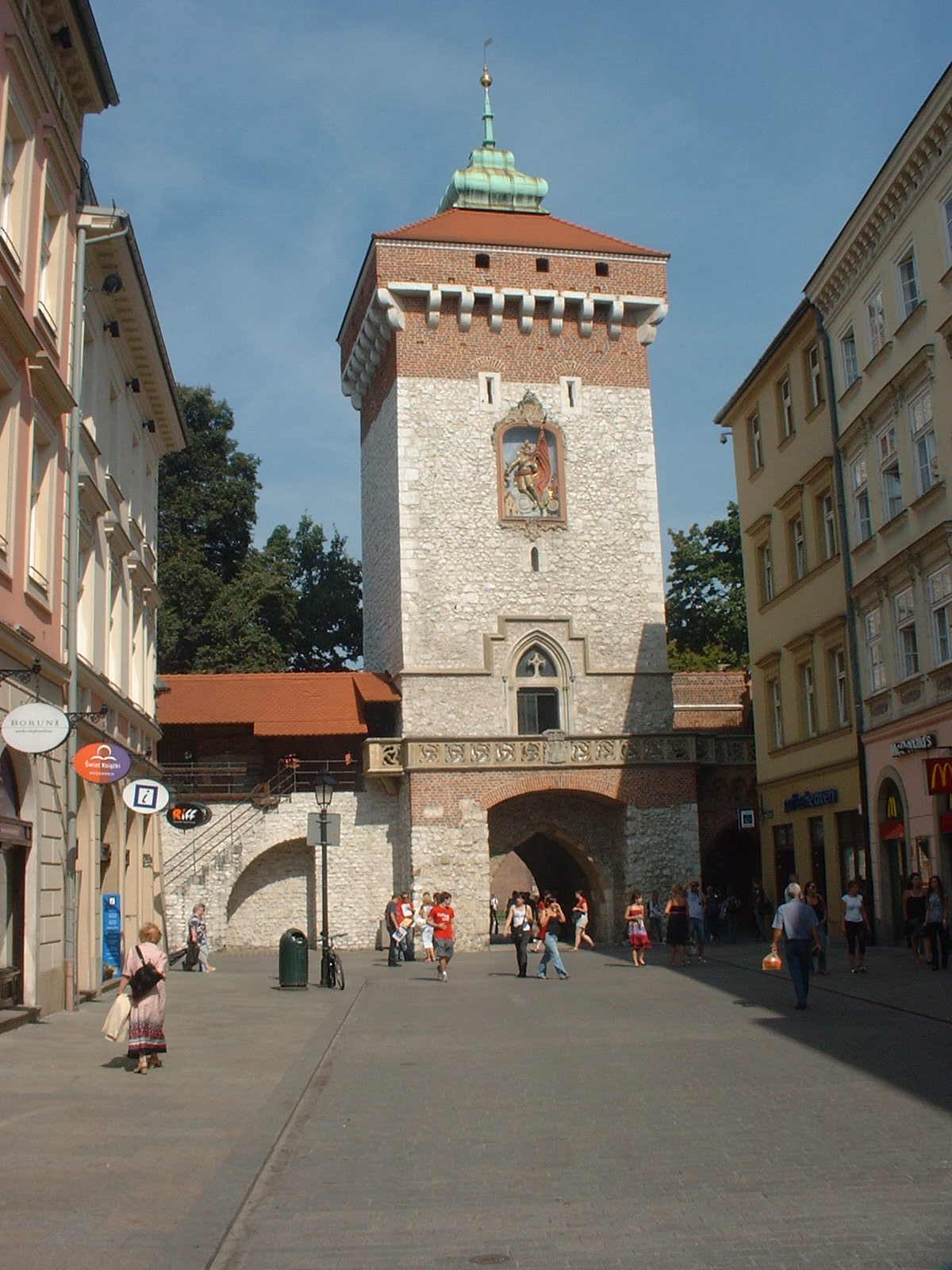
Florianska is one of my favourite streets.  Leading north from the Rynek, the architecture is powerful, old and new mingling with surprising ease.  High fashion hides behind grand old facades and at Jama Michalika, no 45, afternoon folklore shows take place in a cavernous interior.  Florianska Gate, at the end of the street, marks the edge of Stare Miasto.  Artists’ impressions hang on the old defensive walls of the city.  Once there were 3 kilometres of wall, 10 metres high and almost 3 thick, with 47 bastions.  Only Barbakan remains, a lonely giant.  The old town is surrounded by the green and leafy Planty, which follows the course of the old ramparts.

Florianska Gate

Heading south from the Rynek, Grodzka follows the traditional route of the Polish monarchs to the glory that is Wawel Hill.  Part of the old trade route to Hungary, it passes by the Dominican and Franciscan churches, and the mighty Basilica of SS. Peter and Paul.  Beckoning in the distance, the spires of Wawel Castle and Cathedral.

Wawel Cathedral

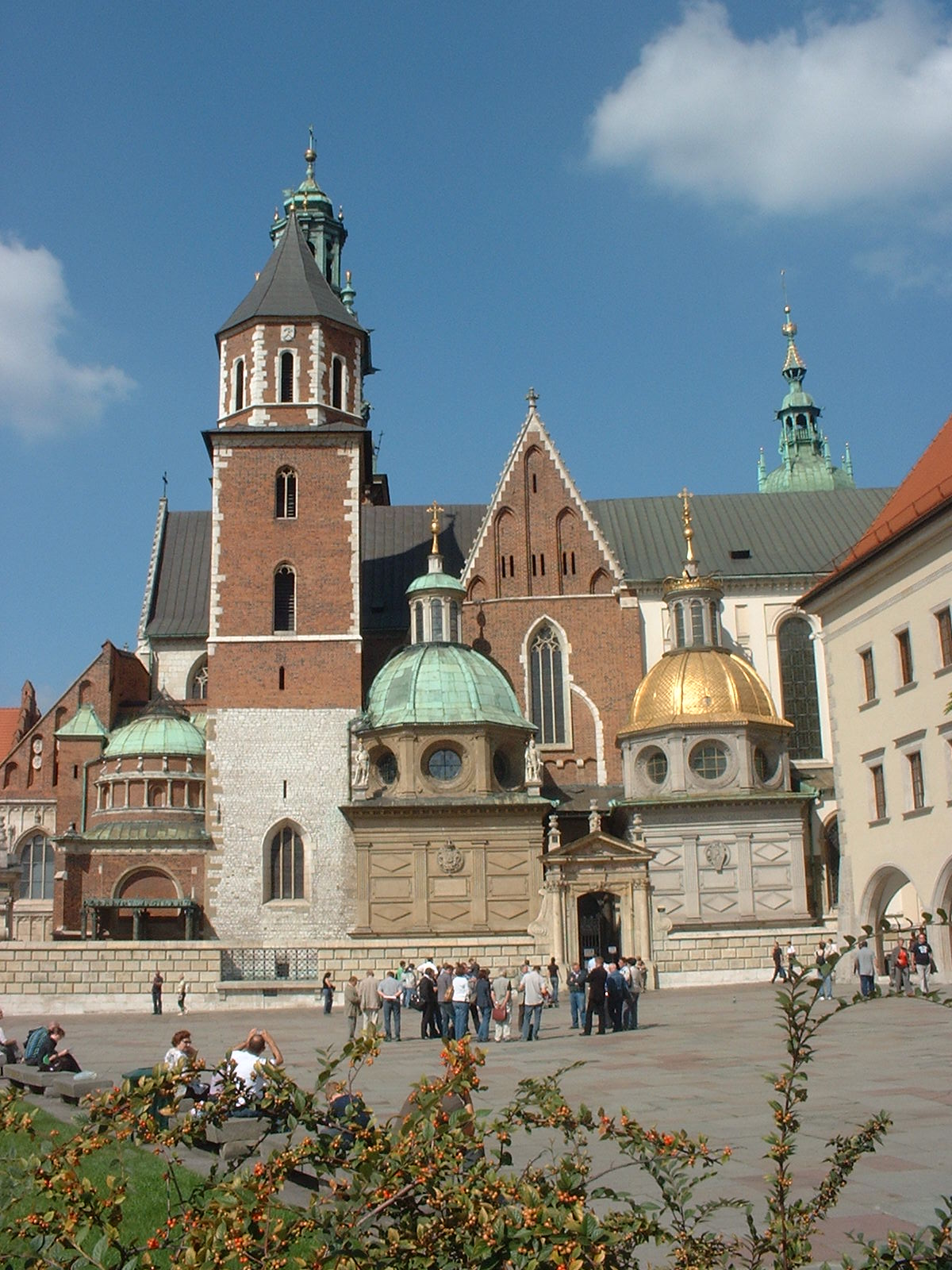
Wawel is the spiritual and patriotic heart of Poland.  Even after the capital was moved to Warsaw, Polish monarchs continued to be buried in Wawel Cathedral, along with many of the nation’s heroes and writers.  You will find as many Poles as foreigners looking around this awesome sight, justifiably proud of their heritage.  Pope John Paul 2nd, who gave his first mass as a priest there and became a much loved Archbishop of Kraków, described the cathedral as “the sanctuary of the nation”.  The first cathedral was built here around 1020, and fragments of the original can still be seen.  I never saw so many beautiful shrines in one space.  The largely Gothic Cathedral is as lovely outside as within.  It’s a bit of a scramble up Sigismund Tower to view the mighty bell “Zygmunt” and its four medieval companions, but the views are fine.

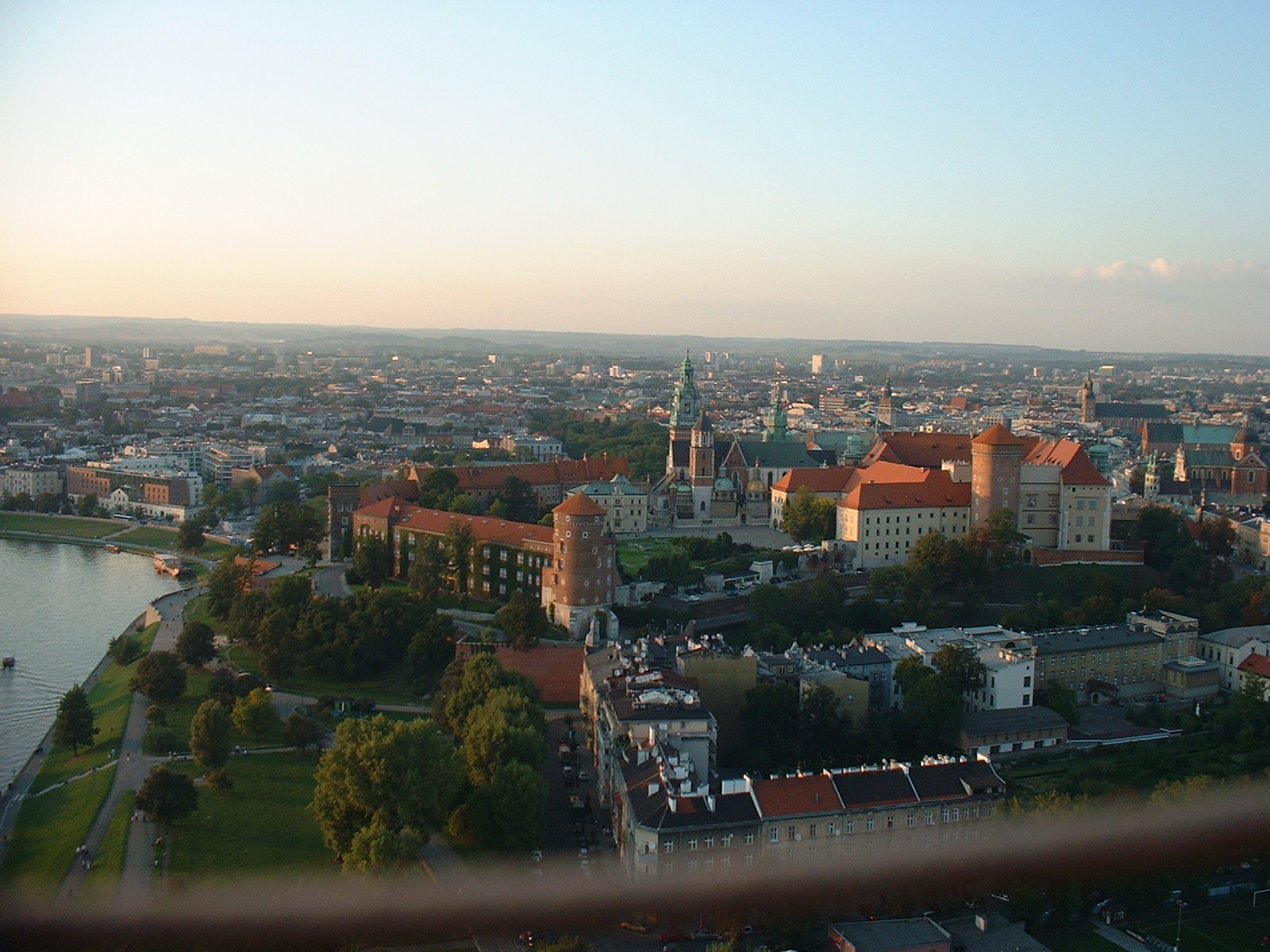
The magical view from Balon Widokowy at sunset

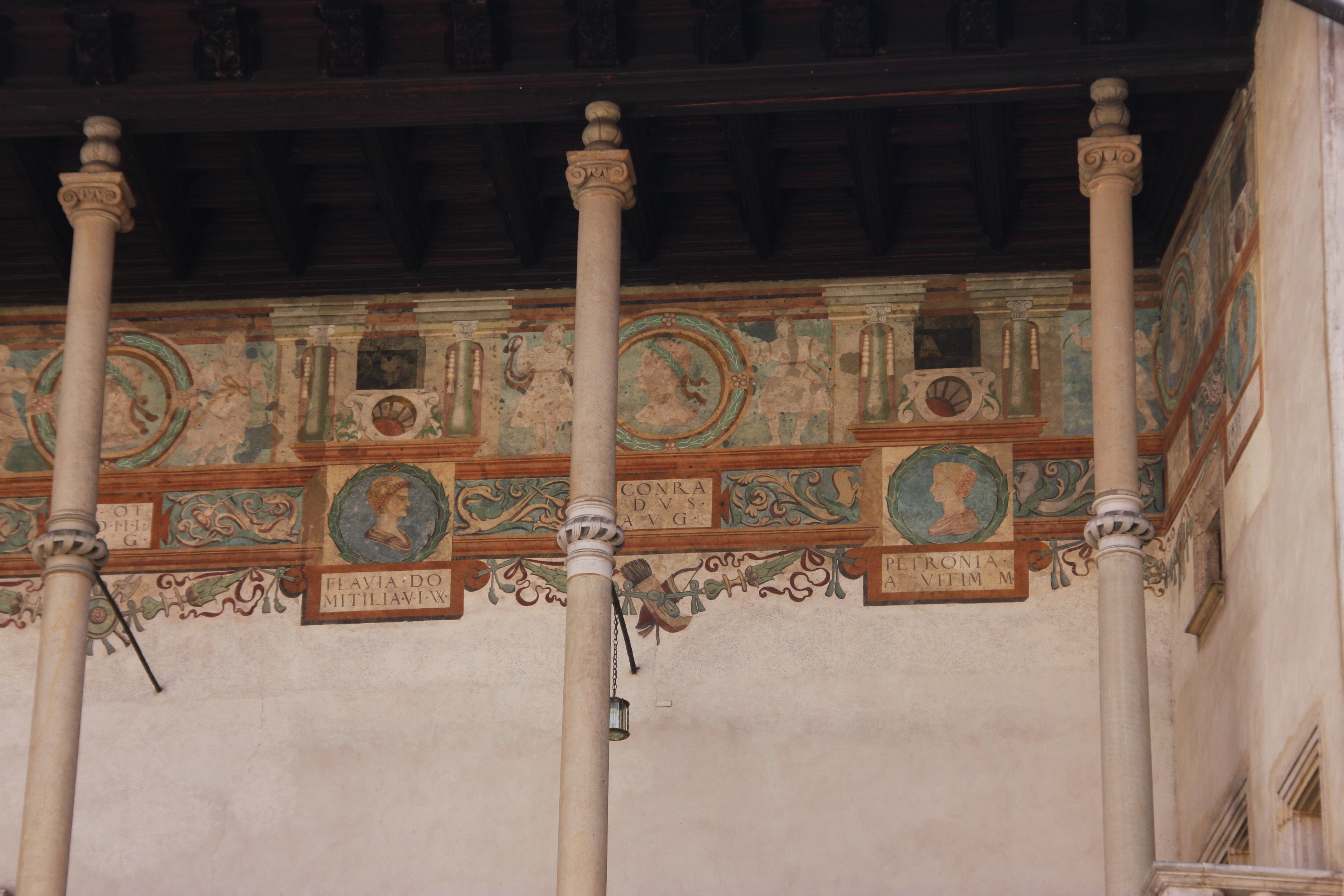
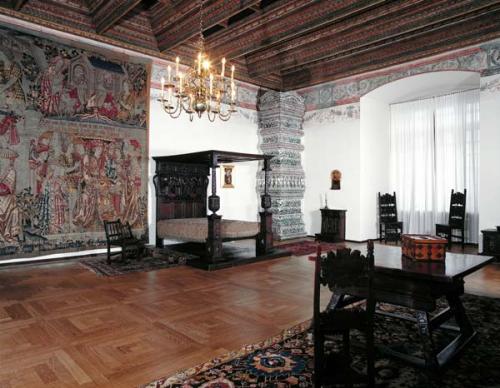
Wawel Castle spins a fairy tale if ever there was one.  One of my best memories is of viewing it from the sky in “Balon Widokowy”- a tethered hot air balloon on the banks of the River Wisła (Vistula).  The Castle was the royal residence until 1609.  The internal courtyard is immense.  Surrounded by 3 tiered arcades, it has the feel of an Italian palazzo.  The Royal Chambers are furnished in Renaissance style and contain 136 well-travelled Flemish tapestries from the 16th century.  At the outbreak of World War 2 many of the castle treasures were spirited abroad.  Just as well because occupation by Governor Hans Frank and his Nazi henchmen followed.  The tapestries were only partially recovered, many of them returning from Canada in 1968.

The castle courtyard. Below, frescoe detail

Tapestries on display in the Royal Chambers

Guest bedroom with the oldest of the tapestries and 18th century ceramic heater

Admission to the Royal Chambers is free on Sundays.  Separate tickets are needed for Castle and Cathedral and I could fully recommend the Castle tour.  Details on www.wawel.krakow.pl

Oh dear!  I’ve only just scratched the surface and I haven’t even mentioned Kazimierz, the charismatic Jewish Quarter.  Or the szopki, nativity scenes very special to Kraków.  Or Wieliczka– salt mines such as you’ve never seen, with salt crystal chandeliers.  Or the views from Kosciuszko Mound (don’t go on a hazy day, as I did!)  Or, more seriously, Auschwitz.

Just as well I can put these into other A-Z posts!  Meantime, for all the things I haven’t told you www.krakow.pl is an excellent site, with English version available.  Transport, what to see, events- it’s all there.

Kraków is an emotionally charged city for me and I hate it when I see it dismissed as “a venue for stag nights and hen parties”.  Having survived so much, I’m sure it can overcome this image.  Do go and see for yourself.

I’ll close with some Easter symbols: eggs, the candles bought for me in the Rynek by Aunt Anna and an Easter blessing.


Few things stranger than life, and just after posting this I got a “shout” from Mark of Travels of a Non Traveller, who was in Krakow.  He has some great tips on free walking tours so just follow his link.

W is for Warsaw

I do worry that maybe I’m being a bit too personal with my A-Z of Poland so I’m nipping right down to the foot of the alphabet to tell you about Warsaw, a place I don’t have an emotional connection to.  Some of you may know it much better than I do.  I was only there for one day, but what I saw was truly inspirational, and I wouldn’t hesitate to go back.

Not that I was sure of this when I emerged from Warsawa Centralna railway station into a honking, braking cacophony of traffic.  I looked across at the unmissable 231 towering metres of the Palace of Culture and Science, took a deep breath and plunged.  Once over on the green island that surrounds the museum, things didn’t seem so bad, but that impression wasn’t to last.

Museum of Culture and Science

Time was short and my priority was to see Stare Miasto, the old town, more than 80 percent of which had been deliberately razed to the ground during World War 2.  Some of the family were already inside the museum, cameras clicking.  The rooftop panorama from the 30th floor viewing deck appealed, but it was hot and busy so I decided to reconnoitre the surrounding area, looking for a bus stop which would take us to the Old Town.  Mistake!  With hindsight it would have been faster to walk, but that was never an option as Dad was with us, and he’s not so good on his legs.  He’d been determined to accompany us, despite knowing that it would be a tiring day.  Rightly enough, as he’d never seen his Polish capital in all his 80+ years.

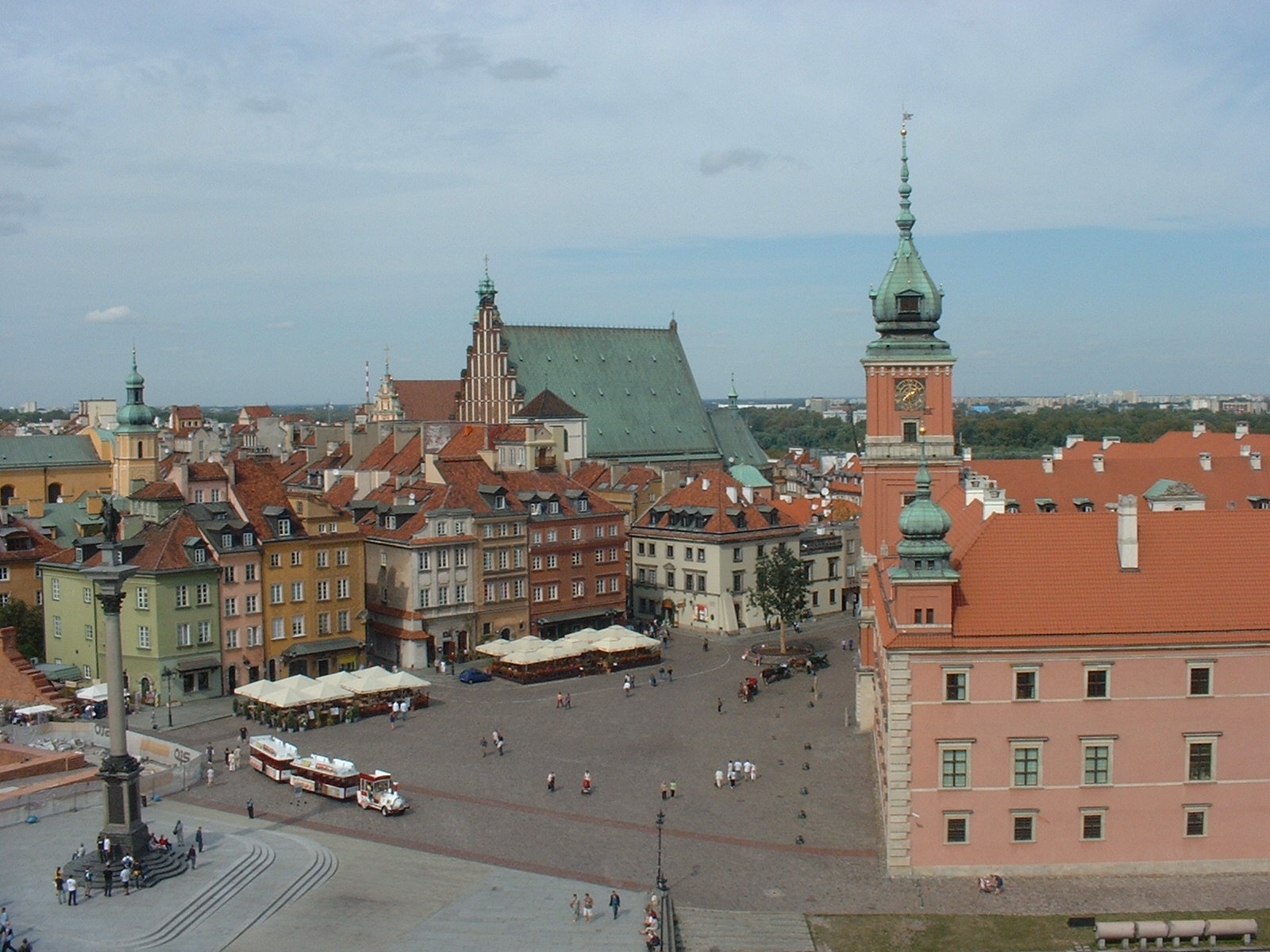
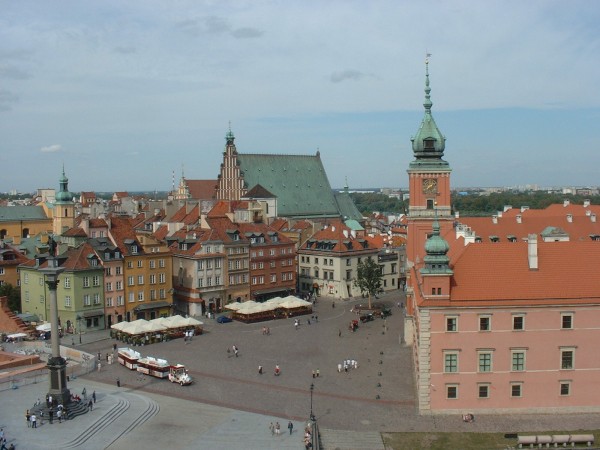
Let’s just say that we hopped into taxis, but not before I had seen a little too much of modern Warsaw and taken plenty of wrong turnings.  Never mind, it all faded away as I gazed in awe at Plac Zamkowy, Castle Square, with its serene Royal Palace, barely believing that this was all reconstruction.  I said that I don’t have an emotional connection to this city but it would be impossible not to be moved by what transpired here.  Following almost total annihilation, in 30 years, working from paintings and old photographs, the Old Town was painstakingly resurrected in all its glorious colour.

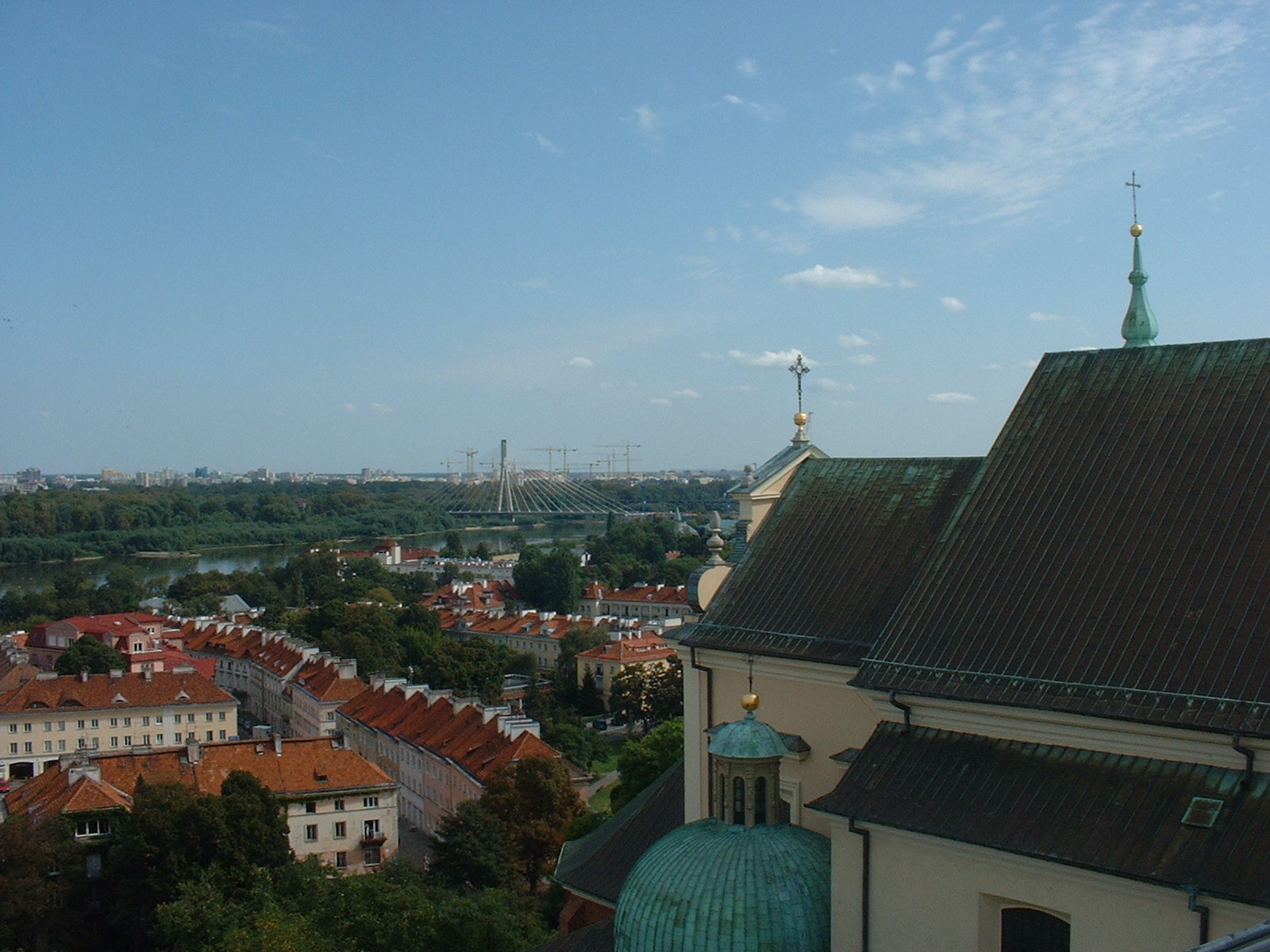
Plac Zamkowy from St Anne’s Church roof

It was a grand setting in which to sit and admire this seat of Polish kings from 17th century onwards.  It opens for guided tours Tuesday till Sunday (free on Sundays).  http://www.warsawguide.com/royal_castle.html  Cafes and restaurants line this majestic space, not cheap by Polish standards, but you don’t have to pay for the view if you don’t want to.  You can grab an icecream and hitch up on a wall or the stone seating if you can find a space.  Dad, as so often, charmed his way in.

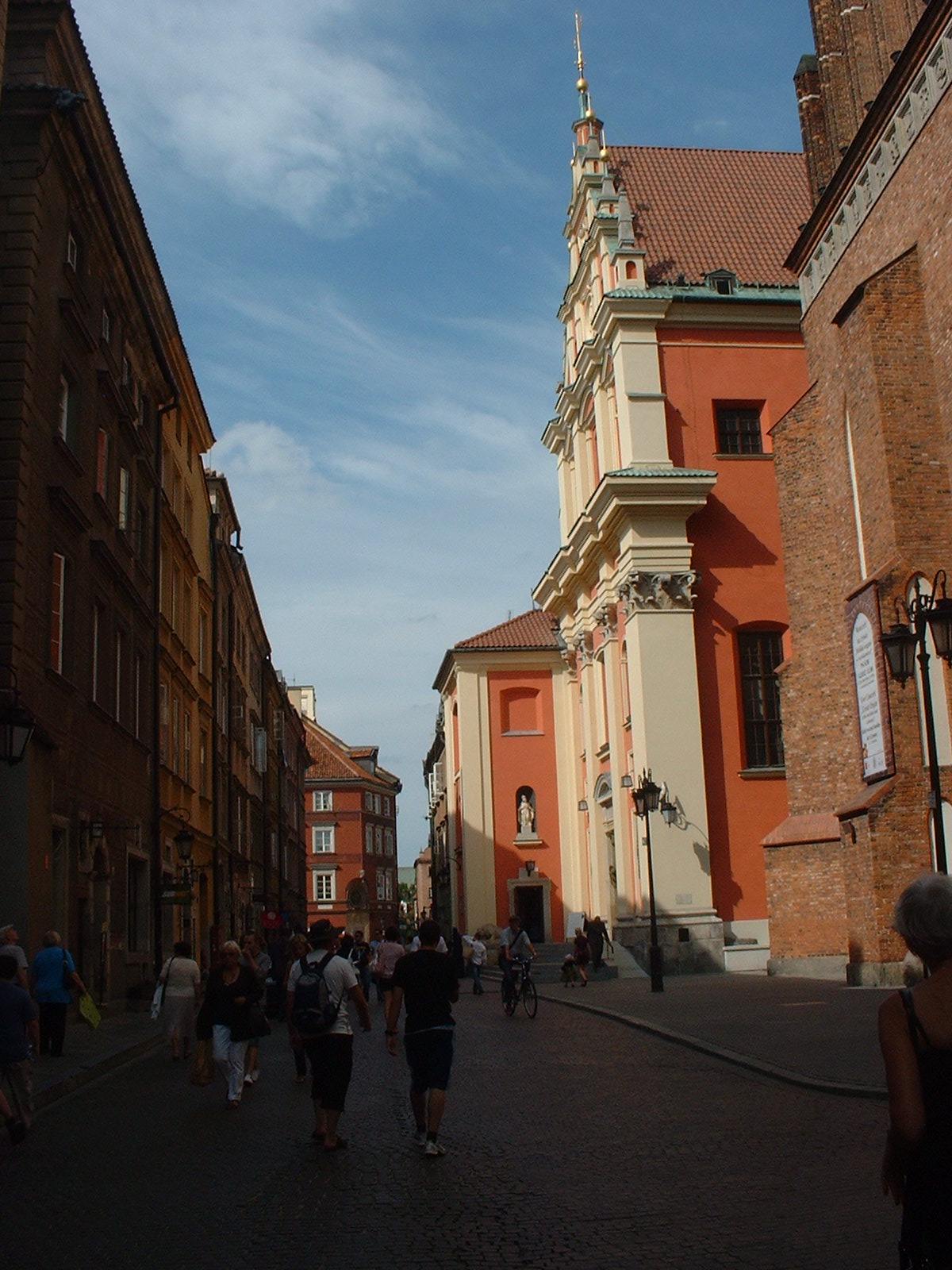
I had picked up a map at the Tourist Information office in the square and it seemed a good idea to get our bearings on board the mini tourist train.  The commentary was in Polish but it didn’t matter as it was difficult to hear whilst rattling over the cobbles.  The map was useful, especially when it came to strolling out of Plac Zamkovy, past St John’s Cathedral.  It was occupied by German tanks during the war and so badly damaged that only the Gothic exterior is original.  Kanonia, behind, has views of the endless River Vistula.

St John’s Cathedral

Kanonia

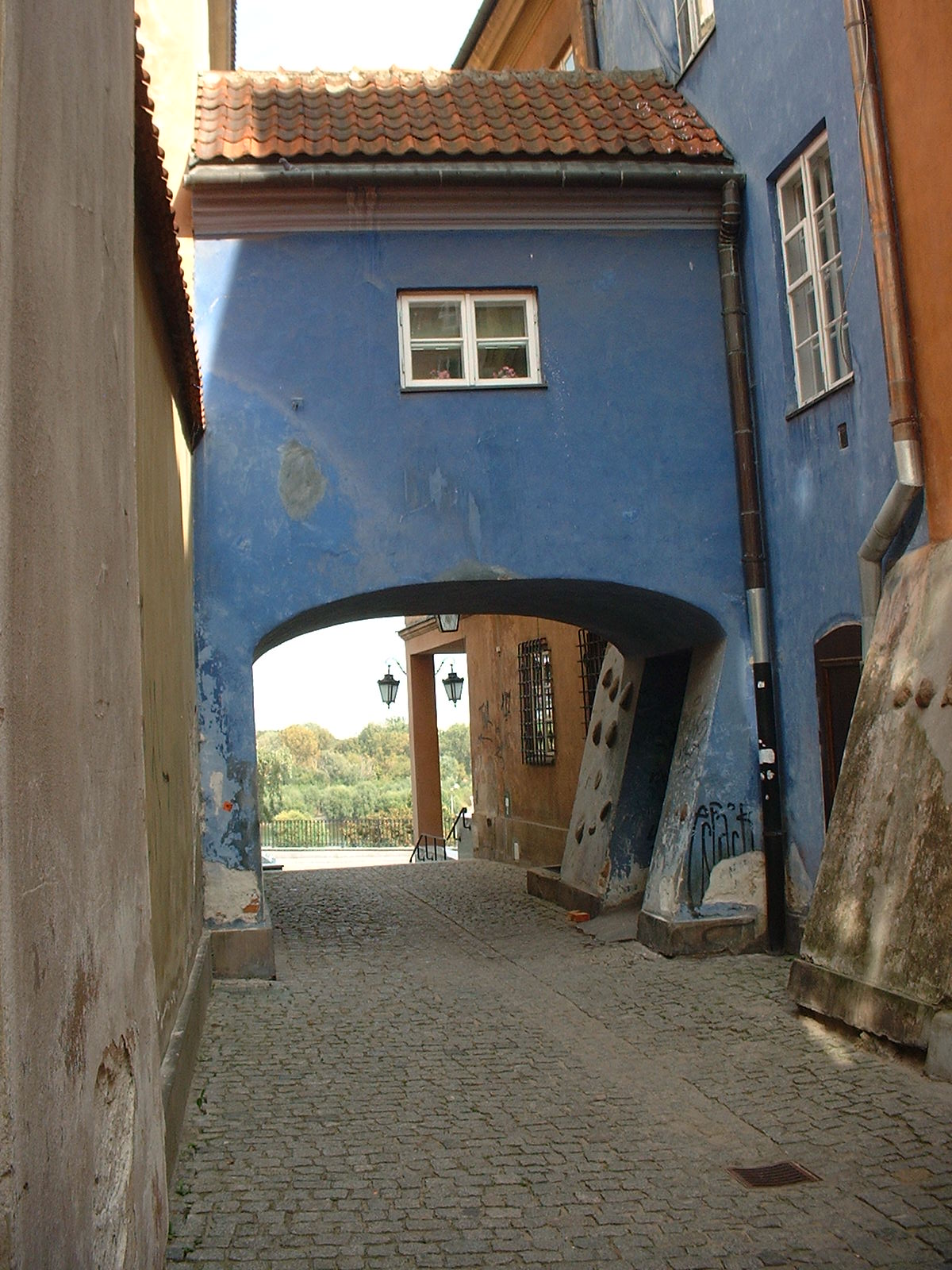
By the River Wisła (Vistula)

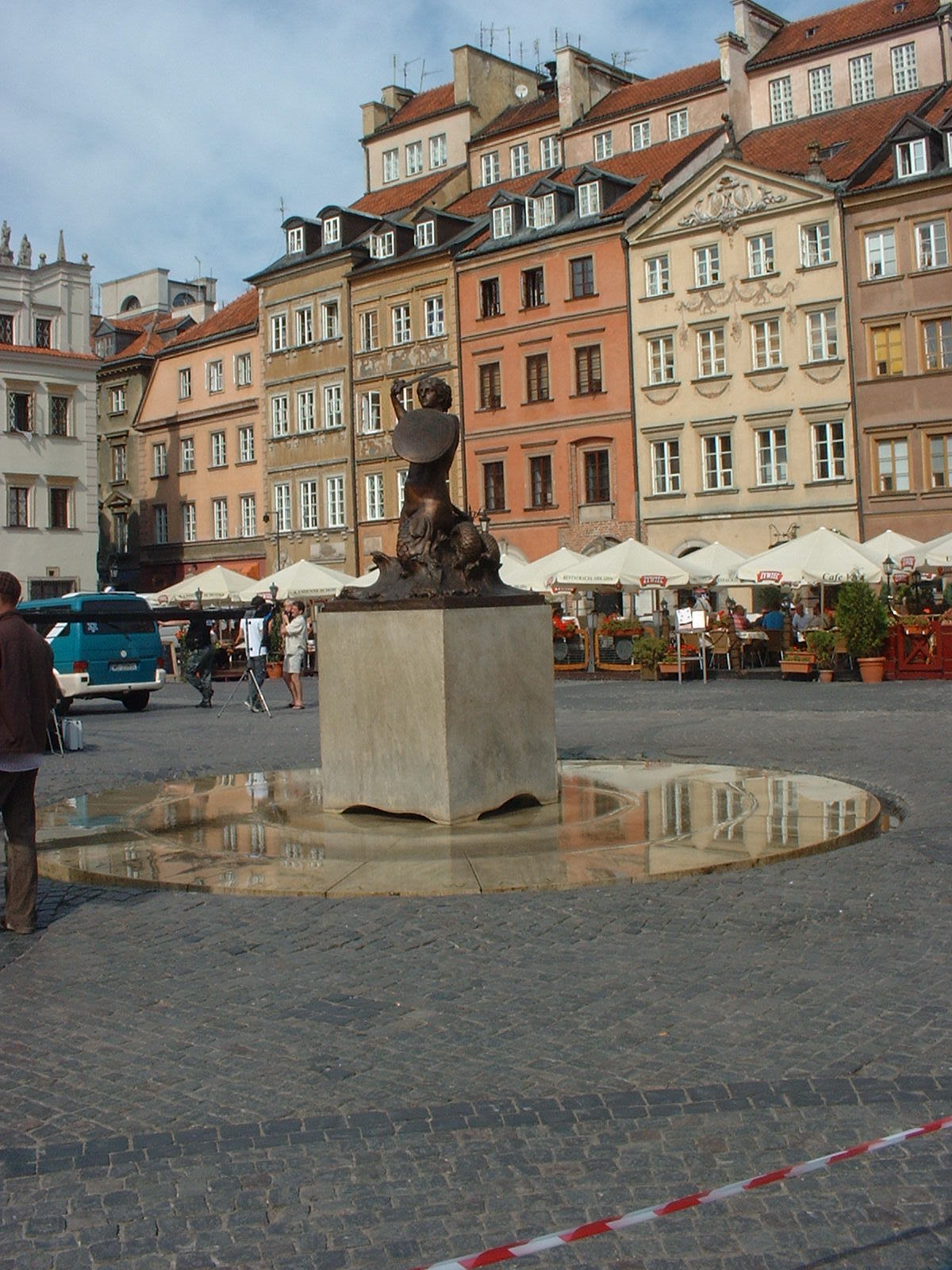
I was beguiled by Rynek Starego Miasta, Old Market Square, smaller and bustling, with Syrena, the mermaid statue, at its heart.  The buildings are beautifully patterned.  No.42, the Historical Museum of Warsaw, is where you can follow the entire story of the city’s heroic rebirth.  In Summer artists stalls and florists thrive in the space.  A circuit of the charismatic narrow streets will bring you to Ulica Podwale, where a bronze statue of a small boy in a gigantic helmet symbolises the children who fought alongside their parents in the Warsaw Ghetto.

Syrena, the mermaid, in Rynek Starego Miasta

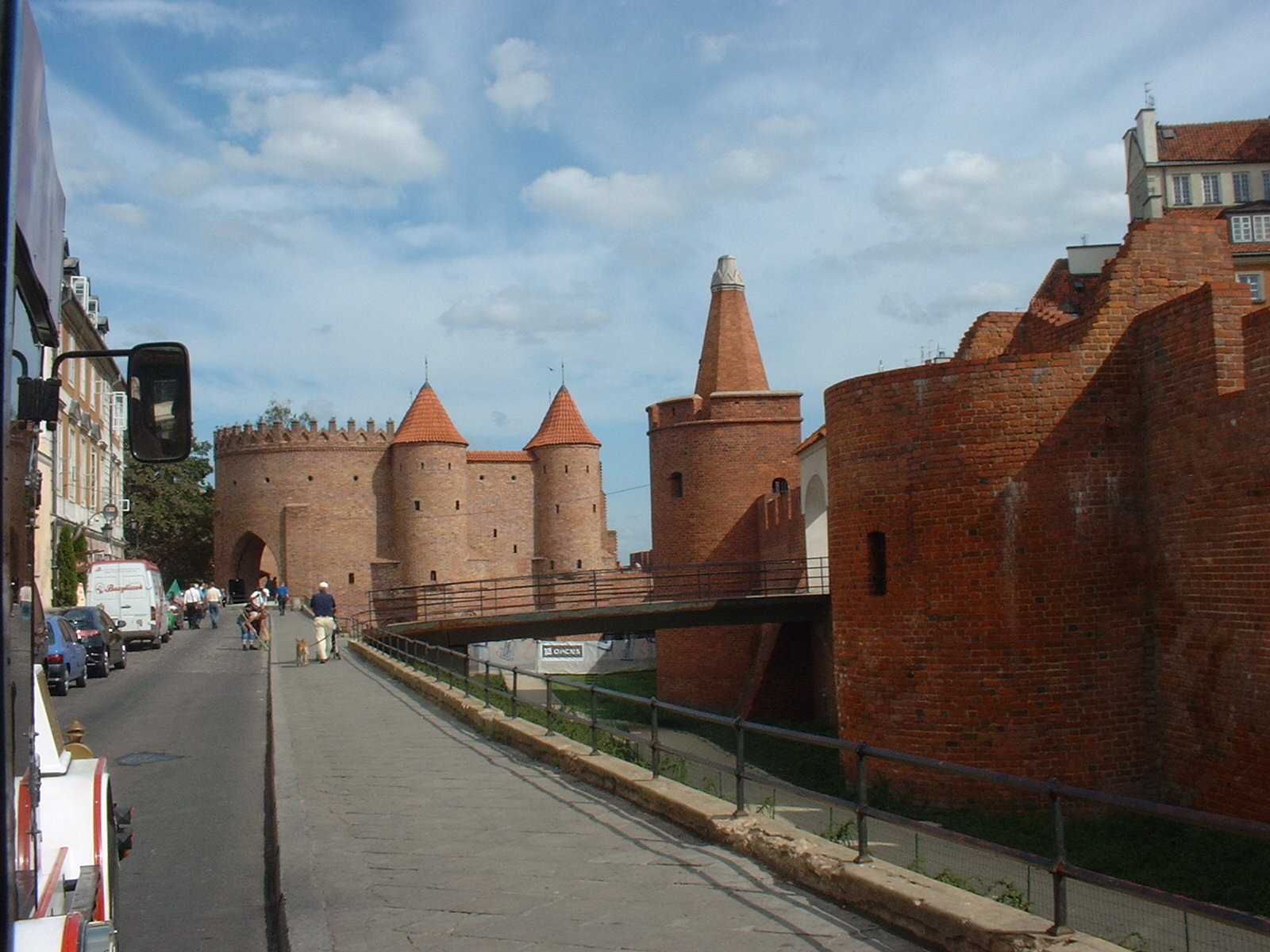
The defensive walls of the Barbican lead back to Plac Zamkovy.  A final treat before leaving the square is to climb to the observation tower in St Anne’s Church, which amazingly withstood the surrounding devastation.  The views out across the Old Town and the river provide wonderful photographic opportunities.

The Barbican

River view from St Anne’s roof

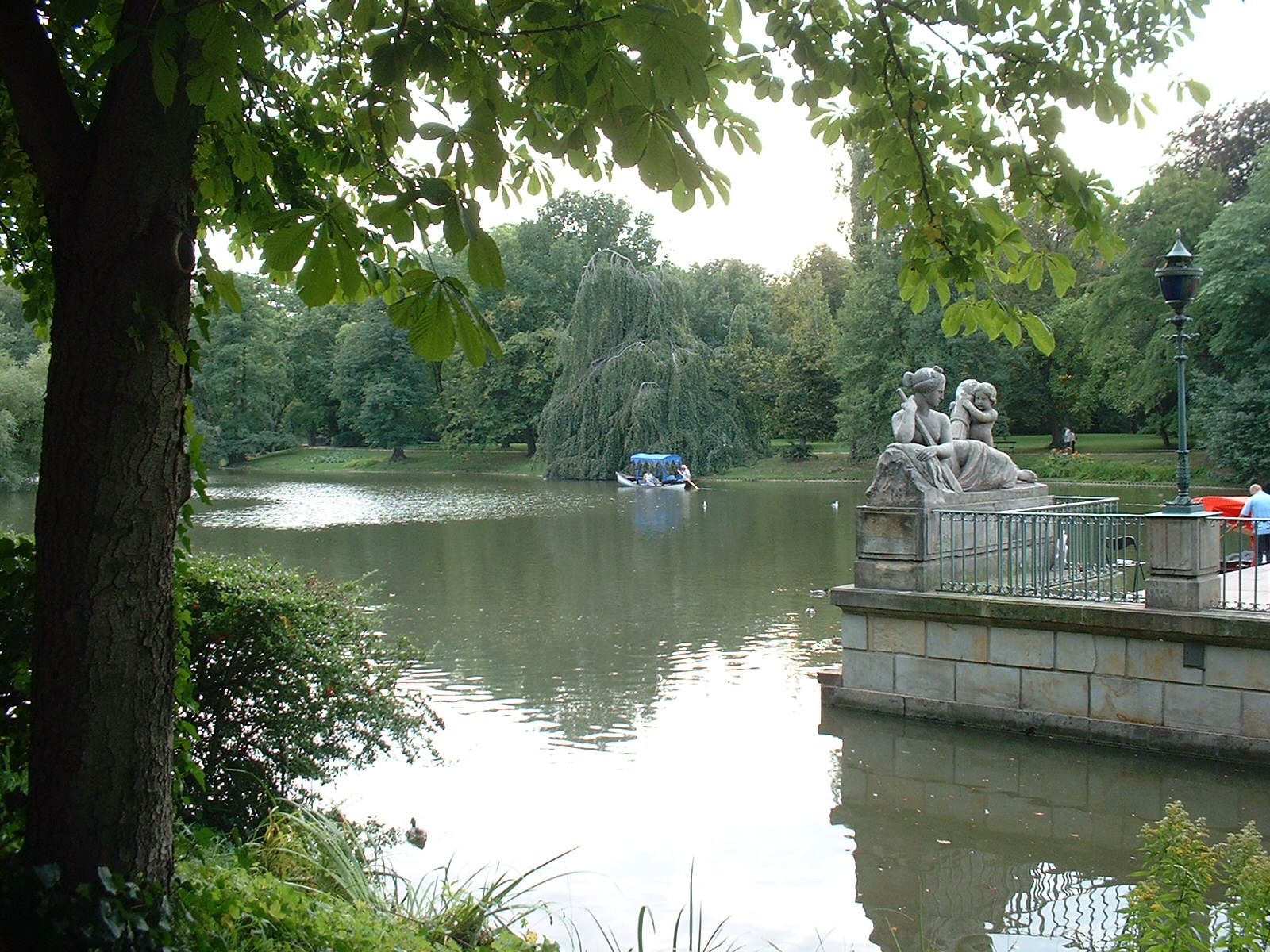
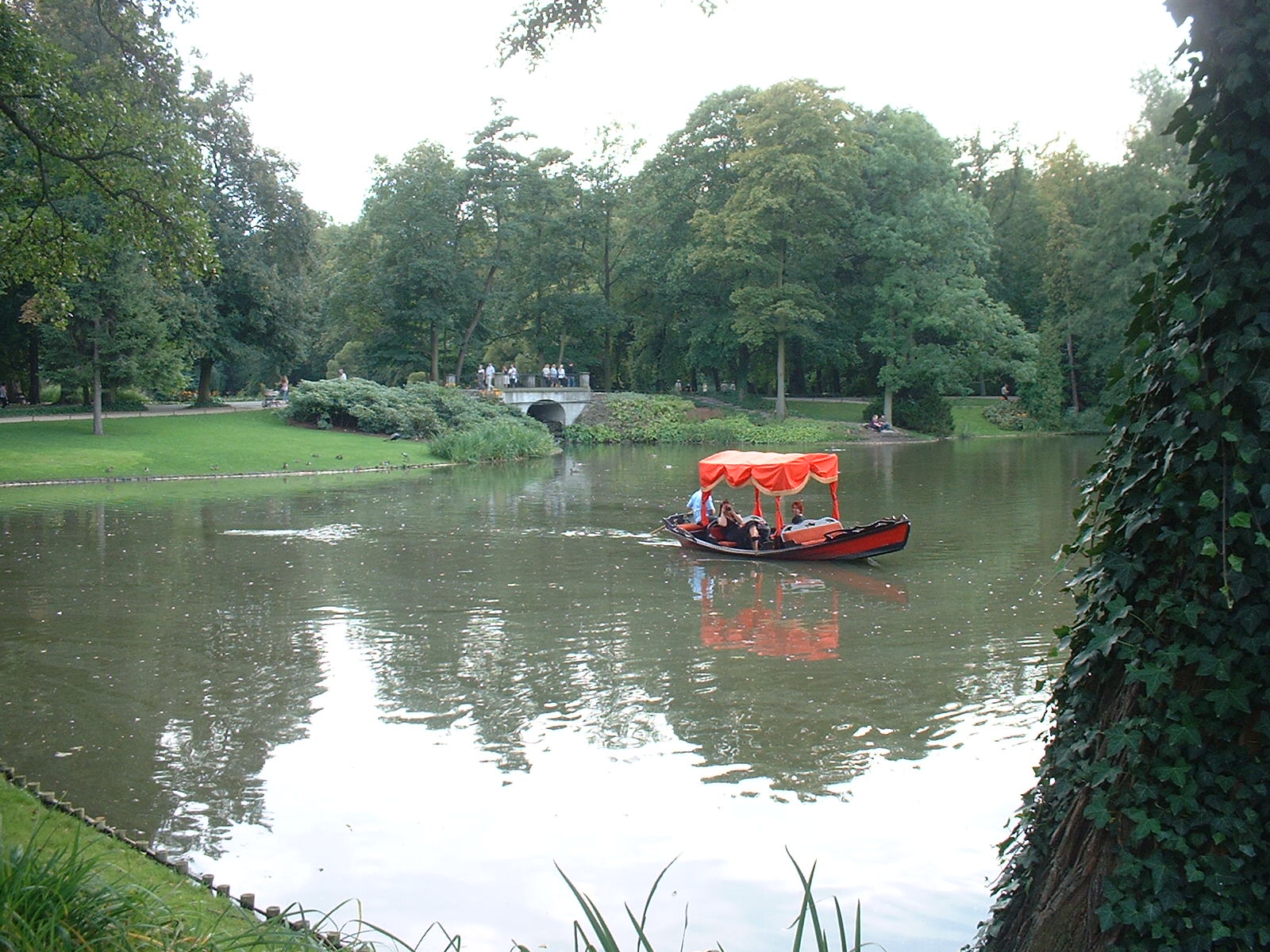
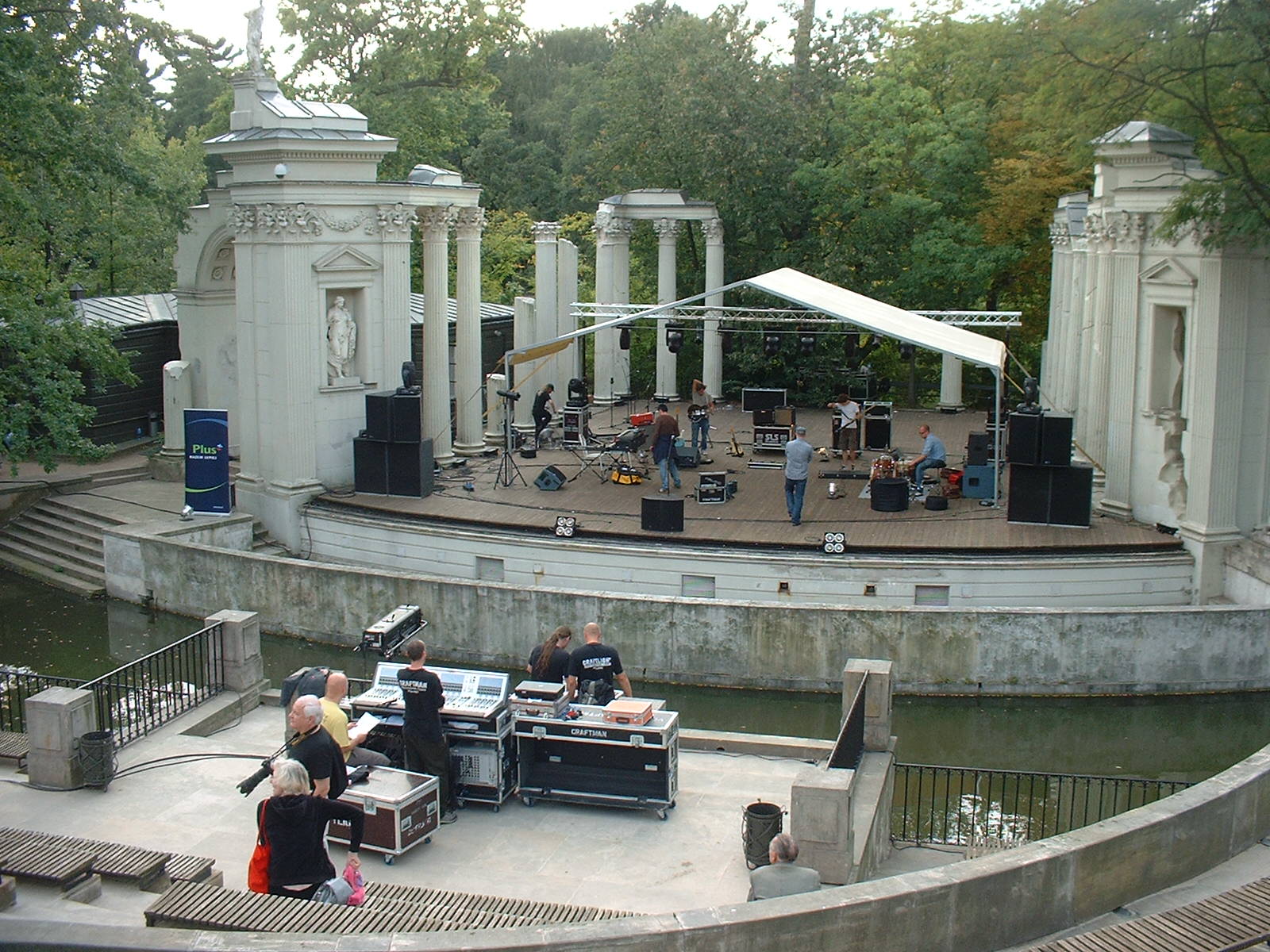
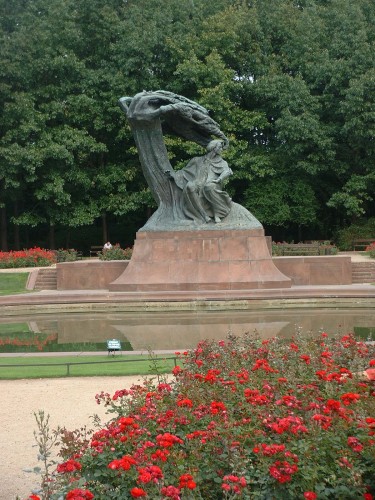
Krakowskie Przedmiescie is the start of the 4km Royal Way and an elegant stroll to Łazienki Palace.  My husband designs gardens for a living and I was sure that he would be impressed by these.  Dad was tiring and we hopped a 180 bus directly to the palace gates.  Not far inside Dad was delighted to find an open air café where he could relax with herbata (tea) while we explored.  The palace was the Summer residence of Poland’s last monarch, King Stanislaw Poniatowski, and the park was awash with canals, pavilions and statuary.  We shared the green space with nimble red squirrels and gracious peacocks.  On Sunday afternoons in Summer, the Chopin Monument is a concert venue to showcase the composer, but we were surprised to find a rock band tuning up in a handsome stone amphitheatre.

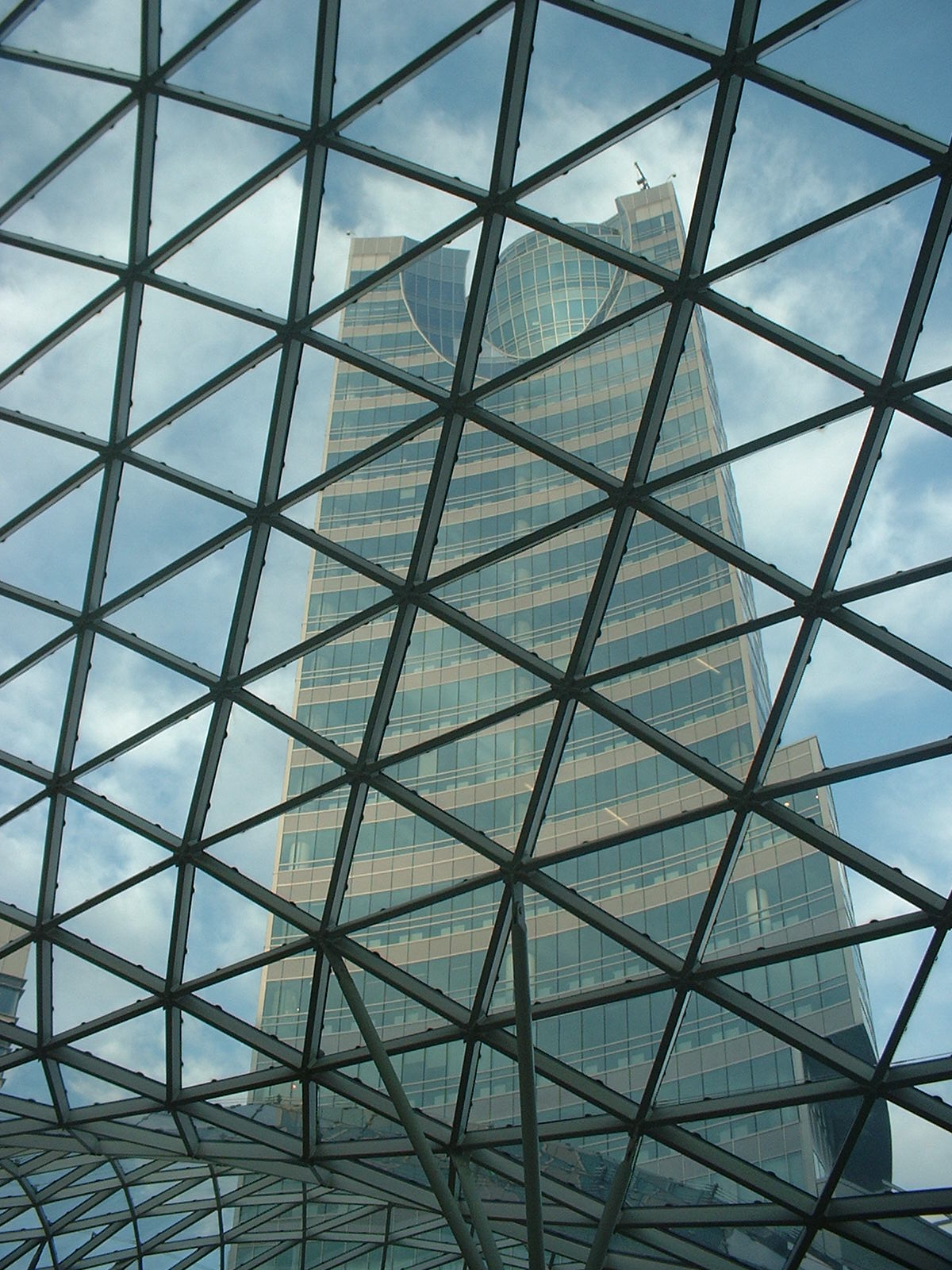
Time was beginning to run out on us and we gratefully languished in a taxi back to the centre.  We rejoined the rest of the family and ate in the striking glass shopping complex, Złote Tarasy, close to the station.  I had the strong impression that this could be a shopper’s paradise.  I left Warsaw with the happy conviction that there was much more to see and do, after a totally memorable day.

Złote Tarasy

I should mention that I travelled to Warsaw by express train from Kraków, in the company of my step-brother Tony, wife Carole and step-sister Lynne, who had travelled all the way from Canada with husband George, so it was quite a family affair.

More of my Polish adventures can be found by clicking on the Polish eagle banner at the top of this post, and in the sidebar.  You can join in with Julie Dawn Fox’s Personal A-Z challenge from the link or the logo below.  And if you want a different take on life, Frizz at Flickr Comments welcomes all comers on his A-Z challenge too.

banner4

A is for Alphabet, and also for Aunts

The Polish alphabet (alfabet polski) has 32 letters:

 a  ą  b  c  ć  d  e  ę  f  g  h  i  j  k  l  ł  m 

n  ń  o  ó  p  r  s  ś  t  u  w  y  z  ź  ż

plus these sounds represented by 2 letters

ch  cz  dz  dź  dż  rz sz   

A bit tricky looking, isn’t it?  It has most of the letters of the English alphabet and a few extras with tails, dots or slashes.  Q ,V and X are not used in Polish except in foreign words or as symbols.  And don’t be fooled- even the letters that look like our good old English ones don’t necessarily sound the same, i.e ‘c’ has a ‘ts’ sound and ‘w’ is pronounced ‘v’.

And then the fun begins- speaking the language.  The pronunciation is half the battle, and I’m still in heavily armed combat.  The BBC has an excellent website if you fancy having a play around. http://www.bbc.co.uk/languages/polish/soap/alphabet.shtml

My story starts with an Aunt

Aunt Anna

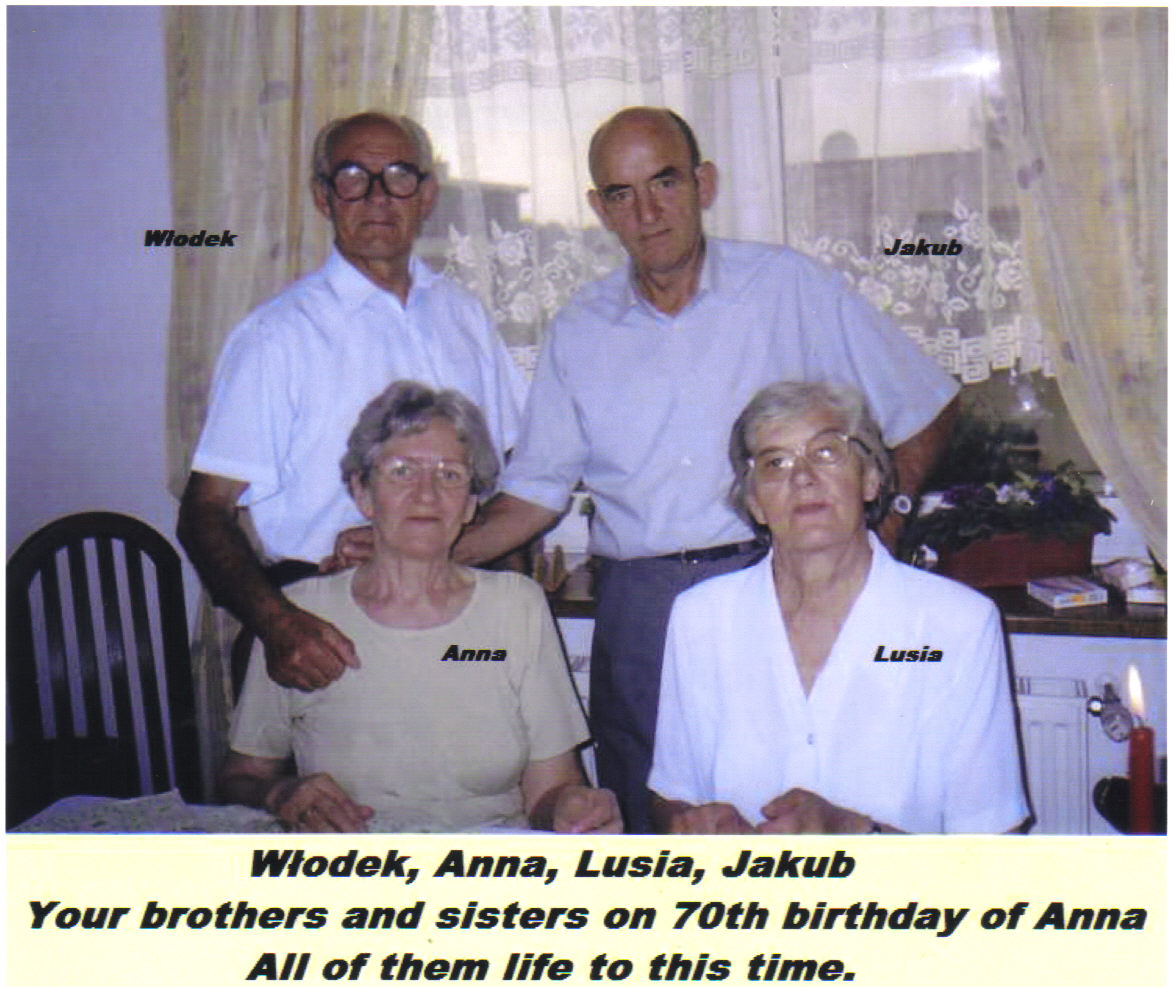
When I first looked at her photograph, 5 years ago this month, I felt a jolt of recognition.  It was not unlike looking at myself in the mirror, but maybe a few years down the line.  I was already 57 but had never met her- had not even known that she was still alive.  But it was due to her persistence, and refusal to believe that my Dad was dead, that we finally came together as a family.

Aunt Anna- I was named for her.  I have a huge lump in my throat writing this as she died on 25.11.09.  All those years of waiting and then so little time together- but we made it count.  My lasting memories of her: regally enthroned at the table at the Hotel Wierzynek, looking every inch the Polish Royalty for which this hotel was designed; more simply pottering about at home, setting the table for food and chattering, chattering.  Her hands were often painful but she used them expressively.  I was so new in the language that it was all I could do to nod dumbly and smile.

Dad, Anna and me

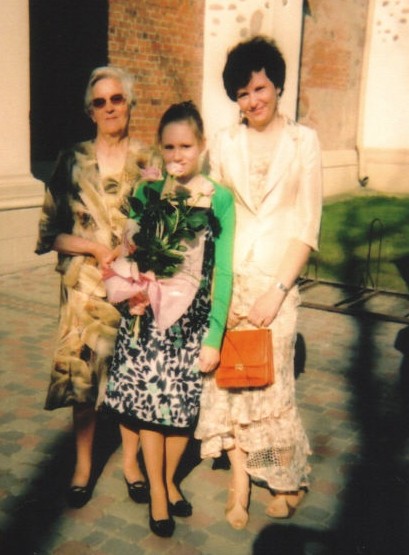
Dad, Anna and her son Adam, at home

Dad, Aunt Anna and grandson Lukasz, Hotel Wierzynek

Ciotka Anna (Aunt Anna) was bound to steal the show, but I have another surviving aunt.  Ciotka Lusia (given name Otylia but always known to me as Lusia) lives in a beautifully modernised bungalow on part of the farm land originally owned by my grandfather.  He and my grandmother had terribly hard lives and thinking about them makes my Dad sad.  I never met them as he was taken from the farm by Germans at just 15 and never saw them again.

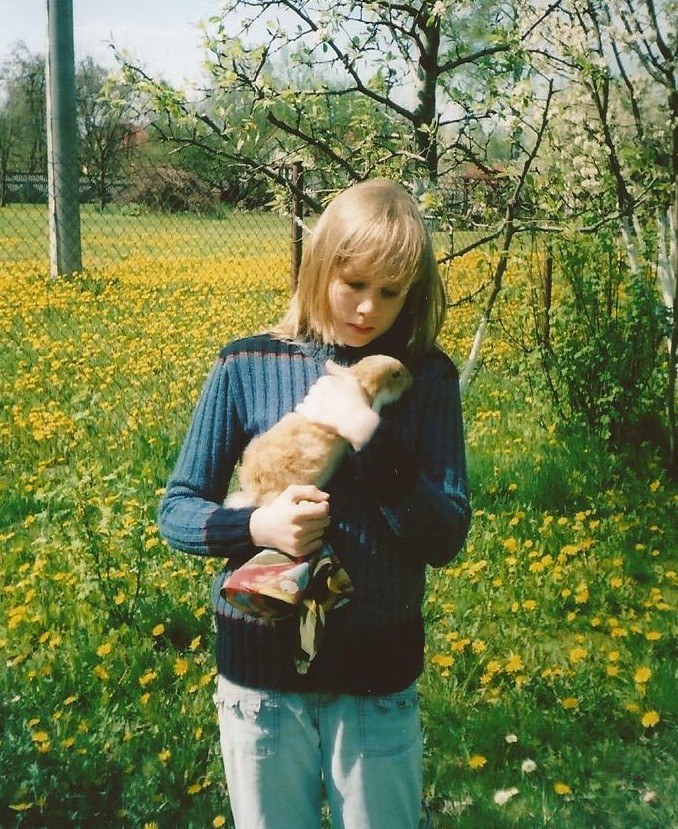
Ciotka Lusia is a joy.  Always close to the land, she has a huge plot which until quite recently she managed to cultivate, growing all her own vegetables.  Ciotka Lusia’s potatoes are legendary!  Her daughter Teresa and granddaughter Edyta live with her and help to share the work.  Edyta is a beautiful teenager now but when we first met she was a shy child, cuddling her rabbits.

Dad and Aunt Lusia in her garden

Aunt Lusia, Teresa and Edyta

Edyta with one of the many rabbits

Some of the original farm is intact but much of the land has been divided between the children and lovely family homes built on it.  No doubt they will be the subject of a later post- it’s a big story.  For now I need to conclude with the fact of my other aunts, Urszula, Krysia and Sabina, all of whom died before Dad could be reunited with them.  So many family photos I have looked at.

The whole of Dad’s story (in brief) is told here:  https://restlessjo.wordpress.com/2011/10/24/exploring-the-polish-connection/

My personal A -Z of Poland

My personal A-Z of Poland

There are folks out there who’ll think I’m greedy, or just a glutton for punishment- I’m not sure which?  Couldn’t help myself, I just had to raise a hand in the air and shout “me, me!” when the prospect of a personal A-Z of Poland came along, even though I had already committed to a Portuguese A-Z.

You see, the Polish journey for me is a relatively new and very special one.  It’s just 5 years ago this month that I discovered that I had any Polish family at all, apart from my Dad, but I’ve since acquired loads!  I have already written about this in https://restlessjo.wordpress.com/2011/10/24/exploring-the-polish-connection/ and it is for me a very emotional subject.  It would be a privilege to share a little of what I have learned about Poland, and my wonderful Polish family, here in these pages.

I wasn’t encouraged to learn the Polish language as a child- Dad was busy integrating into the English community.  I have sincerely regretted my own lack of application since then, and have struggled mightily to be able to communicate with older family members.  The youth are great, and go out of their way to speak English to me.  So, a few Polish phrases may slip in now and then, but I will be writing in English, sadly.

I’m itching to get started, but first must give credit to Julie Dawn Fox, who developed the original idea of “A personal A-Z of…” with her post on Portugal  http://juliedawnfox.com/2012/01/10/a-personal-a-z-of-portugal/

In the spirit of this challenge I’d be more than happy for bloggers out there to write their own A-Z, in English, Polish or whatever your native language is.

Can’t wait to post this then I can move on to “A is for…”  See you soon!

My A – Z of Travel

Life’s good sometimes, isn’t it?  I was just recovering from being awarded the ABC Award (Awesome Blog Content) by lovely Alyson Weldrake of http://thethoughtpalette.co.uk/abc-award/, when Lucy Dodsworth, of ontheluce.com, another favourite blog, passed me this challenge.  Well, I have a lot to live up to, but I get to revisit some really happy memories.  Then I pass it on and take time out to read all those other A-Z’s- pure pleasure!  So, here goes:

A : Age at which you went on your first trip abroad:

My Mum’s idea of a holiday was a cottage near Scarborough, so trips abroad didn’t figure in my childhood.  My first ever bid for “freedom” was aged 21, when, quite pregnant with my daughter, I could see the world slipping away from me and booked myself solo on a flight to Paris.  It took me 40+ years to return but I managed to spend my Silver Wedding anniversary in the gardens at Giverny, and Versailles. (my husband is a garden designer, so he was easily persuaded)

B : Best foreign beer you’ve had and where:

Truthfully I’m not much of a one for beer.  Occasionally, after a long hot day, one hits the spot.  You wouldn’t go with one of my recommendations though.
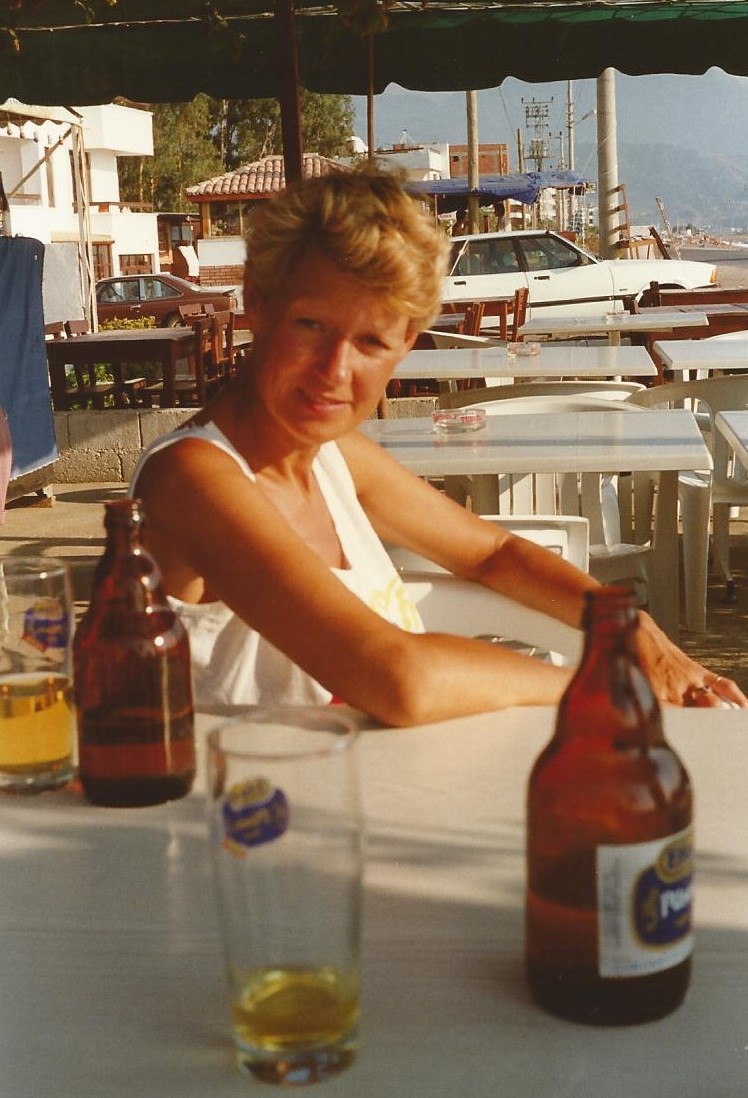
Beer in Turkey

Can’t dispute photographic evidence- Turkish beer?

C : Cuisine : 

Probably Italian, but I’m quite versatile and will try most things.  Could quite easily become vegetarian.  Not sushi please, and never try to make me eat any of those spicy sausage, chourico-types.  Big shout up for Polish pierogi and soups, (my Dad would be proud), and I like a bit of spice.

D : Destinations, favourite, least favourite, and why:

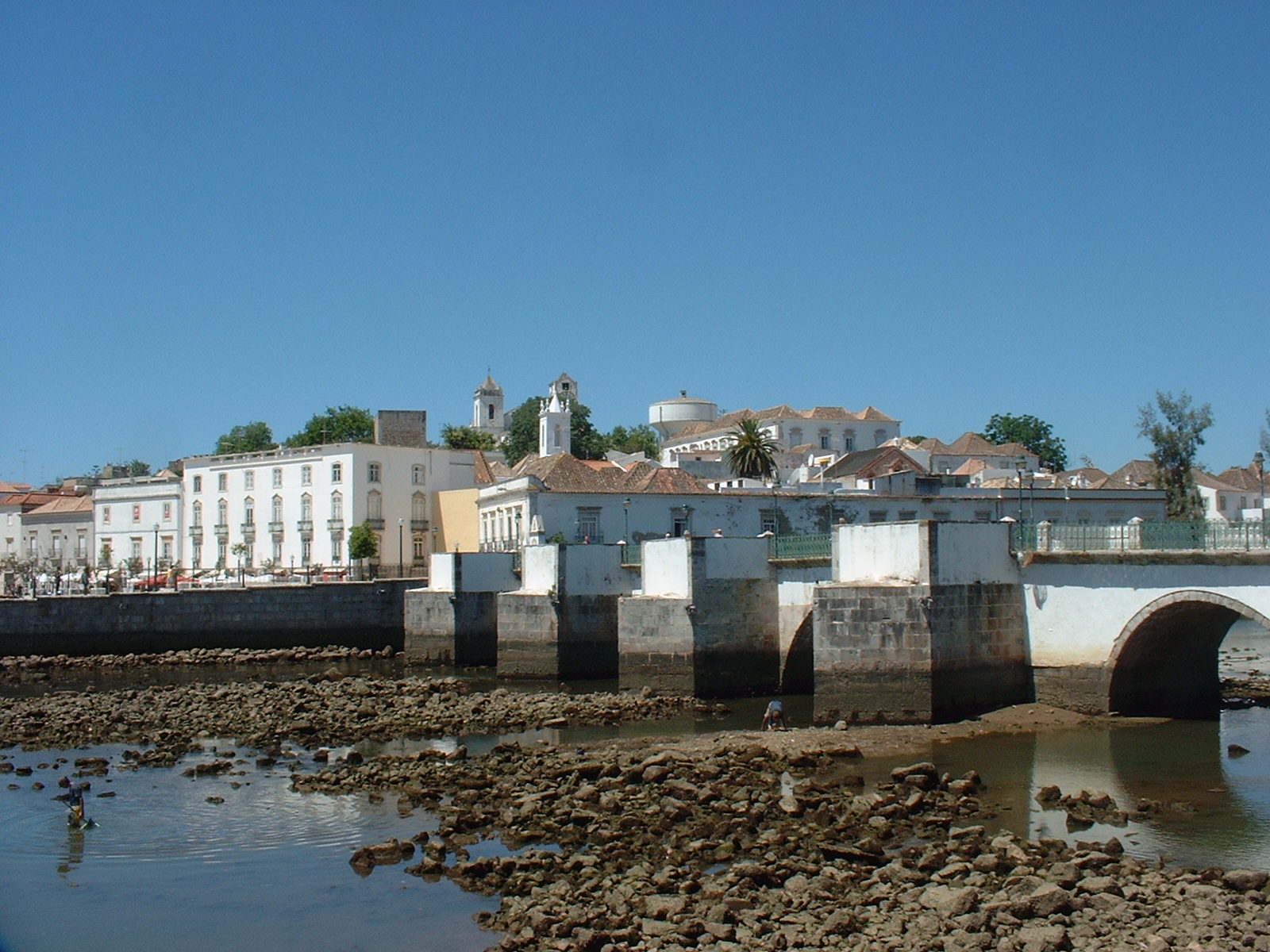
Ponte Romana at Tavira

Anyone who knows me will know that I have a second home in the Algarve and that I am passionate about Portugal as a destination.  For me it has everything, from glorious beaches to stunning sierras, a fascinating history and a wealth of places to explore, many of which I have yet to reach.  Least favourite?  Wouldn’t really want to pin that on anywhere specific, that’s a bit unkind.  I’ll just say that I’m a Scorpio and anywhere that doesn’t have water nearby, I struggle with.  Lakes and mountains are great, but not fussy on flat open spaces.  

E : Event you experienced abroad that made you say “wow”:
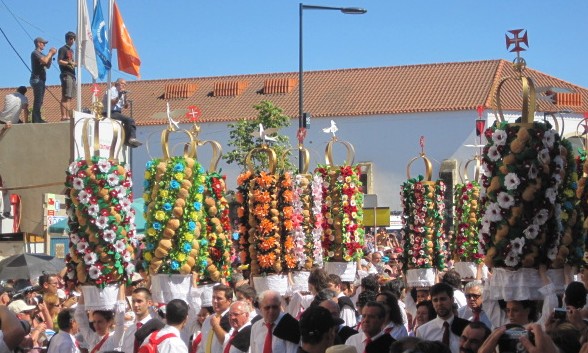
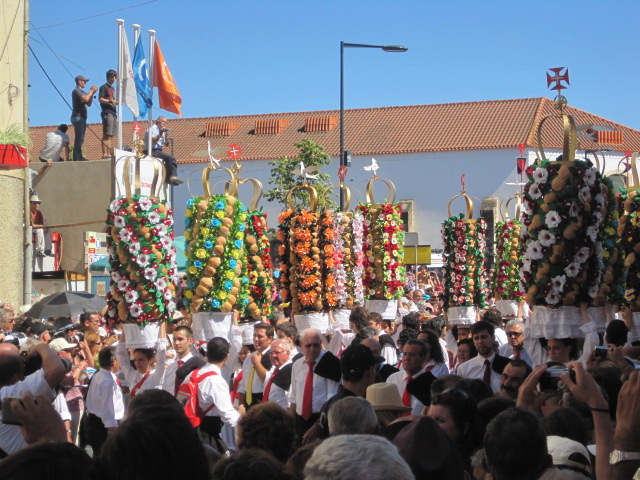
Festa dos Tabuleiros

Festa dos Tabuleiros- the procession

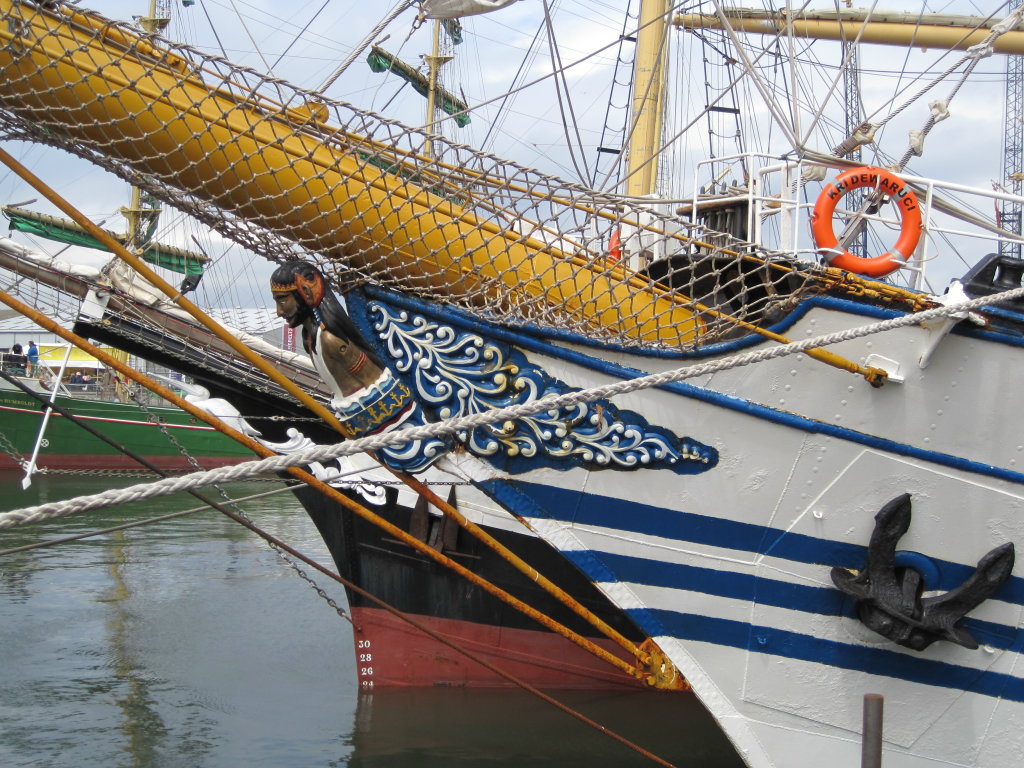
“Wow” in a good way?  The Festa dos Tabuleiros in Tomar last July was pretty special.  The event is only held once every 4 years and when you see the effort that goes into it you can well understand why.  Given my love of boats and water, the Tall Ships Races have great pulling power for me too.  I totally loved having my home town Hartlepool, in North East England, host the final leg last year, and am hoping to make it to Cadiz in July to see them again- breathtaking!
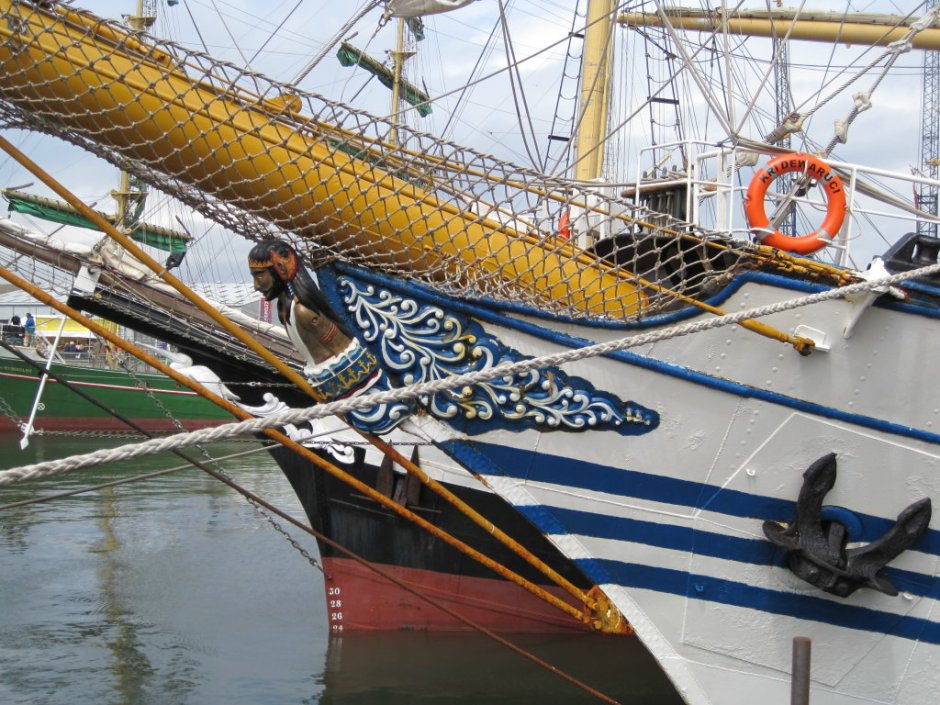
Dewaruci

Dewaruci- one of my Favourite Tall Ships

F : Favourite mode of transportation :

Everyone loves trains.  Me too, but I have to say that I do love flying.  Not the boring waiting about, and the confined space and recycled air on board, but that awesome experience of looking down at my world.  Torture for me is one of those really cloudy flights that you sometimes get- zero visibility.  Nightmare!  Once we start to taxi along the runway I put on my specs and prepare to glue my nose to the window.  (I’m no fun if I haven’t got a window seat)  Love trying to identify which part I’m overflying (stunning views of Porto once) and I always mean to travel with a detailed map on my knee, but usually forget!

G : Greatest feeling while travelling :

Anticipation!  I just love it when I’m heading for somewhere new.
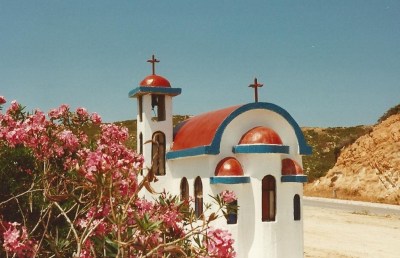
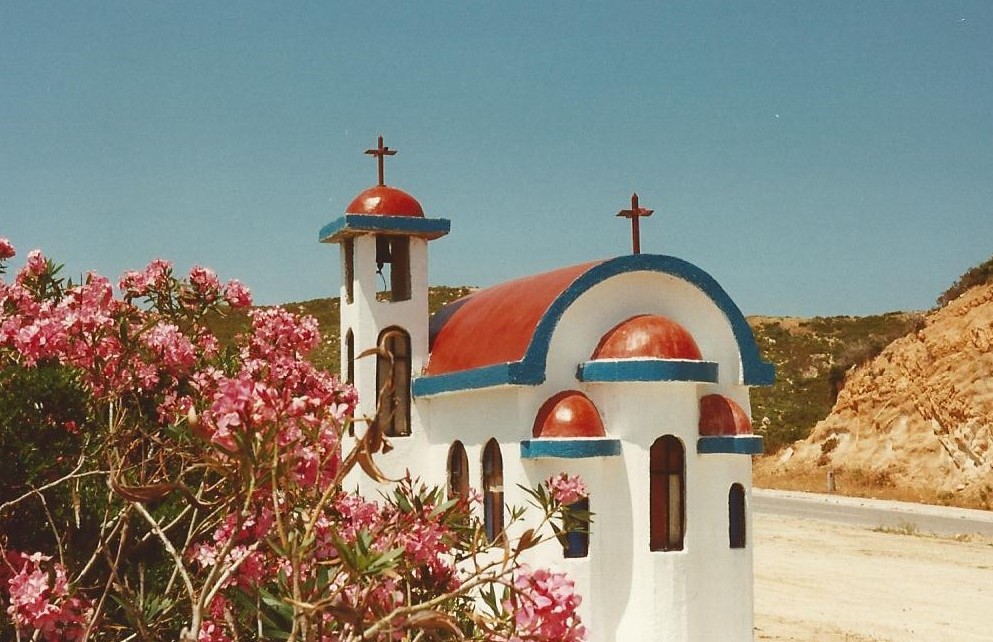
The prettiest little Greek church?

H : Hottest place you’ve travelled to :

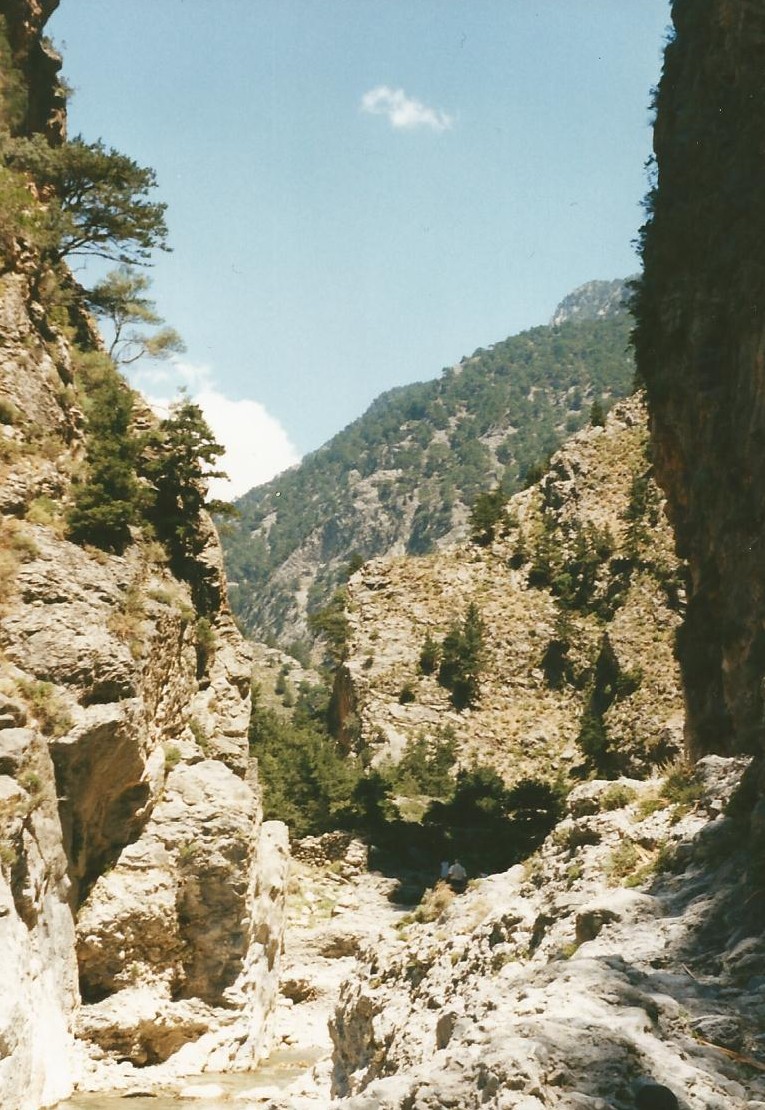
Haven’t been to any of the world’s truly hot places, and most of my experiences have been European but I can remember melting in Venice once (worth it, of course and I’ve been back twice in cooler temperatures).  The Samaria Gorge in Crete wasn’t exactly cool, and I always seemed to toil up to the top of a Greek Island in heat, no matter what time of day I set off!  Terrible planning.

Hot in the Samaria Gorge

I : Incredible service you’ve experienced and why :

I’m going local with this one- local to Tavira, that is!  We have a lovely little riverfront bar, called Anazu.  From the moment we first set foot in there 9 years ago, Paula, her husband and Luis have made us welcome.  There’s always a smile, and an enquiry after the family.  Two glasses of port appear in front of us unsummoned.  The cares of the world just roll away.  We’re home again.

J : Journey that took the longest :

Hmmh, that would be the first trip to America.  We checked into Newcastle airport, only to be told to hang onto our cases as we were being transferred by coach to Manchester.  Strike action was afoot and bodies littered the concourse when we did get there.  Many wearying hours spent at Manchester, we arrived in the States at entirely the wrong time of day to pick up the hire car and head out into the dark with a sketchy bit of paper showing our destination.  “You’re the navigator” said my tired and irritable husband, trying to fathom junctions and overhead signs.  Happy days!

K : Keepsake from your travels :

Postcards for me too (can they be an addiction?) but I am often to be found pocketing shells and stones from some of the lovely beaches I’ve wandered on.  I have a wonderfully creative daughter who endeavoured to use them up by making me jewellery Christmas presents this year.

Shell necklace

Shell necklace

L : Let-down sight, where and why :
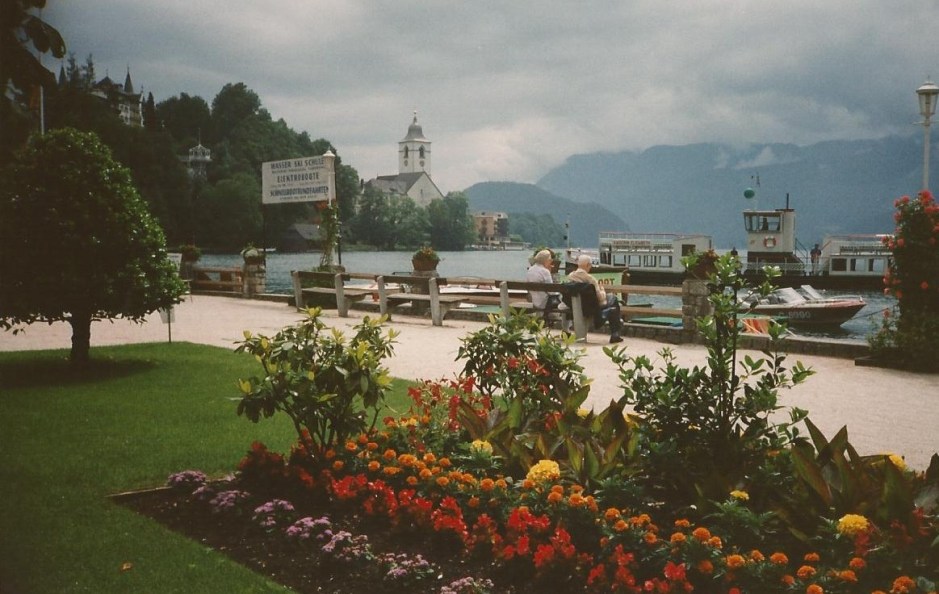
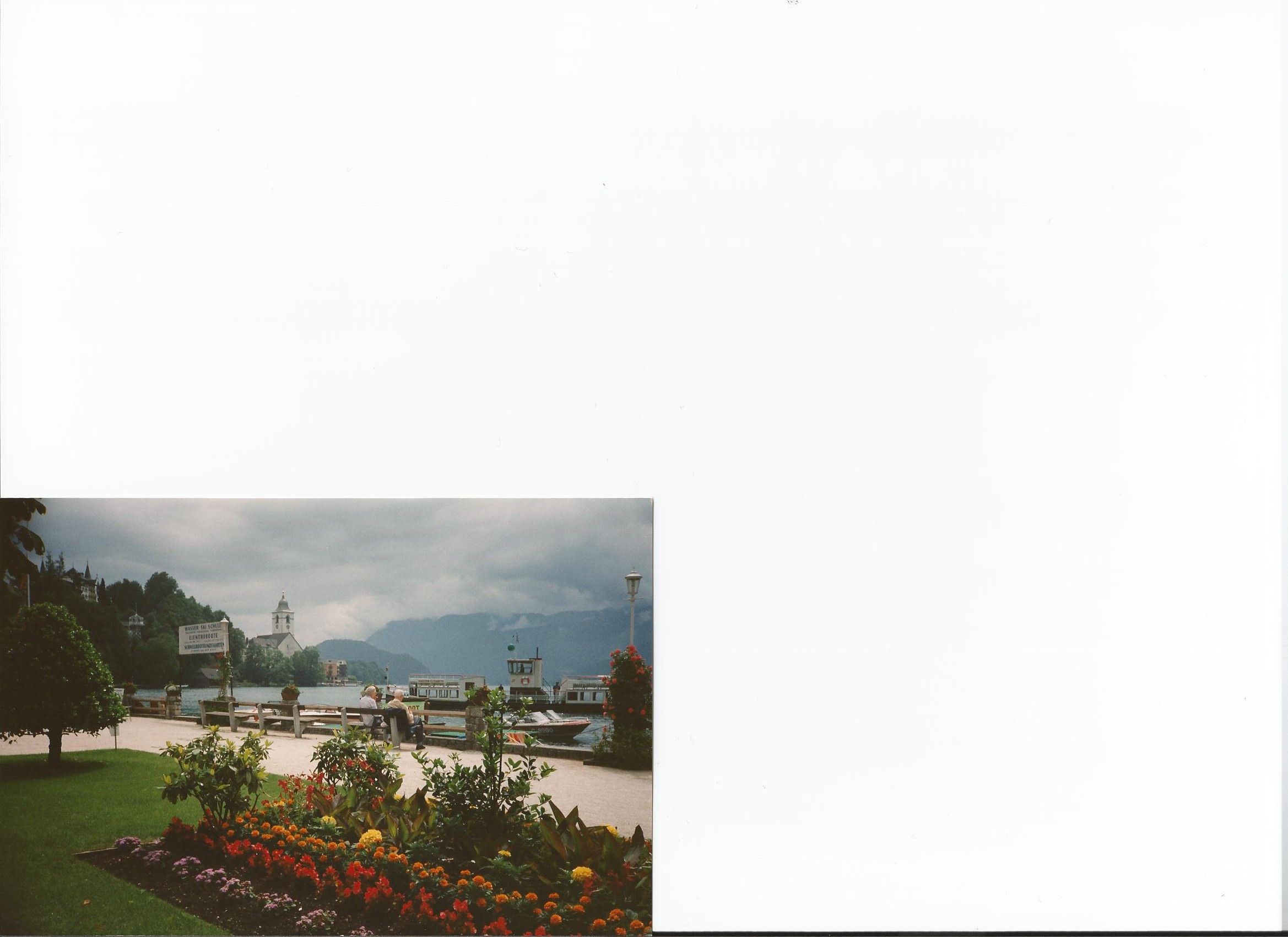
St Wolfgang in the sunshine

St Wolfgang, in the sunshine

It was clear and pleasant when we left the lakeside at St Wolfgang to rack and pinion our way up to the peaks.  Alas, when we got there the promised spectacular mountain views had “disappeared” in thick, cold, Alpine fog.

M : Moment when you fell in love with travel :

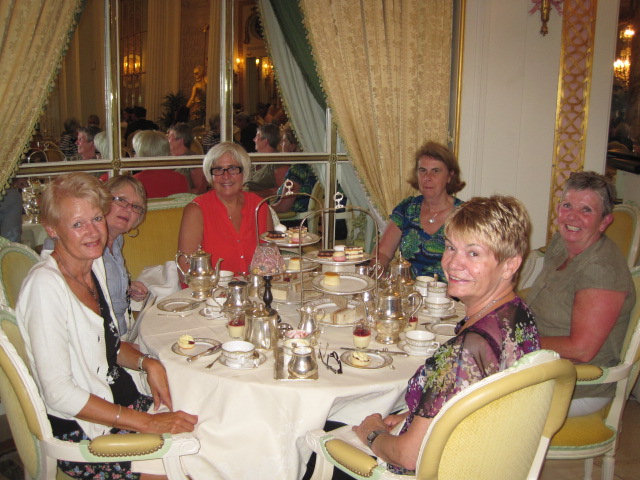
Afraid I’ve always been restless- must be in the genes.  At 18 I left home and friends to live in London and I explored that city to within an inch of its life!  With prescious little money in my pocket, I walked till I couldn’t any more.  Love the city still, though I’m more for the quiet life these days.  My lady friends and I made a celebratory visit there last August (coincided with the riots, of course).  Oh, did we have fun!

Tea at the Ritz

Tea at the Ritz

N  : Nicest hotel you’ve stayed in :

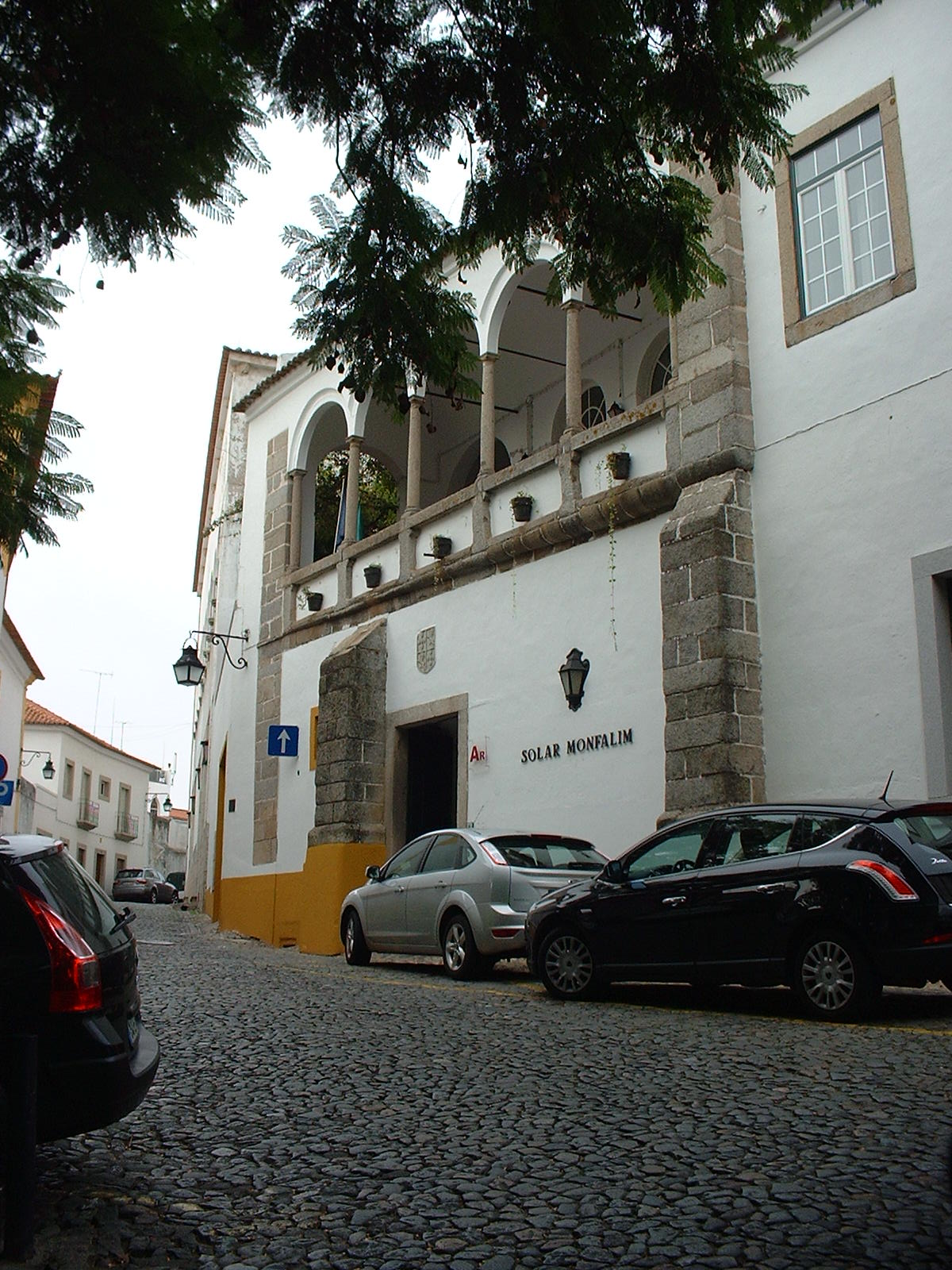
Sadly, don’t do posh hotels in the main.  We usually travel as cheaply as possible.  A couple are memorable; notably Hotel Guadeloupe, which was ideally placed for the Alhambra; Solar de Monfalim in Evora, such a gracious Portuguese mansion in the most atmospheric of cities; and a lovely family-owned small hotel in Bardolino on the shores of Lake Garda, whose name escapes me (it WAS 18years ago, but the pasta was amazing).
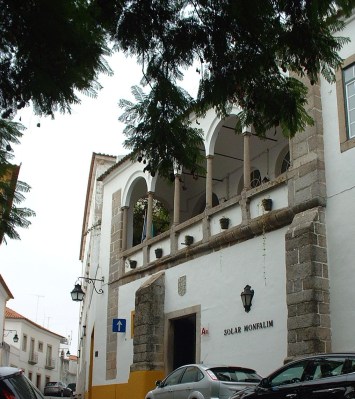
Hotel Solar Monfalim, Evora

O : Obsession : what are you obsessed with taking photos of when you travel :

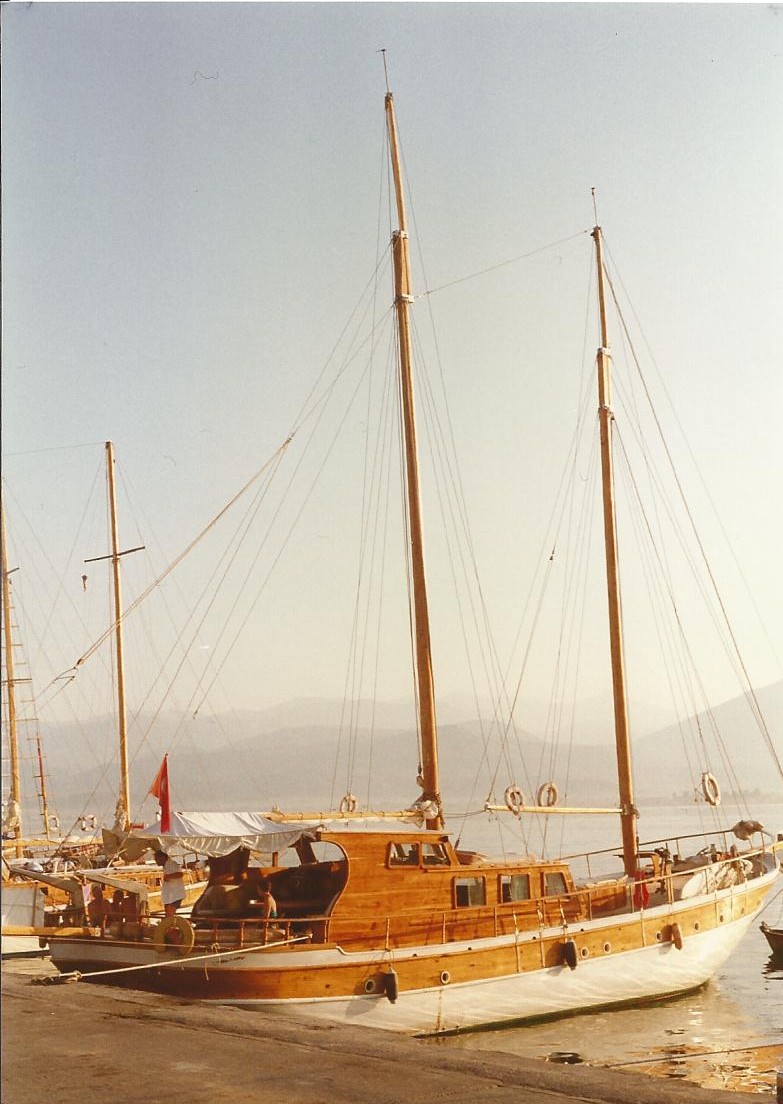
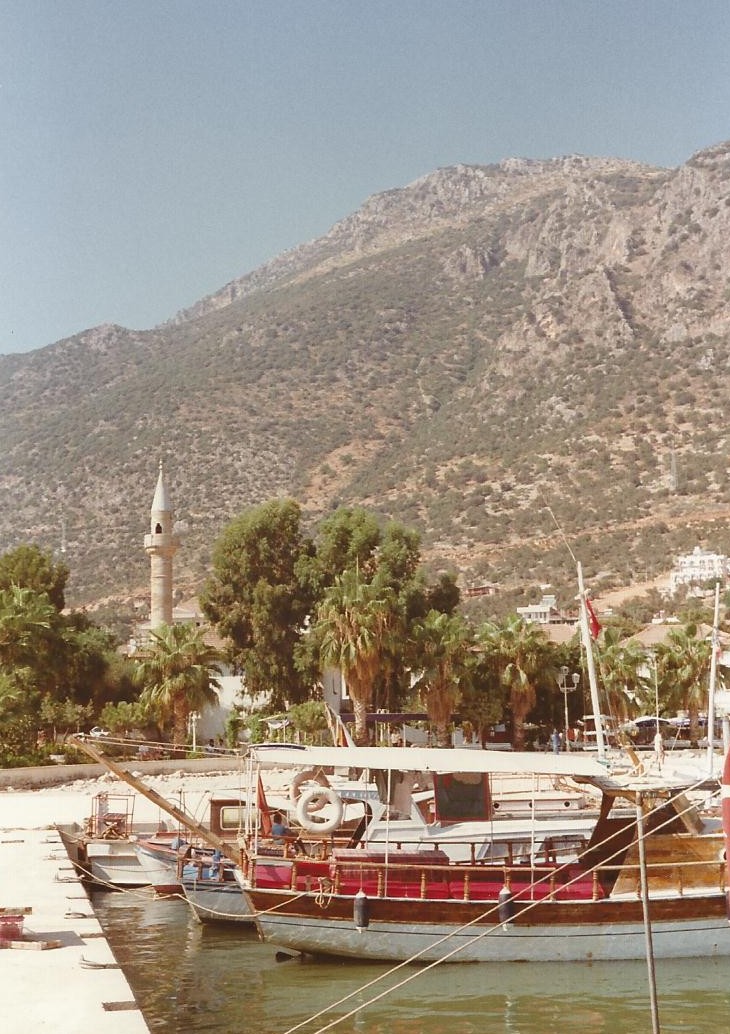
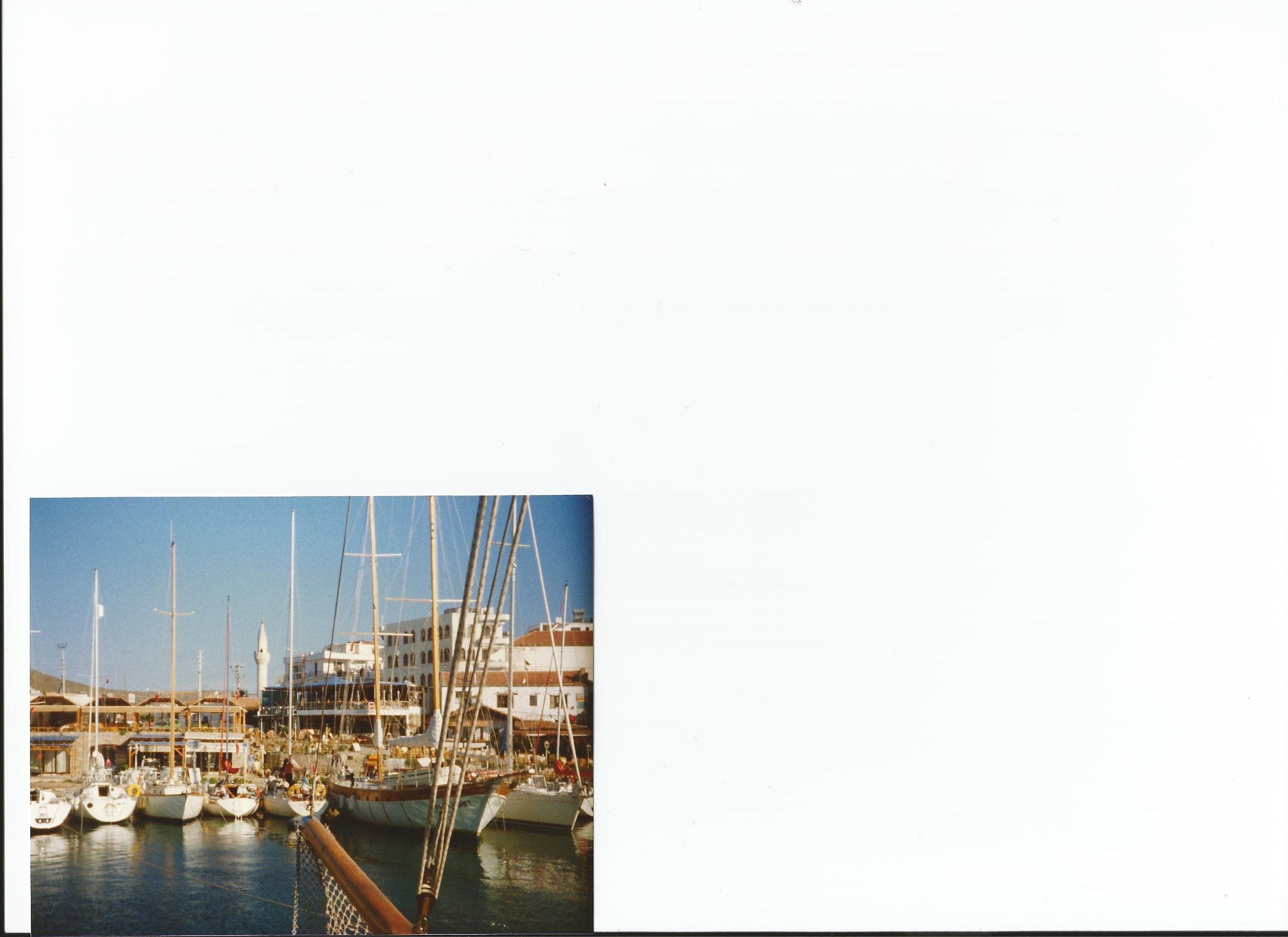
Boats and water mainly:
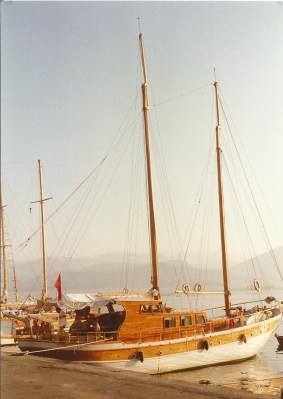
Turkish Gulet
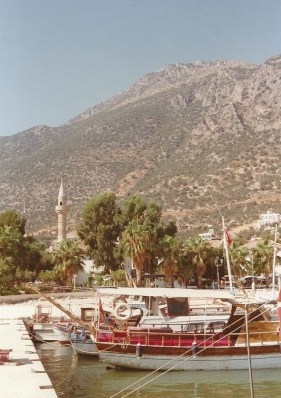
Mooring at Kas
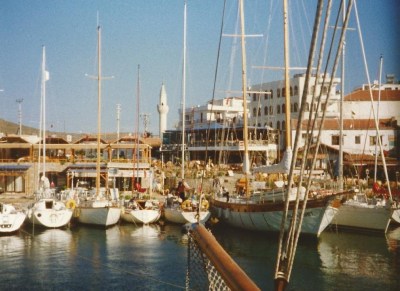
The harbour at Fethiye

Or anything I want to retain as a memory:
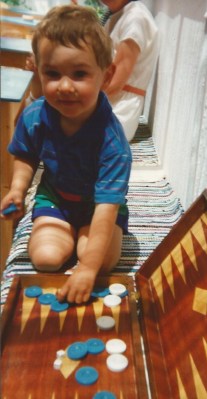
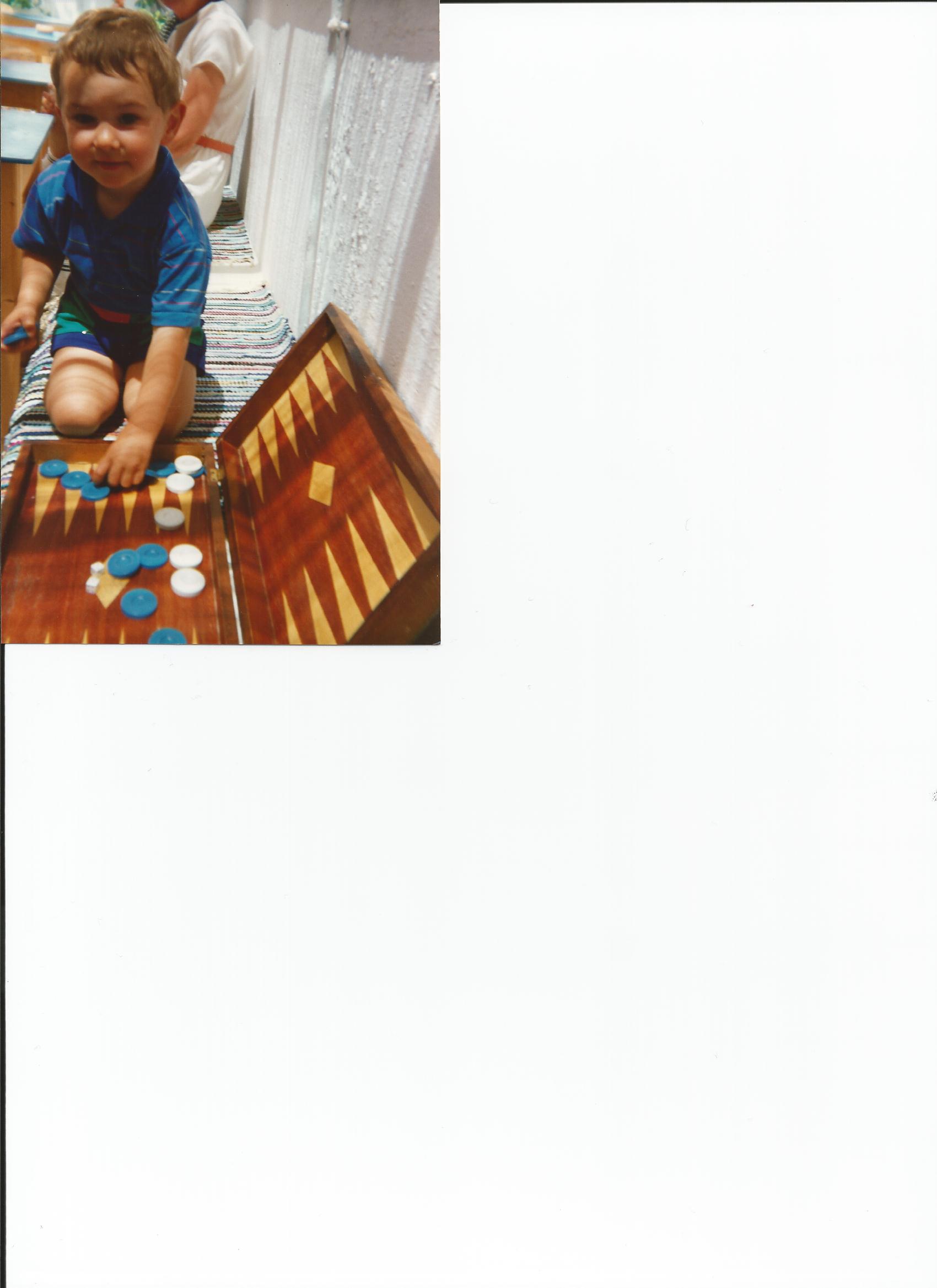
The backgammon ace!

P : Passport stamps, how many and from where :

Not many I don’t suppose, but I’ve visited Austria, Belgium, Canaries, Corfu, Crete, Croatia, Cyclades, Denmark, France, Greek Mainland, Italy, Madeira, Poland, Portugal, Rhodes, Spain, Turkey, the USA, Zante  (alphabetically, of course).  The wish list is huge.

Q : Quirkiest attraction you’ve visited and where :
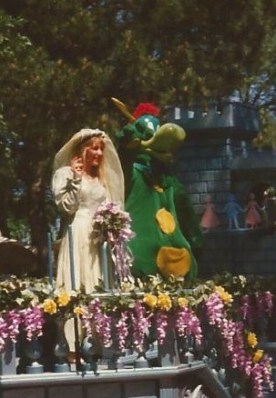
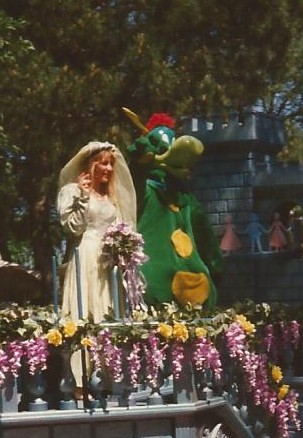
Prezzemolo

Parsley the Dragon

I can remember following a green dragon called Prezzemolo (Parsley) in a procession at Gardaland in Italy many years ago.  The things we’ve done to keep our son amused!  Also in Italy, Il Vittoriale, high above Gardone Riviera, sports a large battleship, Puglia, in it’s gardens.  Definitely landlocked!
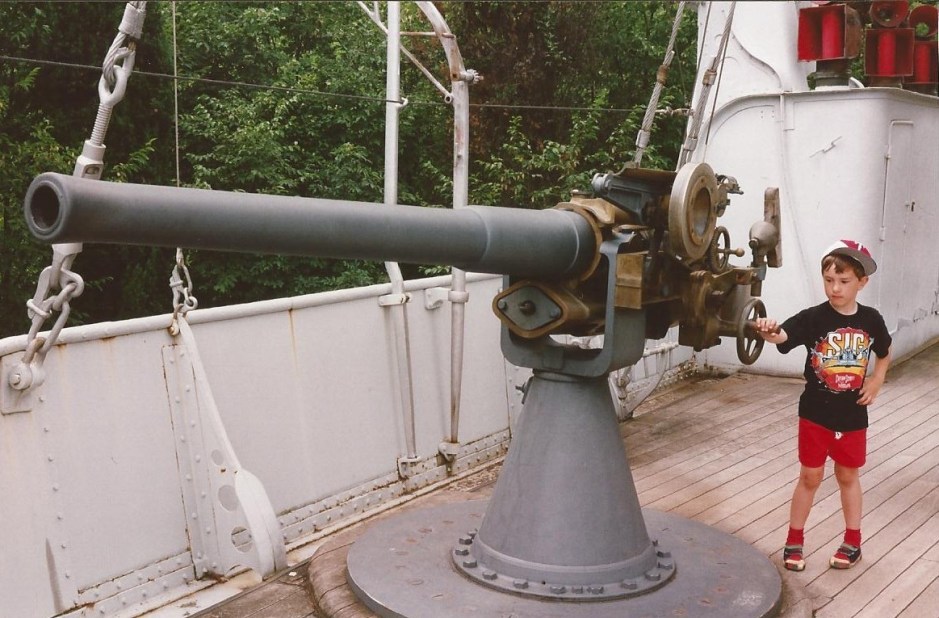
Puglia, Il Vittoriale

Stand by for blast off! On board Puglia

R : Recommended sight, event or experience :
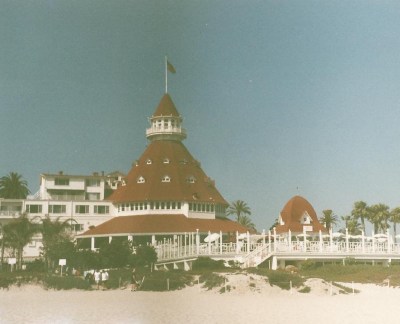
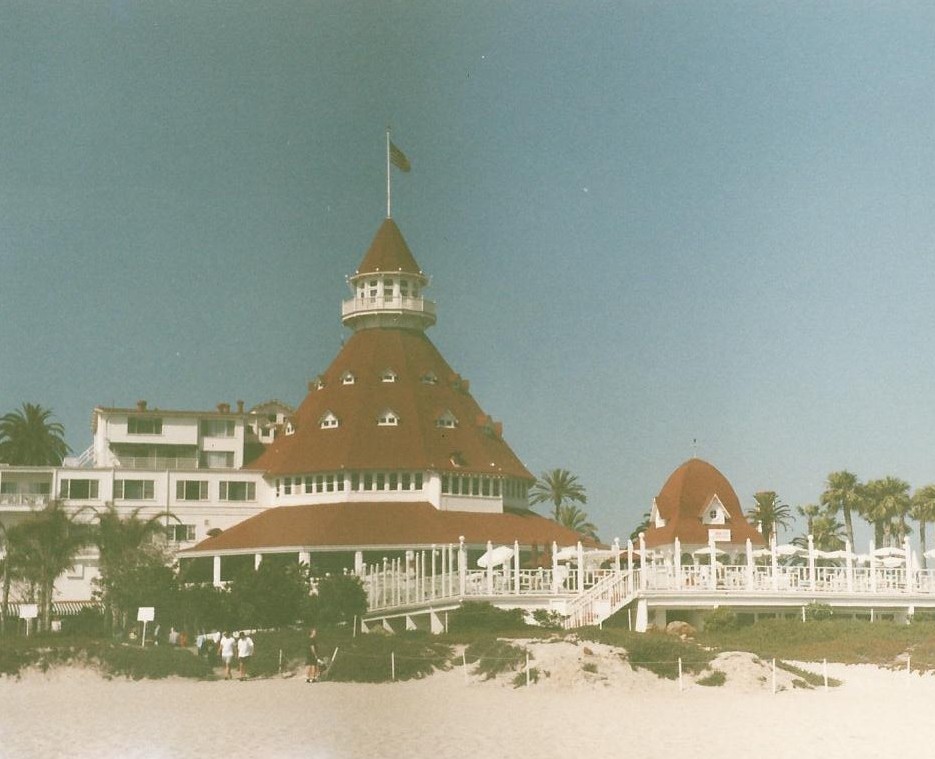
Hotel Coronado

Hotel Coronado-not a great shot,but what a destination!

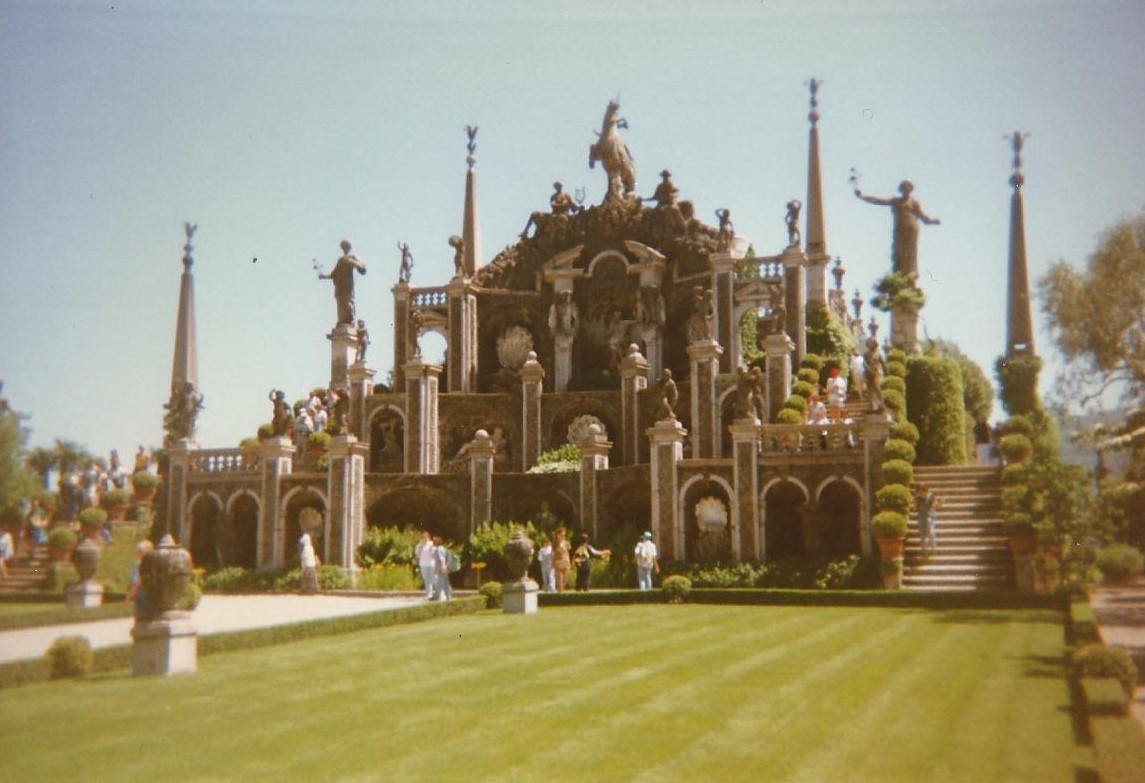
Where do you start?  One that stays with me and I would love to revisit with more time to spare is San Diego Bay.  On the beach by Hotel Coronado I had a Marilyn Monroe moment, and the views out across the water from the restaurants were superb.  Or incredible Isola Bella on Lake Maggiore- water AND gardens, the perfect confection.  So different, but I was also wholeheartedly in love with Warsaw’s Stare Miasto- impossible to believe that so much of it was reconstruction after the Nazis raized it to the ground.
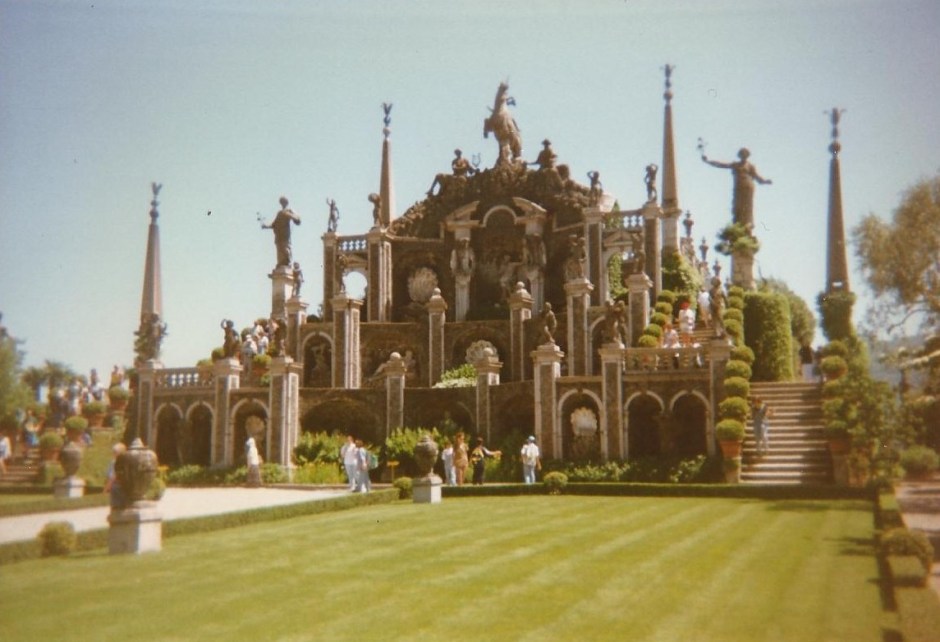
Isola Bela, Lake Maggiore

Stare Miasto, Warsaw

S : Splurge ; something you have no problem forking out money for when travelling :

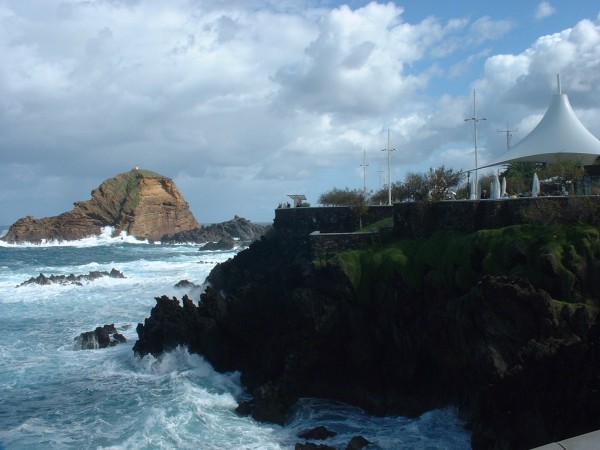
If I can find somewhere with a lovely view I’m happy to sit indefinitely with a glass or two of wine.
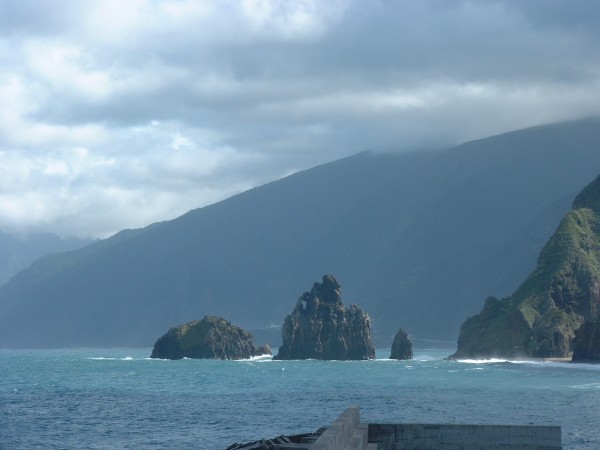
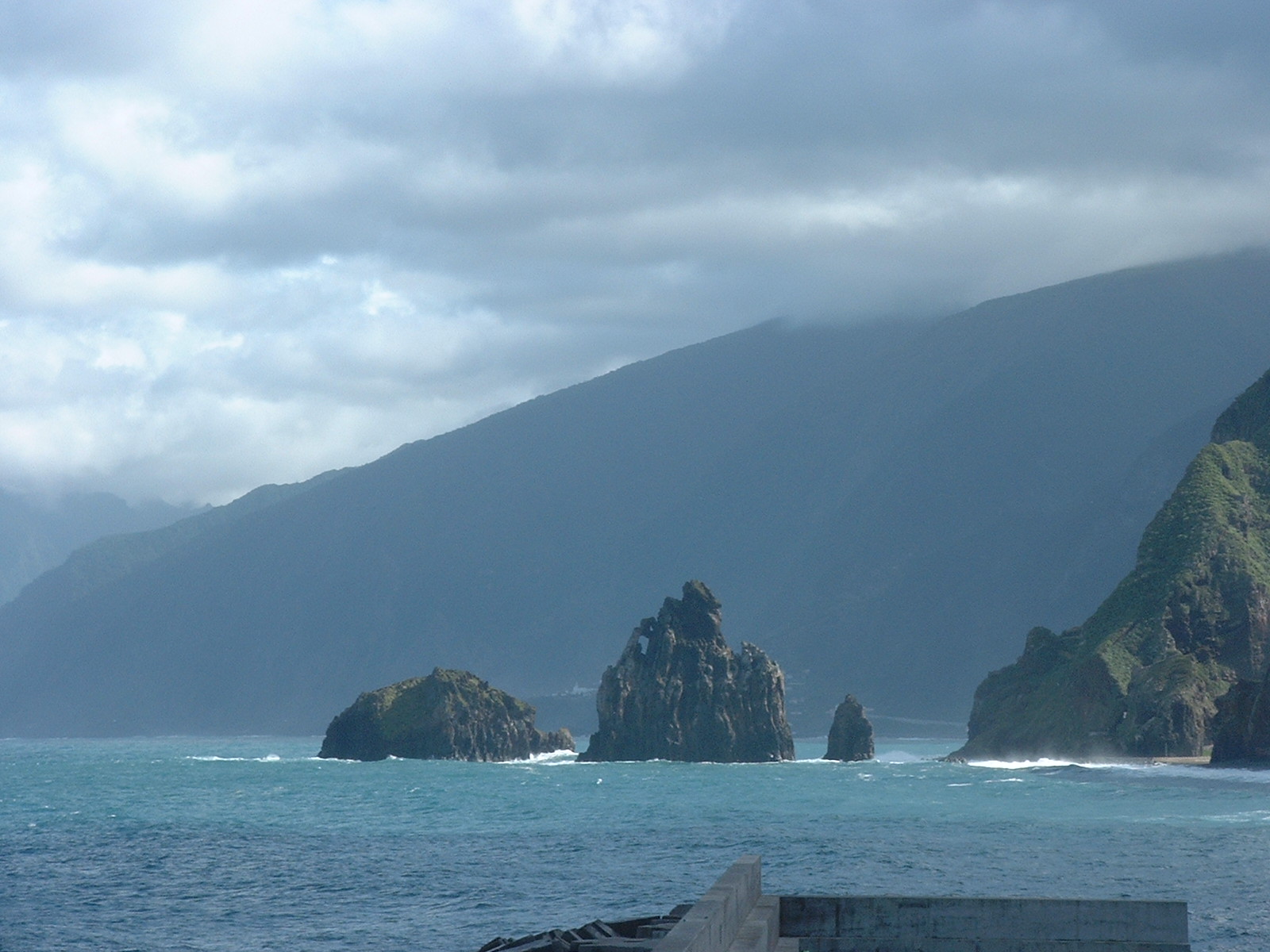
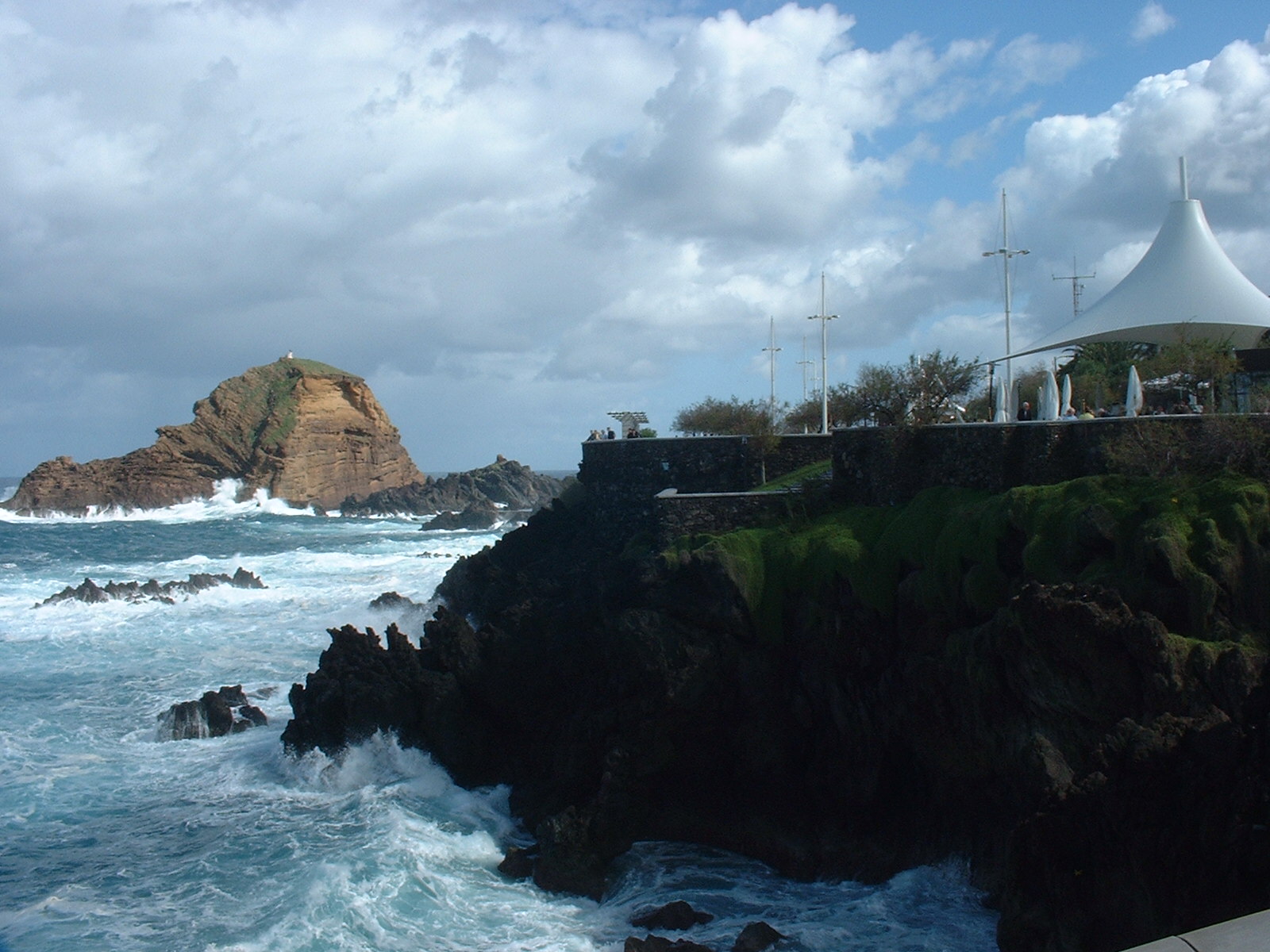
Porto Moniz, Madeira
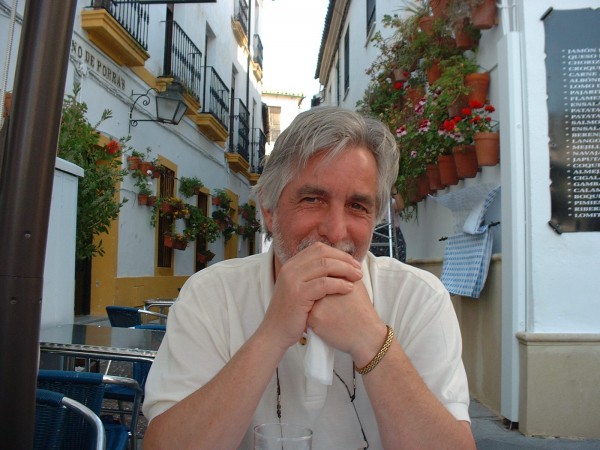
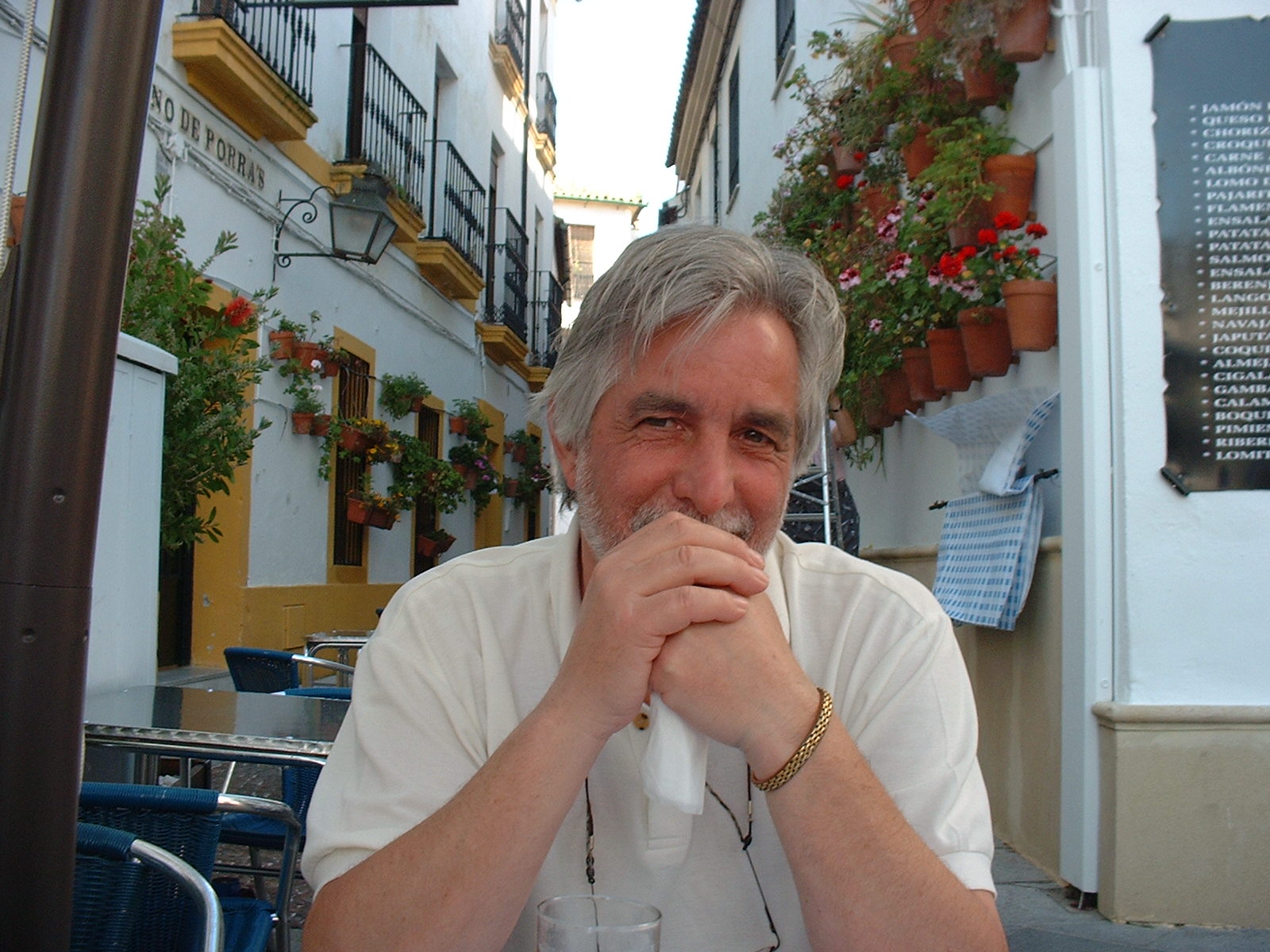
A smiling husband in Cordoba
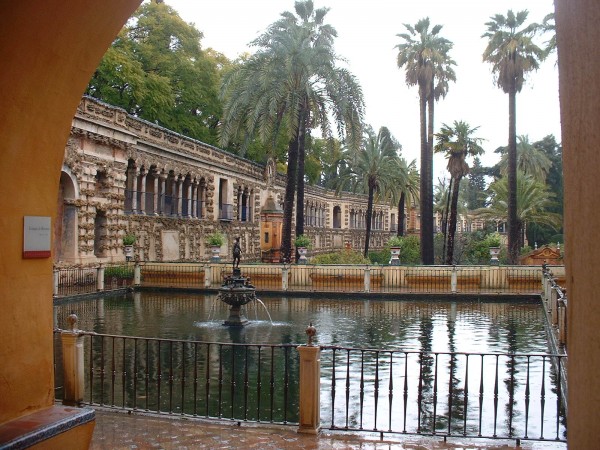
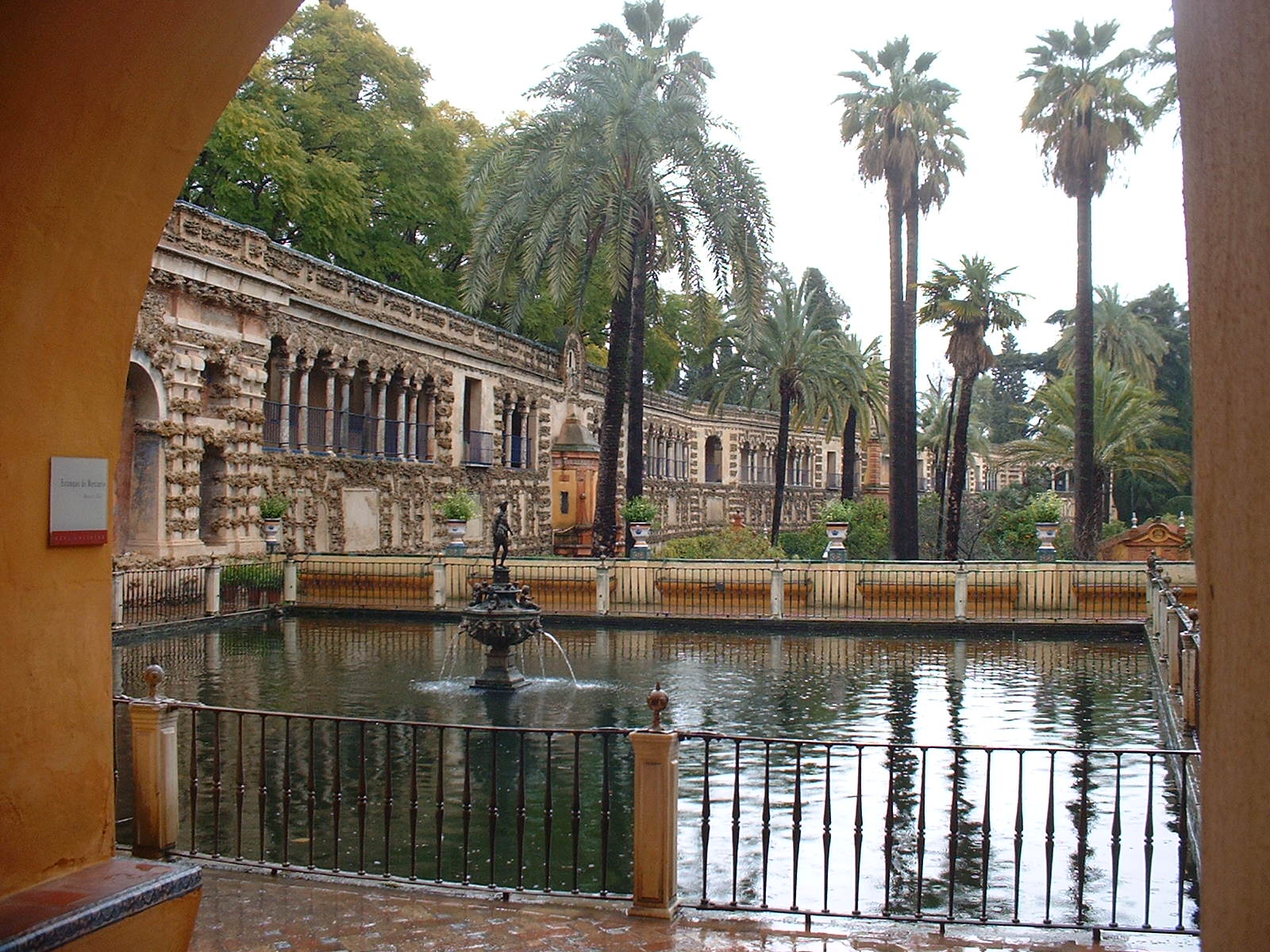
Real Alcazhar, Seville

T : Touristy thing you’ve done :
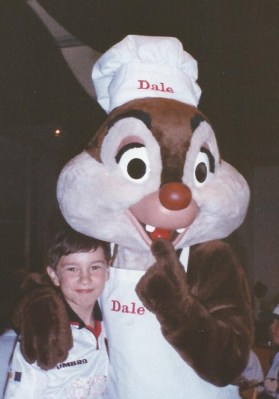
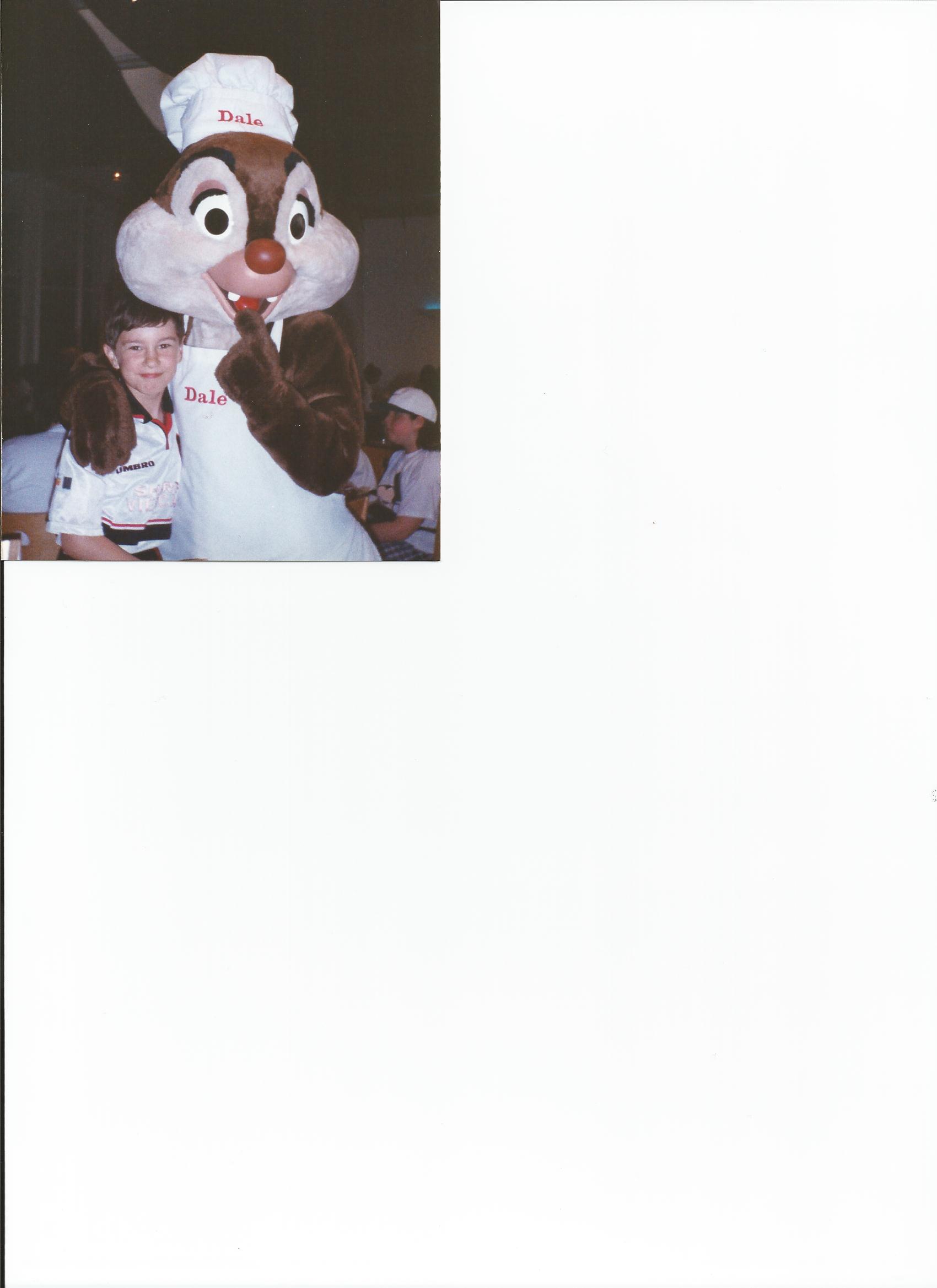
Breakfast with Dale

Have to confess to absolutely loving the Disney parades.  I was ecstatic to have Buzz Lightyear kiss my hand, and Chip and Dale- who wouldn’t want to take them home?

U : Unforgettable travel memory :
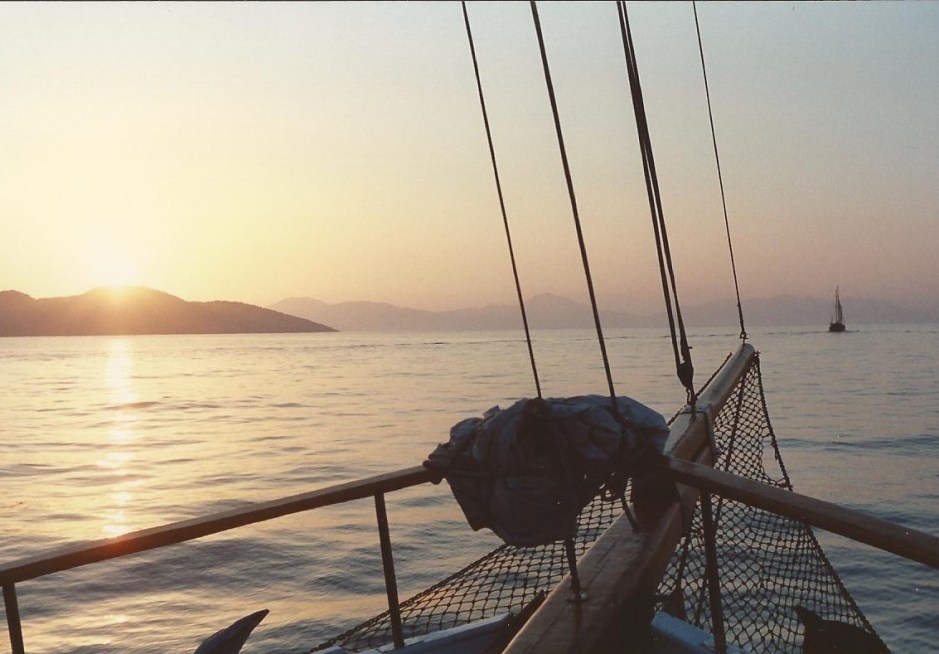
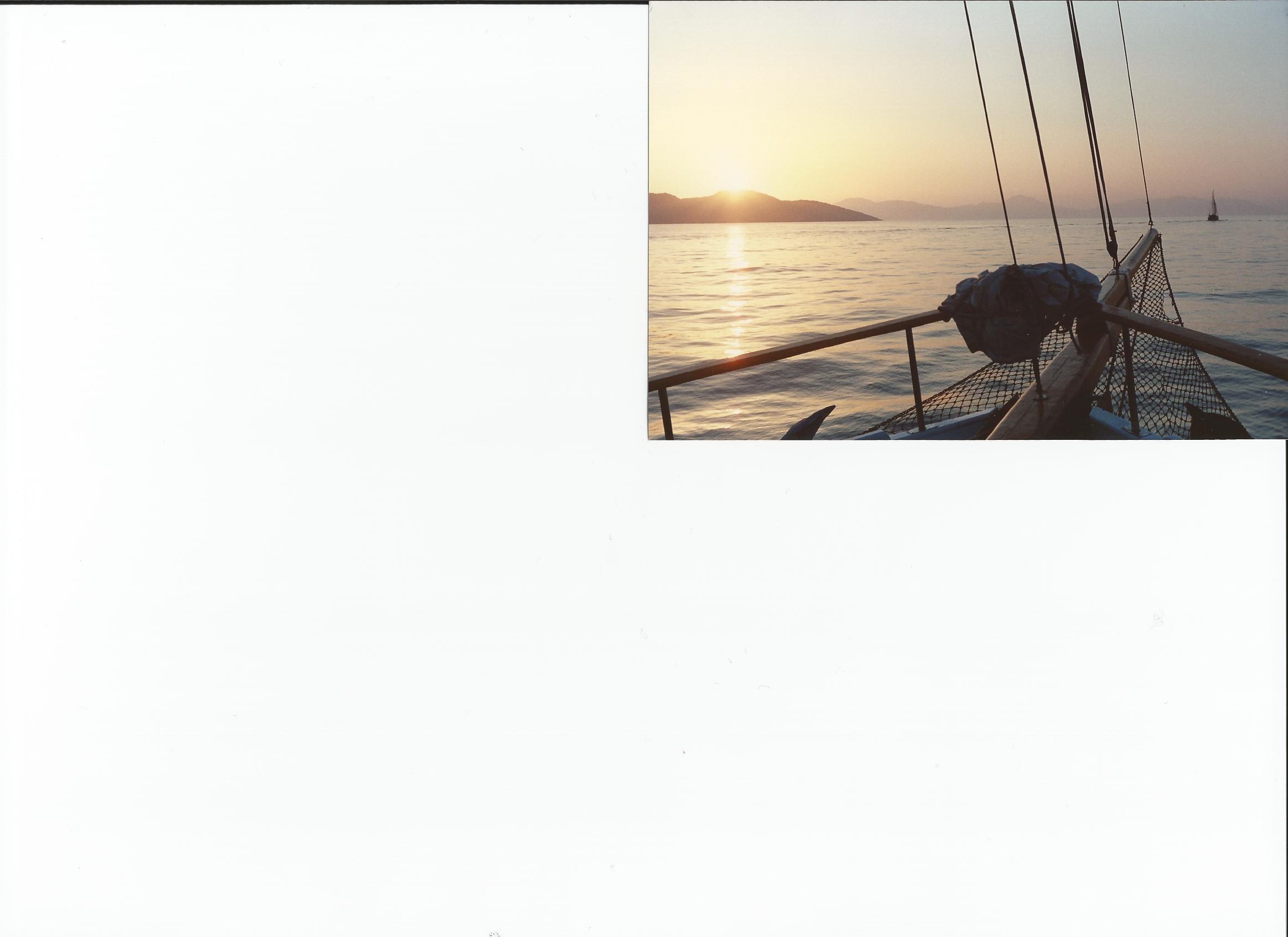
Gulet sunset

Gulet sunset

Gulet cruise from Bodrum to Fethiye- a little strange in that it was a late honeymoon, but we couldn’t afford to do it at any other time.  Certainly we weren’t sure if we wanted to share with 10 other people and 3 crew, but it was a fabulous holiday, despite my being stung on the bum by a wasp.

V : Visas ; how many and for where :

Easy answer- none.  Have led a sheltered life!

W :  Wine, best glass of wine while travelling and where :
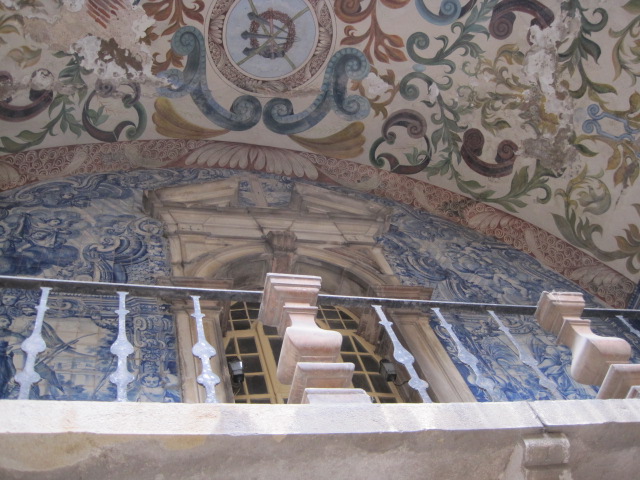
Welcome to Obidos! The gateway

Obidos. O Conquistador restaurant.  We were taking a breather in a long day’s travelling and opted to eat before returning to the fun of the Medieval Fair.  The restaurant was quiet as everyone was at the fair and the owner was wonderfully relaxed.  The wine was served in earthenware tumblers and was as good as any I’ve ever tasted.  Portuguese Dao and Alentejan wines are generally superb.

X : eXcellent view and from where :

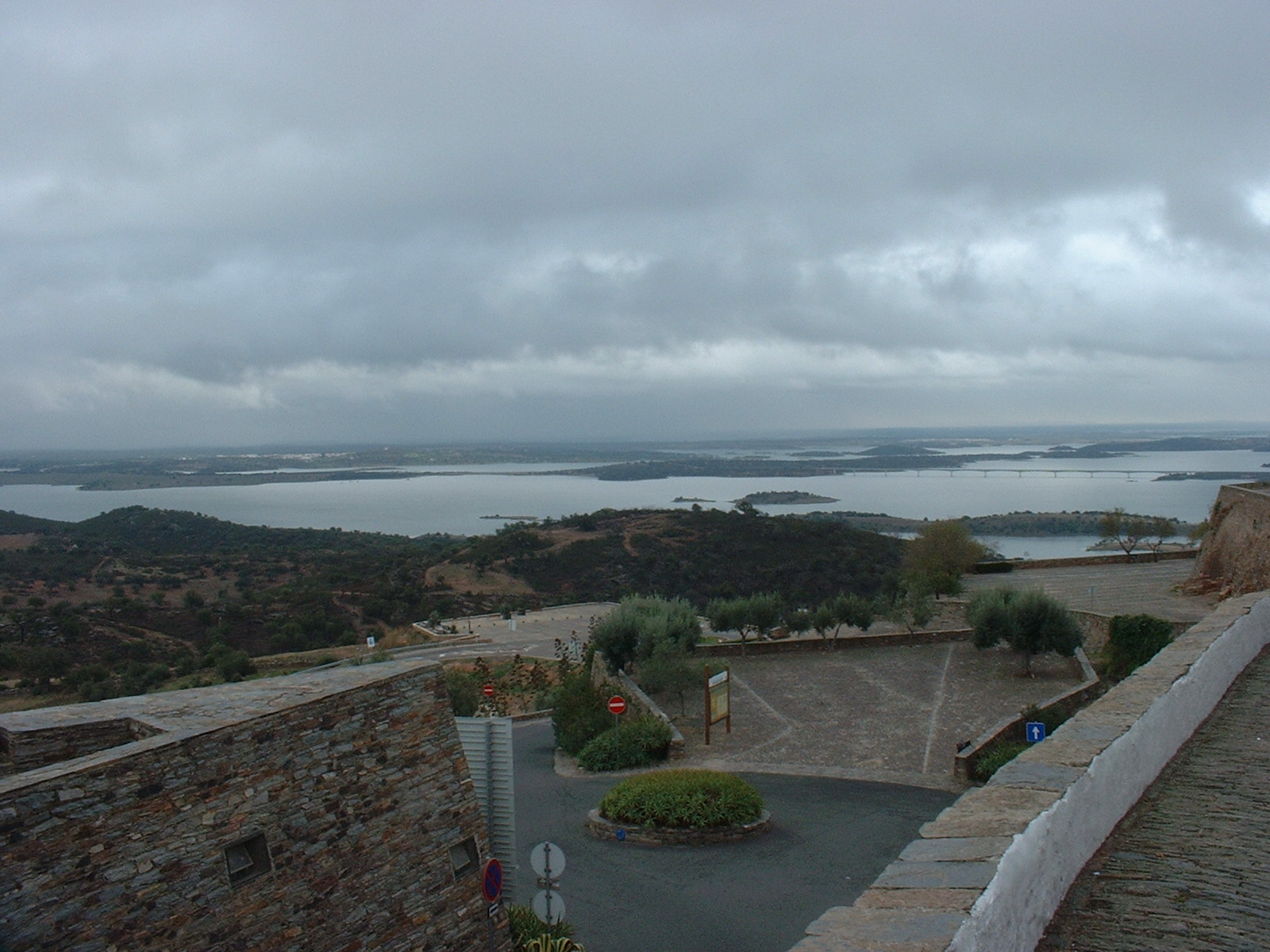
So many it’s an impossible choice but I’ll go with the view of the River Guadiana down to the Alqueva Dam, from the turrets of Monsaraz in Portugal.

A grey day at Monsaraz- imagine it in sunshine

Y : Years spent travelling :

Embarrassingly 40+.  Wish it had been constant though.  Much of my travelling is done fairly locally, but it’s all world, and so much to enjoy.

Z : Zealous sports fans and where :

I’m not a huge sports enthusiast but I rarely miss Nadal playing tennis (on TV).  My husband and son are passionate about football and never pass up an opportunity to see a live match.  Las Palmas on Tenerife was a rowdy and memorable one but the Portuguese take some beating when it comes to “excitability” for a normally calm and courteous race.

I’ve really enjoyed doing this.  Good old Memory Lane.  Now, who else would appreciate this challenge?

http://apetcher.wordpress.com/ Have Bag/ Will Travel

http://mecwrites25.wordpress.com/  La Chica Writes

http://megtraveling.com/  Meg Travels

http://shipscooksstuff.wordpress.com/  Shipscook Stuff

http://kimberlyblagrove.wordpress.com/  The Nappy Wanderer

Grassington hosts 30th Dickensian Festival

Every year it seems there are more and more Christmas festivals and markets.  I’ve never had the authentic experience of a German Christmas Market.  Totally a sun-lover, pretty as a picture the markets might be, but I’m less than keen to embrace the biting cold and streaming eyes that often accompany them.  Never the less, I have an abiding memory of a crisp, cold December day when I was utterly transported by a Christmas Festival.

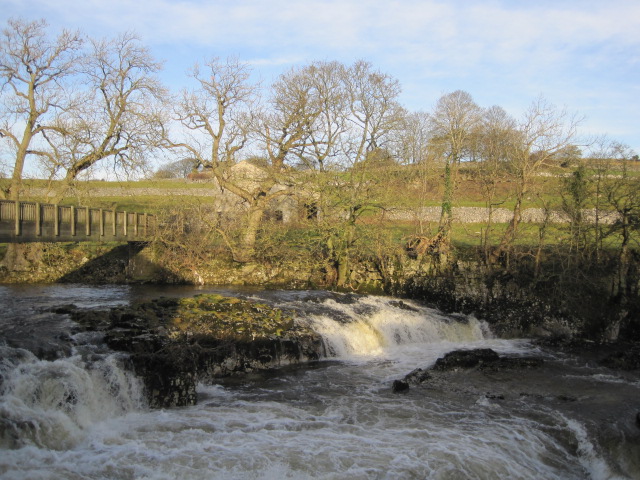
River Wharfe at Grassington

River Wharfe at Grassington

Grassington is a small town in a wild and beautiful location in the Yorkshire Dales.  In ferocious weather it’s every bit as difficult to get to as an alpine village, but, on an English Winter weekend in December, it casts a spell.

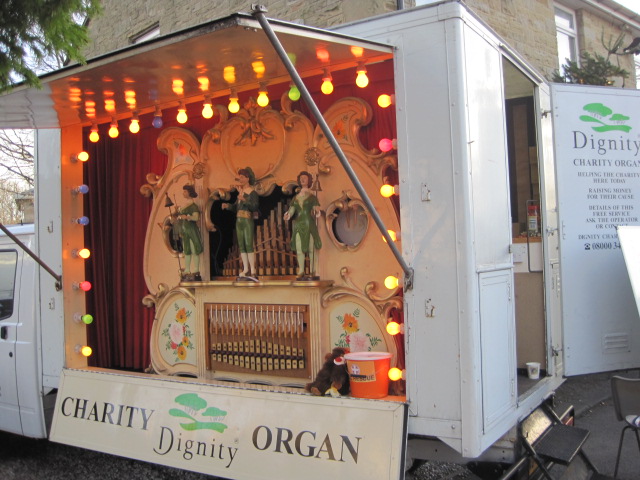
Pipe organ

Pipe Organ "Dignity"

Buckets are rattled at you as you pass the fire station and a lovely old pipe organ gives you pause- long enough to notice the sign inviting you in for refreshments.  It is, after all, an event in aid of charity.  But as you progress to Main Street, the sights and sounds capture you, and the magic of Grassington Dickensian Festival takes over.

Organ grinder at work

Organ grinder at work

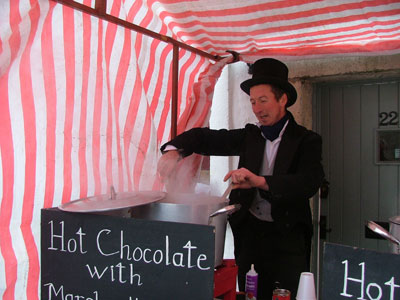
First, the organ grinder, twirling out his sounds, then a homemade cakes and biscuits stall.  None of your ordinary old cakes here- chocolate tart with raspberries has my name written all over it.  Jewellery and crafts, chestnuts, honey roasted cashews, spit-roasted pork- my nose doesn’t know which way to turn.  The chill in the air persuades me that a hot chocolate laced with brandy will be just the thing.

Get your hot chocolate here!

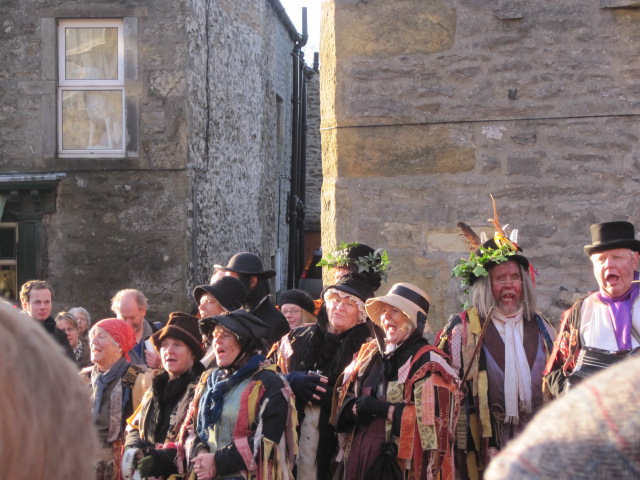
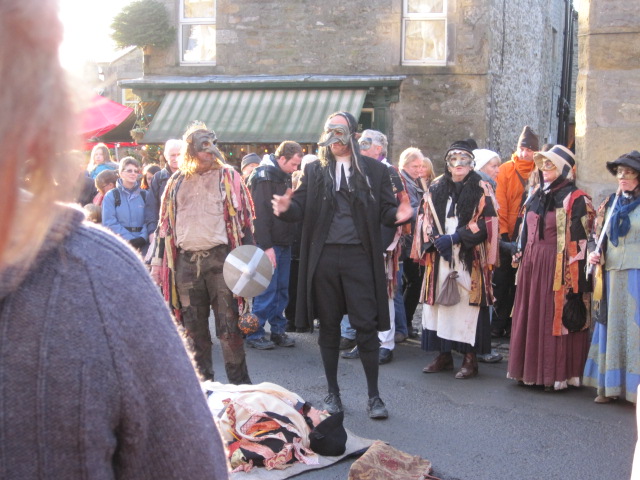
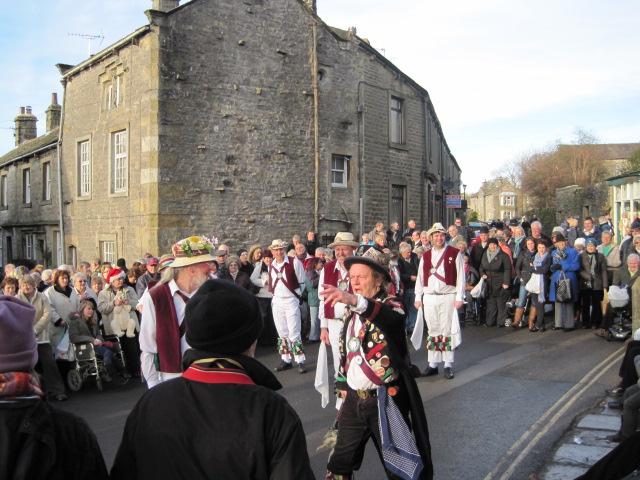
Clutching it to me for warmth, I smile at the age-old antics of the Mummers, drawing in the crowd.  Morris dancers hop and skip.  Best not to loiter, unless you want a starring role.
Mummers singsong

The Mummers sing-song

Mummers

The Mummers and a "corpse"

Morris dancers

Morris dancers entertain the crowd

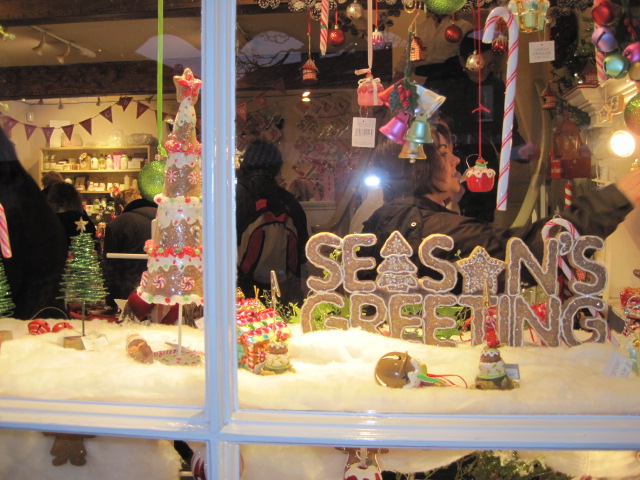
Maybe after another hot chocolate and brandy?  No, better to turn to the serious business of selecting a few small gifts from the many and various shops and stalls.  On Main Street, Gemini glistens with metal and gems, whilst Rustic Rabbit sparkles with every imaginable Christmas bauble.

Rustic Rabbit's Christmas window

Rustic Rabbit's Christmas window

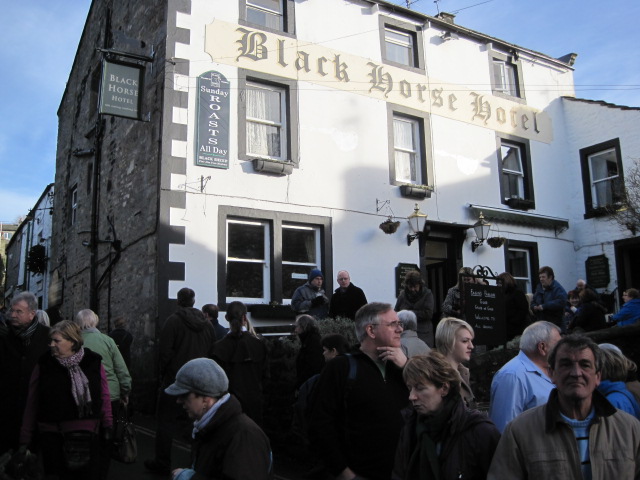
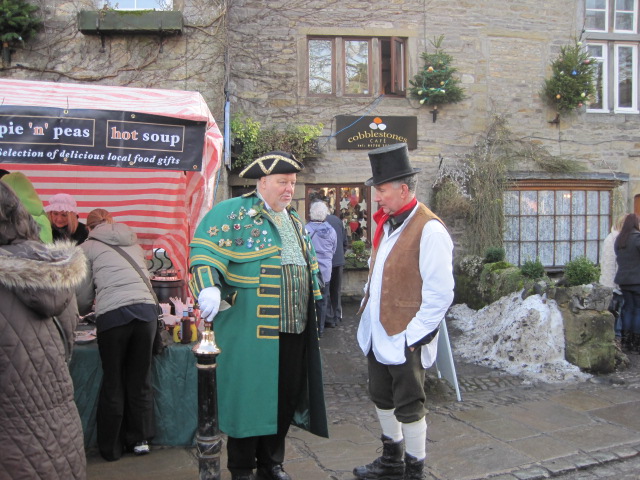
As the day draws on and the pallid sun retreats, the atmosphere begins to build for the main event- the procession.  The town crier hovers by the brazier where torches are on sale to light the streetsThe youthful shepherds and kings, who have manned the hospice stall all day, quench their thirst at the Black Horse Hotel, still uninhibitedly selling 20p kisses for charity.

Town crier

Town crier

Black Horse

Black Horse Hotel

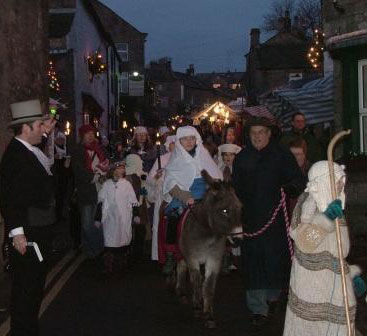
At 4pm sharp the procession is off and gathering momentum through the streets, the crowd following on.  A sharp rap on the door- “Is there any room?” asks Joseph, at the first hostelry.  “No room” booms the landlord.  On to the second and third of the town’s inns, the torches flickering, the atmosphere electrically charged.  Again the response, “no room”, and the crowd stifle a groan.  We exchange anxious looks, but the ending is inevitable- a return to the manger erected in the square.  Christmas carols have never sounded so poignant.
The procession

The procession

Suddenly it’s all over and the stall holders are packing for home.  The shops are open for a while longer if you’re quick, the queues gone now.  I seek shelter myself in the warmth of The Forester’s Arms.  Shrugging off my coat, I listen to the impromptu performance of carols from the fine voices gathered by the pool table.  The joy and wonder of Christmas is here in Grassington.

This year the final Saturday of Grassington’s 30th Dickensian Festival takes place on 17th December.  For the first time ever there will be an ice rink on this final weekend.  The festival is staged on three consecutive Saturdays in December, while 8 miles down the road, neighbouring Skipton has a Yuletide Festival on corresponding Sundays.

The town’s three inns all supply reasonably priced accommodation, or an opulent stay can be had at 5 star Grassington House Hotel.  Park and Ride is available, and coaches visit from far and wide.  Full details are available on  http://www.grassington.uk.com/dickensian%20festival/dickensian.htm, with a video to get you in the mood.   A useful little booklet, “One hundred things to see on a walk through Grassington”, can be very cheaply purchased from most of the town’s shops and pubs.  Proceeds go to charity and it will enable you to have a better look at this deserving little town and the beautiful surrounds.

Everything changes with time, but I do hope that popularity doesn’t spoil this wonderful event.  All the way home I sing to myself “There isn’t any room for strangers”.

Discovering Durham

My husband can’t understand how or why I haven’t written more about the city of Durham.  It’s one of our favourite places for strolling (what’s more alluring than a river bank?), and beautiful in all seasons.  One of the many reasons we fell in love with Tavira in the Eastern Algarve was that it reminded us in some unspoken way of Durham: the churches, the river, the many places to eat, and to drink in lovely views.

Milburngate Bridge and the Weir- credit Wikipedia

Of course Durham is bigger and more cosmopolitan, and can’t compete when it comes to weather and beaches.  It doesn’t need to.  The 11th century Castle and Norman Cathedral, linked by Palace Green, have been a UNESCO World Heritage Site since 1986.  It was very fitting that at the recently staged Lumiere Festival, the Lindisfarne Gospels were projected onto the south face of the Cathedral.  The origins of today’s city can be traced back to AD995, when a group of monks from Lindisfarne chose this highly defensible “island on a hill” as the final resting place of St Cuthbert.

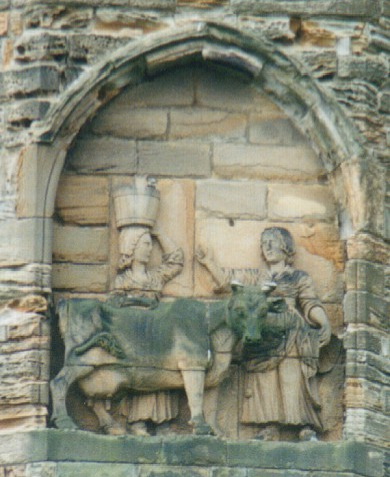
Legend of the Dun Cow on the South face of the Cathedral- credit Rebecca Kennison for Wikipedia

The River Wear surrounds Durham on three sides.  The place name derives from Old English “dun”, a hill, and Norse “holme”, an island.  The Legend of the Dun Cow is depicted in a carving on the Cathedral’s south face, adjoining Dun Cow Lane, known to be one of the earliest streets in the city.  The story goes that the homeless monks carrying the coffin were mysteriously brought to a halt, unable to move, close by the present site of the city.  After 3 days of prayer and fasting, St Cuthbert appeared to one of the monks with the instruction that he be “carried to Dun Holm”.  The whereabouts of this place was unknown to the monks, but a milkmaid arrived later that day, and claimed to be searching for her “dun cow”, last seen at Dun Holm.  Recognising this as a sign of divine intervention, the monks suddenly were able to move the coffin, and follow her.

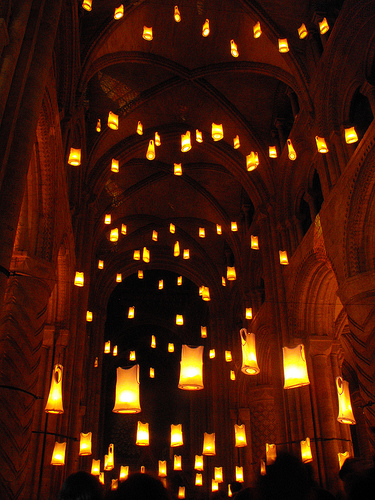
“Miner’s vests” in Durham Cathedral at Lumiere 2012

Today’s cathedral is an awesome space, usually busy with tourists, unlike the modest one erected by the monks.  St Cuthberts relics are still enshrined here, as are the bones of St Bede the Venerable.

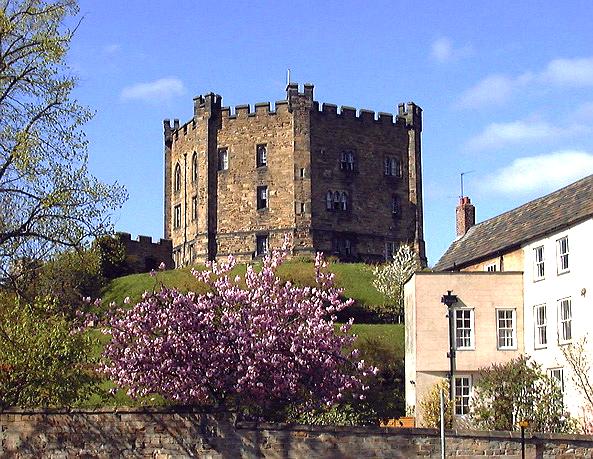
Castle Keep and Dun Cow Lane- credit Robin Widdison for Wikipedia

Durham Castle is a fine example of the motte and bailey style favoured by the Normans.  In continuous use for over 900 years, it remains the only castle in the UK never to have been breached.   Now home to Durham University, guided castle tours lasting 45 minutes can be arranged, afternoons in term-time and mornings during vacations.

Durham Traditional Christmas Festival, the first weekend in December, sees Durham get in party mode. (free on Friday, admission charge to the marquees and craft fair on Palace Green, Saturday and Sunday)  Children’s events take place at the World Heritage Visitor Centre on Owengate over the weekend, with falconry and balloon making as well as the more traditional reindeer.  The children’s lantern procession takes place on Saturday afternoon, and Christmas Carols in the cathedral are always a bit special. www.durhamchristmasfestival.com

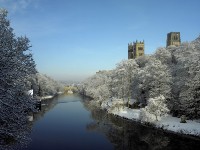
Cathedral in the snow

Despite its heritage and historical buildings, Durham is not a stuffy place.  The student population keeps it young and lively, and also keeps the prices down in the rich variety of cafes and restaurants.  There’s an indoor market off Market Place, for “cheap as chips”, and an Oxfam bookstore over 3 storeys, where I love to curl up in a corner and browse.

My food of choice tends to be Italian and over the years I’ve thoroughly enjoyed La Spaghettata, upstairs at 66 Saddler St.  The décor is quite individual and the menu extensive.  Quite different but also a favourite, especially if you can get the window seat to spy on shoppers down below, is De Medici on Elvet Bridge.  When it comes to cafes you really are spoilt but I especially like The Almshouses on Palace Green, surrounded by lovely university buildings.  There’s always a choice of homemade soups and oh those cakes and puddings!  The artwork on the walls is good for conversation too.

If you’ve walked through the cathedral and cloisters, don’t neglect the Dean and Chapter area at the reverse.  It’s one of the loveliest and most peaceful spots in Durham.

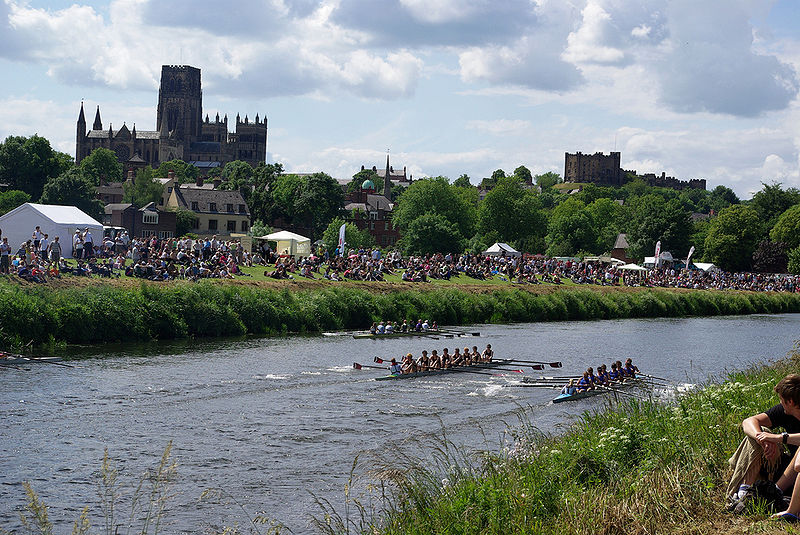
Durham Regatta- credit Wikipedia

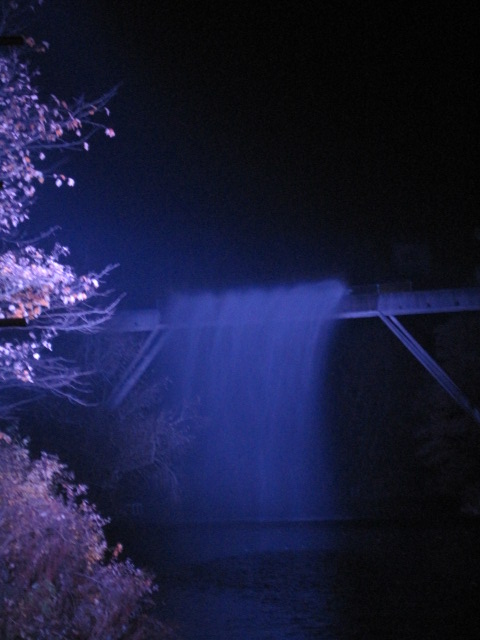
The river can be pretty peaceful too.  Coxless fours glide effortlessly past, while less coordinated efforts come from the families in rowing boats.  The river truly comes to life in June when Durham Regatta provides enormous enjoyment for everyone.   Best riverside moment this year just has to be the vapour “waterfall” streaming from Kingsgate Bridge during “Lumiere”.  Splash! by Peter Lewis of Canada provided all the magic you could want.  I loved that lone canoeists roamed the water at sunset, waiting for the moment when they could paddle “through the waterfall”.

"Splash" created by Peter Lewis of Canada

Durham is a compact, easily walkable city, with excellent bus and rail transport links.  For drivers there are 3 Park and Ride facilities, making life easy.  My husband says not to tell you, but we always park for free, by the playground at the top of Wharton Park, and walk down past the viaduct.  It’s a steep climb back up though.

So there you have it- the Durham I know and love.  As good a place to do your Christmas shopping as anywhere you could find.

“Lumiere 2011” was special. You can read more about it in  https://restlessjo.wordpress.com/2011/11/20/celebrating-light-with-durham/

A tale of three weddings

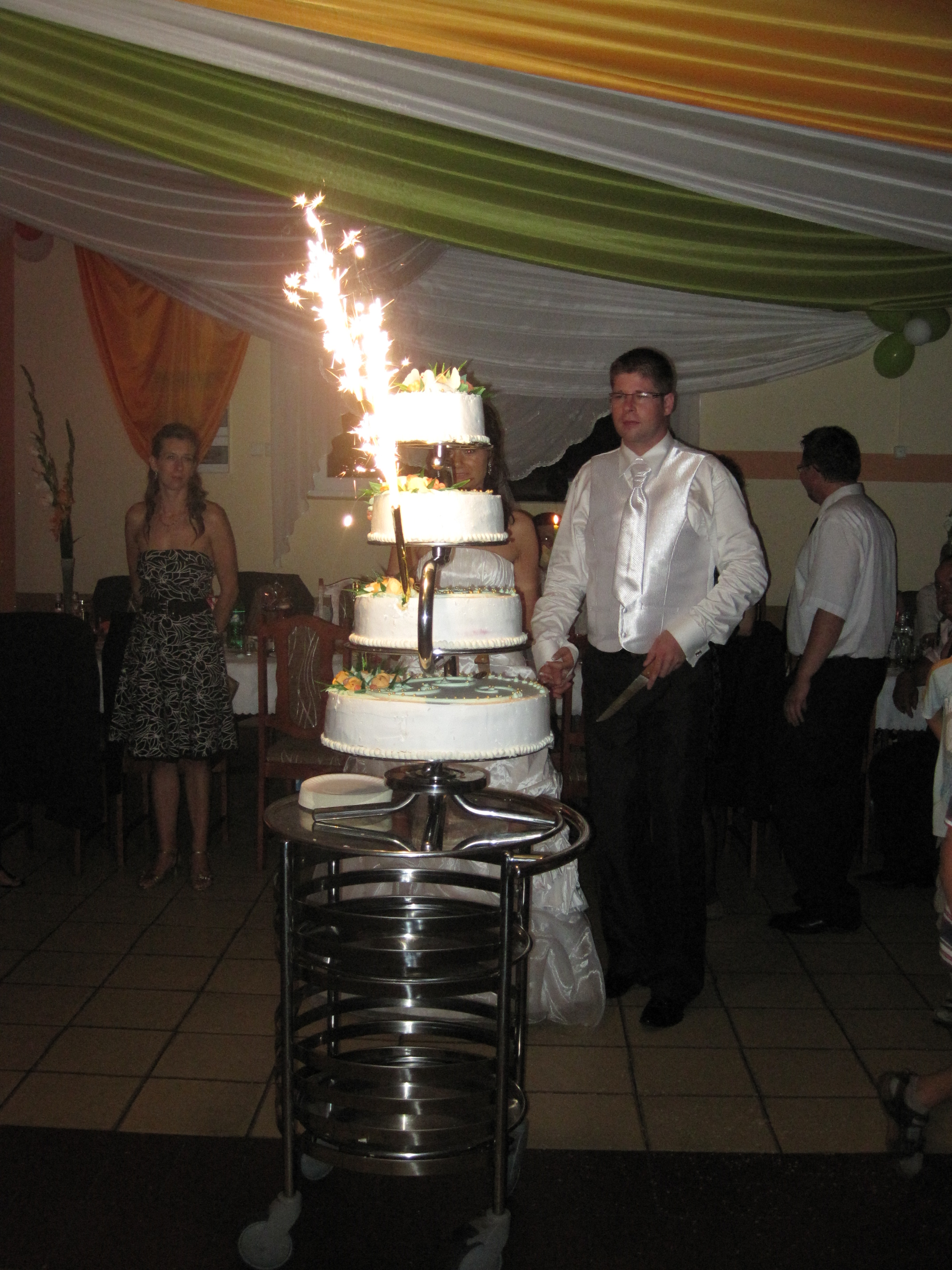
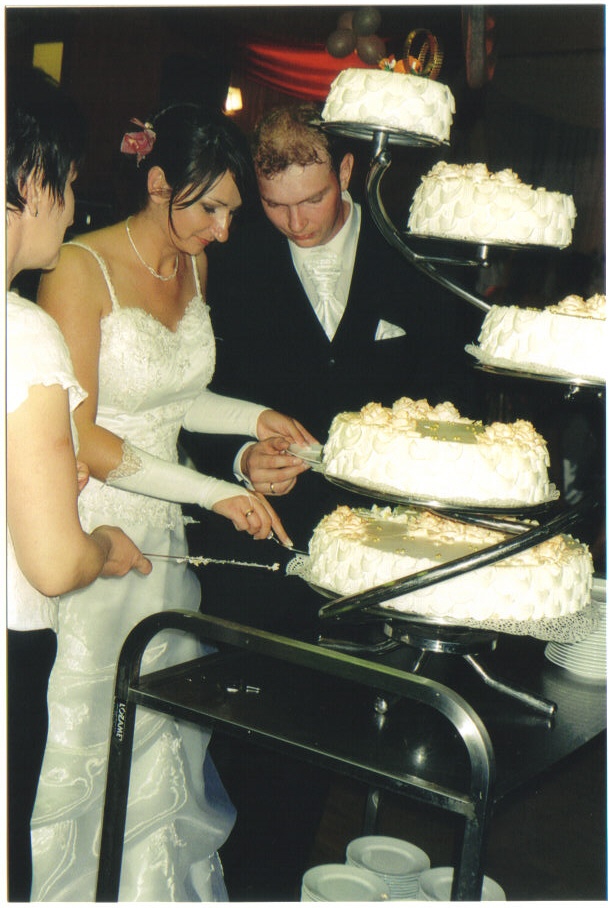
To call a Polish wedding an explosive occasion would be no exaggeration.  I have vivid recollections of fireworks raining down from the pinnacle of a sparkling tiara of wedding cakes.  But I’m getting ahead of myself, as usual.

It all started one April with two wedding invitations, for back to back weekends, to the offspring of two different Polish cousins.  Fortunately both lived in close proximity, in the neighbourhood of Belchatow, Central Poland.  It was only a year since we had been reunited with our Polish family, and neither Dad nor I could wait for the experience, which we had been warned would be “lively”.

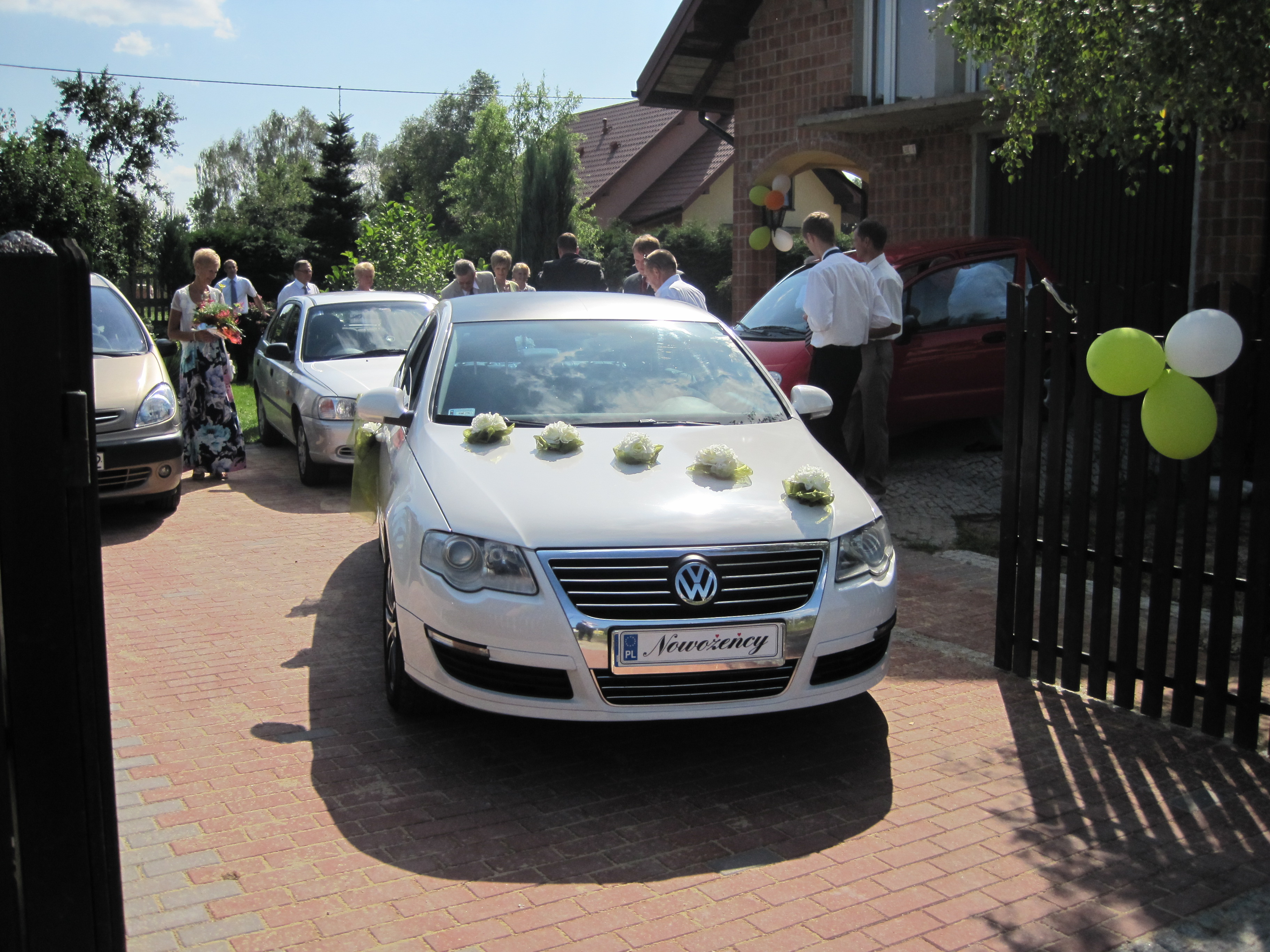
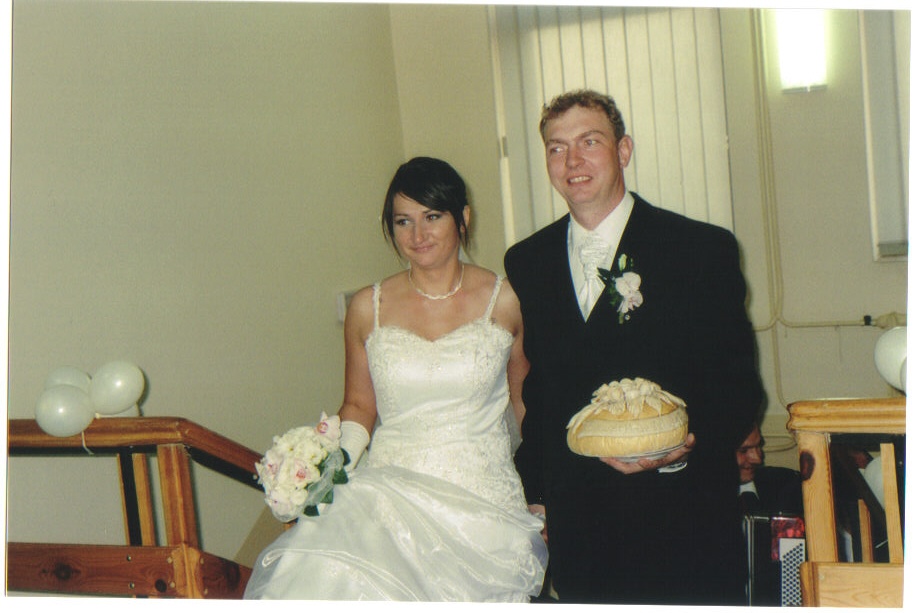
Jemy, pijemy, tanczymy-“we eat, we drink, we dance”, sums it up, and we certainly did!  A Polish wedding is a very traditional and religious occasion, both romantic and innocent in a heart-warming way.  Prior to going to church, the bride, groom and parents assemble at the bride’s home for a blessing.  Bride and groom then travel together to the church in a car adorned with paper flowers. The guests follow them in a humorous cavalcade.  Road work barricades may be set up at intervals, to be bypassed on payment of a bottle of vodka!  The guests toot car horns and heckle.

The church service, around 5pm Saturday, is a solemn and beautiful occasion.  Then, the fun starts.

At the reception, the tables groan beneath their load.  Pyramids of fruit and sweets are surrounded by savoury platters.  Cake cuddles up to the vodka.  We raise a toast and sing the traditional Sto lat– 100 years.  Comes my favourite part- the bride and groom take to the floor, at the centre of a heart made from the guests floral tributes, or perhaps candle tealights.  The guests join hands and slow dance around the room.

Food next, accompanied naturally by vodka, and copious quantities of fruit juices, herbata (tea) and kawa (coffee).  Laden trolleys approach and the tables are heaped with soup, then chicken, pork, fish, pasta dishes, it just keeps on coming.  At every pause in the conversation, someone proposes na zdrowie- good health, and another shot of vodka disappears.  Just as your stomach is protesting “no more”, the band strikes up and the whole room are on their feet.  A gentle polka becomes faster and faster, the room whirling past.

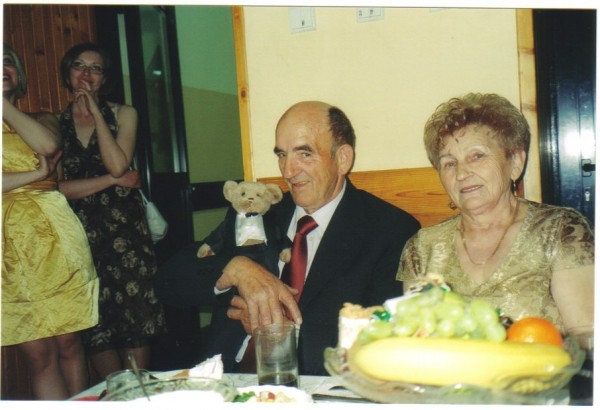
Several numbers later the band subsides and it’s back to the tables, where yet more food is being delivered.  The vodka bottles are replenished as soon as they are empty.  A hot beetroot drink, tasty in small quantities.   Beer for those not drinking vodka.  Not wise to mix them, but Dad has left his sensible Polish head at home.  Still he gamely gets up, walking stick in hand, when the music starts up again.  Which of the nieces to gallantly partner?  A kiss on the hand, the reward for a dance, bestowed by every Polish gentleman.

At midnight the lights are dimmed and a hush falls.  The wedding cake makes its entrance, fizzing joyfully with giant sparklers.  Oohs and aahs, then it’s distributed and eaten and we’re dancing again.  This is how the night passes by, eating, drinking, dancing, laughing and smiling.  As dawn breaks the feasting comes to an end.  But only for a little while- the party reassembles after a bit of a nap. At 4pm Sunday we’re ready to go again!

Astonishing to English eyes, the soignee, sophisticated bridal party don jeans and grab mop and buckets to clean up in readiness for the next guests, then back into the glad rags!

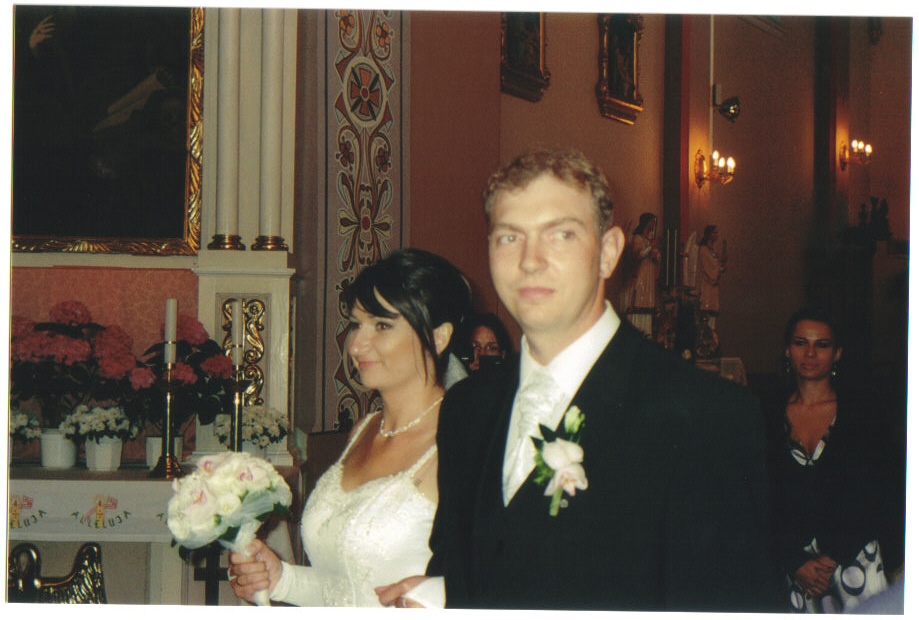
Let me introduce you to Ania, daughter of my cousin Jadwiga, and her new husband Hubert.  We had never met as they had been working in Reading to finance the wedding and a fresh start in their homeland.  None-the-less we couldn’t have been made more welcome, to the extent that the bride’s parents sacrificed their own bed for us.

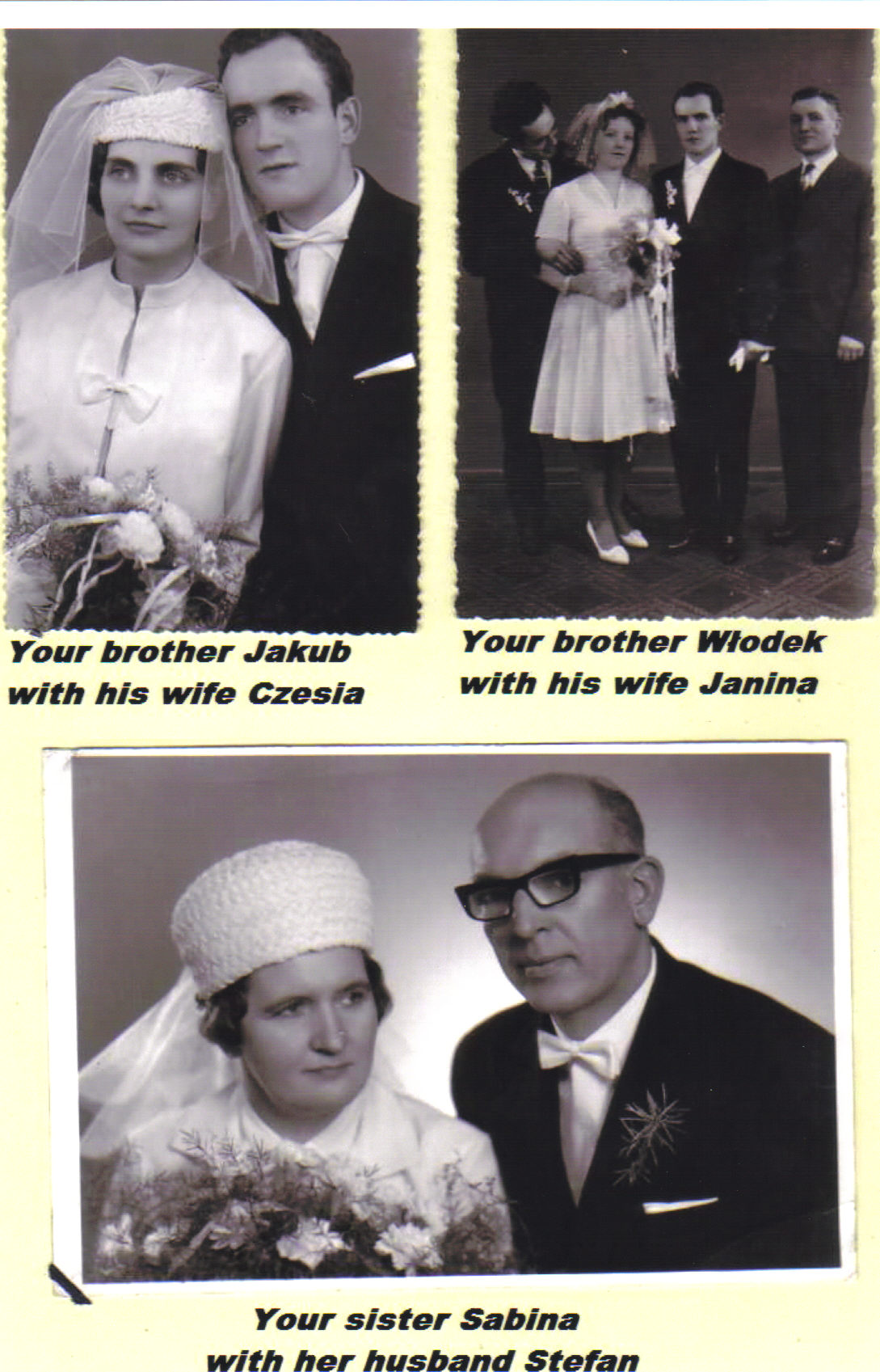
The second wedding was for my Uncle Jakub’s son Krzysztof and his partner Ilona.  We stayed with Jakub and his wife Czescia and no-one was displaced from their bed.  The wedding was at the impressive parish church at Grocholice.  Construction work had begun on the marital home- a joint effort with family contributing skills and labour according to their abilities.  Till completion they would live with Ilona’s parents.

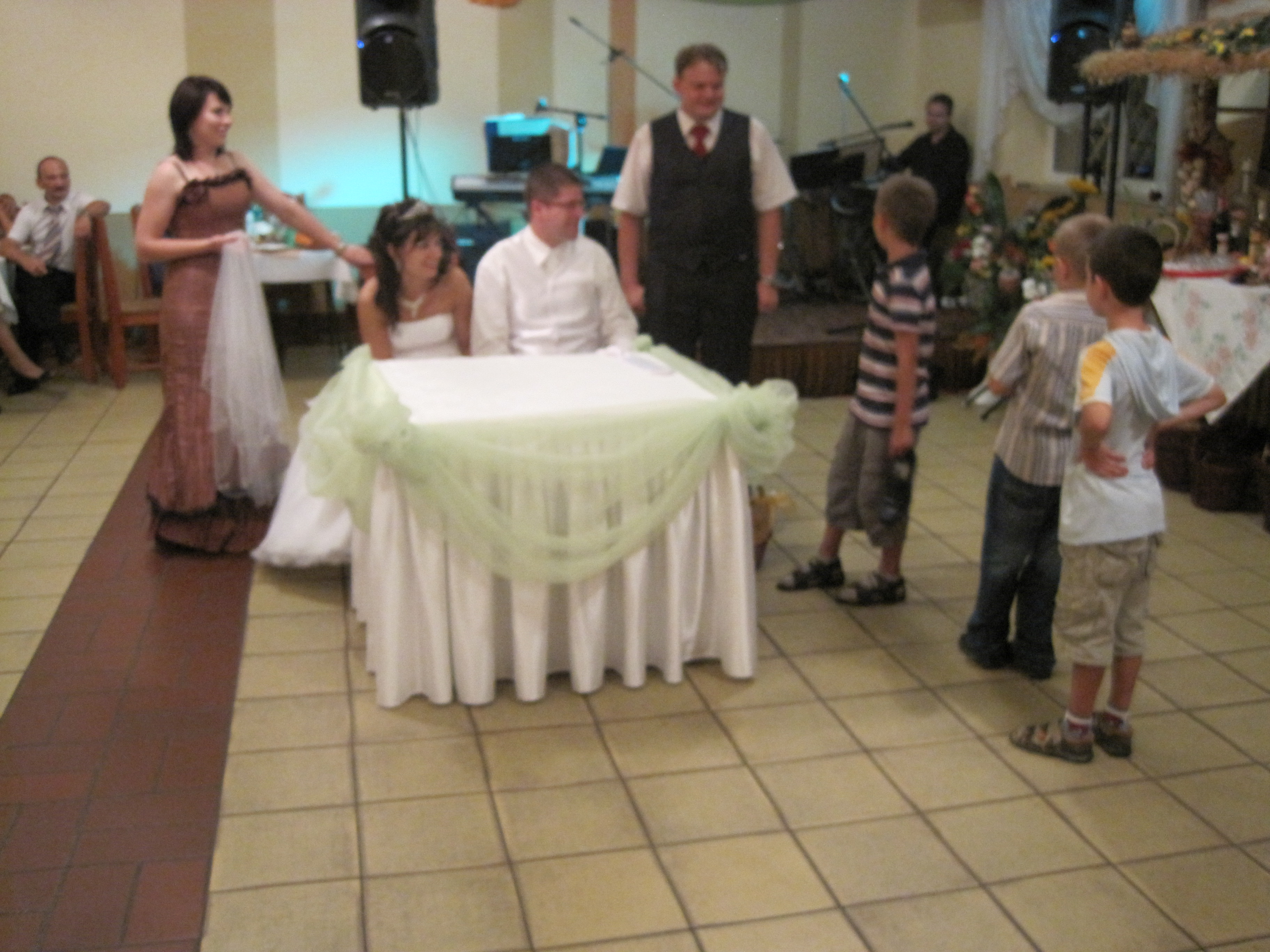
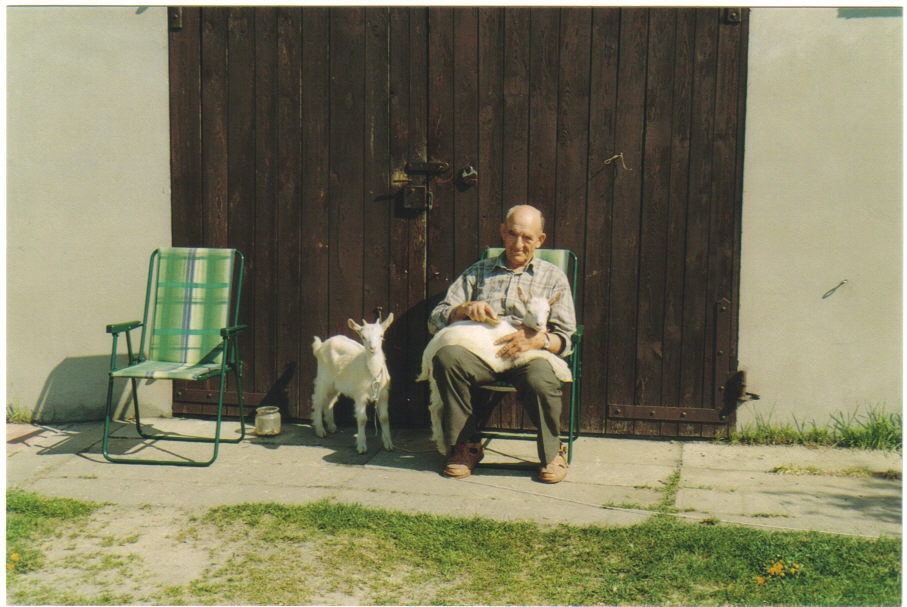
It’s obvious that stamina is a requisite for Polish weddings.  At the poprawyny (the second wedding celebration) more emphasis was placed on younger members of the family.  The odd solo was performed on stage by the least shy of the little ones.  Silly games were entered into with gusto, a favourite being a “family” version of musical chairs.  The prize was invariably vodka.  Most memorable of all was the presentation to my Uncle Jakub of two delightful baby goats.  He has a good plot of land with hens and beehives.  The kids were a huge hit with the grandchildren.

Eating, drinking and dancing continued throughout the celebrations, till my legs were turning to jelly.  Ania contrived to extend her wedding into the Monday.  I’m not sure if this was due to an excess of food or a larger than usual family.  For Krzysztof the party ended and the cleaning began after 10pm on Sunday evening.  A party and a half!

You’re thinking I can’t count, aren’t you?  It was after Ania’s wedding that it was confided to me that her younger brother, also a Krzysztof, was to marry his sweetheart Marzena the following year.  Both of them live and work in Southern England and we were delighted to be asked back to Poland the next August to take part in a third wonderful Polish wedding.

Since then, babies have been born.  But that’s a different tale altogether.