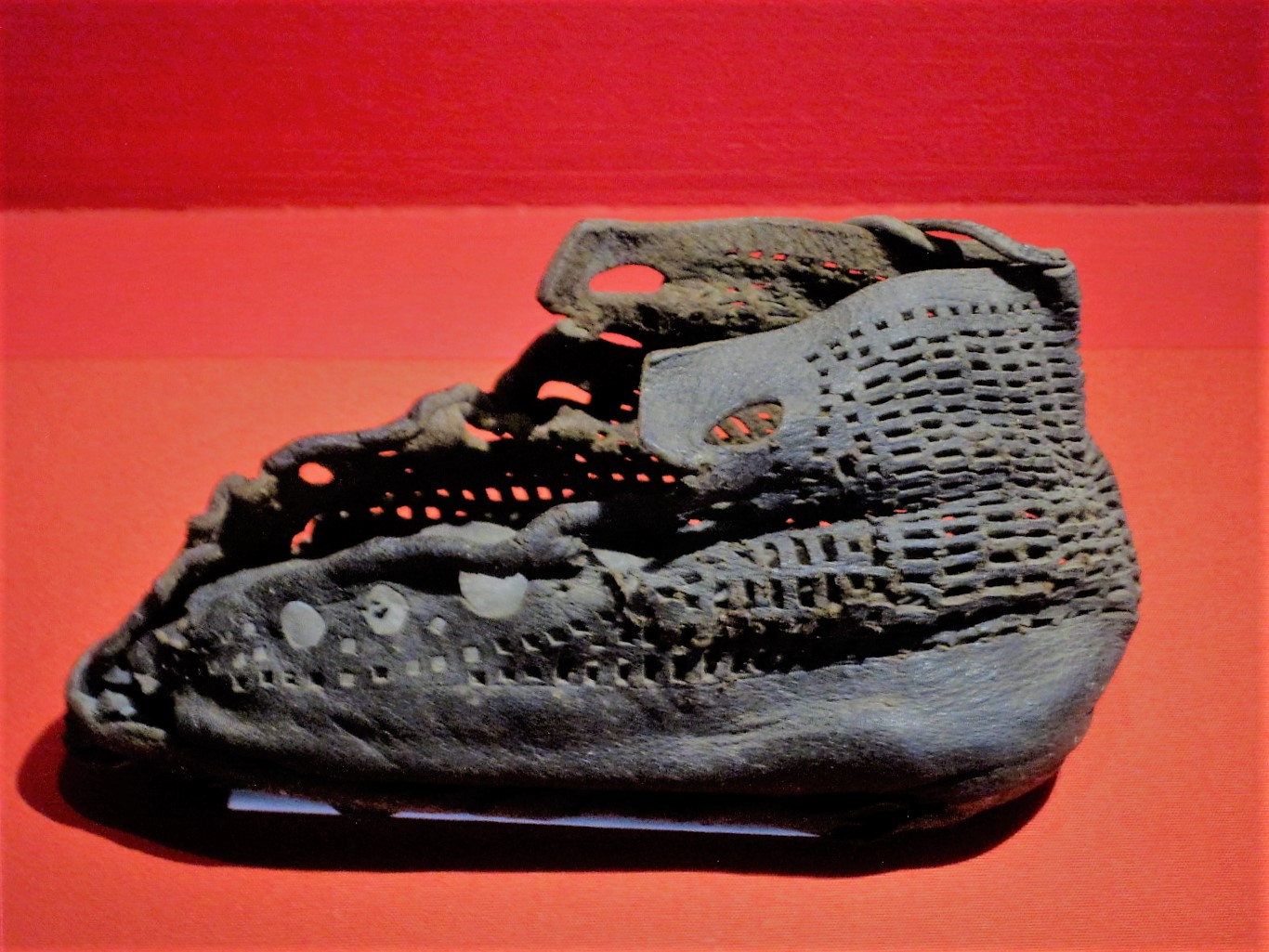
Knee deep in history this week, I spent a fascinating day out at Vindolanda, on Hadrian’s Wall in Northumberland. Come and walk with me, in Roman footsteps. Can you believe, this tiny child’s boot, found here on this site, is from Roman times?
At the edge of the Roman Empire, the Wall was to stretch 73 miles across Britain, from coast to coast. A formidable undertaking! The garrison at Vindolanda was the first of a series of bases enabling the Wall to be built, and then defended. The name means ‘white field’ or ‘white moor’, and I can testify that freezing conditions are often to be found at the border in winter. On a warm Spring day, the beauty of the surrounds was what struck me first. But I’m getting ahead of myself. Let’s build the suspense a little. What might I find here?


I had, of course, heard all about the Vindolanda Tablets– telling scraps of bygone lives, written in ink on wafer thin slivers of wood, they are the oldest surviving hand written documents in Britain. But what would they look like, and how did they come to be still intact after almost 2000 years? This UNESCO World Heritage Site has ongoing live excavations, and it was incredible to watch history being unearthed before my eyes.


Meet Graham, and his merry team, and let him enthrall you with tales of some of the finds from the 14 years he has been helping to excavate this site. The twinkle in his eyes can’t disguise the passion he has for this very special place. The stories will give you goosebumps. It was from Graham that I first heard the explanation as to how well preserved everything was. The first 4 forts here were made of wood, but over time they were demolished and 5 new stone forts were built over the top. Each layer of new building sealed the previous levels, creating anaerobic (oxygen-free) conditions, effectively preserving them from decay. An unbelievable 6000 items have been recovered so far. As they continue down they hit further pockets of discovery, adding to the already amazing haul.


Throughout the site information boards help you to reconstruct what once stood there. The Romans were very resourceful, channelling water from nearby streams in stone aqueducts or timber pipes. They had underfloor heating systems, steam rooms and communal but comfortable toilets. It was a well-ordered society with a recognised chain of command and luxurious, for the times, quarters for the Governor and his guests. It is believed that the Emperor Hadrian himself once stayed here.


On the Vindolanda website there is a detailed timeline and enough information to keep you reading for a considerable time. I can only skim the surface here. The Romans arrived in the mid AD70s and were here for more than 300 years, building and rebuilding a sequence of forts and, from AD120, Hadrian’s Wall. When the Romans withdrew from Vindolanda it continued to have a life for a further 400 years, before falling into decay.
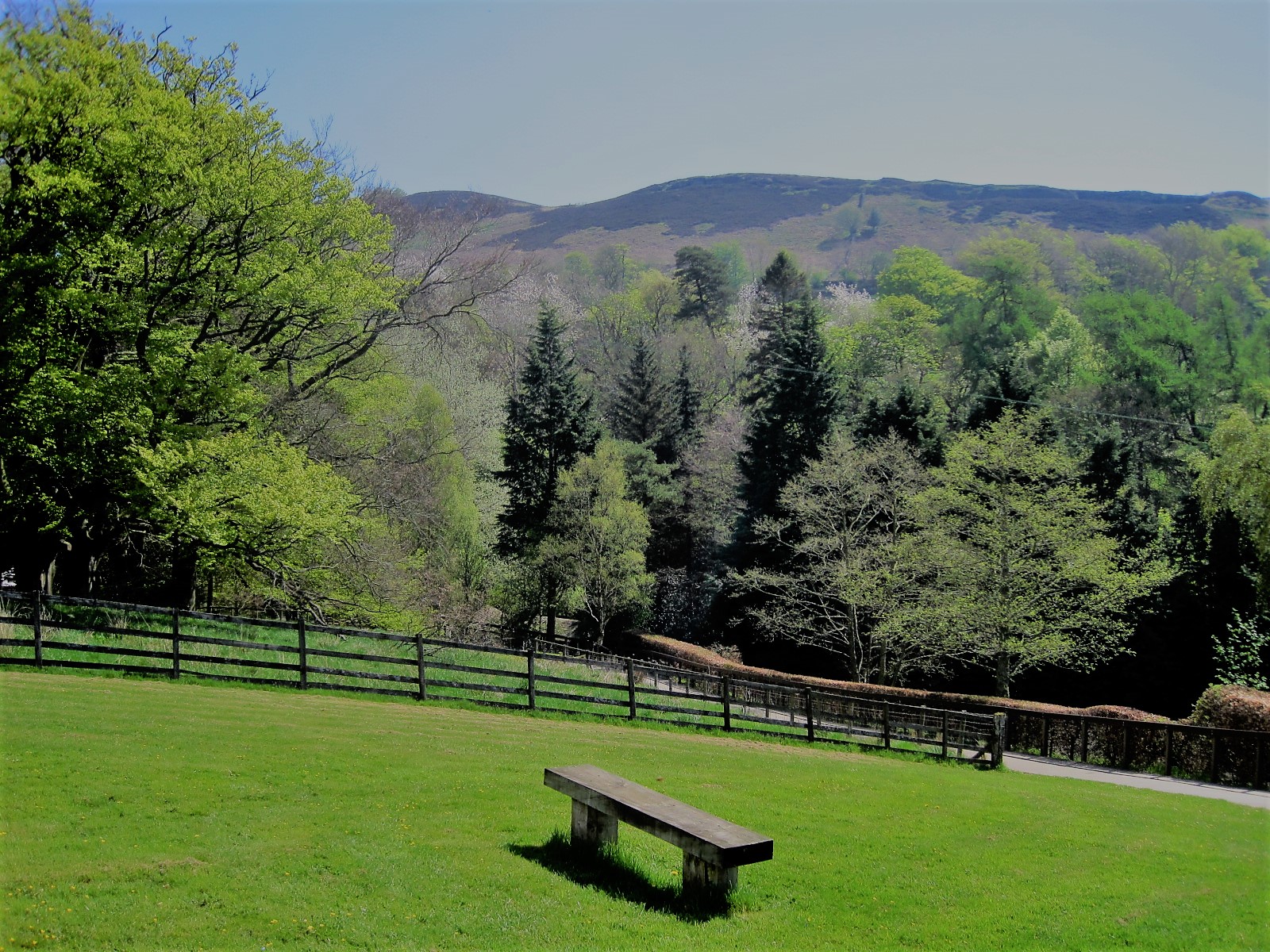
It is a spectacular site, built on a hill, and would have been easy to defend. Follow me down to the reconstructed Temple of the Nymphs, in the valley below. The Romans worshipped a number of gods, Jupiter, Mars, Mercury and Neptune among them. The wall paintings inside are based on examples at Pompeii and Herculaneum.


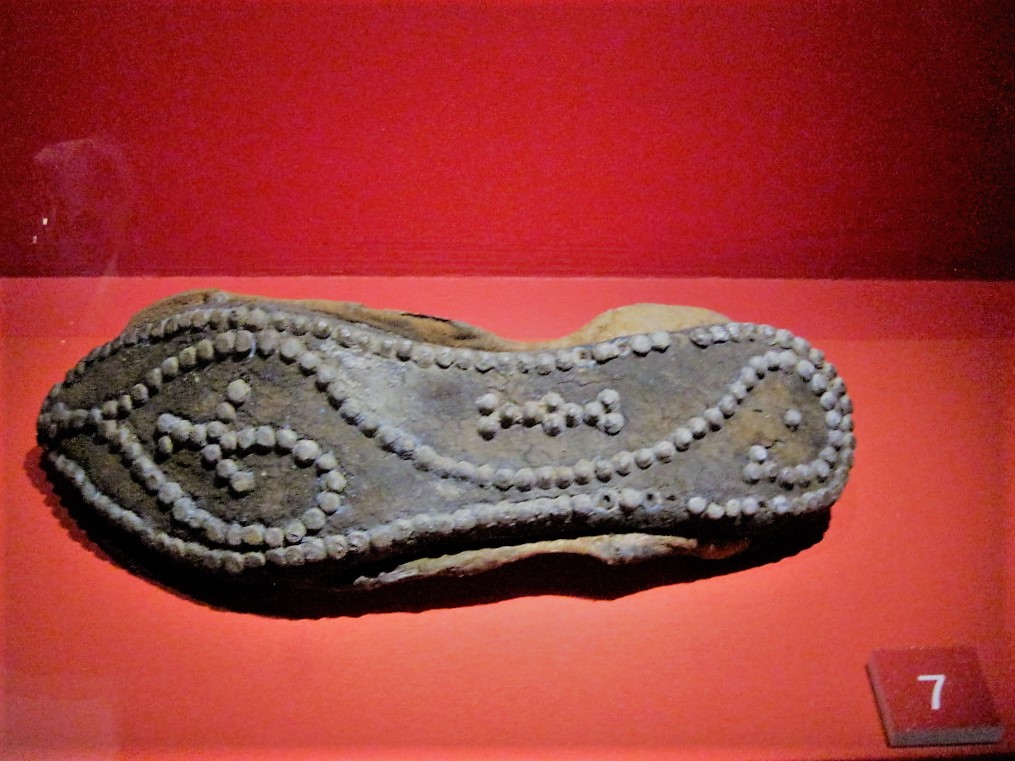
The museum is in a beautiful setting, in what was formerly Chesterfield Cottage. It was purchased by Vindolanda Trust in 1974 and has been extended and modernised, and includes a very friendly little restaurant. If you can make it here, I cannot recommend it highly enough. One of the collections that I found extraordinary was the shoes. I had no idea that the Romans had so much choice in the range of footwear available to them. (especially if they had plenty of money) Coloured socks are believed to have been worn with the latticed style, to highlight the pattern. The soles were studded to prolong wear, children’s shoes being a smaller version of adult footwear.


Whatever attracts or interests you, I’m sure you can find something to marvel at, be it fine bronze armour, worn by the legionaries, oyster forks, a range of keys, painted glass from the Rhineland or the military standard and horse brasses of a cavalry troop.


Goods were made locally by craftsmen but were also trafficked throughout the mighty Roman Empire. Leather for clothes, shoes and tents for the military was produced at Vindolanda, and woodworking was an essential craft. A workbench belonging to ‘Atto’ bears his carved name and the punch marks from his tools. Another compelling recent find is a pair of ancient ‘boxing gloves’, probably used by a soldier during fitness training.


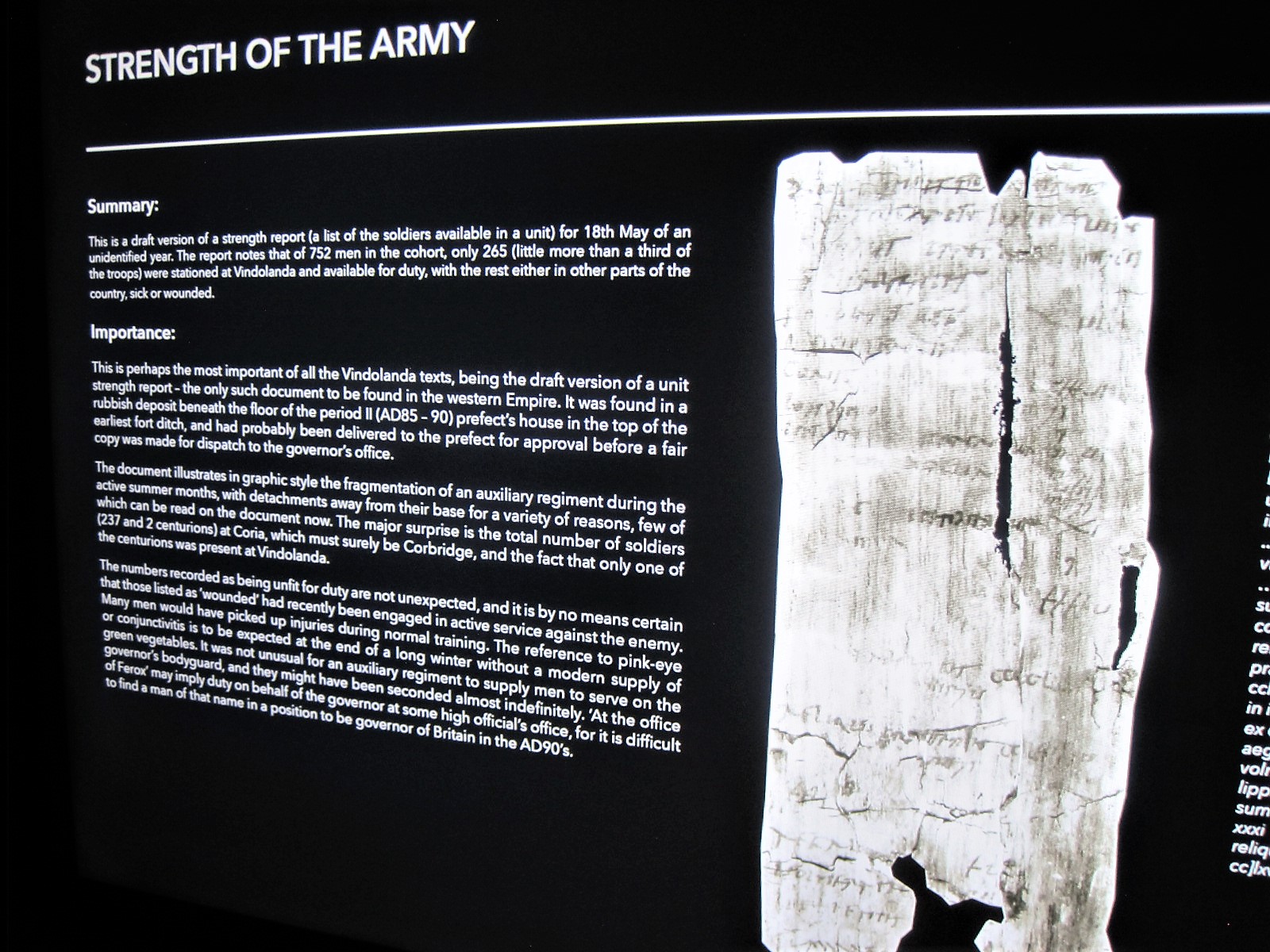
In a darkened corner I finally find what I’ve been looking for. Described as ‘postcards from the past’, the Vindolanda Tablets inspire awe. I peer into the illuminated cabinets, trying to decipher the writing from a world 2000 years ago. Defeated by language, I gaze numbly through the glass. Many hours have been spent transcribing these events from everyday life, and many more could be spent reading them.

Finally I pull myself away, and head back outdoors. Clouds have scudded in and I feel the chill that must once have settled on Roman bones. I linger just long enough to climb one of the wooden forts, hoping to find a degree of shelter from the wind. Looking down on the remains of a bathhouse, I shiver and then march briskly, back to the car.


I hope you enjoyed this venture back in time with me, and can only urge, if ever you have the chance, that you visit. The rewards are rich. Full access details for Vindolanda and the Roman Army Museum (to follow) are on the website.

Another bumper crop of walks to share with you this week. Many thanks to everyone for their efforts, and for many hours of pleasure. Join me any time on Jo’s Monday walk. You’ll be very welcome. Definitely time to put the kettle on!
…………………………………………………………………………………….
Drake was swift off the mark with a bit of fun this week :
Closely followed by Lady Lee, with a garden of her own :
The moon, apple blossom and our garden
And then Lisa took us all the way to Israel :
Always fascinating to see where someone lives. Let Suzanne be your tour guide, with quiet atmosphere:
And, not to confuse you, a very different Suzanne takes you on a forest walk :
Grab a coffee next, and go look at some books with Janet!
Then check out life with Jesh :
And a few thoughts on life from Geoff and friends :
My good friend Pit takes you on two, quite different, sculpture walks :
Sioux Falls/SD : A stroll along Sculpture Walk
Galveston 2017 – Impressions #2 (Tree Sculptures)
Wonderful to find yourself alone in one of the world’s most popular cities- a lovely photo walk with Jaspa :
The Calli, Campi and Canali of Cannaregio, Venice
And talking of popular cities, I wish I could join Susan in this one :
Walking Lombard Street in San Francisco
Two Susans this week, and it’s so nice to have this one back :
A Jane’s Walk in Douglaston, Queens
I love a lady with wanderlust, and you can certainly describe Pauline that way :
It’s always pleasant to see a bit more of Belgium with Denzil (and a daughter too!) :
Walking around Lavaux-Sainte-Anne
And what is it about villages with a stream running through? Join Eunice on a sunny day!
Bank Holiday walk round Barrow Bridge
It’s another sunny morning here in the north east, and I shall be making the most of it. Have a great week, everybody!
 restlessjo
My goodness, Jo. Absolutely thrilling! I can’t imagine walking in the footsteps of history that goes this deep! And to see those little shoes is just extraordinary! I wouldn’t know what thrills me most…it’s all to marvelous. 🙂
LikeLike
2000 years does seem an incredible amount of time, doesn’t it? I tried to think of it in terms of generations, but gave up. 🙂 🙂 Just a superb place to be, Debbie. And chatting to Graham, you could feel the enthusiasm and excitement, even after 14 years on the project.
LikeLike
Looks like I won’t be seeing this place in person since I seem to be averse to flying, or crossing oceans. 😀 But your timing for this post was superb because it dovetailed beautifully with a book I’m reading by a British archaeologist and Medieval historian: Alexander Langland’s “Craft” The images from your visit brought some of the descriptions in the book to life! Thank you.
LikeLike
That’s amazing, Gunta! I shall look out for the book. At least you have the wonderful worldwide web to travel with. The Vindolanda website has lots of images, including the Roman Army Museum link. Not sure yet whether to do that as a separate ‘walk’, but there will be a follow up post. 🙂 🙂
LikeLiked by 1 person
It’s always a stunning experience to immerse oneself in artifacts of former time. And of course, the Roman influence before the Common Era was amazing. A captivating post, Jo.
LikeLike
Thanks a lot, Otto. I’ve meant to visit for a long time and was so glad I finally made it. 🙂 🙂
LikeLiked by 1 person
Amazing how the shoes have survived so long Jo, the Romans were remarkable people weren’t they? I’d love to see this place one day. How’s your week shaping up my lovely?
LikeLike
Incredible determination, Gilly! 🙂 🙂 Had a tooth extracted today and having a nightmare with Polish buses and trains for my upcoming visit. Currently searching for flights for James to somewhere European that go at the right time and don’t cost the earth (i.e school hols 😦 ) Now is not a good time to ask that question. But, the sun is shining 🙂
LikeLiked by 1 person
Oh poo, nothing’s ever simple is it? When are you going to Poland? I must say I’m wondering about the logistics of getting around the city when I can’t read a single sign! What about sites like Love Holidays for James? or a late booking with a budget airline?
Sorry about your tooth, it’s horrid having one out 😦 chin up chook xx
LikeLike
Early June. There appears to be rail disruption and the coach goes from somewhere obscure. 😦 Never heard of Love Holidays but I’ll have a look. Been doing battle with Ryanair. Hugs, sweetheart! I’ll get there. 🙂
LikeLike
Will you see your cousins and Meg as well? We’ll miss each other I assume? We arrive on the 2nd and leave on the 5th!
LikeLike
I’ll email you. I was trying to keep secrets but I can’t lie 🙂 🙂
LikeLike
Eine tolle römische Siedlung oder Legionär – Lager. Wahnsinnig, wie gross das römische Reich einst war…
Liebe Grüsse in den Dienstag. Ernst
LikeLike
Sie waren bemerkenswerte Leute Ernst. Guten abend 🙂 🙂
LikeLike
Excellent captured. 🙂
History always so fascinating. 🙂
LikeLike
Thanks darlin! I really enjoyed my day there xx
LikeLiked by 1 person
What amazing treasures have been unearthed at the dig. I love the old shoes. How incredible that they have lasted this long.
LikeLike
There were heaps of shoes on display in a glass case Suzanne. Hard to photograph but I wish I’d taken more. It’s an amazing place x
LikeLiked by 1 person
It sounds it. I woke up thinking about those shoes this morning. I find it incredible they have lasted so well. 🙂
LikeLiked by 1 person
Good to see you Jo. This was an interesting walk, your commentary gives it so much historical context. Isn’t summer coming soon?
LikeLike
And you, Mary! I’ve wondered a time or two how things are with you. 🙂 🙂 I forget how lovely summertime is until we get a few days of sun. It changes our whole perspective. Thanks, darlin- I’ll pop over and say hello.
LikeLiked by 1 person
Looks really interesting, Jo. Thanks for braving the chilly weather to get these great photos. 😃😘
LikeLike
It’s a very charismatic place, Ad. You can almost feel the weight of history. It was lovely and warm when we arrived, but I’ve also been up that way when it’s been bleak. 🙂 🙂 Thanks, darlin!
LikeLike
Jo, I would love to visit this place. Walking the length of Hadrian’s Wall is on my wish list 🙂
LikeLike
Funnily enough, perhaps because it’s not very far away, we’ve never spent a great deal of time there, and I always want more when I do go, Gilda. 🙂 🙂
LikeLike
Another place that has obviously come on in leaps and bounds since my youthful visits. Very close to my place of origin too (Haltwhistle).
I occasionally consider whether it would be a good idea to do the Hadrian’s Wall walk before coming to my senses.
LikeLike
In small stages, perhaps, Annabel? 🙂 🙂 That’s how I would do it. And yes, the site is much improved since I was last there too.
LikeLike
I was thinking all at once. I’ve always fancied doing a long distance path, but not too long distance, though I think I’ve probably left it too late. Too crazy now!
LikeLiked by 1 person
Never been there but would love to walk in those footsteps (but not wearing those boots). You’ve made it all come alive so beautifully, I was quite sad when I came to the end of your Post.
LikeLike
You can come to the Roman Army Museum later in the week, if you’d like. 🙂 🙂 Nothing like so lovely as Vindolanda, but interesting. Thanks, Mari!
LikeLike
So lovely, RJo! I have for a very long time been a fan of Hadrian’s and all of the various portions of his Wall that remain. Thanks for showing me this one 🙂
LikeLike
I’m trying to get around a few more over the summer, Susan. They’re not too far from me. 🙂 🙂
LikeLiked by 1 person
Definitely a site to cherish, and, for sure, an archaeologist’s dream. I agree these Roman ruins and the museum must have something to offer for anyone. Definitely on my list whenever I’m in the area. Thanks for the in-depth story and walk, Jo. I’m impressed by the shoes as well. But, as to the “comfortable toilets” back in these Roman times… how do they know? Did those toilets already have seats in those days? I wonder what comfortable meant, and means. 🙂
If you are interested to add my last blog to next week’s Monday Walks, feel free to do so. You’ve checked it out already. It offers photos of three very different hikes – in the dunes, to and above a waterfall, and in extensive caverns. Thank you, Jo!
http://www.roamingabout.com/highlights-in-southern-new-mexico-a-long-weekend-away/
LikeLike
If you look at the illustrations on one of the information boards, Liesbet, it show s you exactly what the toilets were like. Though I’ve never sat on one. 🙂 🙂 Of course I’ll include your walk next week. I was going to offer but there were already a lot of walks this week and I worry that people won’t have time to visit.
LikeLike
Thanks, Jo. And, the toilets are approved; as long as the seats weren’t too cold. 🙂 I’ve used worse, especially in China.
LikeLiked by 1 person
Wow – just getting all that historical detail down in a post is daunting, let alone the actual building of the fort, the wall and all the other things the Romans constructed! The old shoes always sort of fascinate me; at the same time that the shriveled leather kind of creeps me out, I have to marvel at the intricacies like the beads on the soles. What a pretty day you had for your jaunt.
LikeLike
I did intend more of the history but it’s complicated and if people are interested they can visit the website. It’s a beautiful part of the world on a sunny day and we were lucky xx
LikeLiked by 1 person
What amazes me about the Romans: wherever they went, they had those wonderful bath houses. I saw it once, a long time ago, at a very small outpost of theirs on a pass in the Lake Distict. Not much of a “fort”, but a bathhouse with it. 😉
LikeLike
They must have been very clean! They’d need them to keep warm up here xx
LikeLike
True!
LikeLiked by 1 person
Thanks, Jo, for mentioning my walk to see Galveston’s tree sculptures! 🙂
LikeLike
Oh, and Sioux Falls and the statues! Thanks again! 🙂
LikeLiked by 1 person
You’re welcome hon xx
LikeLike
🙂
LikeLiked by 1 person
Absolutely fascinating, Jo. Thank you!
LikeLike
It’s an amazing site Angela. Anyone who likes history would be thrilled by it x
LikeLike