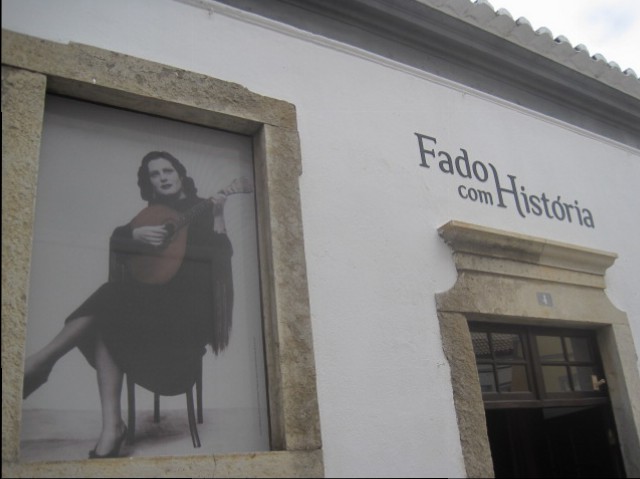
The venue
As I was meandering around the cobbled streets of Tavira, I spotted, several times, a leaflet in a shop window. Always interested in a new venture, I went to find out more. ” Fado com História” is situated in the heart of the old quarter, just beside the Misericordia Church and below the castle walls. What I found delighted me. If you’ve never experienced Fado, or think that it might not be for you, I can recommend you to this introduction.
Fado originated in Lisbon, and the show begins with a video featuring some of Portugal’s most famous Fado singers, so that you get a feel for the sound. Most prominent among these was Amalia Rodrigues(1920-1999). She said that “Fado has to be felt. Fado isn’t sung, but just happens. You feel it, you don’t understand it, nor can it be explained.” Such passion did she arouse that, when she died, Portugal held 3 days of national mourning.
A wonderful live performance
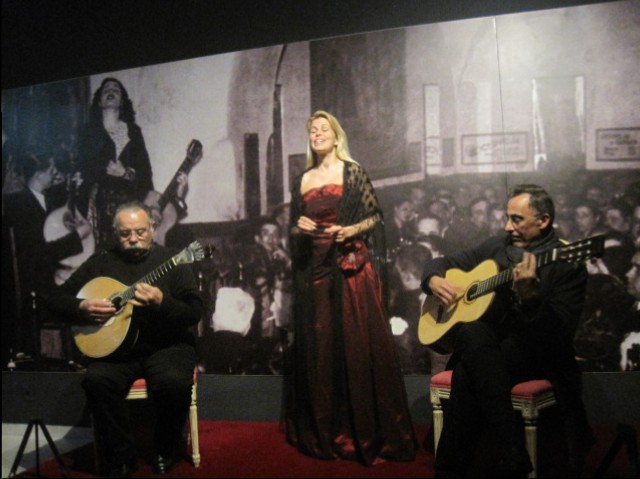
Nowadays Fado can be heard throughout Portugal, usually in an atmospheric bar or restaurant. “Fado com História” is a small venue, featuring a trio of live artists. They include Virgilio Lanca, who plays guitar and makes most of the explanations in a soft voice. He describes fado as “a song that gives you goosebumps”. Miguel Drago plays Portuguese guitar, which has 12 metallic strings in groups of 2. You could hear a pin drop as the two begin a guitarrada, demonstrating the ebb and flow of their art.
They are joined by a fadista, Teresa Viola, a lovely young woman with a beautiful voice. She closes her eyes, takes a deep breath, and leans into the performance. Accompanied by the guitarists she sings 4 or 5 fados, explaining the stories behind them. The backdrop is a wall-sized photograph of a 1942 performance at Cafe Luso, in Lisbon, featuring the great Amalia.
The passion of the performers for their project is clearly evident, and at the end of the show they are happy to talk about it. They are working in conjunction with the Fado Museum in Lisbon but have found a different way to present fado, and the live performances are key.
The museum is open from 10am to 5pm every day except Sundays, and a new show begins each hour. Details are at http://www.fadocomhistoria.wix.com/fado . I can only suggest that if you have the opportunity at any time you should go along. You will be warmly welcomed. This video is in Portuguese but is quite easy to follow.
 restlessjo
Fado is slightly more bearable than Flamenco… the emphasis being on “slightly”. 😉
LikeLike
Can’t please all of the people… 🙂
LikeLike
Too true 🙂
LikeLike
I’ve never heard of fado music Jo thank you for this introduction and yes I can definitely shut my eyes and imagine being in a bar with the lights down low and a nice glass of wine and some one you love (and maybe 20/30 years younger!!!) It is very emotional, from the heart type of music.
LikeLike
You don’t even really need to speak the language, Pauline. It just draws you in. 🙂 So glad you enjoyed it.
LikeLike
Yes it is a very emotional type of music.
LikeLike
It’s fascinating Jo. I watched a documentary about Fado a few years ago and I’d love to hear it live one day.
LikeLike
I have a feeling you’d love Portugal, Gilly 🙂
LikeLike
Well you certainly got that right honey!
LikeLiked by 1 person
I feel more connected to a place when I immerse myself in the customs – music food, etc. While the fado music isn’t something you would listen to every day, hearing it every now and then brings must you back to a place you love. Wonderful wonderful post, Jo.
LikeLike
Thanks, Elisa 🙂 Virgilio was so enthusiastic about the project, which only started last December. It’s a thrill to connect with someone so talented. We have a couple of Fado CDs and sometimes put them on in the car when we’re travelling. You’re right- it brings you back to ‘home’. 🙂
LikeLike
buongiorno Jo , il fado è la musica dell’anima, il canto più vero che ti accompagna ovunque in Portogallo, anche io lo adoro e mi fa molto piacere che tu abbia voluto dedicargli uno spazio sul tuo bolg
ti auguro un lieto giovedì, e ti abbraccio con affetto
LikeLike
Happy Thursday to you too, Annalisa 🙂 I knew you would love this soulful kind of music. It’s not for everybody but I love the atmosphere it creates and the instruments. Un bacio, cara!
LikeLike
Thank you for sharing this with us!
LikeLike
You’re very welcome. It can be an acquired taste and I’ve grown to love it. 🙂
LikeLike
We loved the fado music in Lisbon Jo. Perhaps not something I would like every day but fascinating.
LikeLike
I love the soulfulness, Sue! 🙂 The older style can be a bit mournful but I love the atmosphere it creates, and the way you’re pulled right in. Thanks for reading! Good week so far?
LikeLiked by 1 person
All good here Jo. More snow and a bit colder but then it is winter. 🙂
LikeLiked by 1 person
Absolutely wonderful, Jo. Love the guitar especially. 🙂
LikeLike
The sounds are quite magnetic, Ad. I love that Virgilio has started this in Tavira and I will return. 🙂
LikeLike
I enjoyed this style of music and am grateful for your description and history, too. I enjoy flamenco and other styles of Spanish music, also enjoy Italian opera, so this is a great addition to my musical choices. Thanks, Jo!
LikeLike
It can be very mournful, Robin, but I love the instruments and it was spellbinding being so close to them. Glad you enjoyed 🙂
LikeLike
I am so glad others said it was sad and you used the word, “mournful,” since it may sound like I didn’t like it if I were to describe this so. Jo, this music pulls somewhere deep in my ‘gut.’
LikeLiked by 1 person
You visit the best places, Jo. Thanks for sharing this beautiful music. 🙂
LikeLike
We were a very small audience, Jill, and it was enchanting to be so close. They so love what they are doing. 🙂
LikeLike
Fabulous. Until I heard the voice, I thought nothing could get better than that guitar! Fado in Portugal – hopefully, next spring!
LikeLike
You’ll love it! 🙂
LikeLike
What a beautiful experience Jo. And I don’t think it would matter if one doesn’t understand Portuguese – one can still feel the emotion.
LikeLike
Yes, it’s purely emotion, Colline. All of life! 🙂
LikeLiked by 1 person
Truly lovely, thanks for posting!
LikeLike
Hi Cindy 🙂 Glad you liked it. Thank you!
LikeLike
Never heard of this style of music and how wonderful that they have a living, interactive museum dedicated to it.
LikeLike
We sometimes go to performances in the local bars, if we can. The Portuguese love to draw their audience in and include them. I like it very much 🙂
LikeLike
You’re convincing me that we must visit Portugal!
LikeLike
I really think you should! 🙂
LikeLike
How interesting is this. I’d never even heard of Fado
LikeLike
It’s really only popular in Portugal and Brazil, Peter, so it’s no wonder. 🙂 Thanks for taking time to read.
LikeLike
Beautiful place Jho .
I really enjoy this post.
LikeLiked by 1 person
Thanks, Jake 🙂 They were passionate about their music and I love that.
LikeLiked by 1 person
I haven’t heard of this style of music so thanks for giving me an insight Jo. This sounds like a great way to find out more.
LikeLike
It’s not to everyone’s taste but there’s quite a lot of variety in the style, so maybe something you’d like. Thanks for listening 🙂
LikeLiked by 1 person
She has remarkable voice! Thank you for the video link! :).
LikeLike
Thanks for listening, Amy 🙂 Something a little different.
LikeLiked by 1 person
🙂
LikeLike
I am quite open minded to music, and this is okay to listen but sometimes a lot happens in one movement and to me just sounds like noise….but enjoyed most… I went to Greece years back and listened to a lot of Greek music, balalaikas etc,, live they were good…
LikeLike
It’s an acquired taste, Gerry. It’s evolving a little from the old style and if you’re sat in a bar with a nice atmosphere you’d be happy to join in. I have fond memories of Greek music too (and smashing the odd plate 🙂 ) Thanks for giving it your time.
LikeLiked by 1 person
I think you are referring to bouzouki music in Greece. Balalaikas are a Russian instrument 😀
I like the Greek music too – when I am in Greece 🙂
LikeLiked by 1 person
This is so hauntingly lovely, Jo. Thanks for the intro to Fado.
LikeLike
I’m really glad you like it, Tish 🙂 It’s not to everyone’s taste and some of it is a little mournful, even for me. This is a really good project though, which deserves support.
LikeLiked by 1 person