 This is where my Polish friends might raise their hands in protest. You see, in Polish there is a letter L and a letter Ł (ł in lower case). The two are quite separate, but as there are 33 letters in the Polish alphabet and I am constantly short of time, I’m combining them in this post. To English eyes they probably look very similar, but ł is pronounced like the English “w” in “wet”.
So, the city that I’m going to tell you a little about, Łódź, is pronounced Wooj, or something very like that. I have never actually visited this city, which is the third largest in Poland, but it has always intrigued me for its name, which translates as “boat”. This for a city which lies right in the centre of Poland, 84 miles south-west of Warsaw, and doesn’t even have a river running through it. Apparently the city once had a total of 18 rivers, but they were covered over due to chronic pollution.
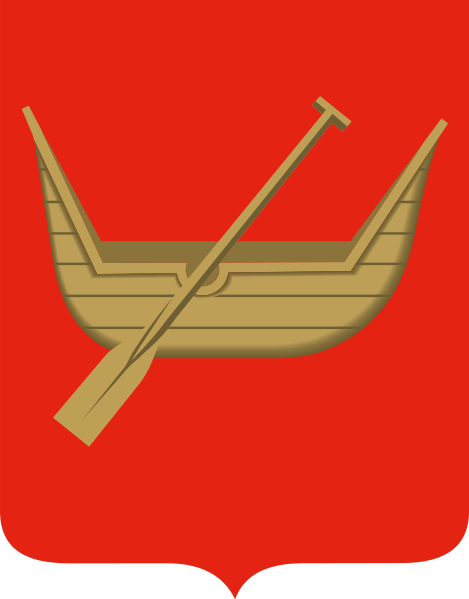
A boat, the coat of arms of Łódź- from Wikipedia
The first written record of Łódź appears in 1332 as the village of Łodzia, and in 1423 King Władysław Jagiełło (who you may remember from my J is for Jadwiga post) granted it city rights. It was always at the crossroads of trade but at this time most of the inhabitants worked on grain farms in the surrounding flat lands.
Like many another Polish city, the history of Łódź is colourful. It lost its identity to Prussia in 1793, and then at the Congress of Vienna in 1815, became part of Russian Poland. The Tzar gave territory deeds to German immigrants to clear the land and build factories and housing. In 1825 the first cotton mill was opened and the textile boom began, with an eager Russian market on the doorstep. Łódź has been likened to a “Polish Manchester” due to its prosperity from textiles. Relationships with their Russian neighbours deteriorated rapidly, climaxing in the Łódź insurrection (or June Days) in 1905, which was violently put down by the Tzarists.
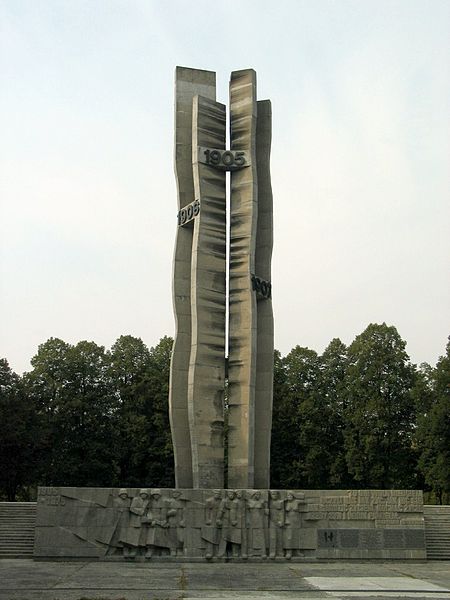
Łódź monument to the 1905 insurrection- from Wikipedia
Many of the industrialists were Jewish, thus, during the Nazi occupation, the Łódź Ghetto was set up. It was the last major ghetto to be liquidated due to the value of the goods the occupants produced for the German military. The Germans requisitioned all factories and machinery and transported them to Germany so that Łódź was deprived of most of its infrastructure. Refugees from Warsaw flooded into the city and in the aftermath of the Warsaw Uprising, Łódź became a temporary capital. Apart from Kraków it was the only Polish city not to have been raised to the ground.
It’s not all doom and gloom. I knew little about Łódź, but even I had heard of the National Film School, founded in 1948, and its famous student, Roman Polanski. The film industry and new businesses locating in Łódź due to its excellent transport links have aided the slow rebirth of the city. Renovation is ongoing on Ul. Piotrkowska, at 5km the longest main street in Europe. OFF Piotrkowska is a lively complex of cafes, restaurants and designer shops within 19th century former cotton mill buildings.

Sculpture of pianist Artur Rubinstein on Ul. Piotrkowska- from Wikipedia
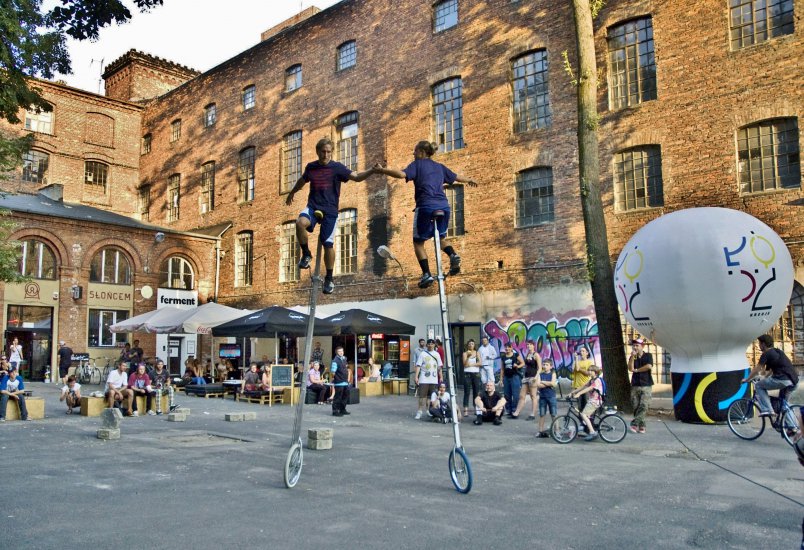
OFF Piotrkowska- from “In your Pocket” Łódź guide
Even better news is that the rivers I referred to at the start of this post are now the subject of a restoration project. Who knows where it all might end for the city of Łódź? Manchester isn’t doing so very badly.
Lusia and Lodzia
Most of my Polish family live in the neighbourhood of Bełchatów, about an hour south of Łódź. As usual, when I was in Poland in May, I went to see my lovely Aunt Lusia in Zawady. She is my Dad’s only surviving sister, and lives close to the farmstead where Dad grew up. Her portion of land is a good size with a lovely pond and numerous fruit trees. Lusia tended the huge vegetable plots herself when she was younger, but now much appreciates the help of her daughter Theresa, who lives with her. Granddaughter Edyta completes the household (if you don’t count the rabbits, of which there are many!)
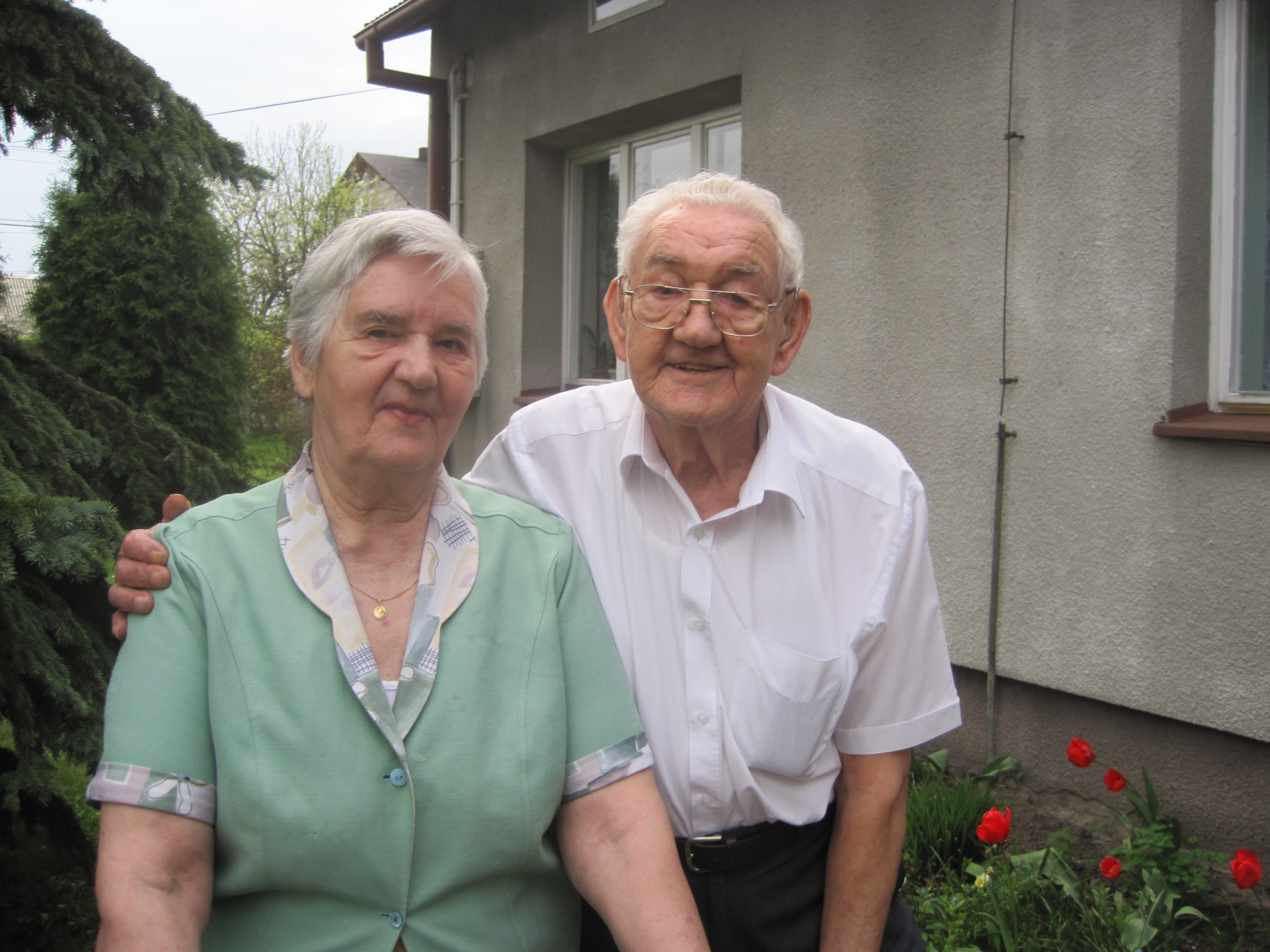
Lusia and Dad
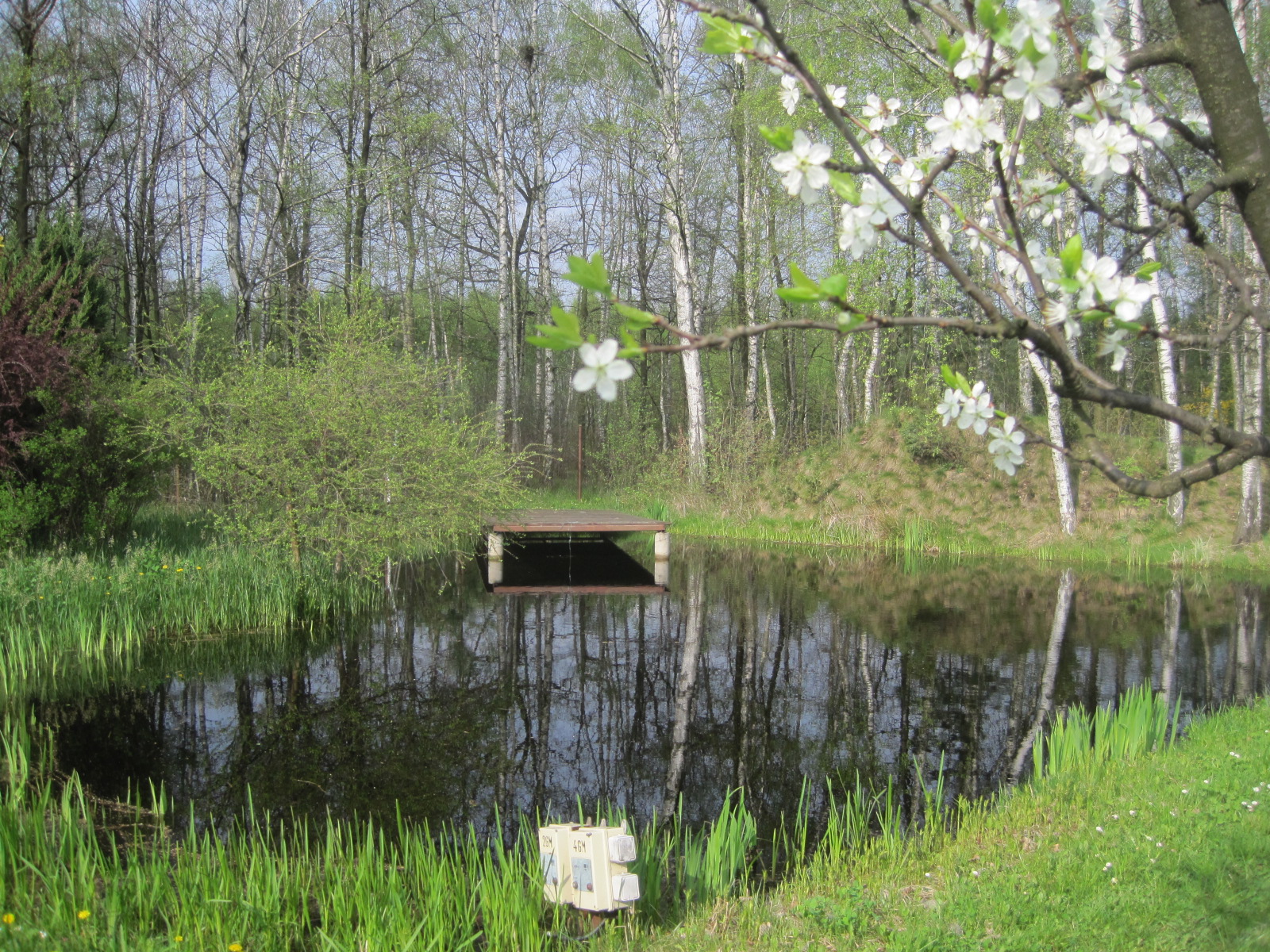
The pond at the bottom of the garden
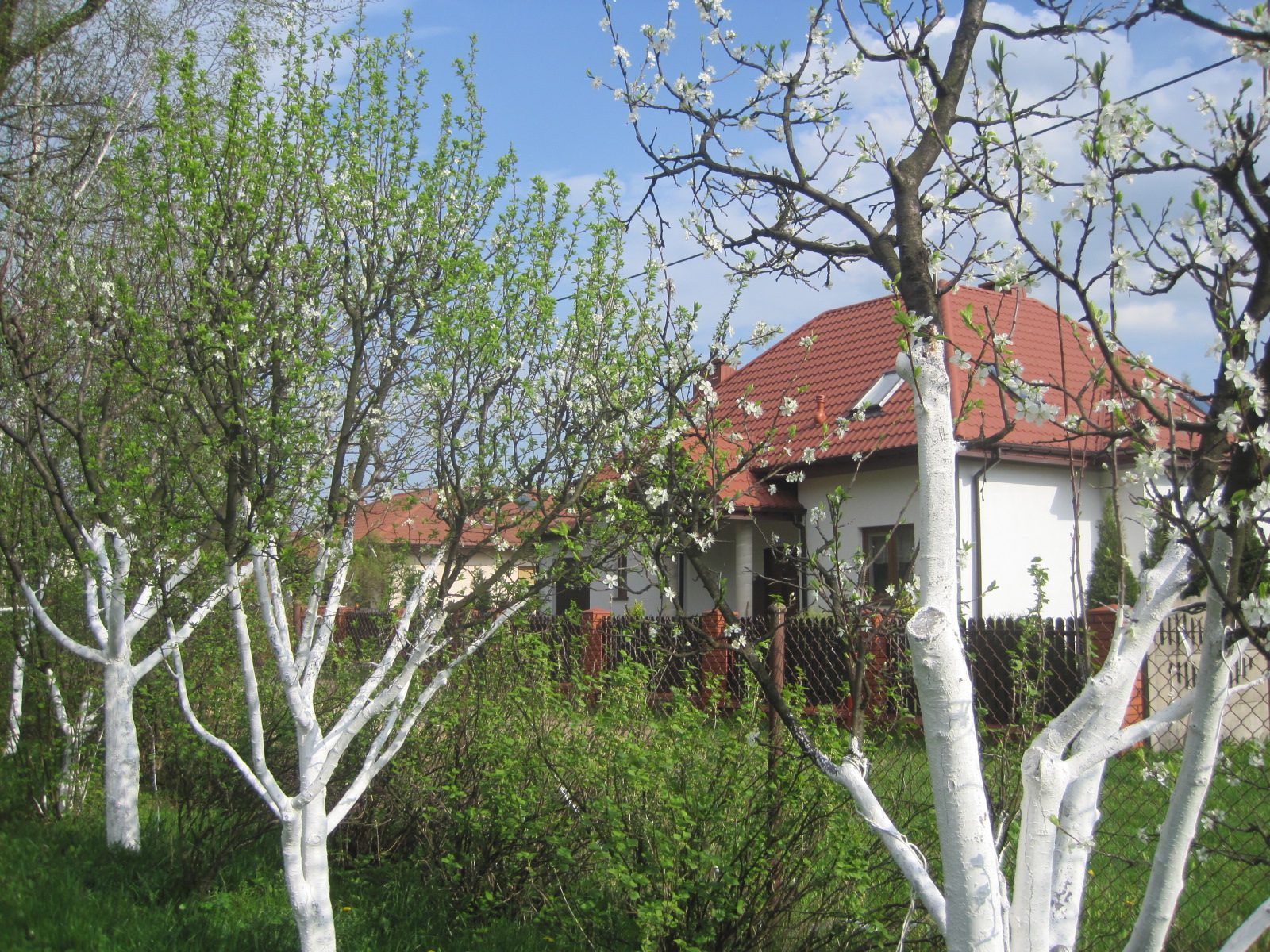
Fruit trees and the neighbours
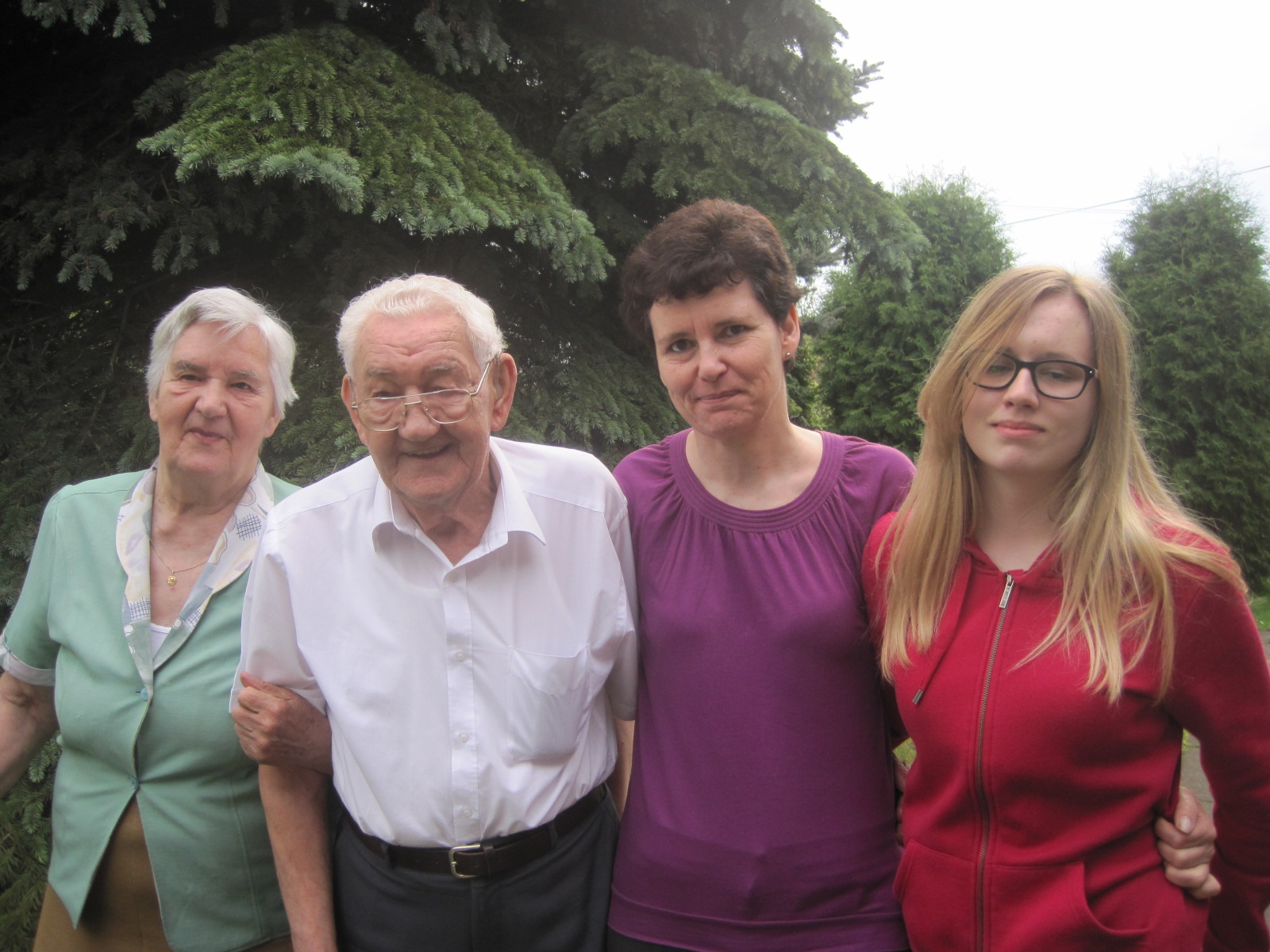
Lusia and Dad with Theresa and Edyta
Most of the family have built houses on land from the original farm, and Lusia is now dividing hers to make life easier. Her daughter Grażyna and son-in-law Marek live in a high rise flat in Bełchatów (I was there on my visit too!) and are now building a house next to Mum. A widow for many years, I never met her husband Zbigniew, but have seen photos of them as a happy young couple. It will help Lusia to have family so close by. A third daughter, Irena (who will feature in my letter “I”), also lives in Bełchatów. One last little thing to share- Lusia’s given name is Otylia. I’m not at all sure how Lusia comes from this, but that’s just how it is.
Just across the lane from Lusia is the home of Lodzia and her remaining unmarried family. This is my Dad’s original home and was taken on by the oldest son Zygmunt, when their parents died. Sadly Zygmunt himself died just months before the family reunion which brought Dad back to Poland. He had tried so hard to find Dad, and maybe things would have gone differently if he had succeeded.
Lodzia has her sons Bolek and Piotrek helping on the substantial plot of land. Dad remembers taking the cows to a stream when he was a small lad, but the cows are long gone (as is the stream, strangely enough).
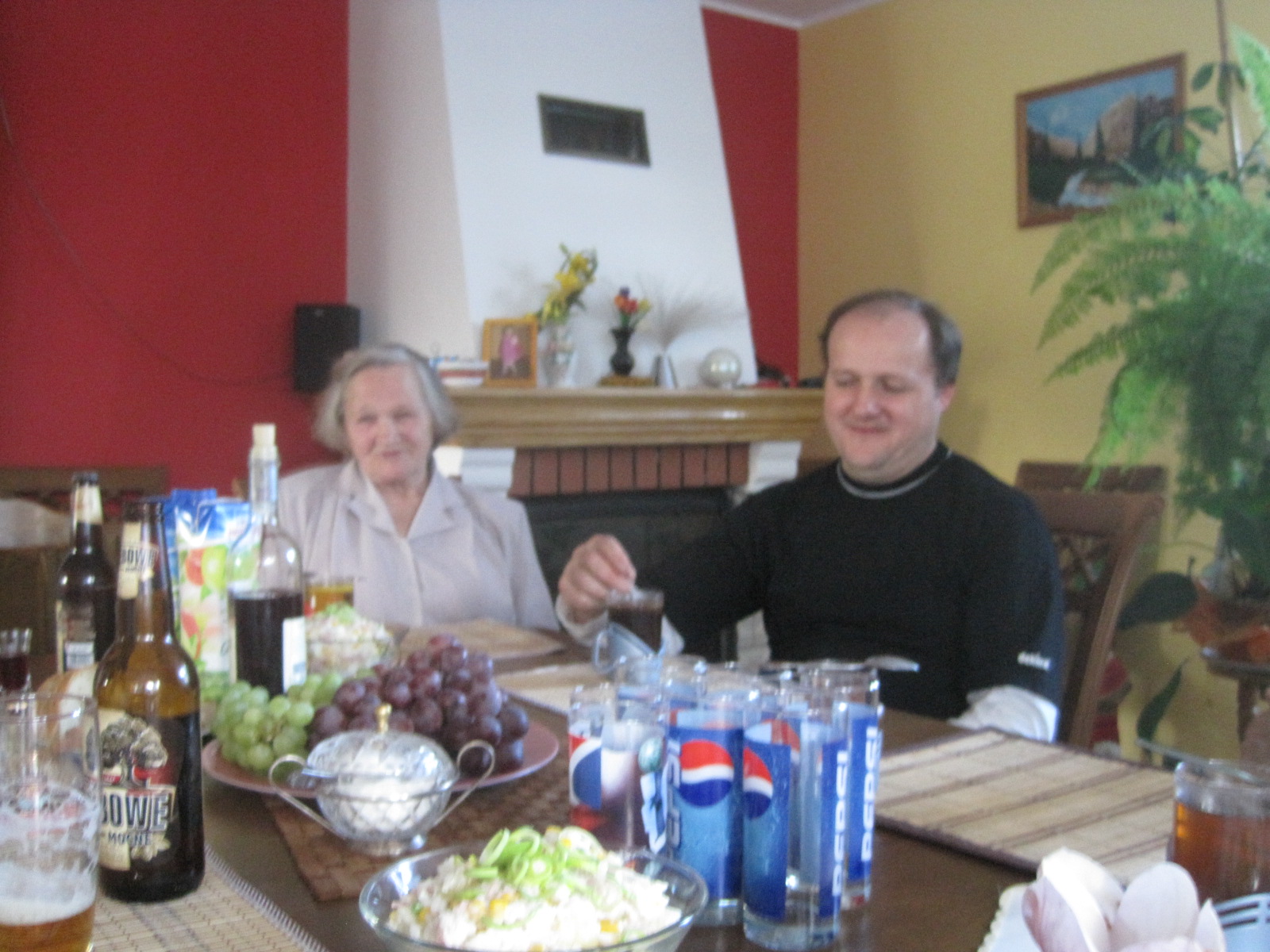
A slightly blurred photo of Lodzia and Bolek at Jadwiga’s home
You will have seen Lodzia on my blog before. She is my lovely cousin Jadzia’s mum and we traditionally have supper at Jadwiga’s home, pictured above. The farmhouse is now very run down and Lodzia does not have an easy life. She also has the care of a blind son, Adam, who suffered the injury in an explosion many years ago. Life is never all roses, is it? My Polish family have had their share of tragedy, but they go on smiling and welcoming us each time.
This post is part of my Personal A-Z of Poland, for which I owe thanks to Julie Dawn Fox. I have put links to Wikipedia and my other posts for anyone who is interested. The logo below will take you to Julie’s A-Z page, and I’m also linking to Frizz’s LLL-challenge, even though, as usual, I’m late! MMM arrived this morning.

 restlessjo
I need to go back and read all of your Poland posts. It’s on my list!
LikeLike
Some of them are a bit long-winded, Ruth 🙂
LikeLike
Jo, This is wonderful … and now I know how to pronounce Łódź – never would have guessed “Wooj.” We have just arrived in Wroclaw and it’s wonderful – beautiful and vibrant! Have you been here? ~Terri
LikeLike
Hi Terri! I spent a week there last August (counting gnomes!) It’s beautiful, isn’t it? I have a cousin who lives there 🙂
https://restlessjo.wordpress.com/2012/08/22/the-gnomes-have-it/
https://restlessjo.wordpress.com/2012/07/28/six-word-saturday-28/
LikeLike
What an interesting family history you have, Jo. How sad that Zygmunt didn’t live for that family reunion. I love the Arthur Rubinstein sculpture, and also the mono-cyclists.Thanks so much for sharing our family photos. 🙂
LikeLike
I only know a portion of it, Ad. Dad had another 3 sisters who died relatively young, and my Aunt Anna who we met but died 2 years ago. The family was scattered when Communism took over but it’s surprising how many of them still live so near their roots. 🙂
LikeLike
I really love your Personal A-Z of Poland Jo, it shows me a side of Poland that I will probably never get to see and family stories are so fascinating 🙂
LikeLike
Thanks so much, Sam 🙂 It’s nice to do different things but I worry that people will find these too long-winded and boring, so I’m glad to hear you enjoyed it.
LikeLike
Very interesting post, really enjoyed it… 🙂
LikeLike
Thanks, Drake. Glad you did 🙂
Have a nice day!
LikeLike
gosh Jo, so much depth in this post … history, family … I need to breathe deeply and think of those fruit trees and vegetable gardens!
LikeLike
Ok, Christine- I’ll do something lighthearted next 🙂
LikeLike
Great post, I’m going to sound rather intelligent talking to my polish friends now
LikeLike
That’s a worrying thought but I like it 🙂 Thank you!
LikeLike
ma che belle variazioni anglo-polacche-portoghesi dall’amica Giovanna ( sì, sì, d’ora in poi dirò il tuo nome in italiano, così ci sarà ancora più confusione,,,ha ha ha)
lettura molto interessante, grazie cara
bacino
LikeLike
You may call me Giovanna if you prefer, Ventis. 🙂 I like a change from time to time. Grazie mille.
LikeLike
What a lovely family you have Jo and such an interesting history of such a beautiful place. Love the pond! Thanks for sharing hon. Great shots! 😀 *big hugs*
LikeLike
Thanks for your lovely company, Sonel. I’m feeling blue tonight so it helps. Hug 🙂
LikeLike
I am so sorry to hear it Jo and I do hope you are feeling much better today. I would love to be there to just hug you and chase those blues away. Take care hon and feel better soon. 😀 *big hugs* xxx
LikeLike
Sky’s still grey but my mood is better, hon. Thanks for understanding. Off to t’ai chi class soon. 🙂
LikeLike
Sorry to hear about the sky but I am sure the sun will come through shining brighter than before and glad to hear you’re feeling better. Enjoy the class. 😀 *big hugs*
LikeLike
Another fine post Jo. Your dad has such a friendly face.
LikeLike
Lived in, in a good way, I think, David 🙂 He doesn’t often frown.
Many thanks.
LikeLike
Beautiful post, Jo! Enjoyed reading the history. Thank you for posting photos enabling us to meet your family.
LikeLike
So many of them, Amy, but the challenge is just about equal to it 🙂
Thanks for your support, hon.
LikeLike
I’ve enjoyed learning more about Poland and your family photos are marvelous Jo!
LikeLike
Hi Meg! Are you in Cornwall, I wonder? I think the weather’s pretty good 🙂
LikeLike
You’re a wonderful teacher, Jo! Lusia has a beautiful piece of property…terrific photos. Your dad looks so sweet…the apple doesn’t fall far from the tree. 🙂
LikeLike
Jill, you could end up being a lifelong friend 🙂 Teaching wasn’t something I ever saw myself doing but this kind I don’t mind.
LikeLike
thank you for
” Łódź, is pronounced Wooj” –
there was a pop song in Germany
“Theo, let’s drive to Łódź” =
Theo, wir fahrn nach pronounced: Lotsch / Lodge
LikeLike
Pretty lady, Frizz 🙂 I seem to remember her from somewhere. Eurovision, maybe.
Thank you for the challenge. I’d better start my mmm tonight! 🙂
LikeLike
Thank you for a lesson on the lodz! Very cook! I love the L with the line in it!
LikeLike
You mean “w” 🙂 It’s a funny old language, Jasmine.
LikeLike
It’s SO interesting!!!
LikeLike
Fascinating post, Jo. And you learn something every day – the two Ls in Polish, makes sense of some of the pronunciations I have heard….
LikeLike
I found pronunciation very strange at first, Sue, but after a while it sinks in 🙂
LikeLike
I love it when they restore cities to their former glory. 🙂
LikeLike
This one’s definitely a work in progress, Colline, but it’s getting there. 🙂
LikeLike
Great post dear Johanna, and wonderful photographs. Thanks and Love, nia
LikeLike
Thanks, Nia. Sooner or later I’ll get to the end of this challenge 🙂
LikeLike