


It was not a promising beginning! I stuck my head out of Edinburgh’s Waverley Station into damp and dreary grey skies. No-one gave the bedraggled looking ice cream vendor a second look. Still I was bubbling over with excitement at a precious few hours in this beautiful city and determined to make the best of it. Where better to start than The Royal Mile?
Approximately a mile long (surprise!), it rolls gently downhill from Edinburgh Castle to the gates of Holyrood Palace. Did you know that miles can vary in length? I was astounded to find that they can indeed, and that a Scots mile is longer than an English mile! No wonder my feet got tired in Edinburgh. The English statute mile was established by a Weights and Measures Act of Parliament, in 1593, during the reign of Elizabeth I. “A mile shall contain 8 Furlongs, every Furlong 40 Poles, and every Pole shall contain 16 Foot and a half”. For more clarity, read this link.


You will observe that Edinburgh has its share of ‘tourist tat’ interspersed with venerable historic buildings. There’s room for all. The Royal Mile is actually comprised of five consecutive streets- Castlehill, Lawnmarket, High St., Canongate and Abbey Strand. I joined High St. directly from North Bridge and was ambling down towards the Palace. Many closes and alleys invite further inspection, but I’m drawn towards the World’s End pub on the corner of St. Mary’s St., a former city boundary. After the English victory over the Scots, in 1513 at the Battle of Flodden, a city wall was built around Edinburgh. Parts of the Flodden Wall still exist in the pub foundations. Brass studs in the road mark the former position of the Netherbow Port, a gateway in the wall.
John Knox House stands on the opposite corner. The gateway was removed in 1764 to improve the flow of traffic where the road narrows. Beyond lies Canongate, literally ‘the canon’s way’, used by the Augustinian monks from Holyrood Palace. Until 1856 Canongate was not only a street, but the name of the surrounding burgh. It was separate from Edinburgh and outside of the Flodden Wall.
The damp persisted, but it didn’t stop my enjoyment of a totally unexpected city garden. I had stumbled upon Dunbar’s Close, complete with wonderfully cobwebby Scottish thistle. This 17th century garden was created by Sir Patrick Geddes, an eminent Scots biologist who was aware of the relationship between health and environment. It was restored to its current condition in 1978.


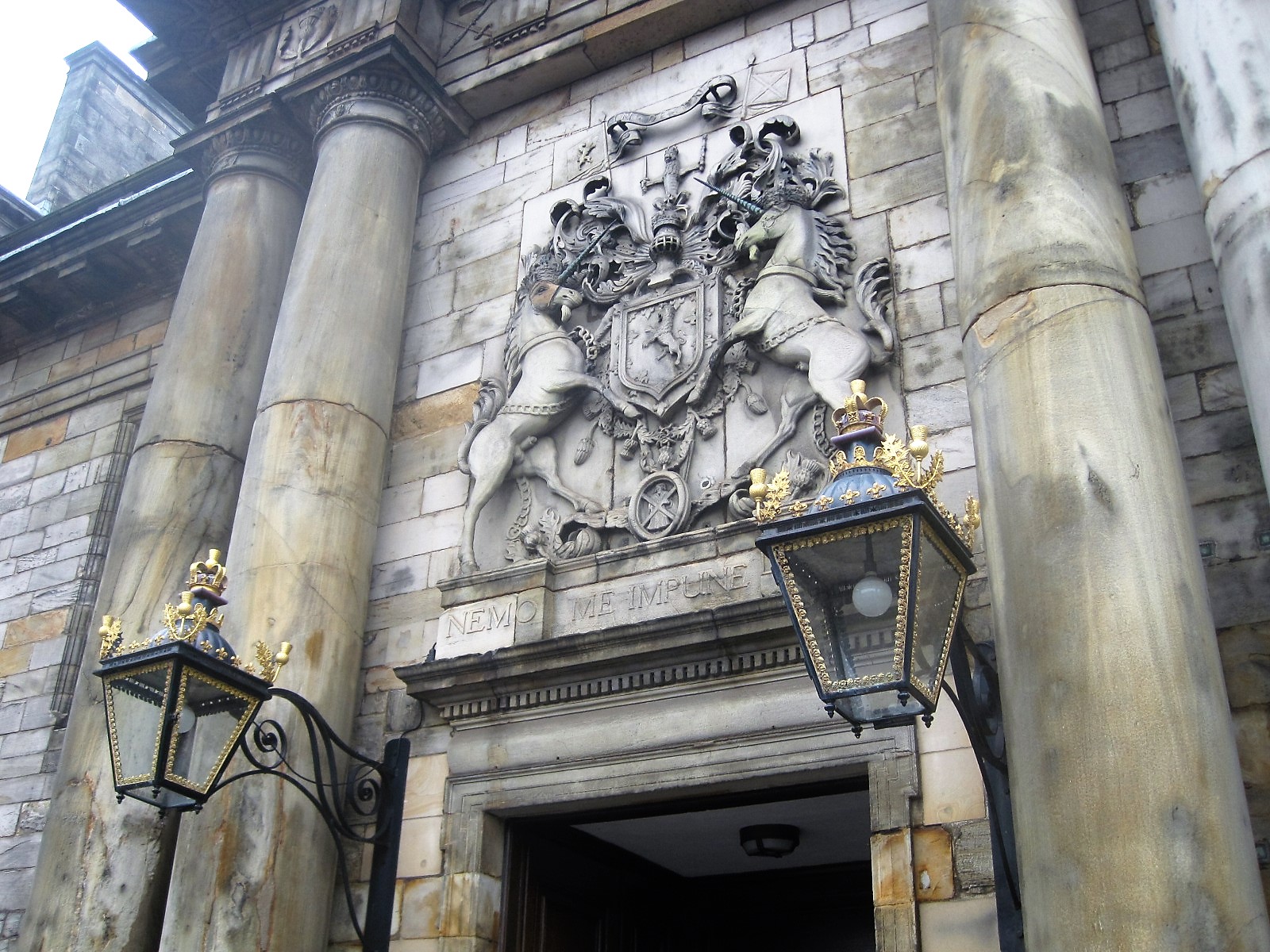
At the bottom of the Royal Mile there’s a choice between the modern and inspiring Scottish Parliament Building and historic Holyrood Palace. You know which I chose, but I neglected to allow you a little glimpse inside. I think you might enjoy this 2 minute video.
Suitably impressed, it was time to make my way back up the Royal Mile. This time I continued on to Lawnmarket, and the Mercat Cross on Parliament Square. Royal proclamations and the summoning of Parliament are traditionally announced here, and a bubble blower was having fun with the crowd. St. Giles Cathedral, on the opposite side of the square, dates from the 14th Century and is the High Kirk of Edinburgh .


The real piper, or a dummy at the traditional kilt store? I liked them both. I had reached the Bank of Scotland, in all its magnificence. Have you noticed that the clouds have lifted and at last the sky is blue? Curious about The Mound, I headed that way. Apparently it’s an artificial hill, built to fill in a loch that was part of ancient Edinburgh’s defence system.
I don’t know about you but I was getting tired and hungry. Up on The Mound, I found the perfect thing.


Haggis, neeps and tatties, of course. Now, I’m not going to take you too much further but my digs are at the far end of Princes St. I decided to walk through Princes St. Gardens. You’d like a quick look, wouldn’t you? The mist is just rising over the castle.


Did you spot the statue of Wojtek and the Bear? You probably don’t know the amazing story of the bear who went to war. A group of young Polish girls were taking his photo, but moved aside for me, with a giggle or two.
I’m going to say my farewells here. I checked into my accommodation, then did the Water of Leith walk that I shared last week. You can get back to our start point at Waverley Station by tram, if you’d like. I never did manage a tram ride in Edinburgh. Maybe next time?

Hope you enjoyed this walk. I’m going to be putting my feet up for a week or two, but first I have some wonderful shares. Thank you so much to everybody for your enthusiasm and support. My apologies that I won’t be able to share for a while, so please do make the most of the following :
…………………………………………………………………………………………………………………..
I cover a decent few miles, and so does my good friend Becky. But sl-ow-ly!
Strolling along the Thames Path- part one!
‘Leaving on a jet plane, don’t know when I’ll be back again..’ Or boat, in Drake’s case :
Them boots are made for… Cardinal!
I hope Lady Lee has good boots too!
It’s many a long year since I was in lovely Inverary. Let Anabel show you around :
Islands around Toronto are always a novelty. Go hopping with Jackie!
And look at local murals with Trav Trails :
What would you expect to see in Bern, Switzerland? Let Laia show you the sights :
Bern : music, roses and … bears?
Making me yearn for the Algarve, Miriam fills my senses with salt spray :
Some of you will know Kathe from Six word Saturday. She’s sampling a little Scots whisky on this walk :
Yesterday’s short walk to Muir of Ord’s Distillery
And Liesbet is keeping us fit with a bit of rock scrambling :
WW- Gorham Mountain Train in Acadia NP, Maine
But there’s a gentler way too :
The Park Loop Road in Acadia National Park, ME
Susan has made it to the Baltic, and found a parade and some idyllic shops :
Or how about a crazy but beautiful Art Party, with Kathrin?
Get those trumpets ready to sound the fanfare! Here comes Badfish :
Strolling Through Prague : One fine day- Part 1
There won’t be another Monday walk until 17th October. Sounds ages away, doesn’t it? I’ll try to keep in touch but I don’t have WiFi in the Algarve. It’s wonderful just to switch off from social media and indulge in friends and places. I’ll miss you, so please take care of yourselves while I’m gone.




 restlessjo
You must be logged in to post a comment.