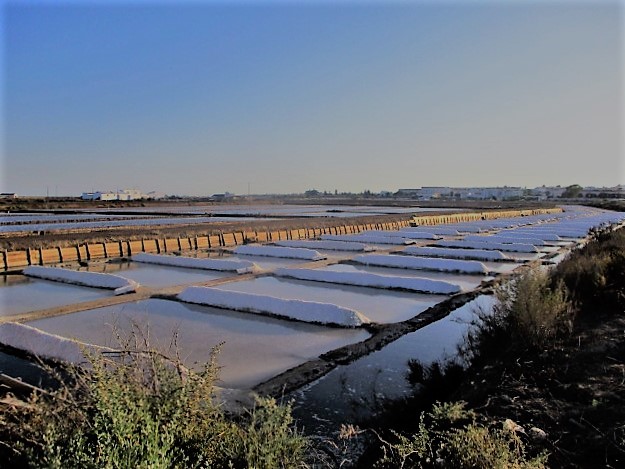
I’ve always meant to tell the story of Flor de Sal, so much a part of summer here in the Algarve. A walk through the salt marshes is one of the joys of summer, though you do have to pick your days as it can be unbearably hot. A hint of breeze can make all the difference.


The pink colouration, from crill, especially transfixes the eye. The fusion of sunshine and salt water creates the salt crystals, which need high temperature and strong sunshine with only gentle winds. This year conditions have been perfect and it’s a very good harvest.


The process starts around April, when the tanks are prepared. Mud and clay has hardened over the years and a first channel of salt water is fed in with the tide, to a good depth. The system of tanks or reservoirs are connected with locks and channels, and gradually the saltwater is transferred to increasingly shallow tanks, warming the water in the process. Finally it reaches the crystallisation tanks where, from June to August, ‘flor de sal’ is formed. The fragile crystals form on the saltwater surface. Harvesting is done by hand, the ‘marnotos’ being highly skilful in collecting the crystals, which must never touch the bottom of the pans. They are raked gently off and left to dry in the hot sun for 7 days, where they become more crunchy, and identifiable as the ‘flor de sal’ which is sold in the markets. Their appearance through a microscope is like a flower. Just one more miracle of summer.
Many thanks to Paula, at Thursday’s Special, for the inspiration.
 restlessjo
Thanks for posting this Jo. I’ve never thought too much about salt, but recently read “Salt” by Mark Kurlansky and was surprised to learn that the method is really ancient and largely unchanged. Well, if it ain’t broke and all that …
LikeLiked by 1 person
Is that a novel, Su? Not heard of it. I just thought I ought to know roughly how it works as I spend enough time in the vicinity 🙂 🙂
LikeLiked by 1 person
It’s a factual book, Jo, and fascinating. He’s done the same for cod!
LikeLiked by 1 person
I should have given the full title “Salt; A World History”
It’s about how important salt has been to civilisations. Can’t remember the exact detail, but I know in Roman times some workers were paid in salt (sal) hence the word salary. It’s full of stuff like that.
LikeLike
Don’t fancy toting the salt around to pay for my groceries, Su. Sounds an interesting book though 🙂 🙂
LikeLiked by 1 person
Me neither!! It’s well-written and comprehensive, but not the most exciting read.
LikeLiked by 1 person
Fascinating – also, live that clear blue, cloudless sky.
LikeLiked by 1 person
Another of the wonders of nature, Anabel 🙂 🙂
LikeLike
Your photos and descriptions were excellent, Jo, and really fascinating. Interesting that the crystals can never touch the pan.
LikeLike
They retain their purity that way, Jet, and are very fragile. I love to see them gleaming in the sun. Thank you! 🙂 🙂
LikeLiked by 1 person
How amazing! I love the one with the crooked gate. The colours are very striking.
LikeLike
The gate is one of the locks, Susan. I like that one a lot too 🙂 🙂
LikeLiked by 1 person
I did wonder what it was.
LikeLike
i have seen salt beds in the Philippines but far cry from your beautiful photos of Flor de Sal. what a feast for the eyes! thank you for sharing, Jo. best wishes 🥰
LikeLiked by 1 person
I had never seen anything like it until I came here, LolaWi, and it fascinates me still. 🙂 🙂 Thanks, darlin!
LikeLike
Thanks for the interesting information, Jo, and – of course – the wonderful pictures.
LikeLike
I thought it was long overdue, Pit. Many thanks to you 🙂 🙂
LikeLike
Oh, those photos… how beautiful!
LikeLike
Thanks, Angela. It’s a beguiling area at this time of year. 🙂 🙂
LikeLiked by 1 person
I have a love for any industry that requires the touch of humans to complete it:)
LikeLiked by 1 person
Certainly applies to flor de sal, Eddie 🙂 🙂
LikeLiked by 1 person
Has this Portuguese salt not become one of the ‘artisan must-have’ salts? I haven’t seen it in the shops. I must say I am tempted by some of them but I think that’s down to the packaging and I managed to resist all but the French Flor de Sel (I think that’s what it was called) and the Himalayan pink salt just because it looked so pretty. I’ve seen the workers in Thailand in the salt fields there and I felt so sorry for them, it almost made me give up that tasty essential.
LikeLiked by 1 person
I don’t think it’s widely marketed outside of the Algarve, Mari, let alone Portugal. It has a lovely crunch and flavour to it. I don’t suppose it’s the happiest occupation when it’s really hot, but much of the year will be fine and they take great pride in the salt. 🙂 🙂
LikeLike
Fascinating. I’ve heard of these places but have never seen one.
LikeLike
It’s an unusual landscape, Frank. 🙂 🙂
LikeLike
Love the photos! You have talked about the salt pans before but never in summer. Must be relentless heat out there with no shade. Hope you were wearing a hat, or maybe carrying a parasol and one of those teeny hand-held battery fans 🤔 I use Cornish salt, but I suspect it’s not dried by the sun!
LikeLiked by 1 person
Thanks, Jude 🙂 🙂 I try to choose a day with a breeze if I’m going that way. Just occasionally I wear a hat 🙂
LikeLiked by 1 person
Very interesting, Jo. Thanks for sharing your beautiful photos!
LikeLike
Thanks for joining me here, Jill 🙂 🙂
LikeLike
Stunning pictures!
LikeLike
Thanks, Ingrid. I do find the salt mounds fascinating. 🙂 🙂
LikeLike
Salt mashes with a splash pink, the last colour I expected to see . Harvesting done by hand must be quite a laborious job. Great article, Jo. Imagining the salt crystal like a snow flake under a microscope.
LikeLiked by 2 people
Yes, I think a snowflake is apt, Sheetal. There are always flamingos there, eating the crill 🙂 🙂
LikeLiked by 2 people
How interesting. Does it smell salty near by? We visited the salt marshes of North Gower last week and they smelt wonderfully salty!
LikeLike
Pungent, I think is the word, Emma. Briney if I were being kind. 🙂 🙂 But I love seeing them at this time of year.
LikeLiked by 2 people
When I saw the first photo I thought it was taken it in winter and you’d had a lot of snow! 🙂 I love the pink colour against the white of the salt 🙂
LikeLiked by 1 person
It’s fascinating to watch the process, Eunice. I’m amazed by the amount of salt this year. 🙂 🙂
LikeLike
It’s so Interesting.. Nice article.😁👍
LikeLike
Thanks a lot 🙂 🙂
LikeLiked by 1 person
Do read my first blog and please give your valuable feedback on that. It will be grateful 🙂
LikeLiked by 1 person
How interesting Jo. Thanks for writing about Estival
LikeLike
I’ve always meant to find out a little about how it works, Marion. It’s fascinating to watch the salt piles grow over the summer. 🙂 🙂
LikeLiked by 1 person
A great one for estival, Jo (though I keep wanting to add an f to the word)
LikeLiked by 1 person
I have to admit, I’ve never come across the word before, Debs 🙂 🙂
LikeLike
That’s interesting Jo – thanks
Chris x
Sent from my iPad
>
LikeLiked by 1 person
Glad you enjoyed it, Chris 🙂 🙂
LikeLiked by 1 person