It was last Summer when I first came upon Bede’s Heritage Trail, quite by accident, in the sleepy hamlet of Whitburn, on the north east coast. A 12 mile walk, it links the church of St. Paul’s in Jarrow with St. Peter’s, down the coast at Wearmouth. I had inadvertently arrived, right in the middle.
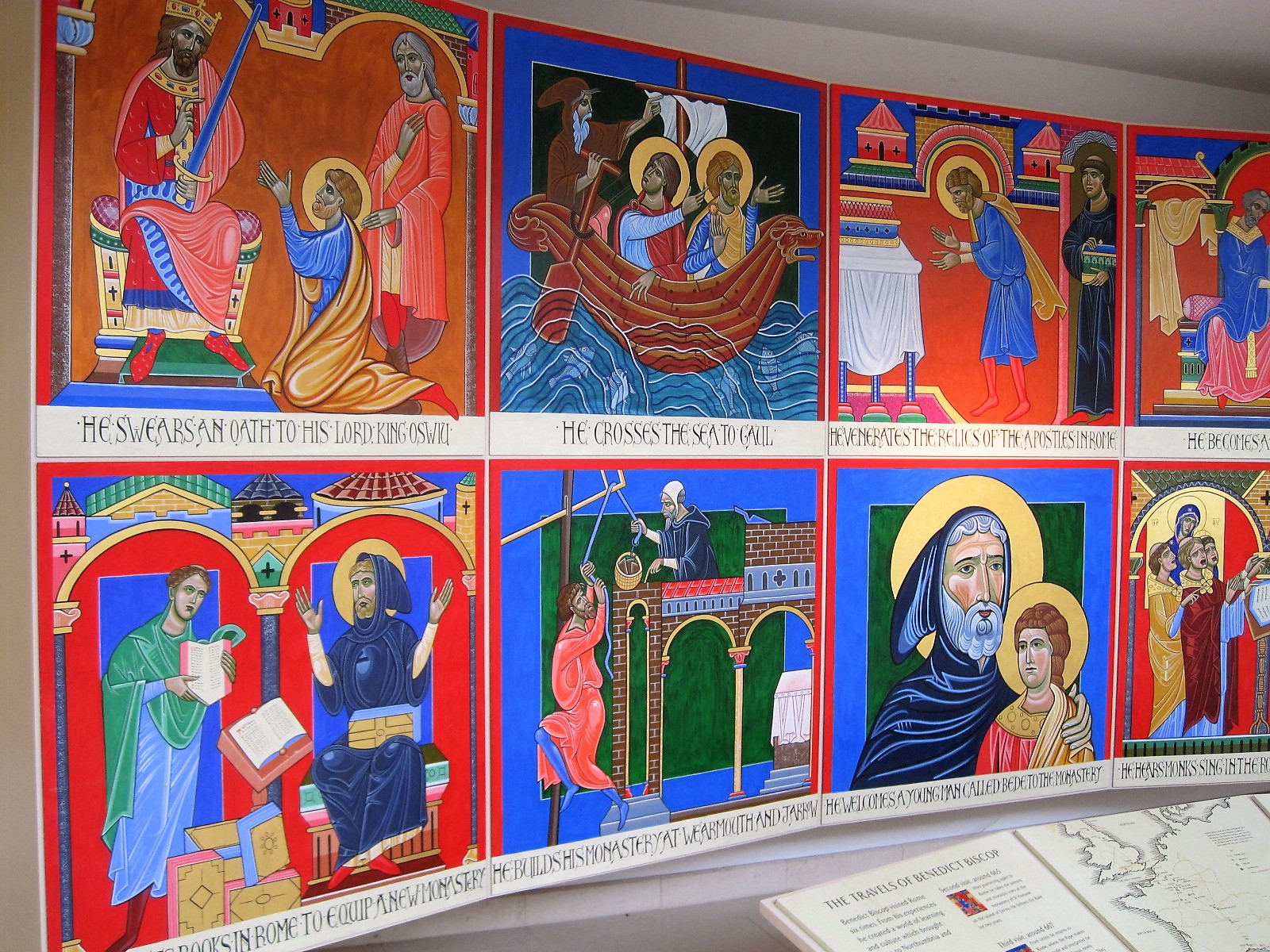
Benedict Biscop, a Northumbrian nobleman, had travelled to Rome 6 times and was inspired by the Christian life he found there. In 674 he approached King Ecgrifth of Northumbria and was given a large estate on which to found the monastery of St. Peter’s, in Wearmouth. It’s twin, St. Paul’s, was begun 8 years later, further north at Jarrow. They were among the first stone buildings in Anglo-Saxon Northumbria, and St. Paul’s contains the oldest church dedication stone in England. Part of the Anglo-Saxon monastery survives today as the chancel of St. Paul’s. A good place to start, I think.


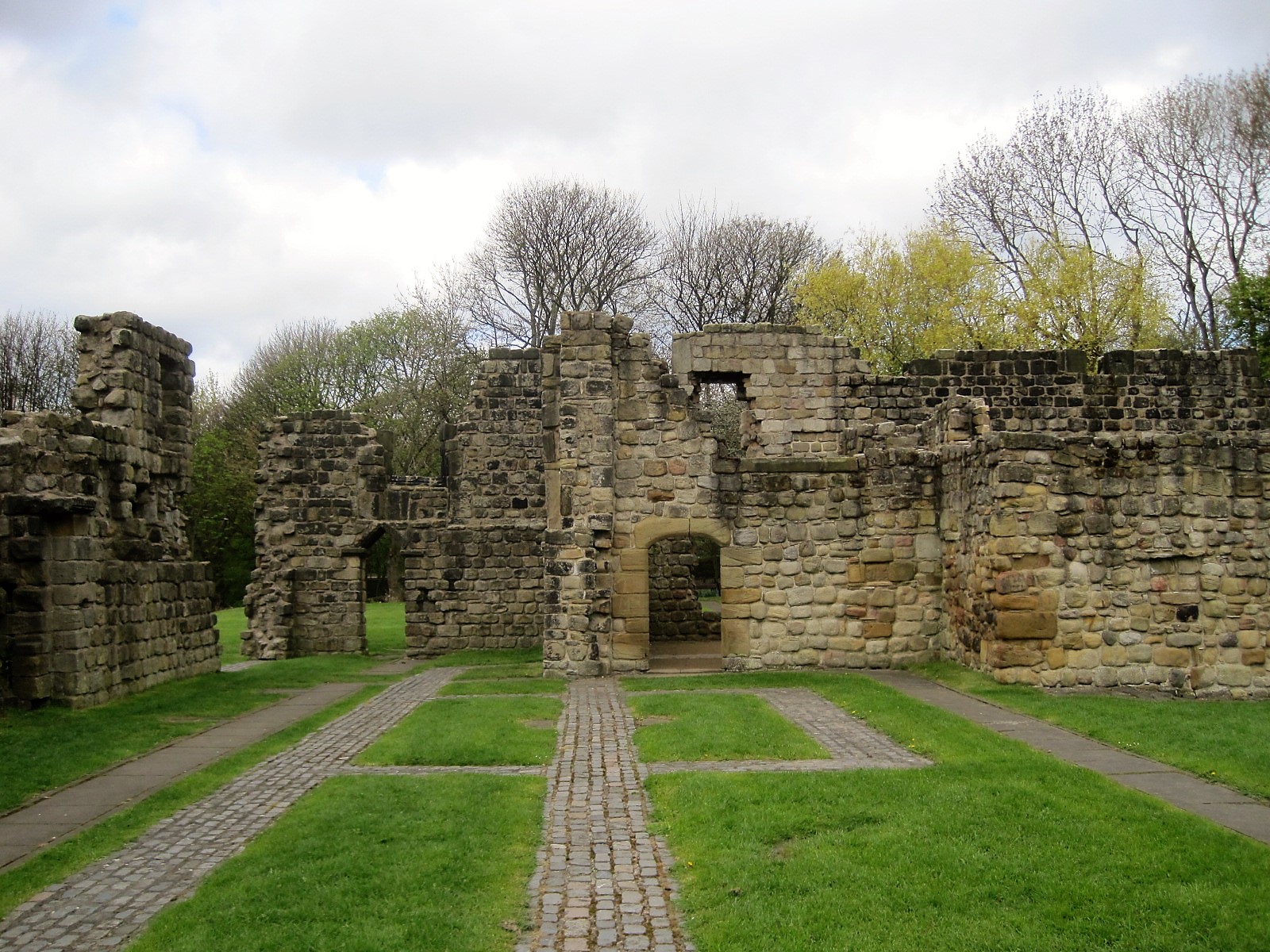
The Venerable Bede was educated in the monastery from the age of seven, and became the most important European scholar of his era. (born 673- died 735) The founder of medieval historical writing, his works give a unique insight into life in the monastery. The two buildings were regarded by Bede as ‘one monastery in two places’ and ‘bound together by the one spirit of peace and harmony’. Monks would have traveled between them on foot, or by boat, using the small tributary of the River Don, which links to the Tyne.
I had scribbled details of the first part of the Heritage Trail on a slip of paper, intending to follow the route of the monks for at least a little way before returning to explore the museum dedicated to Bede. As so often happens, a signpost created confusion. Perhaps I should have ignored the cyclist. In any event, Bede wouldn’t have had to tackle flyovers and underpasses. And certainly not graffiti!


It was something of a relief to return to Jarrow Bridge, spanning the Don, alongside of St. Paul’s. Gyrwe, the Anglo-Saxon name for Jarrow, means ‘place of the marsh dwellers’. Arrows pointed me in the direction of Bede’s World, and from there I couldn’t go wrong. A wealth of information, pleasingly displayed, I found the museum imaginative and entertaining.


Benedict Biscop was keen to build in the ‘Roman manner’ and spared no expense, importing skilled masons and glaziers from abroad, to accomplish this. Over 1,000 fragments of coloured glass were discovered during excavation of the site of the monastery. The Jarrow Figure was reconstructed using glass found under a collapsed wall.


The community of monks was very industrious during Bede’s lifetime. One of their most notable achievements was the Codex Amiatinus, a complete Bible in a single volume. It weighed over 34 kilograms (75 lbs), being made with 2060 pages of vellum – calf skins washed in a bath of lime, stretched on a frame and treated with pumice.


Bede Museum shares the grounds with Jarrow Hall, and the lovely old building provides light refreshments in its cafeteria. (and cake, naturally!) With the sun shining brightly, it was time to take a stroll through the Anglo-Saxon farm. Curly-coated pigs, Dexter bullocks, goats, ducks and chickens share the 11 acre site with reproduction thatched farm buildings.


A gentle green path, fringed with primroses and blossom, leads to a mound topped by a cross, and a viewing point over the industrial River Tyne.


It’s a nice green space in an urban setting. I hope you enjoyed it with me. I’ll take you to St. Peter’s another time. Meanwhile, this leaflet contains details of the whole trail, and here is a link to Bede Museum.

Great to have so many of you sharing walks with me again this week. I really appreciate it. Please find time to visit each other. I know it’s a struggle sometimes but it really is worthwhile. Join me any time here on Jo’s Monday walk.
……………………………………………………………………………………
Starting with a fabulous hike in Japan, with Celia. The vistas are wonderful :
Much flatter, but still full of interest, join Anabel in Holland :
Coffee and Leonard Cohen – I find both irresistible. And where there’s Jackie, there’s always food!
Where would you expect to find an English garden? In Munich, of course! Thanks, Lady Lee :
Standing stones are always fascinating, aren’t they? Suzanne has found some most unusual ones :
A Mystical Destination – AVEBURY
Drake finds me an idyllic piece of Greenland to share this week :
And Gunta has immense Redwoods and Trilliums!
A city I’m to visit soon, but just in passing. I wish I could take this tour with Meg :
Emma is tireless when it comes to the Welsh coastal footpath. Her love for it shows in her paintings :
Pennard Cliffs & Three Cliffs Bay
Something I’d really love to do. I wonder if Susan would like company?
Walking the Golden Gate Bridge, San Francisco
From one iconic sight to another! Hit the heights with Rosemay :
Hong Kong – A Walk Down The Peak (The Morning Trail)
That’s it for this week! Distinctly cool here, but in England there’s another Bank Holiday coming up. I’ll be taking you to some wide, open spaces next Monday. Take care till then!
 restlessjo
I love surprises when I’m out and about.
http://junkboattravels.blogspot.ca/2018/04/love-food.html
LikeLike
Thanks a lot, Jackie 🙂 🙂 Be with you later because I have to go out again now.
LikeLike
What a wonderful thing to come across by accident, Jo!! knew about the Venerable Bede, but it was delightful to see all of this “in person.” :-)I’m off shortly for a morning walk in the park, but here’s what I saw the last time I was there:
https://sustainabilitea.wordpress.com/2018/04/30/spring-walk/
Happy Monday!
janet
LikeLike
That’s great! Thanks a lot, Janet 🙂 🙂 Just back from our group walk up in Durham and the sun is shining brightly.
LikeLike
It’s shining here, too, Jo, and going to be nice and warm the next few days. There were more wildflowers open today, so tomorrow my Nikon goes along on the walk. 🙂
LikeLiked by 1 person
Another fascinating walk Jo – I feel like I’ve learnt so much! So interesting to weave all the history in along your walk and learn more about the Venerable Bede. I can’t get over that bible and how it was made – the poor calves 😦 Have always found these old abbeys so interesting – I grew up on visits to Fountains Abbey and sometimes we went up to Jervaulx or Rievaulx but have never made it as far as Jarrow. The monks certainly kept themselves very busy! Thanks for including me in this week’s walking list – I will get round and read each one over the next couple of days or so it’s good to learn something new! Have a great week 🙂
LikeLike
Poor calves, indeed! 😦 So labour intensive it’s hard to even imagine, in these days of technology. I often do the walking and put the research together afterwards. The information boards are so useful for that. Thanks so much for visting, Rosemay. You always make lovely company. 🙂 🙂
LikeLiked by 1 person
You’re very welcome Jo 🙂 I often do the same – visit a place and then read up all this interesting stuff afterwards. Plus I take photos of the information boards to jog my memory – as you say they are so useful for that! The stories behind places are so interesting! 🙂 🙂
LikeLiked by 1 person
So interesting Jo. I’m always amazed at the age of all these historic places in UK and I loved the reflections of the clouds in the pond, just beautiful
LikeLike
It was a typical April day, Pauline- starting cool and grey but then quite radiant for a while. You can trip over history on every second doorstep around here. 🙂 🙂 And I can never resist a good reflection!
LikeLiked by 1 person
Our old,old history is hidden in “country” with the aboriginals going back over 40000 years. But it can’t be seen…
LikeLike
Just remembered in folklore?
LikeLiked by 1 person
It is a dying culture as it is a verbal history and the younger generation not interested
LikeLike
I suppose that’s very understandable. Their concern is the future, not the past. 🙂 🙂
LikeLiked by 1 person
Yes and not a very good future for the Aboriginals over here
LikeLike
Wow, what an intersting walk, Jo. I learned a lot. I always enjoy tagging along with you via your Monday posts and photographs. Will try to visit some of the links. Just arrived home after another week away with family, this time stateside in Ohio. The colored glass figure must be something to see.
LikeLike
Thanks a lot, Ruth 🙂 🙂 I know it’s hard work keeping up sometimes but it really is much appreciated.
LikeLiked by 1 person
Shared on Fb too. So interesting. Yes can get overwhelming , the keeping up. Reading your posts definitely worth the effort!
LikeLike
Thanks so much 🙂 🙂
LikeLiked by 1 person
Such an interesting, educational walk, Jo! It’s amazing that these places have survived all these years, and the remains are in such good condition. Loved the thatched farm huts – too cute! 🙂 🙂
LikeLike
Many thanks, Celia! 🙂 🙂 There are so many lovely old buildings and ruins around here. And I did like the curly-haired pigs. 🙂
LikeLike
Thanks for the post share Jo, much appreciated. Finding an interesting trail is incentitive to walk even further. Looked enjoyable!
LikeLike
This is an odd one, Suzanne, because we’ve walked much of the area without actually being aware of the trail. It’s just piecing history and places together. 🙂 🙂 You’re very welcome!
LikeLiked by 1 person
Sounds like a lovely walk in the direction of St Peter’s in Jarrow. You are like me…scribbling directions down on paper beforehand. Indeed sometimes the slightest signage can throw us off and make us wonder if we are actually headed in the right direction. Have a lovely week, lovely 🙂
LikeLike
I’m better at following my nose than following directions, Mabel, which is why I often don’t make my walks too specific. It’s fun trying though 🙂 🙂 Thanks, darlin!
LikeLiked by 1 person
This is a very interesting walk, Jo. I love that high cross. It’s quite beautiful.
LikeLike
I love all the old crosses, Carol. I believe this one is just a replica but it’s nicely done. 🙂 🙂
LikeLiked by 1 person
It’s beautifully worked.
LikeLiked by 1 person
What a wonderful trail, Jo. Lots of beautiful photos, but the last one is spectacular.
LikeLike
Thanks, darlin! 🙂 🙂 We’ve done most of this trail without knowing we were doing it, Tish. Just tying the bits together with the historical facts is interesting. And getting lost, of course!
LikeLiked by 1 person
The getting lost bit – goes without saying. We always get lost. Often the best bits – unless one ends up too far from the cafe/pub.
LikeLiked by 1 person
Great start to a Monday morning. Beautiful walk, Jo!
LikeLike
Got to start the week off well, Jill. Glad you could come along 🙂 🙂
LikeLiked by 1 person
Looks a very interesting and colourful trail. Thanks for walking us through it. X 😁
LikeLike
We’d never been to St. Paul’s and the top end of this walk, hon, but know the area south of there pretty well. All sorts of interesting places! 🙂 🙂
LikeLike
How wonderful – a Bede World, a delight for Medieval Historians!!
LikeLike
Yes, I think if you were interested you could spend a long time there, Emma. 🙂 🙂
LikeLiked by 1 person
I used to be a Medival Historian, in a former life, so I could spend a long time there. Bede must have felt he was at the edge of the known world.
LikeLike
Sometimes we still do, Emma 🙂 🙂
LikeLike
Love that archway inn the 4th photo, Jo, and the carved cross
LikeLike
Thanks darlin! Just off out on the trail of bluebells in Durham xx
LikeLiked by 1 person
Oh, looking forward to more photographs! Have a lovely day, Jo!
LikeLiked by 1 person
The list of places that I need to visit thanks to your blog is getting longer and longer!
LikeLike
Sorry, Andrew. 🙂 🙂
LikeLike
It’s quite a lot of years since I was here, and things seem to have changed for the better. It was all a bit of a dismal,edge-of-urban sprawl sort of experience, complete with graffiti and litter. I felt sorry for poor old Bede, who must be feeling happier now.
LikeLike
Yes, they’ve smartened him up a bit. 🙂 🙂 My son was there on a junior school trip 20 years ago. Since then it’s changed hands and is part of Jarrow Hall, Margaret. A wedding venue as well as educational facility.
LikeLiked by 1 person
Lovely walk Jo. It is such a shame that so many of the British Monastery buildings have been destroyed and we are left with ruins, but nevertheless the history lives on. I hope you enjoyed a nice cake after the walk?
LikeLike
Thanks, Gilda 🙂 🙂 I actually had quiche. No cake- shock, horror! 🙂
LikeLike
What a lovely walk Jo full of fascinating history and wonderful photos as usual. I’d love to join you on a walk but I’ve been struck down by a vicious sudden head cold. 🤧
Have a great week.
LikeLike
How miserable, Miriam! Hope you feel much better soon. 🙂 🙂 Thanks for your company, darlin!
LikeLiked by 1 person
Thanks Jo, I’ll get there! xo
LikeLiked by 1 person
Reblogged this on ladyleemanila and commented:
Jo’s walk 🙂
LikeLike
Thanks a lot, darlin 🙂 🙂
LikeLiked by 1 person