It’s not often that my A-Z’s run parallel but, in trying to “patch the gaps” in the alphabet, I find that I’ve arrived at the letter J on both my Polish and my Portuguese challenges. Well, “J is for Jo”, so, let’s try not to disappoint.
Javali means “wild boar” in English.
 Not always the most adventurous of eaters, I’m happy to say that I can quite happily trough away at wild boar. It is delicious! I first experienced it at the end of a morning’s walking with my group in the Algarve. The reward for our walks is usually a restaurant, known to one of the group as being very good value. (us Brits like a bargain!) The “wild boar” restaurant was the occasion of a 60th birthday so it was a bit special. The meat arrived in huge pans and had obviously been slow cooked for hours.
The occasion ended in rather a traumatic fashion, as the partner of the lady who was 60 keeled over and an ambulance had to be summoned! He suffers from low blood pressure. The medics stepped in and would you believe it, another member of the party collapsed with heatstroke! Both were fixed up, and nobody blamed the wild boar. If by any chance you’re reading this, Jeff and Anne, very best wishes to you both.
João is the Portuguese form of the name John. According to Wikipedia the diminutive is Joãozinho, but I’ve never heard it used. I understood diminutives to be short forms, but it doesn’t surprise me that in Portuguese, it’s longer. The feminine form, however, is Joana, and that’s me!
And now for the history lesson. There have been six ruling King João’s in Portugal. To see them in context, click on the Wikipedia link.
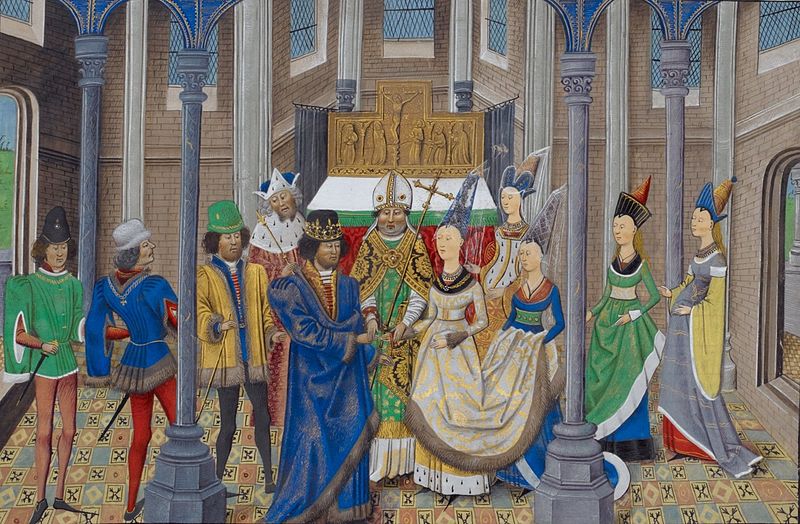
The wedding of King João 1, February 11th, 1387- from Wikipedia
João 1 was King of Portugal and the Algarves from 1385 to 1433. He came to the throne after a 2 year period of political anarchy, when Castile was laying claim to much of Portugal. The overthrow of Castile and their French allies was accomplished with the aid of English troops. When João married Philippa of Lancaster, daughter of John of Gaunt, in 1387, an Anglo-Portuguese alliance was secured which exists to this day.
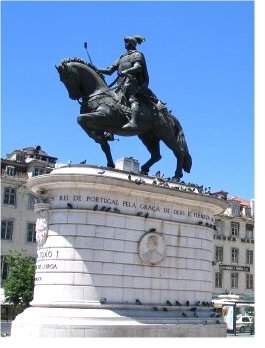
João II (reigned 1481-1495) was known as the Perfect Prince. His chief priority was continuing the exploration of the African coast, hoping to discover a maritime route to India and the spice trade.
João III (reigned 1521-1557) has been referred to as the Grocer King. He extended Portuguese possessions in Asia and the New World, securing the spice trade in cloves and nutmeg. Brazil was colonised and the Portuguese became the first Europeans to establish contact with China (under the Ming dynasty) and Japan.
João IV (reigned 1640-1656) The Portuguese Empire reached its zenith, totalling 12,000,000 km by his death. He was a patron of music and the arts, amassing one of the largest libraries in the world. Sadly it was destroyed in the Lisbon earthquake of 1755.
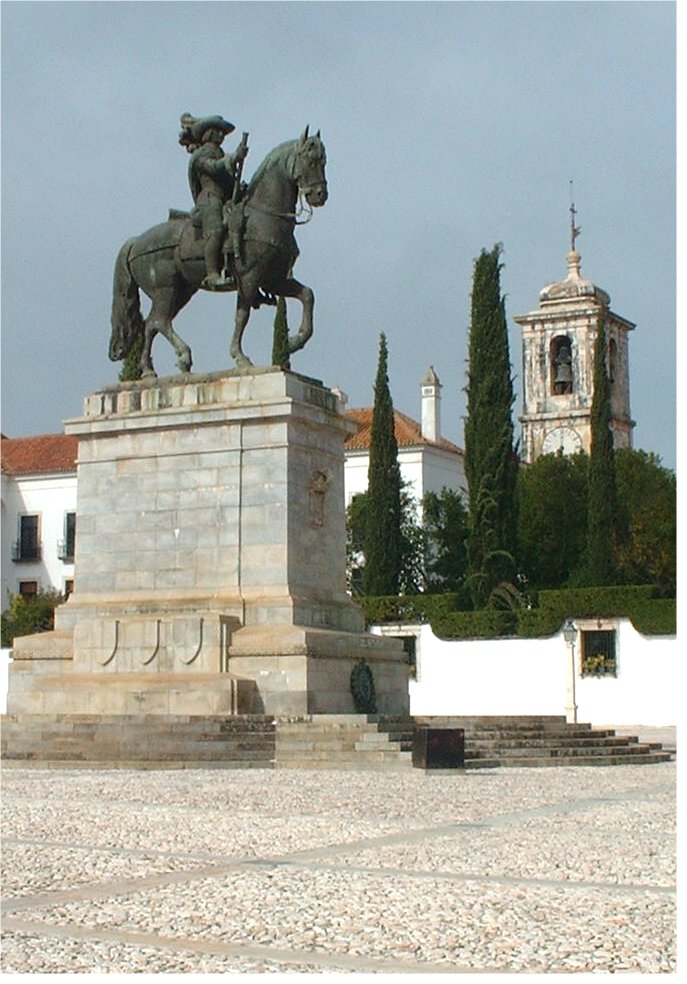
Dom João IV at Vila Vicosa, where he was born
João V (reigned 1707-1750) was nicknamed “The Magnanimous”. He ruled at a time of enormous wealth for Portugal, with gold and diamonds from Brazilian mines filling the coffers. Money was no object, and the Royal Palace at Mafra was built as a rival to Versailles.


João VI (reigned 1816-1826) had something of a turbulent time. His kingdom included sovreignty of Brazil until independence was declared in 1825, and he had to flee there when Napoleon’s troops invaded Portugal. He stayed in Brazil for 13 years, establishing a court and growing to love the place. The loss of Brazil had an enormous effect on the Portuguese economy, and João was constantly embattled and plotted against on his return home. His eventual death was believed to be as a result of poisoning.
Phew! I hope you are not too exhausted by my tale of six Johns. I’m linking this post to Julie Dawn Fox’s A-Z Personal Challenge and to Frizz’s A-Z. You can follow their challenges through the links. Many thanks for staying with me.

 restlessjo

That palace looks so opulent and stunning! I enjoyed learning about the six Johns. 🙂
LikeLike
Thanks, Jackie 🙂 I haven’t been to Mafra, but it’s on my list.
LikeLike
Oops I forgot! I love Boar, a nice stiff demi glace.YUM !
LikeLike
Loved every word Joana! Thanks for sharing so much !
LikeLike
Lovely to see you here, and I’m glad you enjoyed my boar-ing stories. 🙂
LikeLike
I did and I love game …in Hawaii I saw some in the woods and steered clear !
LikeLike
I AM exhausted by your coverage of the Joãos, Jo, but I think my favorites are the Grocer King and, of course, the feminine Joana, aka, YOU of restless jo! I’m not a meat eater, so I have to say the Wild Boar sounds a little bit scary, especially after what it did to your friends! Beware! 🙂
LikeLike
Not a bad choice, Cathy. I love nutmeg 🙂
LikeLike
Very interesting history and great photos, Jo. I think that João V would have been my choice of a suitor, had I lived in that era. I do like a magnanimous man. 🙂
LikeLike
If you find one, can I have first pick? 🙂
LikeLike
😀
LikeLike
I enjoyed reading it. That’s was such a glorious time under João V. And, the influence on Brazil was very interesting. Thank you, Jo!
LikeLike
European history is a nightmare, Amy! So much scheming and back-stabbing. Come to think of it, just like politics today 😦
LikeLike
so interesting post for me too. Thank you dear Johanna, I enjoyed to learn. Love, nia
LikeLike
There’s a bit of everything in the posts at the minute, Nia! It’s my random mind 🙂 Many thanks for putting up with me.
LikeLike
I love wild boar 🙂 It’s been ages since I tasted it though. Hey, how about the post J is for Jo? 😉
LikeLike
I decided you’d find that post VERY boring, Paula. Expect you might find wild boar in Corsica? Certainly, you could enjoy trying. 🙂
LikeLike
😀 We shall see 😉 And no, I would not find THAT post boring at all 🙂
LikeLike
Wild Boar ….yumm! It’ called Jabali in Sanish, almost the same. My word, what an experience that lunch was 😉
LikeLike
The two languages do a nice little side by side, don’t they? We all went home feeling a bit shellshocked, but it was wonderful to hear that Jeff was ok after they carted him off to hospital. Poor Anne- not a birthday she’ll forget in a hurry! 🙂
LikeLike
I like your random approach to alphabet posts – what will you do next?
LikeLike
Like to keep you guessing, Andrew. I have a fairly random mind, so it’s no wonder 🙂
LikeLike
very interesting story, Jo.. thank you so much for sharing. Beautiful photos too.. wild boar is tasty indeed;-)
groetjes, Francina
LikeLike
Thanks, Francina. Time I went to the kitchen to cook (but I’ll just read a few more blogs first 🙂 )
LikeLike
Very interesting and informative Jo. Now I’m hungry. 😀 *hugs*
LikeLike
Your turn to make supper, Sonel 🙂 I’d settle for a roast pork sandwich.
LikeLike
Hmmmm..delicious! Your lovely photo’s are always so inspiring hon. Thanks for sharing. 😀 *big hugs*
LikeLike
Another fine post Jo. Just pleased that your friends were OK after their experience in the Wild Boar…..I can smell it now! Right…off to the Old West Quay for a pork chop 🙂
LikeLike
Almost as good, David??? Well, at least you’ll have nice views down there.
Where are you toddling off to next? 🙂
LikeLike
You’ve inspired me to pay my gran a visit in Portugal! 🙂
LikeLike
If I had a gran in Portugal, I’d be there like a shot! 🙂 Whereabouts?
LikeLike
Braga, small but quiet 🙂
LikeLike
I was almost there last September, but we ran out of time and had to make choices, so Guimaraes won it, being European City of Culture. But I’ll be back- I loved the Douro area. 🙂
LikeLike
“j” for johanna!
P.S.:
I like your slogan:
Inspiring bloggers to get personal”!
LikeLike
It’s a good one, isn’t it. Frizz! I can’t lay claim to the slogan- it belongs to Julie Dawn Fox, who lives near Coimbra in Portugal. I don’t know if you’re familiar with her work but she has a very good blog, as well as running this challenge. http://juliedawnfox.com/
Many thanks again for your hospitality 🙂
LikeLike
hahaha I have much enjoyed the misadventures of friends at the restaurant of the boar!
the rest I have read with interest, thanking you for everything again I learned, talented Johanna!
passes a serene day
LikeLike
Isn’t he the cutest little boar? The day was quite traumatic at the time, but ended well or I wouldn’t be telling the story. 🙂
Many thanks for your kind encouragement, Ventis. You are an early riser 🙂 Soon I’m going to t’ai chi class, and then… who knows? You too, have a beautiful day.
LikeLike
sono molto indaffarata in questo periodo e se voglio ammirare le novità degli amici devo alzarmi molto presto, ma è solo un piacere
bacino
I am very busy during this period and if I want to enjoy the novelty of the friends I have to get up very early, but it’s just a pleasure
LikeLike
I’m enjoying the history lesson and of course the derivation of names.You have quite an archive of pictures to support your A-Z, Jo.)
LikeLike
If only we took the perfect photo for each of the places we’ve been, Lynne! Statues in particular, we have only random shots of. We’ll have to go back to Lisbon and do it properly- I’m astounded that it was 2007 when we were there last. I didn’t even know what a blog was! 🙂 Via Vicosa is a lovely place but we have just a handful of shots.
LikeLike
You have a knack for teaching history through your beautiful photos, Joana! Like you, I’m not very daring when it comes to trying new and unusual foods, but if you said it was delicious, I’ll take your word.
LikeLike
Thanks, Jill. I worry about being boring- history’s not everyone’s thing- so I try to find interesting illustrations. The big photo in Vila Vicosa is one from our album- I loved it there. 🙂
LikeLike
It wasn’t boaring at all. 🙂
LikeLike
Oh dear! Or should I say snort? 🙂
LikeLike
You may even groan. 🙂
LikeLike
Such an interesting post Jo – I enjoyed fading it very much.
I have never had he occasion to taste wild boar but would if I had. Does it taste a little different to the pork we buy in our supermarkets?
LikeLike
I suppose a more intense flavour, Colline, but so tender and juicy. Quite hungry thinking about it 🙂
LikeLike
I know what I am going to taste if I ever have the opportunity to go to Portugal again 🙂
LikeLike