
I’m going to struggle for photos for this post, because I visited Monsaraz on a damp, if not soaking wet, day! Seems to be a recurring theme on here lately, doesn’t it? But such was the impact it made that I loved it anyway. Some day, I hope to return and see it like this.
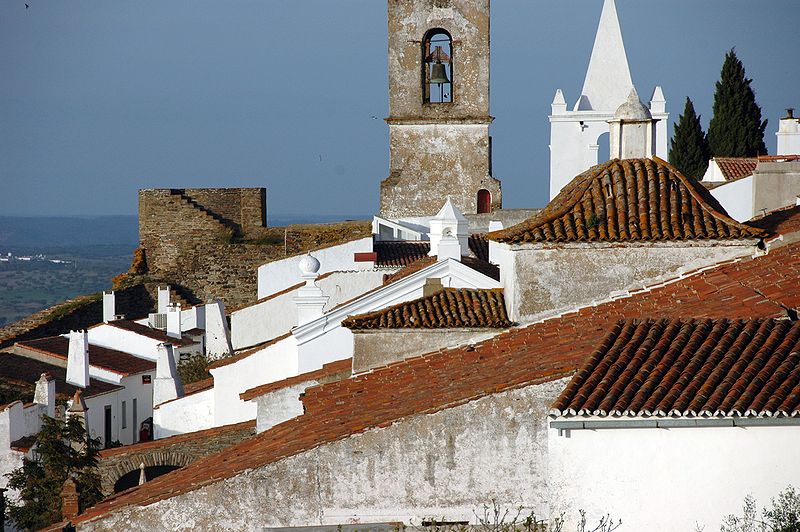
So will you excuse me for borrowing from Wikipedia?
It must have been an anniversary or a special occasion, because I was sitting at a table in “A Ver” when I first heard about Monsaraz. This Tavira restaurant is named for its view down over the rooftops and the prices are more than we would normally pay. But treats are treats, and so I happened to be sitting at the next table to a couple whose evening was interrupted by the wife’s mobile phone. The wife excused herself and was gone for some considerable time.
I can’t remember what prompted me to start the conversation, but before too long the husband was telling me about this beautiful place that I must see for myself. The fact that it was a 4 hour drive or more seemed insignificant to him. And so Monsaraz nestled in my imagination until I could make it a reality.
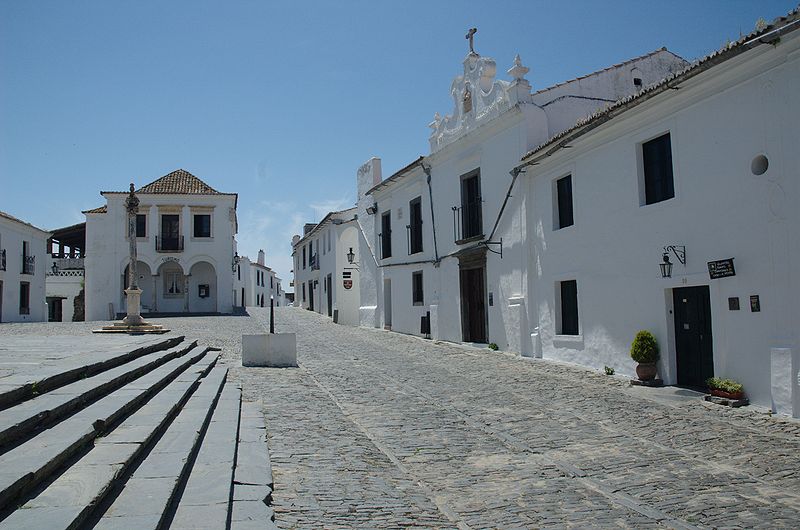
The town square and pillory on a sparkling day- from Wikipedia
The “Rough Guide”, always my bible, confirmed what I wanted to hear. Monsaraz is a tiny, hilltop, walled village with sweeping views across the Guadiana to Spain. It’s name comes from the Iberian word for Cistus landifer, the Gum Rockrose. Xaraz thrives in dry, acidic slate-based soil, thus Monte Xaraz was a hill surrounded by Rockroses.
Monsaraz is one of the oldest settlements in the South of Portugal, and there are many menhirs and neolithic remains in the area. Due to its strategic location, there was certainly a fort there before Roman occupation. Then came the Moors, and in 1232 it became a stronghold of the Knights Templar. In 1640 it was refortified, during the Portuguese Restoration War and the border struggles. Then land reforms and the growth of farm estates heralded change. These days Monsaraz is no longer embattled, but there are still signs of the past.
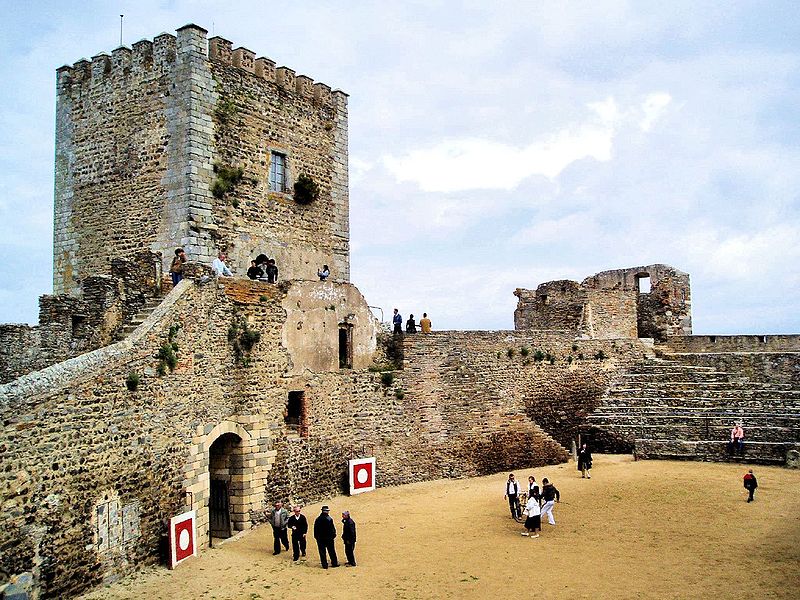
The castle and keep- from Wikipedia
In late October 2009 I journeyed north from the Algarve, across the wide, empty plains of Alentejo. My destination lovely Evora and proud Elvas, but on the return leg I knew I would visit Monsaraz. The weather was autumnal this much further north. Leaving Elvas I headed directly into a rainbow and travelling south the weather steadily deteriorated. I clung tenaciously to the hope that I would be blessed with a patch or two of blue sky, but it was not to be.
I stepped out of the car under leaden skies and looked up at the castle walls, and then out across the Guadiana. Nothing could prevent an idiot grin settling on my face. I grabbed Mick by the hand and started up the slippery damp cobbles, and through the narrow archway in the walls.
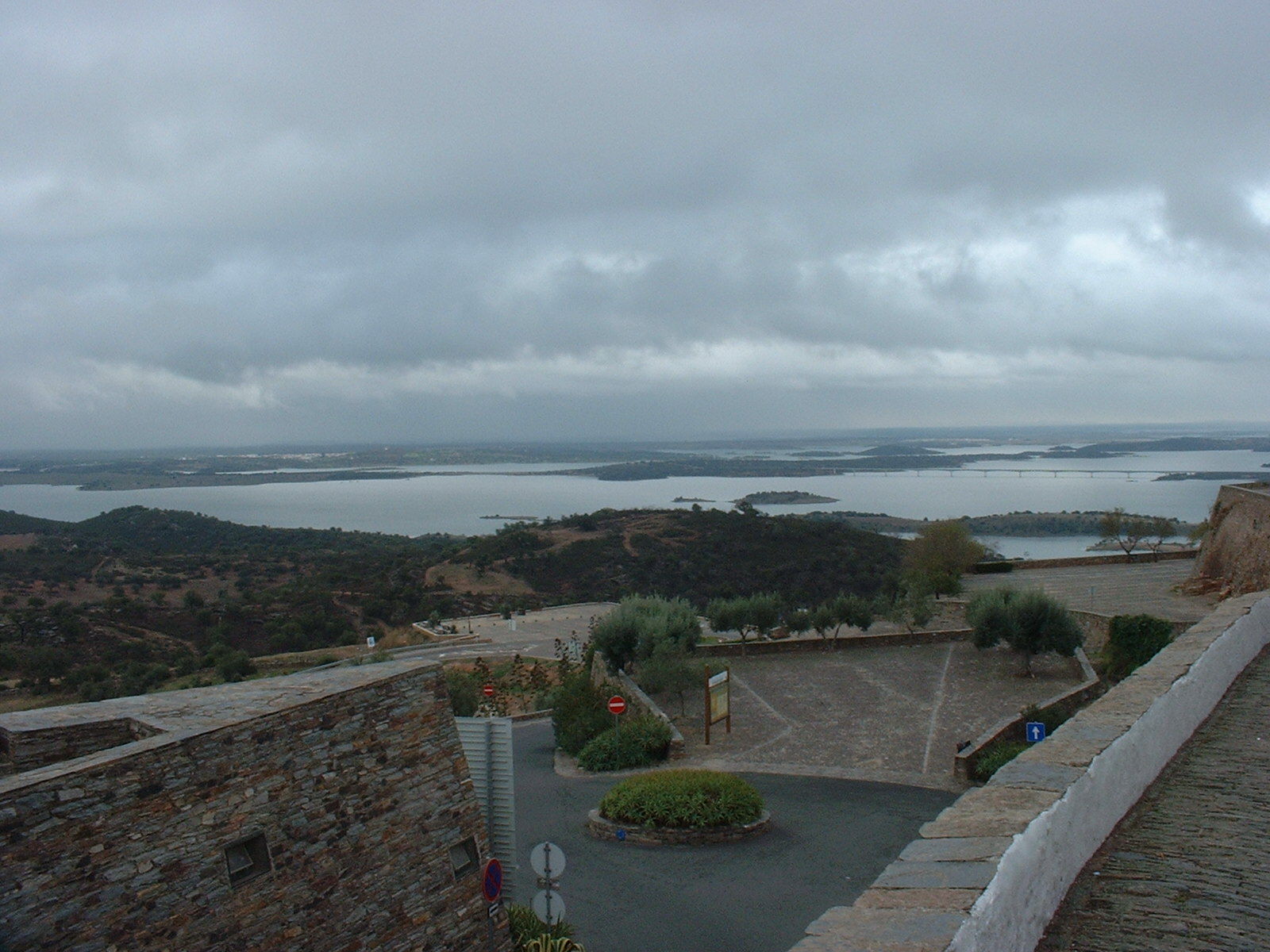
Looking out from beneath the town walls, across the Guadiana
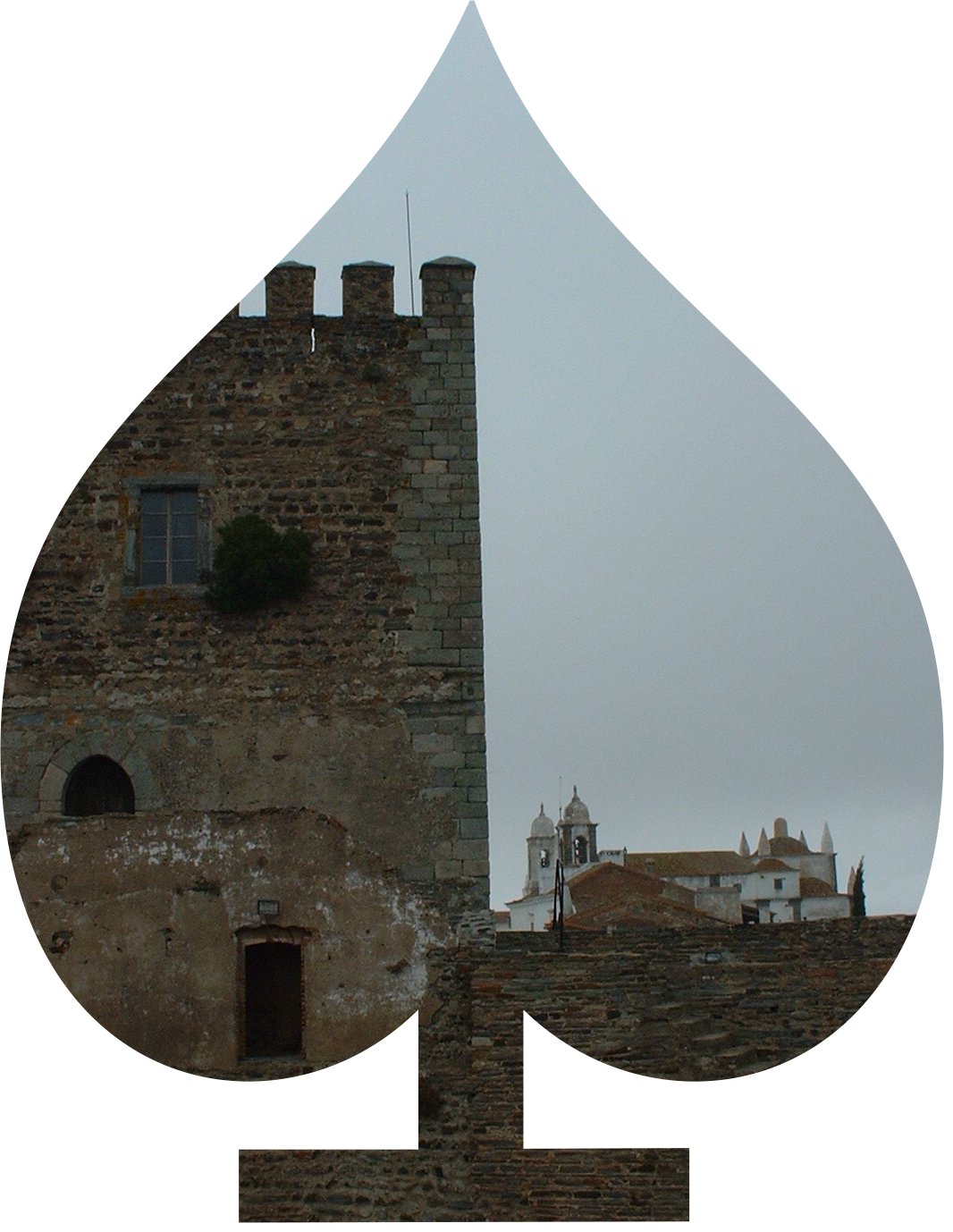
Medieval Monsaraz has only one main street, Rua Direita, with the village square at its centre. The Inquisition House and the pillory point immediately to troubled times. I was more intent on escaping the chill as I slipped inside the Chapel of Sao Bento, with its serene warmth and frescoes. The main church, Nossa Senhora da Lagoa, was closed. Climbing up to the castle walls, in a light drizzle, I felt I had reached the summit of a watery world. The plains below had been flooded by the creation of the Alqueva Dam, boating heaven in Summer and a vast body of water.
The castle is topped by the Witches Tower (Torre das Feiticeiras) and within, the unexpected sight of a bullring, complete with tiered seating! Currently it’s used for Festivals and fireworks, so no sad bulls. As the rain increased its pace, tiny Cafe de Cisterna provided shelter, warm turkey pies and a slab of delicious cake. Despite all that water outside, a drinking supply for the villagers had required a huge cistern to combat the blazing summer sun. It was just visible through a barred window and then the weather really did drive us away.
I had planned a leisurely route back, crossing over the dam by a bridge to Mourao, but visibility was so poor that I had no choice other than to agree as Mick pointed the car due south. In a couple of hours I was back under the blue skies of the Algarve.
I’ve found a site with some lovely atmospheric photos of Monsaraz, if you click on this link. And you can get a better look at the whole trip on my E is for Elvas, and Evora. It wasn’t all rain!
Meantime it’s thanks again to Frizz for prompting me to respond to his Tagged ‘M’ and to Julie Dawn Fox for the Personal A-Z Challenge. And many thanks to you for reading!

 restlessjo
You must be logged in to post a comment.