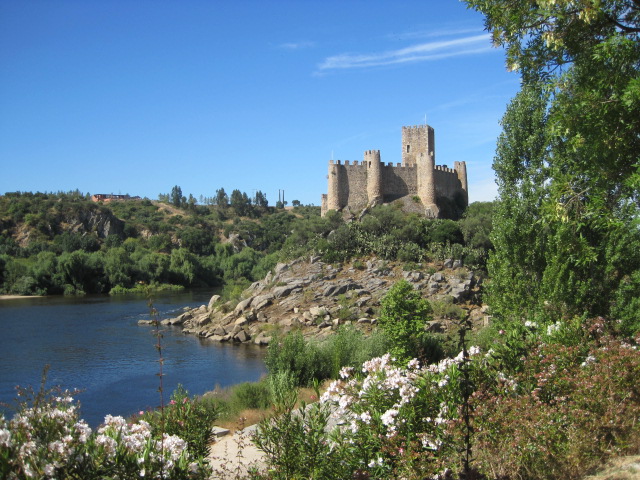
Romantic Almourel
Hidden in Portugal’s quiet depths we found another Templar treasure. A more serene setting I have yet to find, wholely at odds with the history of the Knights and their battles against the Moors. We had travelled from Constancia in the Ribatejo, at the junction of the rivers Tagus and Zezere (a name that delighted me), so we knew all about sleepy and tranquil. Still, nothing prepared me for this.
A little before 10 in the morning we rounded a corner and there it sat, with barely a ripple reflected in the water. A tiny ferry boat lay at anchor, awaiting a boatman and maybe even a passenger or two. Castles just don’t come any more enchanting than this. Nothing to do in the still morning air but to breathe in the calm and admire.
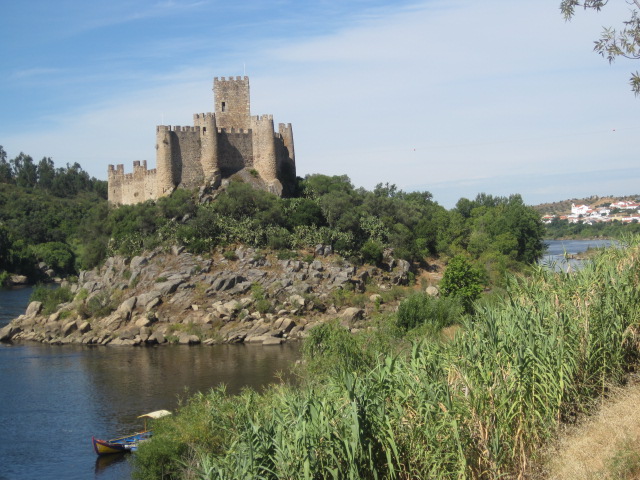
The ferry boat awaits
How and why was it here? The name seems to derive from the Arabic, almoran meaning “high rock”, appropriate for a huge chunk of granite. The site was known in Roman times, and used for defence purposes then. It was during the Reconquista period, when the Portuguese were trying to break free from the stranglehold of the Moors, that it came into it’s own.
The Knights Templar were entrusted with the rebuilding and fortification of the castle, in a line of defence of the then capital, Coimbra. Like the mighty Convento do Christo at Tomar, they gave it nine circular towers, enclosing a quadrangle, and a jail tower at the centre. It was completed in 1171, two years after the castle at Tomar.
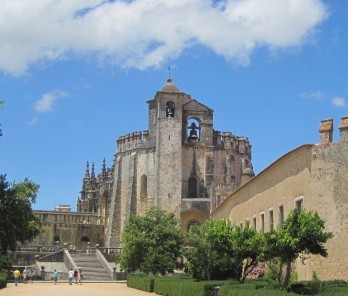
Convento do Christo at Tomar
With the Moors evicted from Portugal, Almourel was abandoned and fell increasingly into disrepair. Further damage was inflicted by the 1755 earthquake, but all good castles have a happy ending. The castle became a listed building in 1910. Further renovations took place and during Salazar’s dictatorship events were held there.
Today there is no sign of any conflict…. just a ferryman plying his craft.

The lone ferryman
Naturally there’s a legend befitting the castle. A tale of Moors, Christians and treachery. The Arab lord of Almourel’s daughter fell in love with a Christian knight, and gave away the secret of a passage into the castle beneath the Tagus. When the knight ambushed the castle, the lord and his daughter flung themselves from the ramparts rather than face capture.
There is no charge to visit the castle, generally open from 10am till 5pm. Simply pay the ferryman his minimal fee.
 restlessjo
You must be logged in to post a comment.