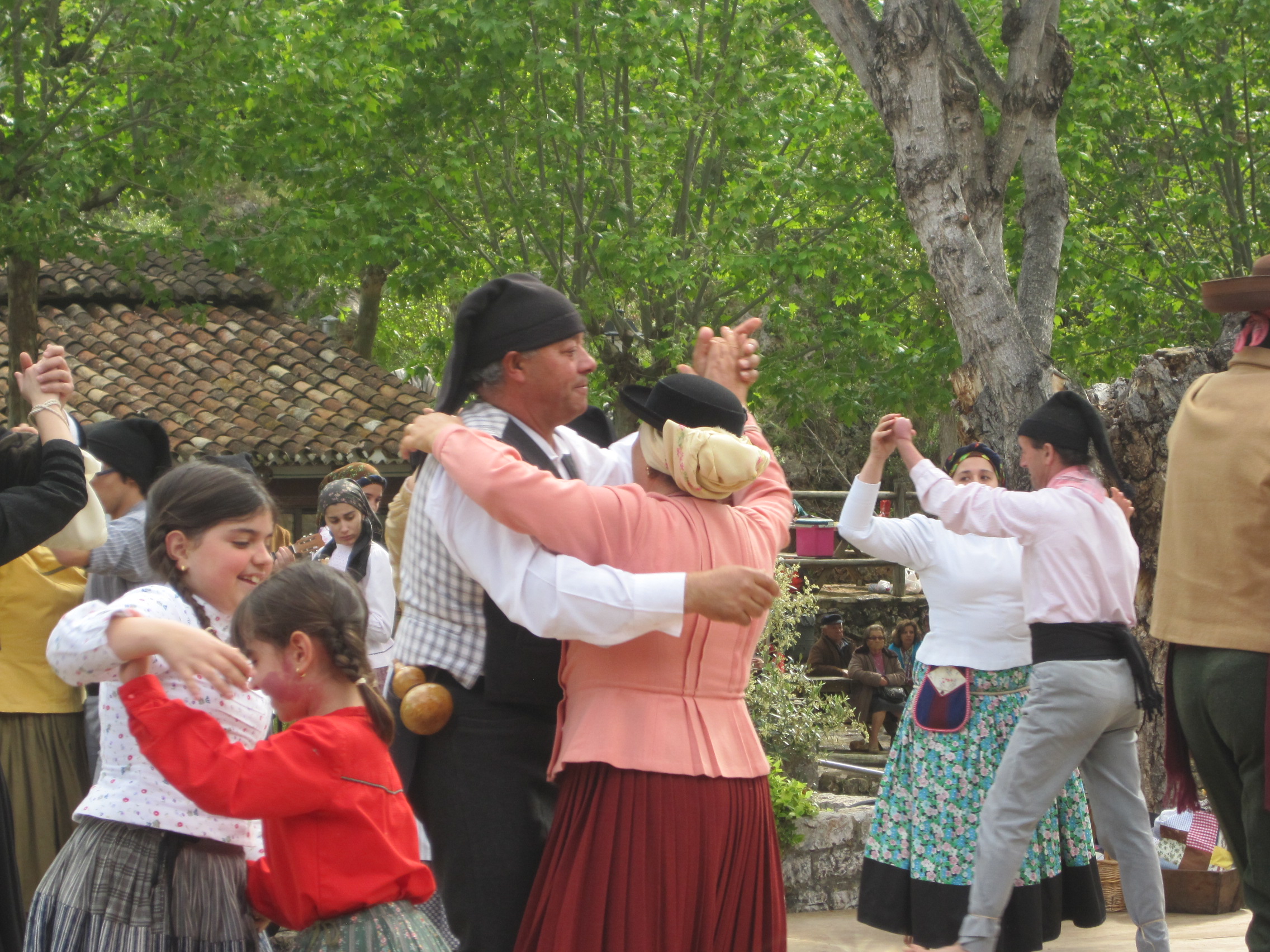
My personal A-Z of Portugal

P is for Porto

You knew it was coming!  The final post on my visit to Porto.  Just one more time I’m going to take you there, and try to capture the impact it had on me.
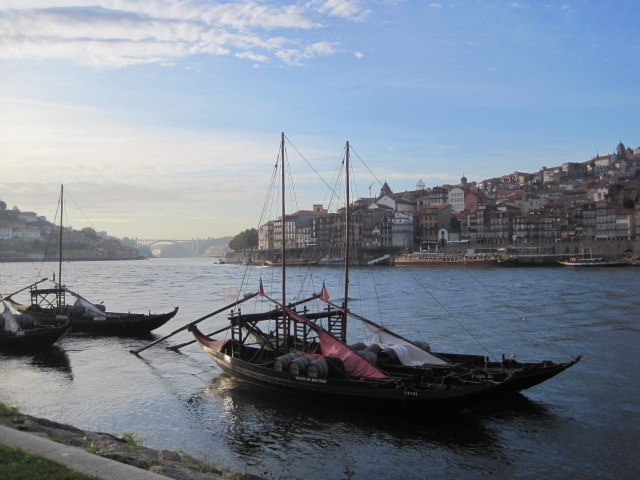
Looking out to the river mouth (Foz do Douro)

I’m not sure if it’s because it’s a northern city that I felt such an affinity with Porto.  At home I’m used to the north/south divide and the differing attitudes of the two.  Being “from the north” confers a kind of backward status, despite us having some beautiful cities of our own.  I felt a little of the same in Porto.  Like us north-of-Englanders, Porto is far from feeling inferior.  It’s proud of its past, and fighting for its future.
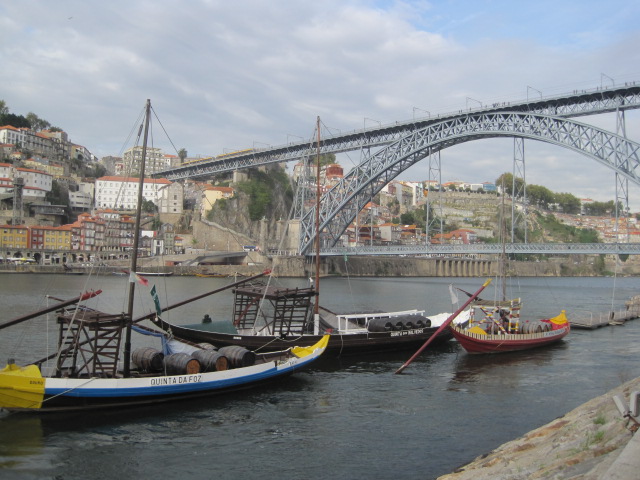
Barcos rabelos below Dom Luis I Bridge
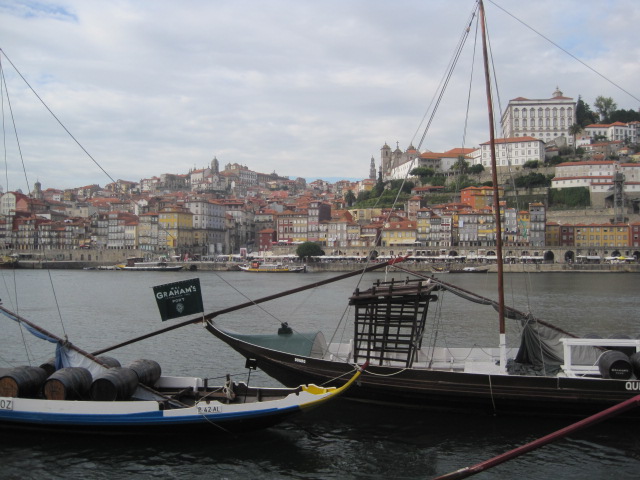
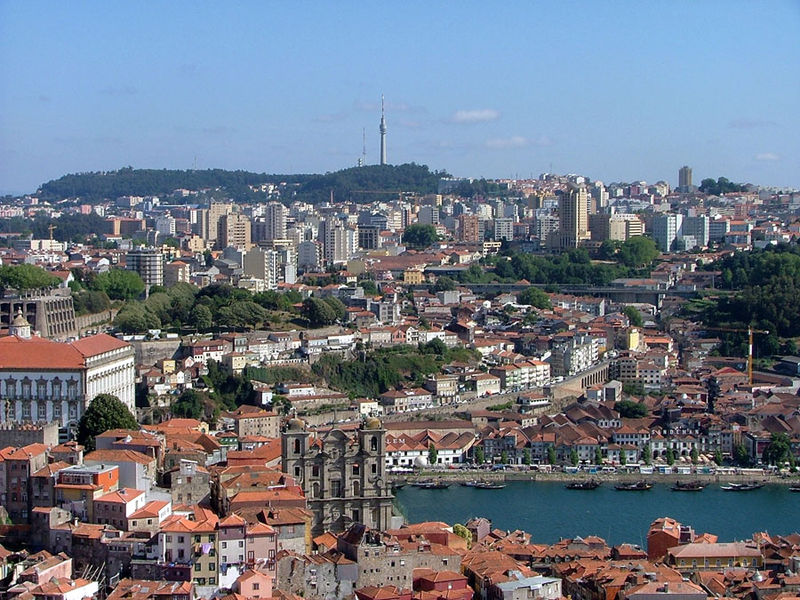
The lovely Porto skyline

In Roman times, the twin cities at the mouth of the River Douro were known as Portus, on the right bank and Cale, on the left.  During the Moorish occupation, the entire region between the Minho River, to the north, and the Douro, was called Portucale.  When Afonso Henriques founded the new kingdom in the 12th century, and became its first king, he named it Portucalia after his home province.  So you see, Porto and the Douro are an integral part of the Portuguese nation, and have every right to be proud.

They’re quite feisty too.  Porto is known as A cidade invicta, “the invincible city”, because of its unparalleled resistance to Napoleon during the Peninsular Wars.  In modern times too, the city was the centre of opposition to Salazar’s right-wing dictatorship.
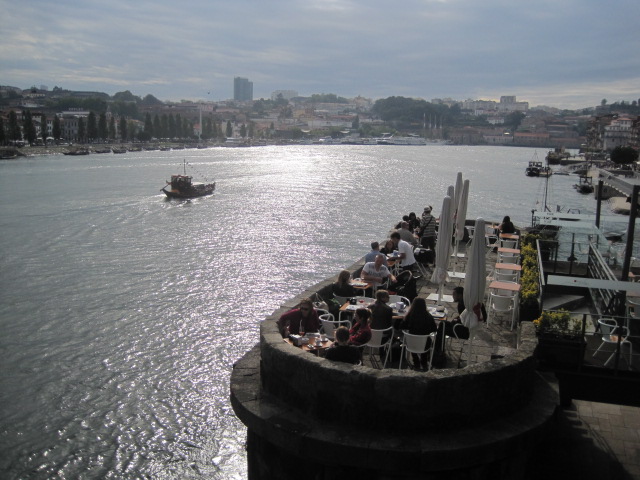
You can’t get much closer to the river than this cafe

One of the best things I did in Porto, and I would recommend it to anyone relatively fit, was the free walking tour with Pancho Tours.  I had in mind that the person we would be meeting beside the Dom Pedro IV statue in Praca da Liberdade would be a guy sporting an orange t-shirt emblazoned with the company logo.  Wrong!  A small, dynamic, curly haired bundle of fun by the name of Iris was our guide.  She proceeded to entertain and enthrall 24 of us multi nationals for two and a half hours!
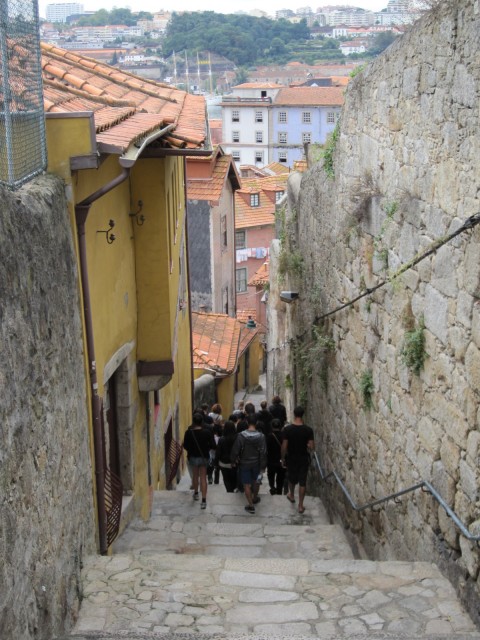
Our tour group, captured by my husband, Michael

As you can see from the photo, there are many ups and downs involved in a walking tour of Porto.  It wasn’t an historical tour, but gave you a real insight into the city and an appetite to come back and see more.  At a brisk pace most of the important sites were pointed out, with essentials like the cheapest places to eat good Portuguese food, and where to buy the best cakes. (everywhere!)  Believe me, in Porto you’d soon burn up the calories.

One of the high points of the tour (literally) was the upper tier of the Dom Luis I Bridge.  The Metro rumbled past perilously close behind us, but the views were staggering.
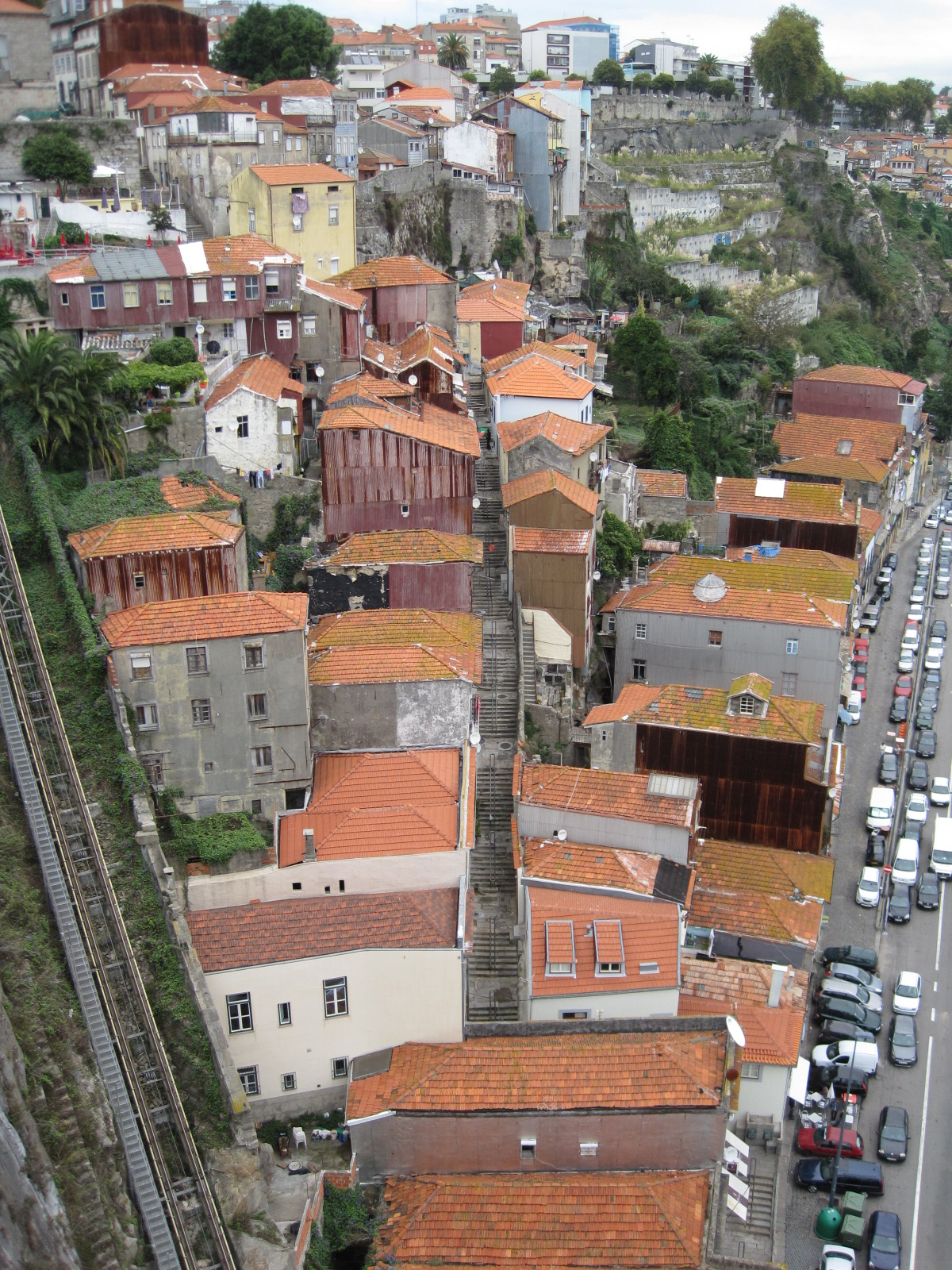
Michael’s again. The steps or the funicular?

We wound our way down the steps to the quayside, and, tour over, indulged in a meal in Iris’s company.(our feet needed a rest and it seemed a good opportunity to try the Francesinha– a chunky spicey meat-filled toasty smothered in cheese and served in a piquant sauce)
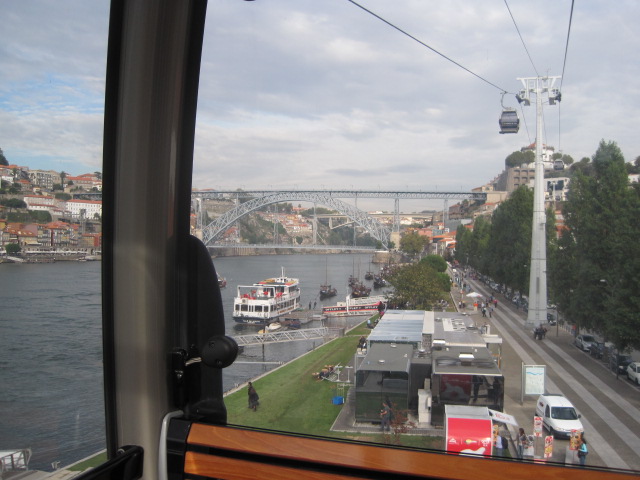
Riding the cable car over Vila Nova de Gaia

Back on my feet again, I couldn’t resist a ride in the cable car over on the Gaia side of the river.  I love a bird’s eye view!  My only complaint, the ride was over too quickly.   I compensated later by riding the funicular up to the clifftop.  It’s only as it glides into the old city walls that you realise how solid they once were.

Still chasing views, and with a fresh pair of legs the following day, I undertook the 225 steps to the top of the Torre de Clerigos.  This six-storey granite tower was built in the 18th century as a landmark for ships coming up the Douro.  Well worth the climb!
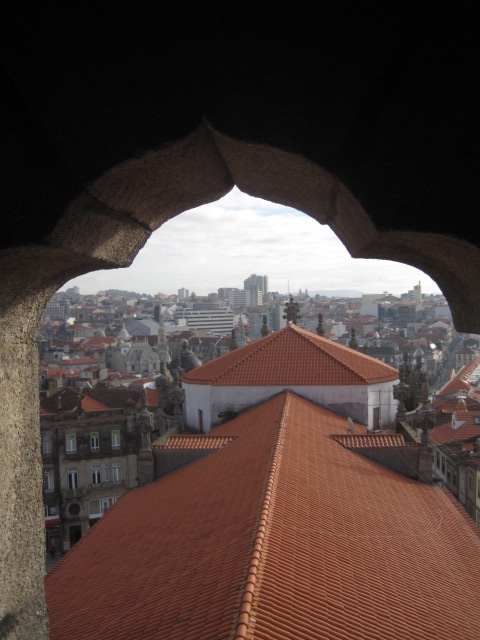
The tower has some interestingly shaped windows
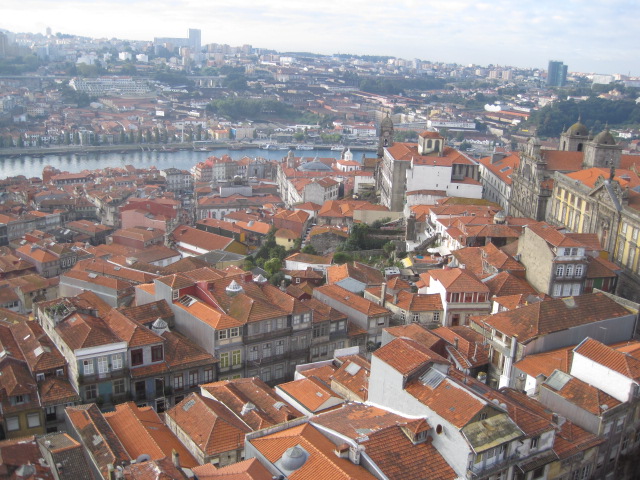
The view from the top

For a change I found myself looking up when I visited the Palacio de Bolsa, the former Stock Exchange.  The palace can only be seen as part of a half hour organised tour, but I was keen to see the famed Arab Salon.  Loosely based on the architecture of the Alhambra, it was without question built to impress, and it did.
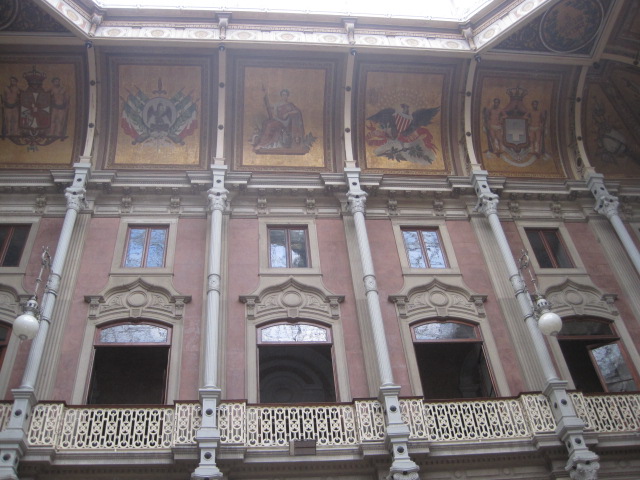
The internal courtyard in the Bolsa Palace, decorated with heraldry
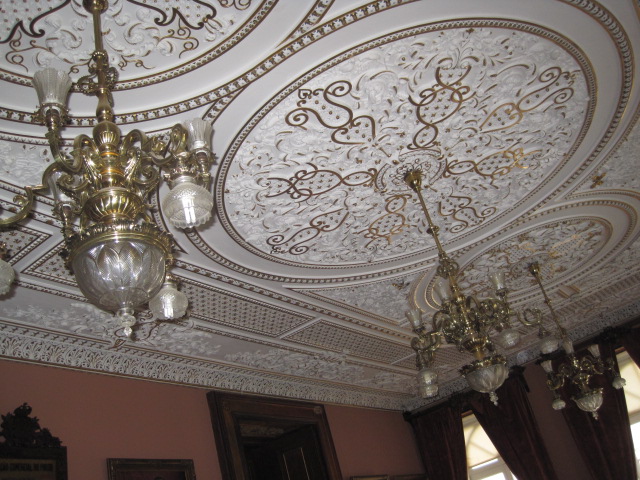
Just like my ceiling at home (er, not quite!)
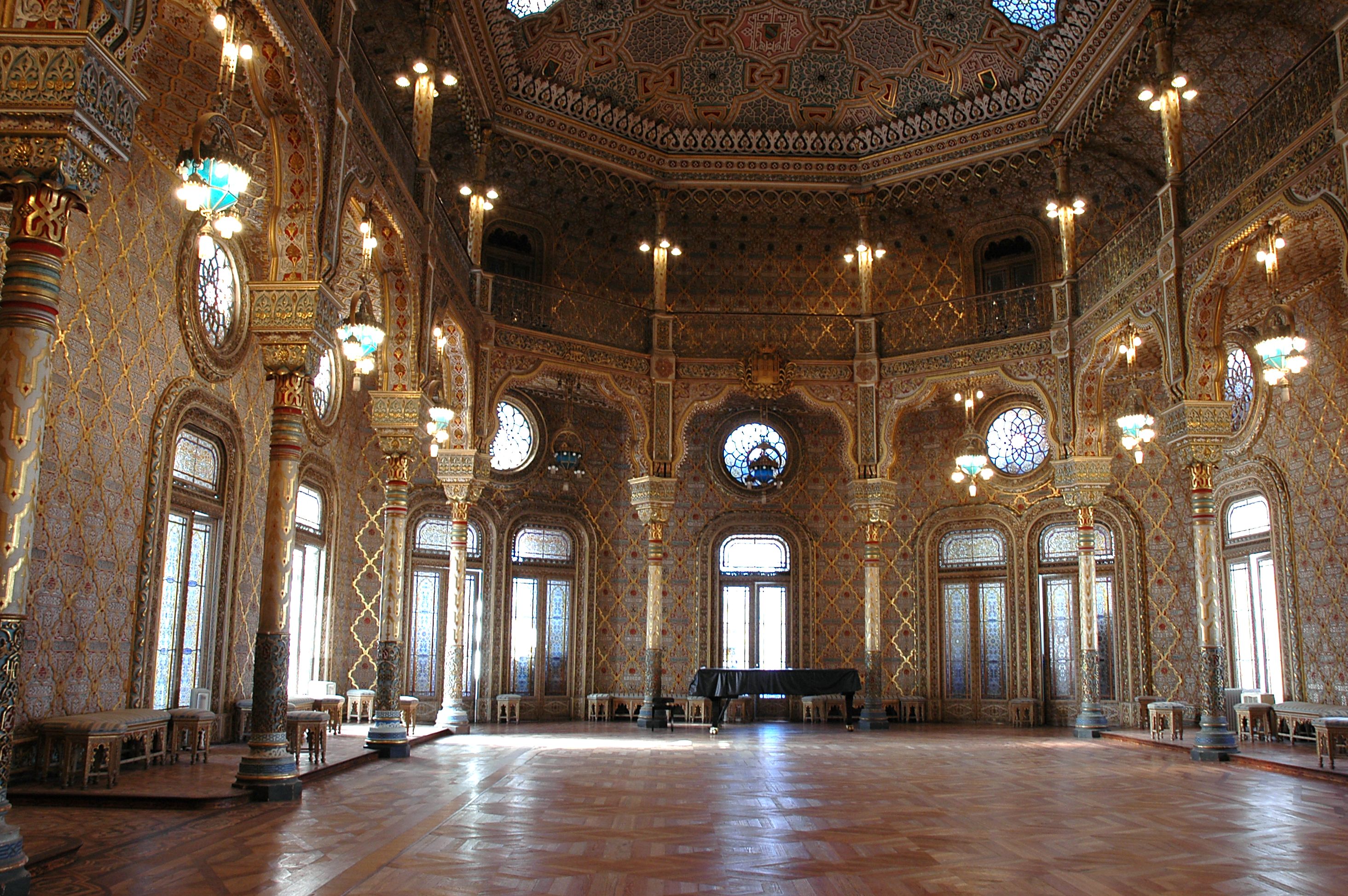
The stunning Arab Salon- courtesy of Wikipedia

Not all of Porto is quite so perfectly preserved, and it’s part of the gritty reality of the place that the ramshackle lives side by side with the chique.  The indoor market at Bolhao was decidedly shabby, but for the people selling their wares in the little kiosks it was their whole life.  Iris informed us that it was soon to be another casuality of the city, as there are simply insufficient funds to restore it.  I was glad I saw it when I did.
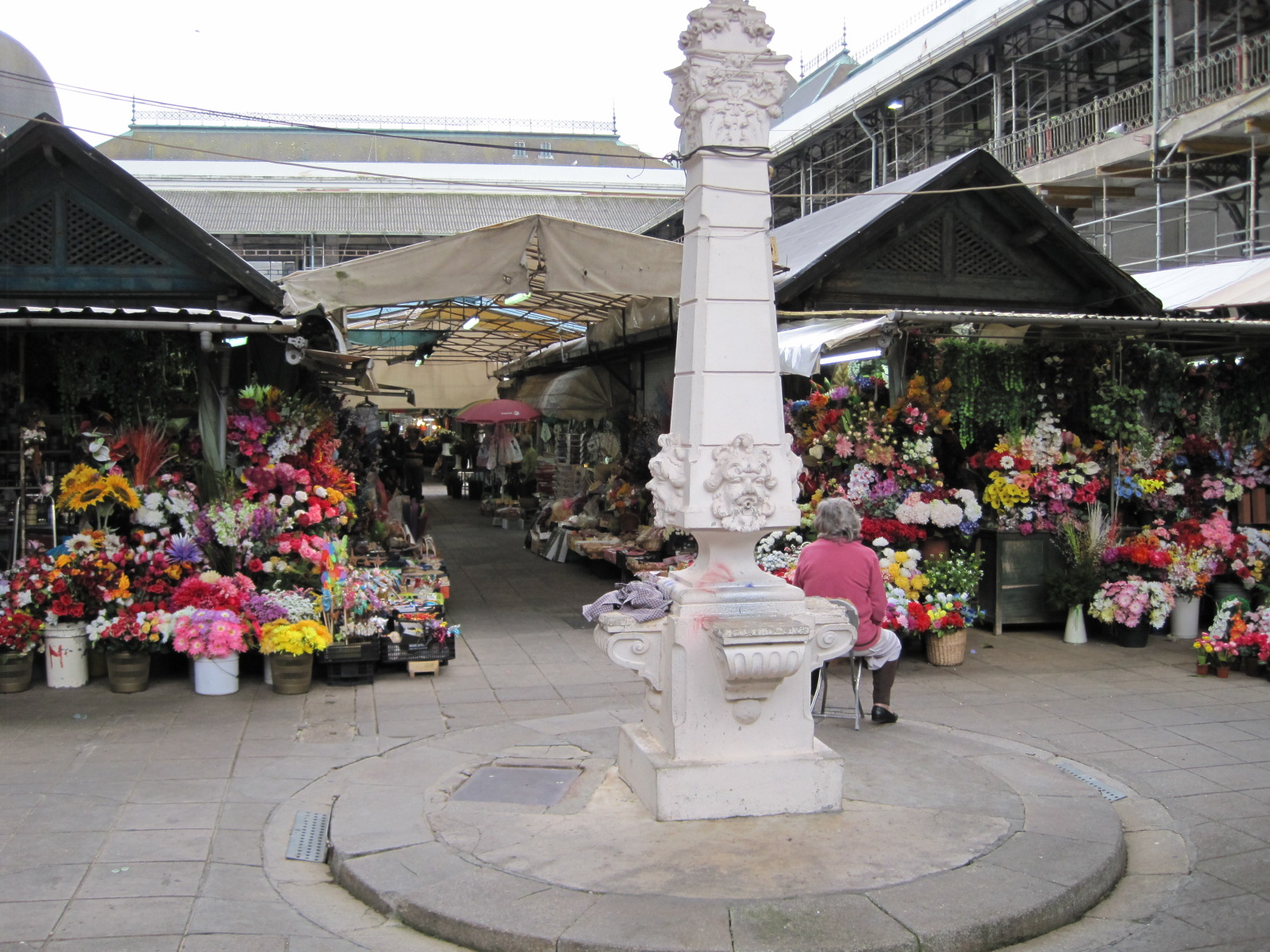
Bolhao’s indoor market- courtesy of Michael Bradley
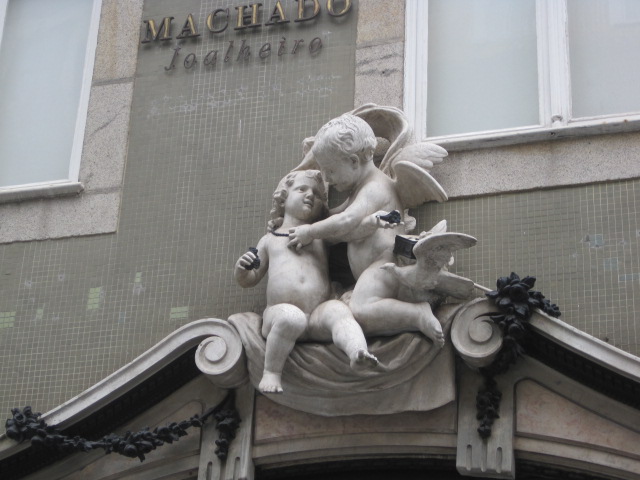
Cherubs on a peeling wall, Rua de 31 de Janeiro
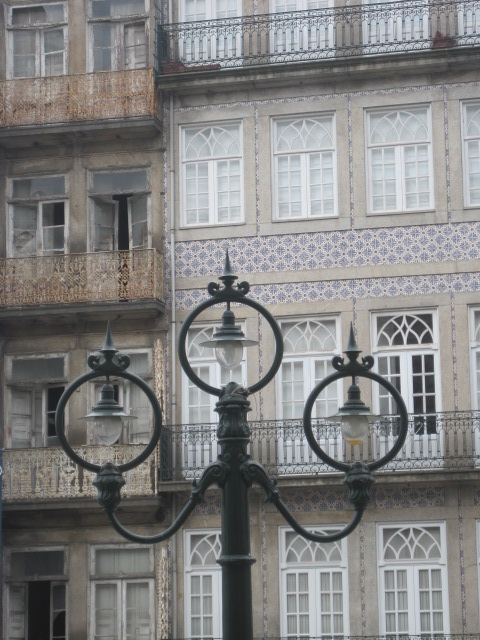
Renovated, and not, opposite Sao Bento railway station

One of the shinier, newer parts of the city came as a real surprise to me.  I had little idea what I would find at Foz do Douro, other than the river mouth, so I mounted the tram with real excitement.  It trundled out along the shoreline with wonderful views to either side- the houses tumbling to the water on the one, and the ever widening river on the other.  The tram ends at Passeio Alegre, and from there you can stroll and stroll.
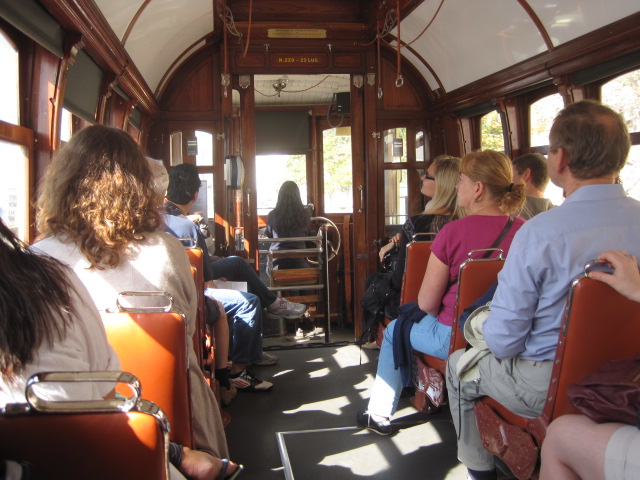
The lovely old tram, complete with lady driver

The view back towards Porto
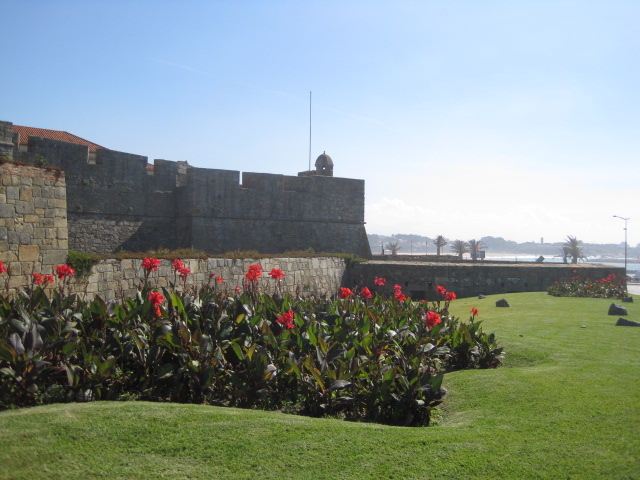
Forte de S. Joao Baptista da Foz

Suddenly I was at the seaside, with the tang of the salt air, and the snap of the waves.  The sunshine was radiant and I collapsed at a bar to feast on the sparkling water.
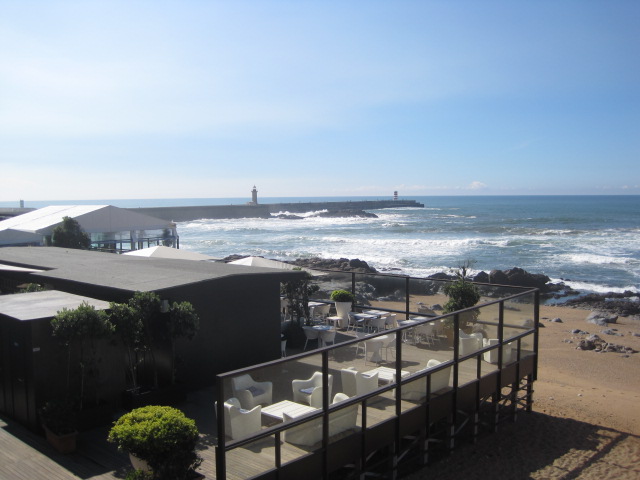
The waterside world in Foz do Douro
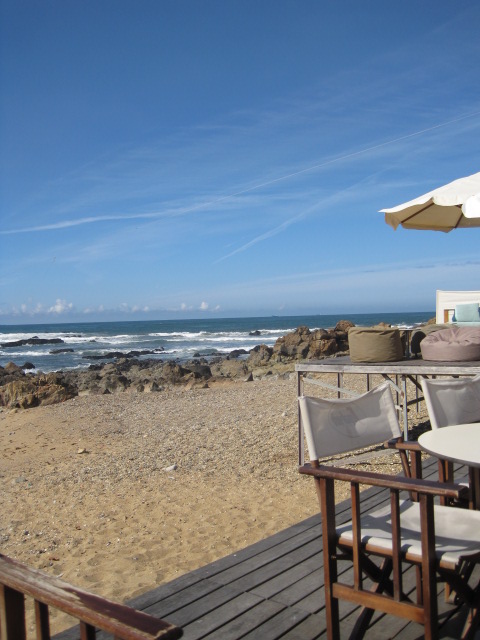
Squishy loungers were severely tempting

I wished I could have spent more time in this lovely spot, and if (when!) I return, I will certainly do so.  The tram has two routes and after I’d struggled up the steep incline to reach the gardens of the former Crystal Palace, I discovered that one of them bypasses the gardens.  It’s a peaceful spot, and I guess the views down to the river were compensation for the climb.
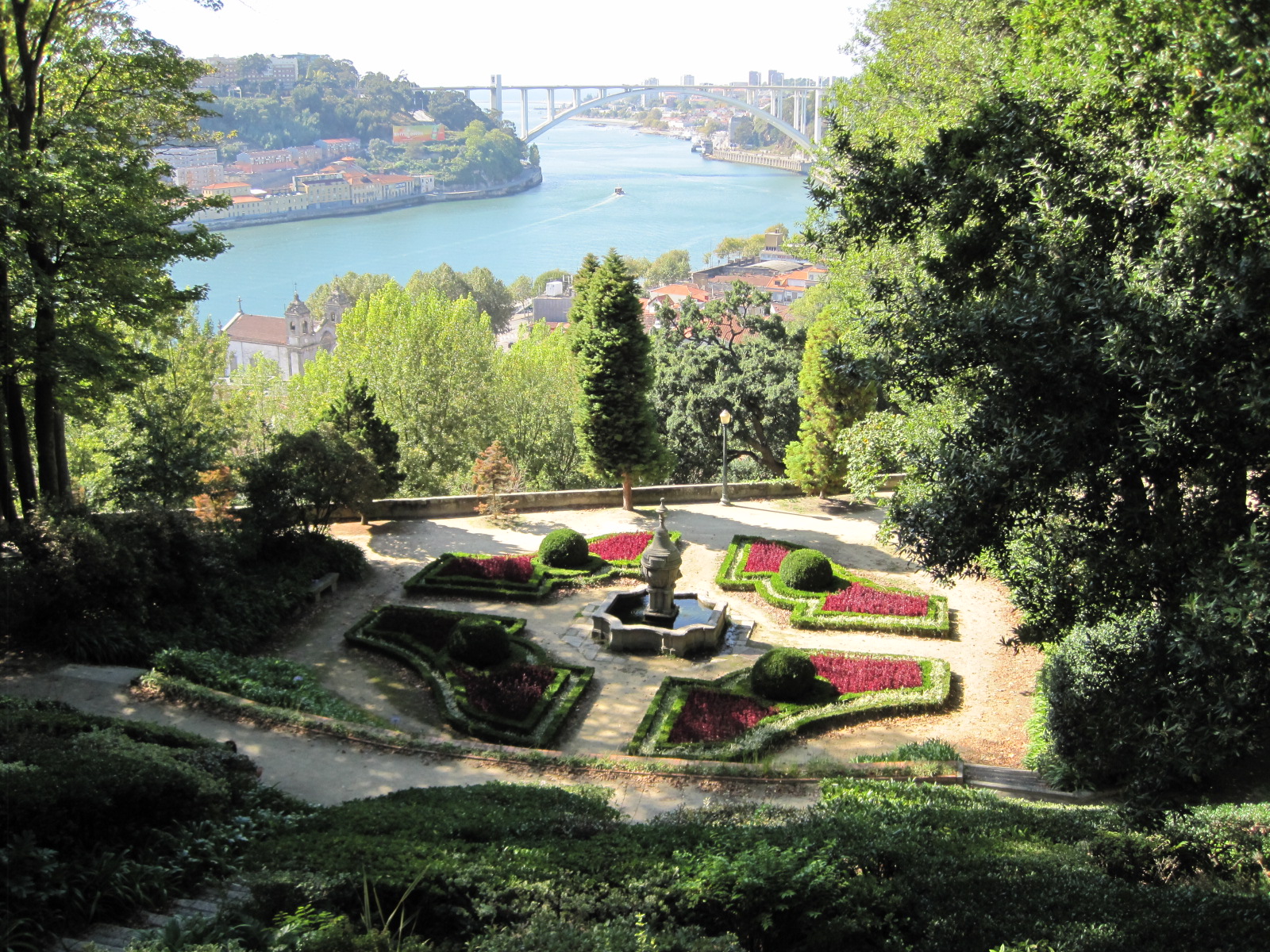
The Jardins de Palacio de Cristal- Michael does distance shots much better than me

You’ll notice that I haven’t even mentioned the “A” word once?  Azulejos, that is.  The reason of course is that I went to town on them in my Simply Beautiful Blue and White post.  If you didn’t see it and are thinking of coming to Porto, please take a look.  It might just convince you.  I still haven’t managed to fit everything in.  It’s probably a capital offense but I didn’t even mention port-wine tasting!  Well, you know I do my share of that anyway.

For now, I’ll leave Porto, with lots and lots of beautiful memories.  Many thanks to Julie Dawn Fox for giving me the opportunity to post this in My Personal A-Z of Portugal.  If you haven’t already seen her A-Z Challenge, click on the banner below.  It might give you some ideas.

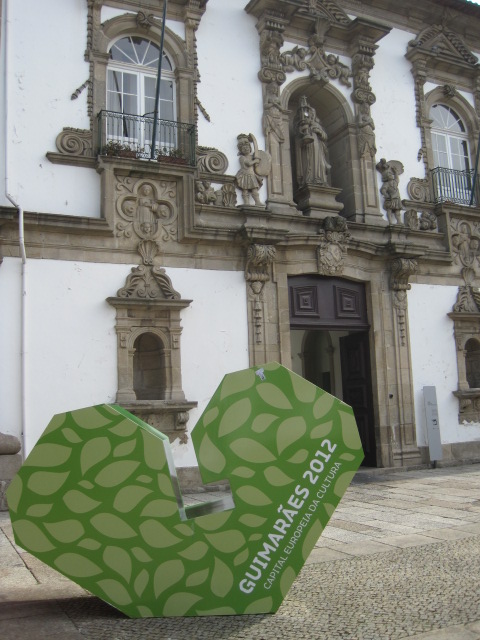
H is for Happy Heart

Guimaraes, European City of Culture 2012

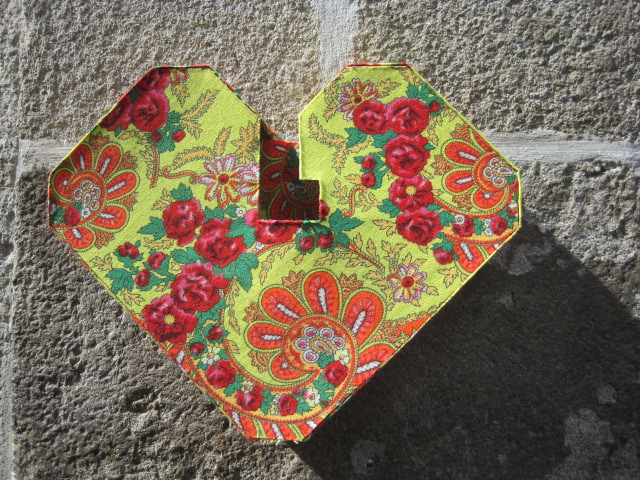
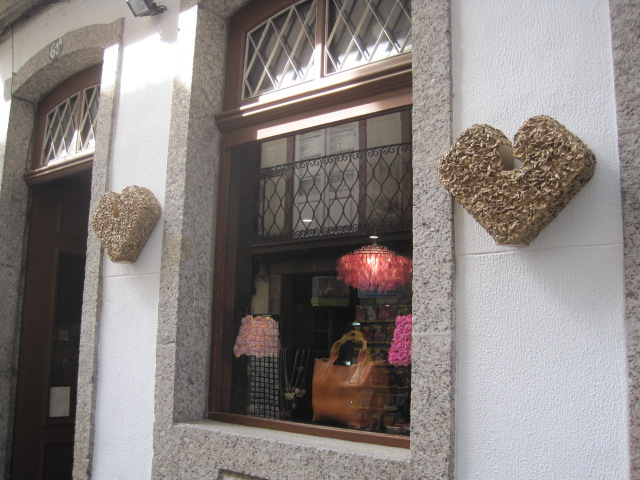
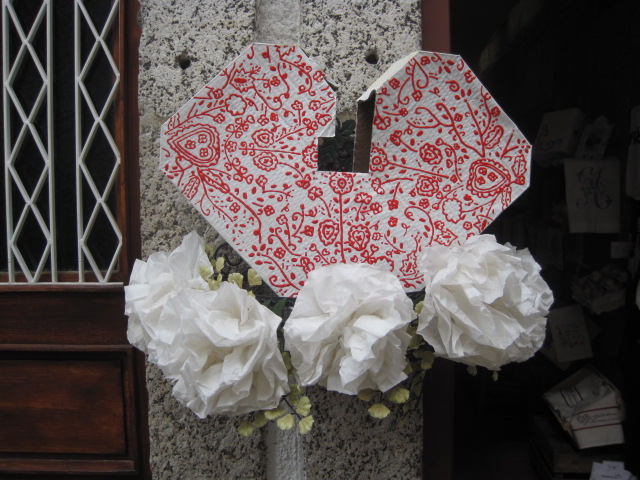
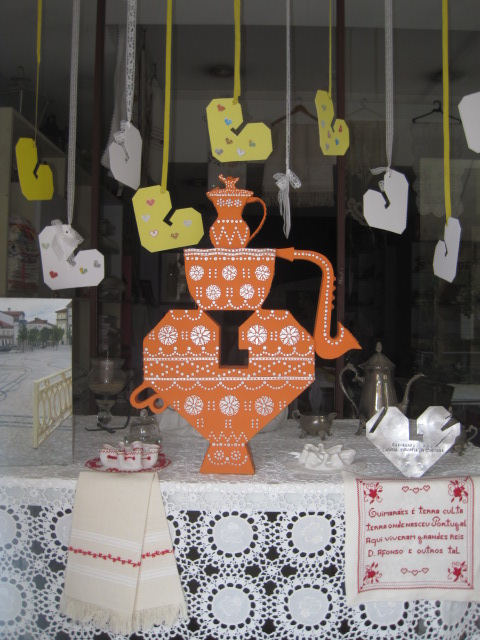
I was immensely taken with the heart logo which pops up everywhere in Guimaraes this year.  Designed by Joao Campos, it was inspired by the crenels of Guimaraes Castle and the helmet of King Afonso Henriques, the first king of Portugal.

I couldn’t be so close to Guimaraes without paying a visit in this, its special year as the European City of Culture.  “You are part of it” is a theme running throughout the year, and the logo is an important symbol of this. You might enjoy the promotional video  http://www.guimaraes2012.pt/index.php?cat=49&item=912&kword_cat= (choose 2012) I caught the train from Porto’s fabulous Sao Bento railway station to arrive on a sleepy Tuesday afternoon.

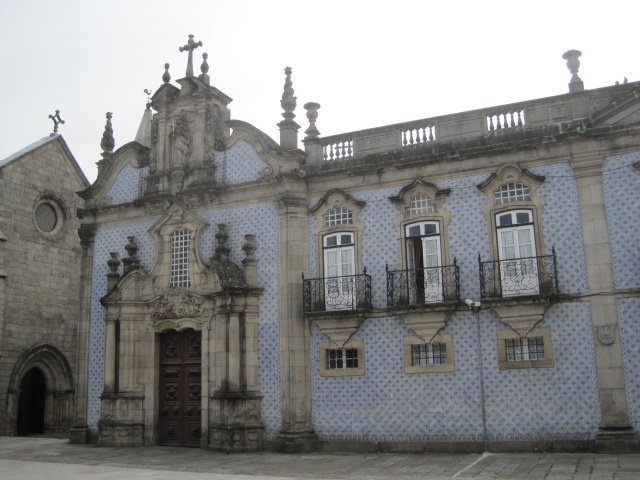
I didn’t know quite what to expect of Guimaraes, except that it would have a historic significance for the nation.  Everyone I had spoken to said it was very charming and captured “traditional Portugal”.  Of course, you know by now what traditional Portugal means to me, so, at the first hint of an azulejo, I was in through the doorway of the church of Sao Francisco.

Igreja de Sao Francisco

More cherubs!  I’m happy.

Michael’s photo of the altar was much better than mine

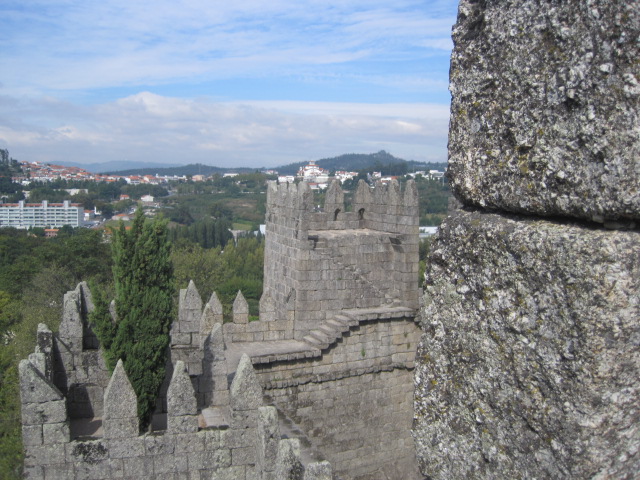
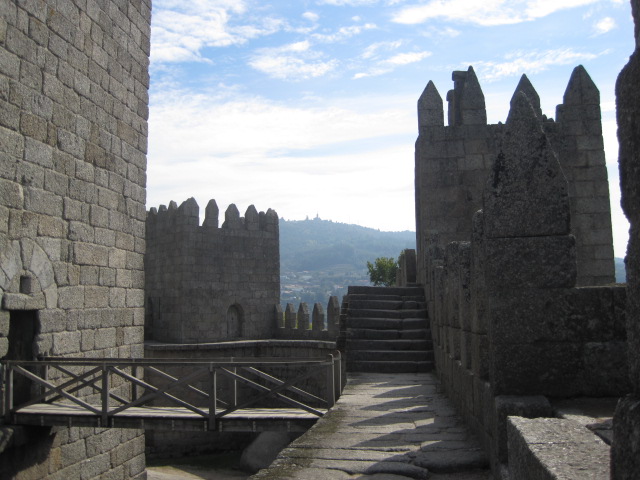
Guimaraes has its origins in the distant 10th century.  The widow Countess Mumadona Dias ordered the construction of a monastery in her estates at Vimaranes (Guimaraes today).  Constant attacks from the Moors and Normans necessitated a fort to defend the monks.  The Castle was built on a nearby hill, and a settlement grew up between the two, enclosed by walls.

In the 12th century, the County of Portucalem came into existence and the Castle became the residence of Count D. Henrique.  King Afonso Henriques was probably born here, and christened in the tiny chapel.  In 1128 the nearby Battle of Sao Mamede was instrumental in the founding of the Portuguese nation.

Modern Guimaraes from the castle walls

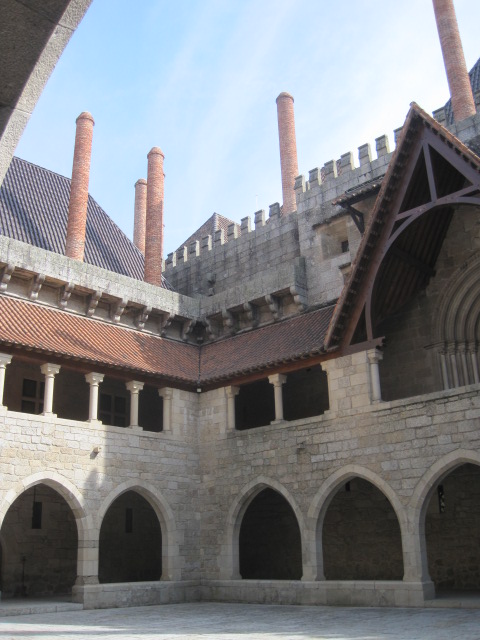
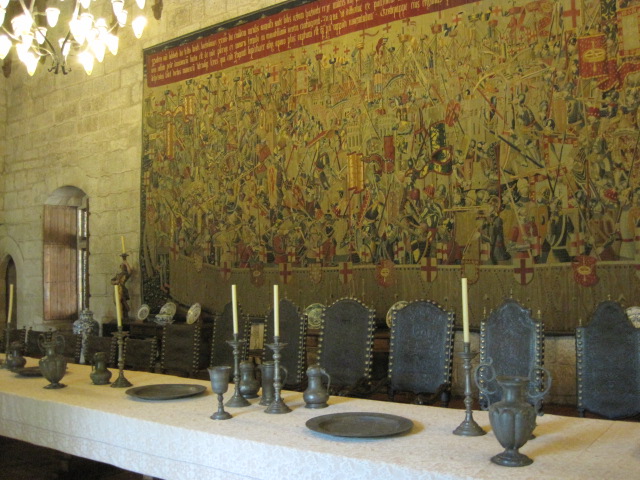
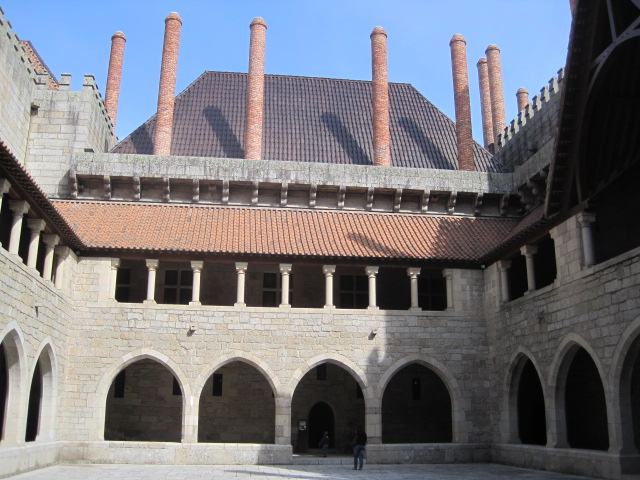
Walking back down from the vantage point of Guimaraes Castle, you cannot but be drawn to the Palace of the Dukes of Braganca.  I have visited the marble enhanced Braganca Palace at Vila Vicosa, and was intrigued by the difference.  Built in the 15th century, it is a unique example on the Iberian peninsula of a fortified house in the manorial style.

Braganca Palace with its distinctive chimneys

A collection of tapestries adorn the walls

A central courtyard captures the sunlight

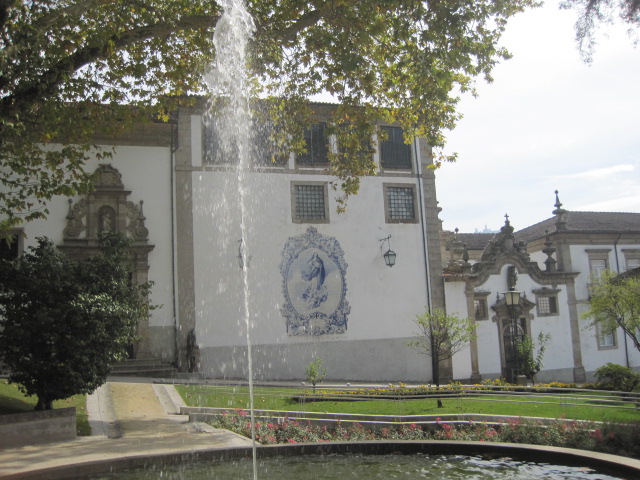
The city’s first street, Rua de Santa Maria, unravels gently into the cluster of the old town, but not before you pass through Largo Martins Sarmento.  The fountain, with chapel beyond, makes a pretty picture.

Largo Martins Sarmento

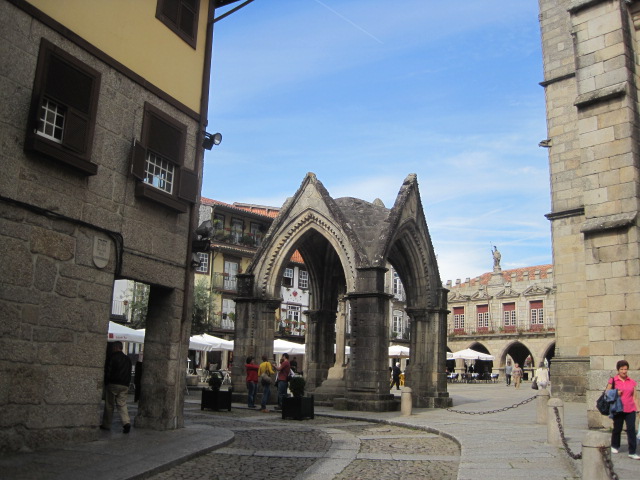
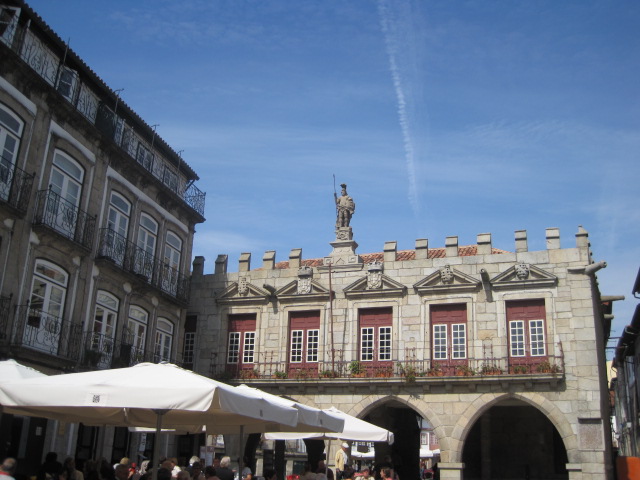
The narrow streets wrap around two large squares, Praca de Santiago, and Largo da Oliveira.  The photo everybody’s keen to take features the old Council Chambers and Gothic Salado Monument.

Largo da Oliveira and Salado Monument

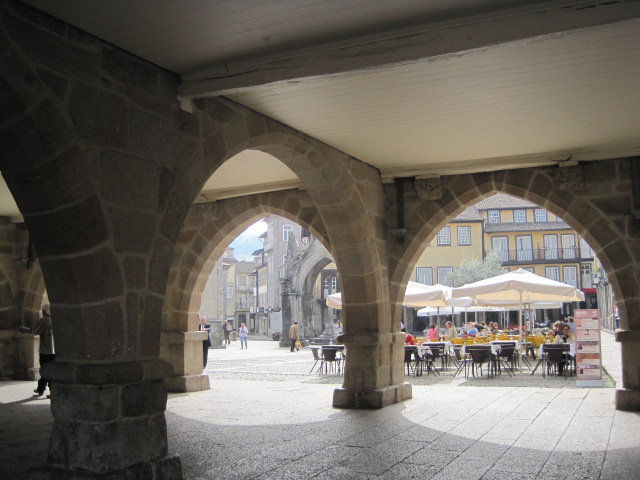
The square seen from beneath the old Council Chambers

Nice spot for a coffee, or something stronger

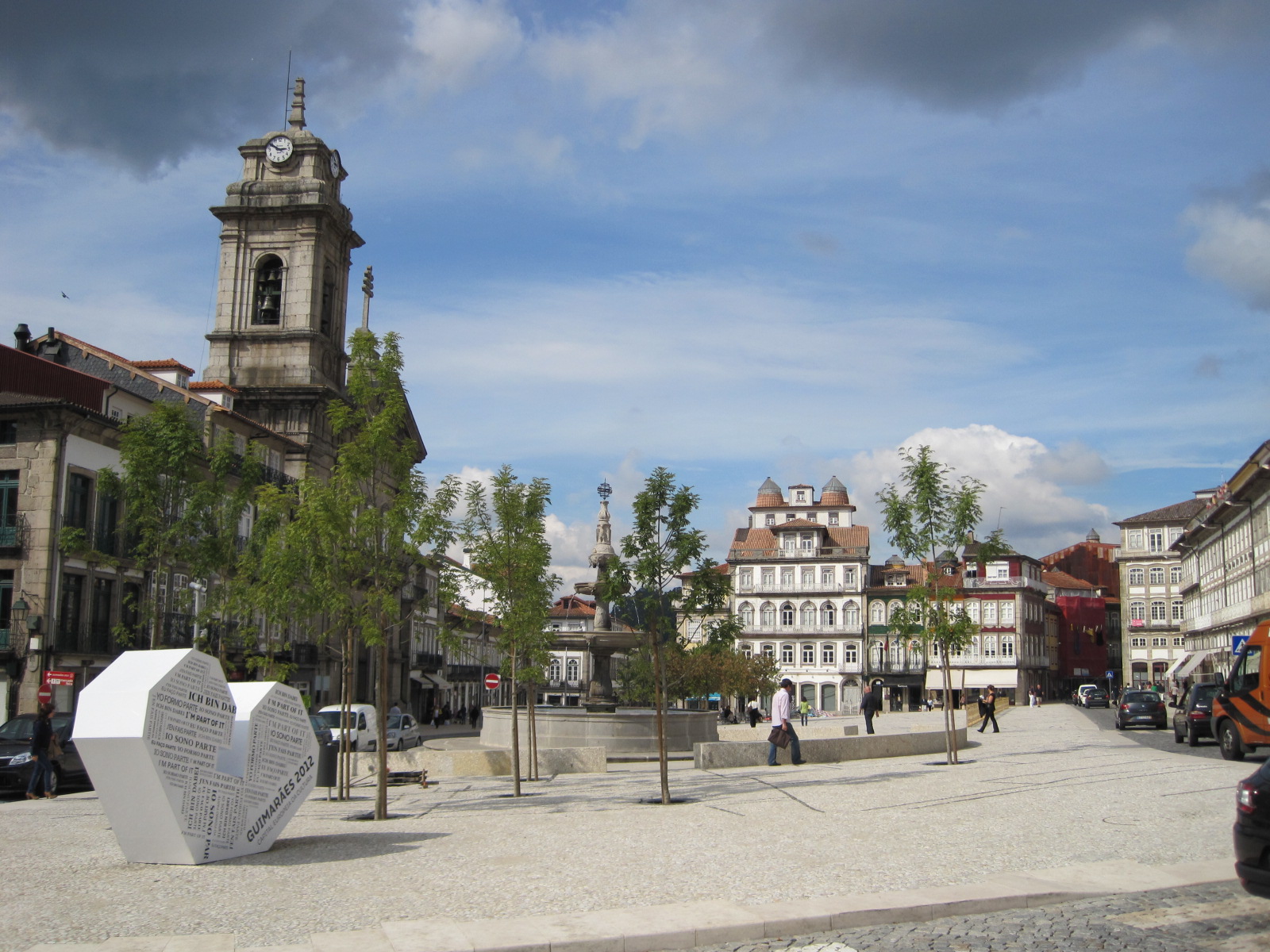
At the end of the 19th century, Guimaraes achieved city status, and sadly the city walls were demolished.  Let me end in Largo de Toural, the focal point of modern Guimaraes, and outside those city walls.  The legend “Aqui nasceu Portugal” – here Portugal was born- sits proudly on a remnant of wall.

One last heart in modern Toural Square- another Michael photograph

The old centre has UNESCO World Heritage status and this year every effort has been made to turn Guimaraes into an inviting tourist destination.  If you like what you see, there’s still time to visit.  The events are posted on www.guimaraes2012.pt

Me, I have a “happy heart” whenever I’m in Portugal.  Many thanks to Julie Dawn Fox who gave us the idea of “My Personal A-Z Challenge”  Follow the links to discover more, and maybe join in yourself.

T is for the Tavira Vase

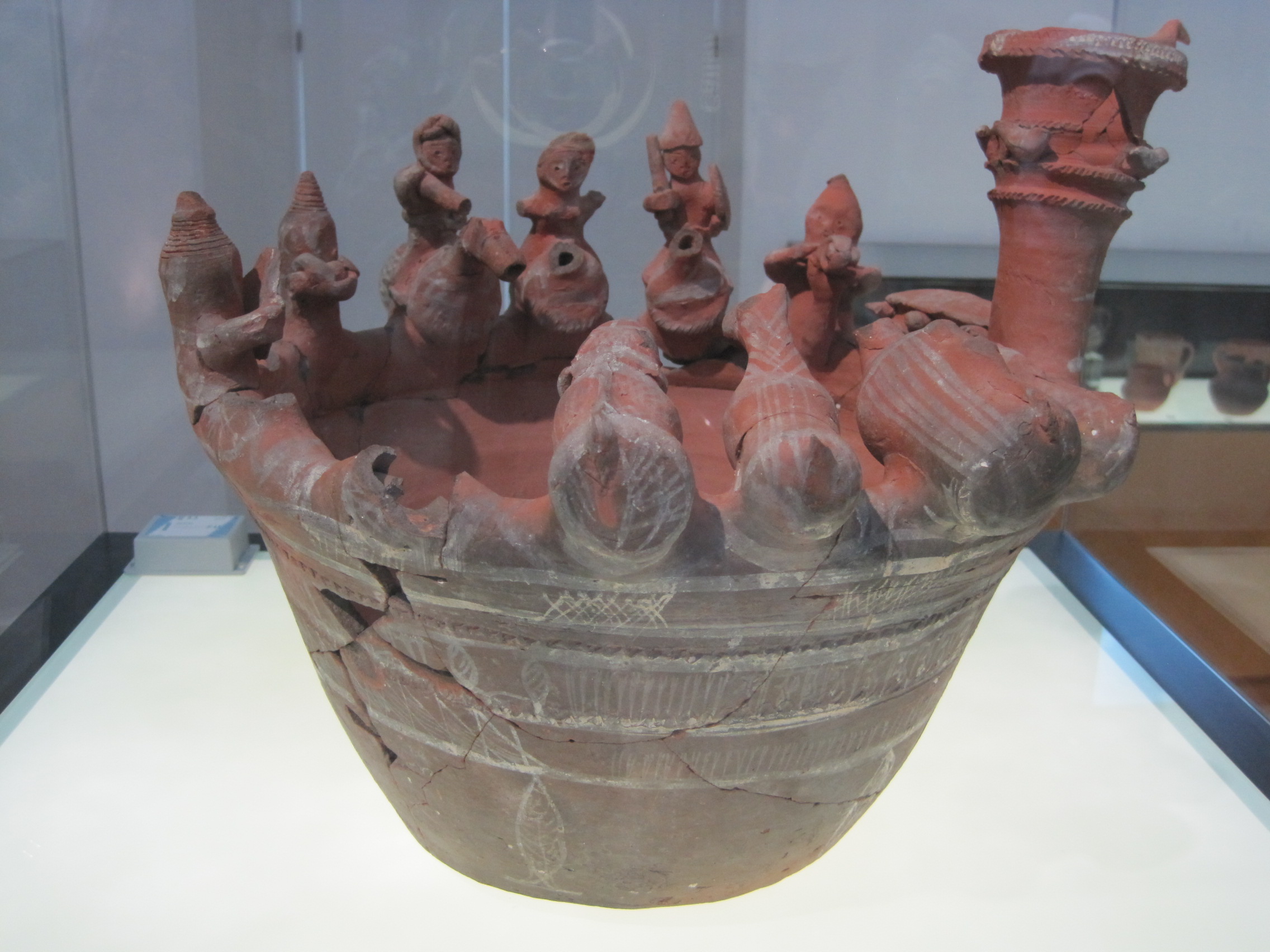
Now this may not be what you’re expecting, but I’m well aware that I’ve filled pages with the delights of Tavira, in Portugal’s Algarve.  So I thought I’d dedicate my “T” post to something I find quite intriguing- the Tavira Vase.

As I walk around Tavira I’m constantly aware of renovation work going on.  Many of the older buildings have been painstakingly restored, the Galeria Palace being a prime example.

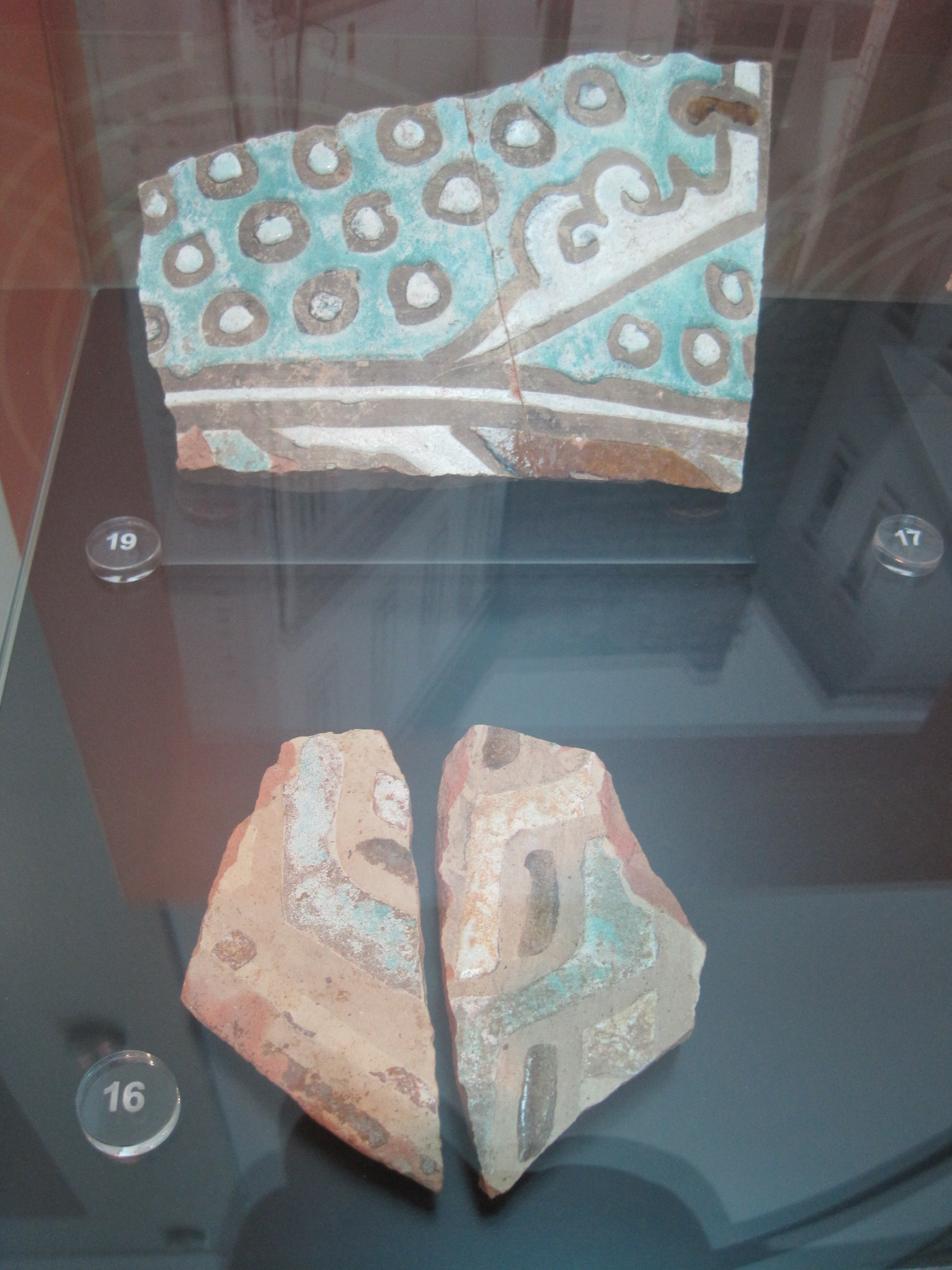
At the reverse of the building, excavation has been in progress for some time.  A long promised museum, dedicated to locally discovered Islamic Art, finally opened in April last year.  On display are fragments of many of the mosaics originally incorporated into local buildings.

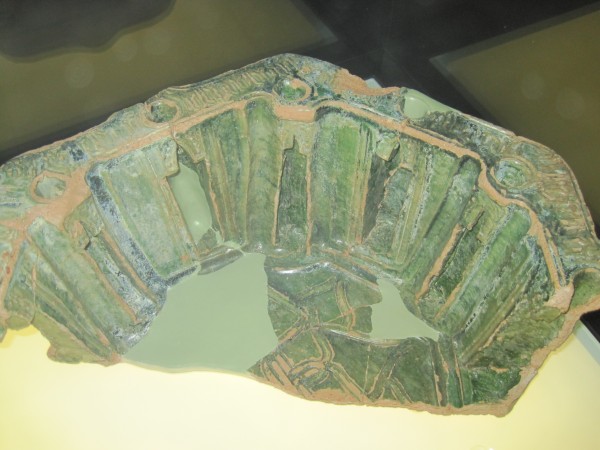
The centrepiece of the museum is the Tavira Vase, and I include the link as it explains the function far better than I am able to.  My husband describes it as a water feature, but then, he would!  http://www.discoverislamicart.org/database_item.php?id=object;ISL;pt;Mus01_C;9;en

The museum is situated behind the Tourist Information Office.  It’s a shame that the information displayed is all in Portuguese, however there is a video with English subtitles to give you a historical overview.  I found it moved at too rapid a pace, and would have liked a little more detail.  It’s a good start, however, and as I wander Tavira’s streets now, I’m more able to visualise how once it might have looked.

If you’re not familiar with Tavira, then please let me introduce you.  I fall in love with it all over again when I read this post.

I’ve been contributing to Julie Dawn Fox’s A-Z Challenge for some time now.  If you’d like to join in, click on the banner below, or view my previous entries on my A-Z pages above.

G is for Guadiana

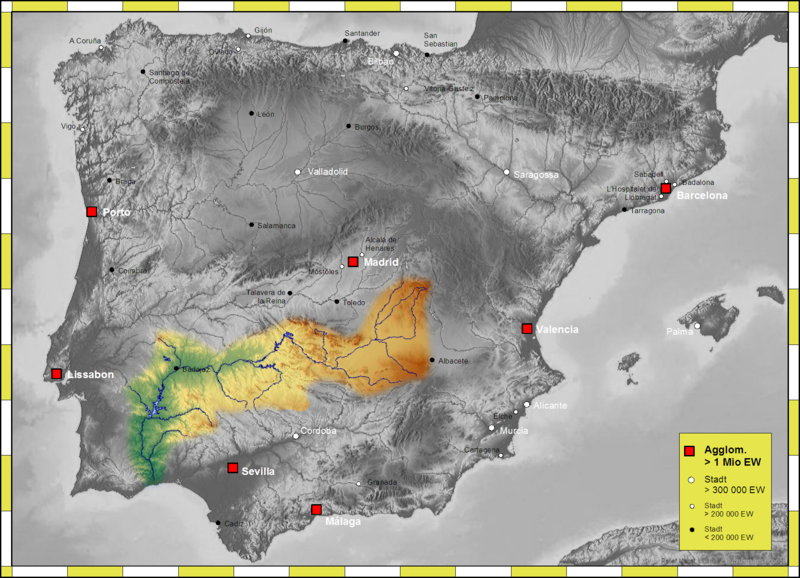
My next post seems to flow quite naturally from my recent trip across the Guadiana River.  More than 800 kilometres long, if you look at it on a map it’s very clear that the bulk of this river is in Spanish territory.  It rises in Castile-La Mancha and shortly after the Spanish city of Badajoz, turns south, forming the border with Portugal for most of the remainder of its length.

Guadiana’s origin- from Wikipedia Commons

It’s this southern area that I love, and with which I’m familiar.  The Guadiana glides out into the Atlantic Ocean.  At the river mouth a brief ferry ride connects Ayamonte on the Spanish side with Vila Real de Santo Antonio in Portugal.  The difference between the two cultures is tangible, and the time difference simply serves to accentuate this.  Unless you time it carefully you will frequently find that Ayamonte is engaged in a prolonged siesta when you arrive.  The elegantly tiled main square and pretty calles are still worth a stroll, but remember to switch to buenas dias when you order your tapas.
Main square, Ayamonte

A street corner in Ayamonte

Vila Real de Santo Antonio (as opposed to Vila Real in the north) is one of the architecturally more interesting towns in the Algarve.  Demolished by a tidal wave following the 1755 earthquake, it was rebuilt on a grid plan by the Marques de Pombal.  Using the same plan he had pioneered in Lisbon’s Baixa district, the rebuild was completed in just 5 months.  The attractive main square bears his name and is often the scene of lively cultural events.
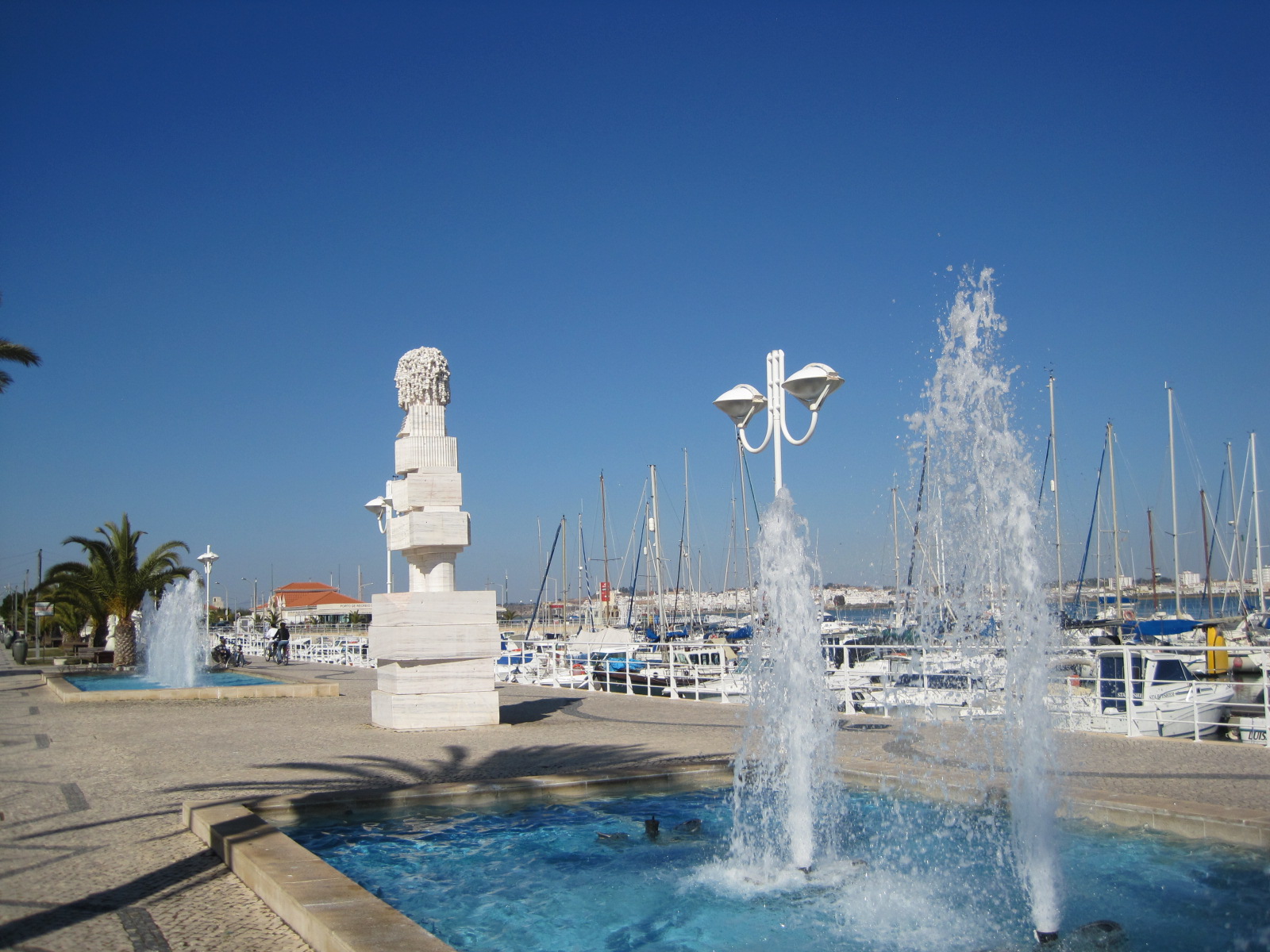
I love to stroll along the mosaic tiled river bank, picking a favourite yacht from the dozens moored in the extensive marina.  4km to the north, the arcs of the bridge linking Portugal with Spain are clearly visible.  In summer a very pleasant boat trip can be taken up the Guadiana, to the Foz de Odeleite, where a restaurant and refreshing swimming pool await.

River front at Vila Real de Santo Antonio

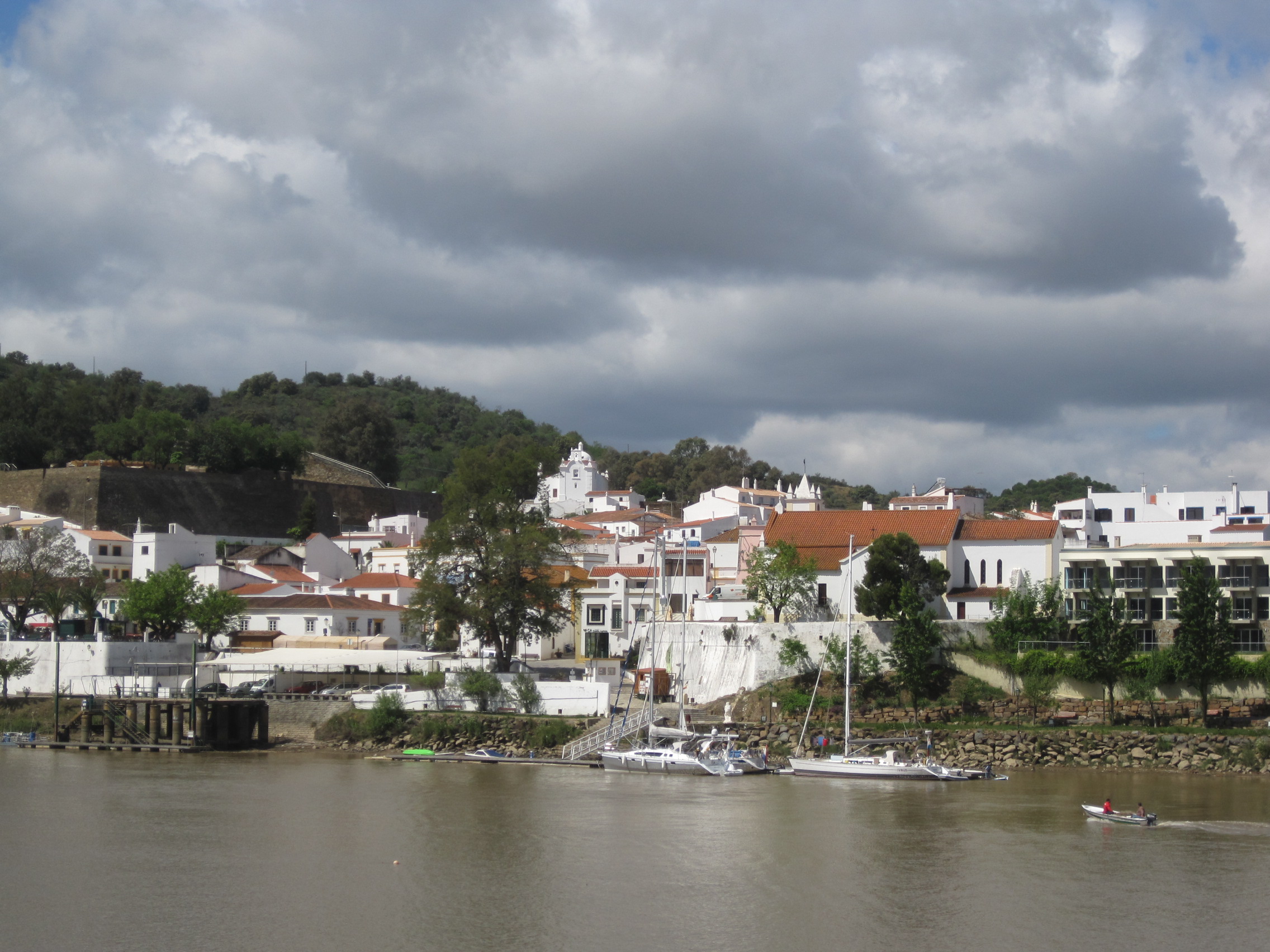
The swift and often empty IC27 runs north from Vila Real to connect with Alcoutim, the next town along the river.  Alcoutim has a long history as a river port.  It was fortified by the Greeks, Romans and Arabs, and the commanding castle dates from the 14th century.  Not much battling goes on these days and Alcoutim is a delightfully sleepy spot to simply sit and stare.  Across the river, idyllic Sanlucar de Guadiana looks back.  If you can catch the small ferry, a wander through Sanlucar’s immaculate white streets is a lovely distraction.  Restoration is taking place on the castle ruins so that might prove a rewarding trip for the future.  The Romeria takes place the first weekend in May, for a feast of flamenco frocks. Just ask Flat Ruthie.  She’s been!

Alcoutim from the river

Sanlucar de Guadiana from the river bank at Alcoutim

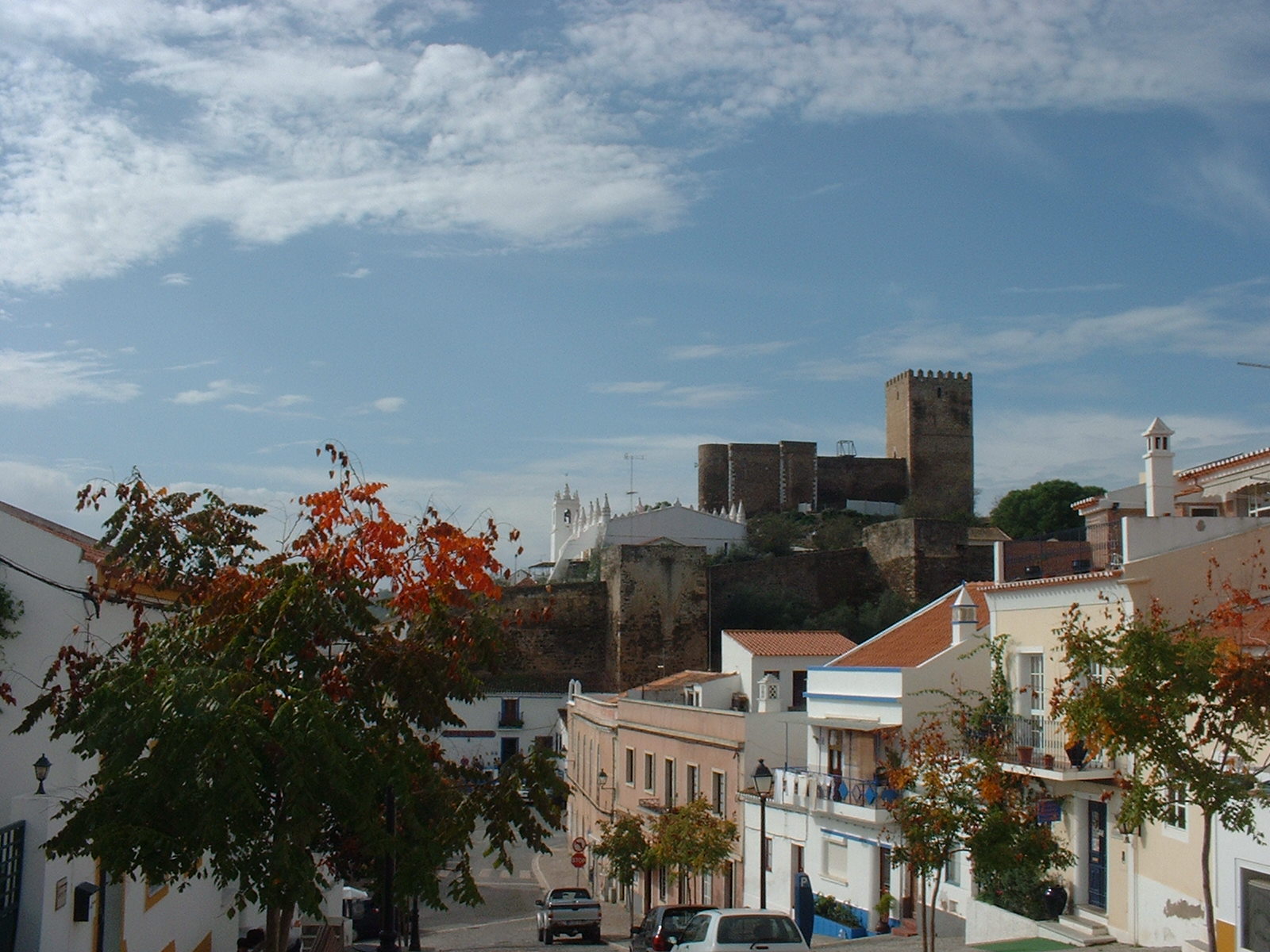
The banks of the Guadiana are wonderful for walkers, and the riverside road back down towards Castro Marim, from Alcoutim to Guerreiros do Rio, is one of the loveliest I have ever driven.  For now though, continue north on the N122, over the border into the Alentejo.  Set high above the Guadiana, at Mertola, are the mighty ruins of yet another Moorish frontier castle.  The region is home to the rare black stork and little other than birdsong disturbs the peace, though copper was once mined locally.  At the top of the winding streets the mother church, Igreja Matriz, looks down.  Behind the altar on the eastern wall the mihrab (prayer niche) testifies to her former life as a mosque.

Mertola hilltop fortress and Igreja Matriz

North of Mertola the river carves through a deep gorge with limited access by road.  For intrepid types the reward is the Pulo do Lobo waterfall and some remarkable rock formations.

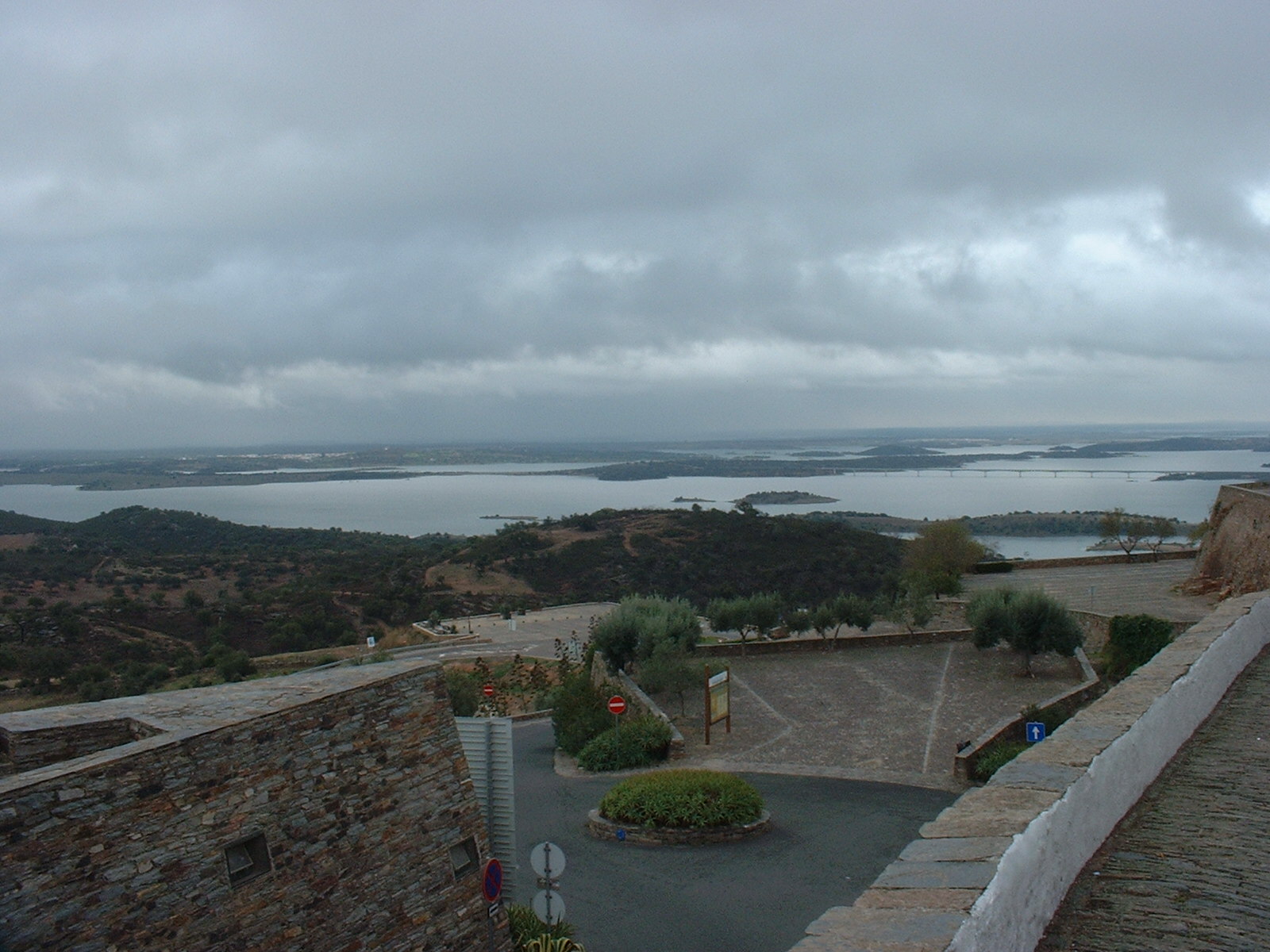
Despite a lot of opposition to the project initially, the Alqueva Dam today presents a serene surface.  It’s a developing market for gentle boating holidays.  The 250square metre reservoir was created by damming the Guadiana, causing substantial loss of natural habitat, not to mention the compulsory relocation of the hamlet of Luz.

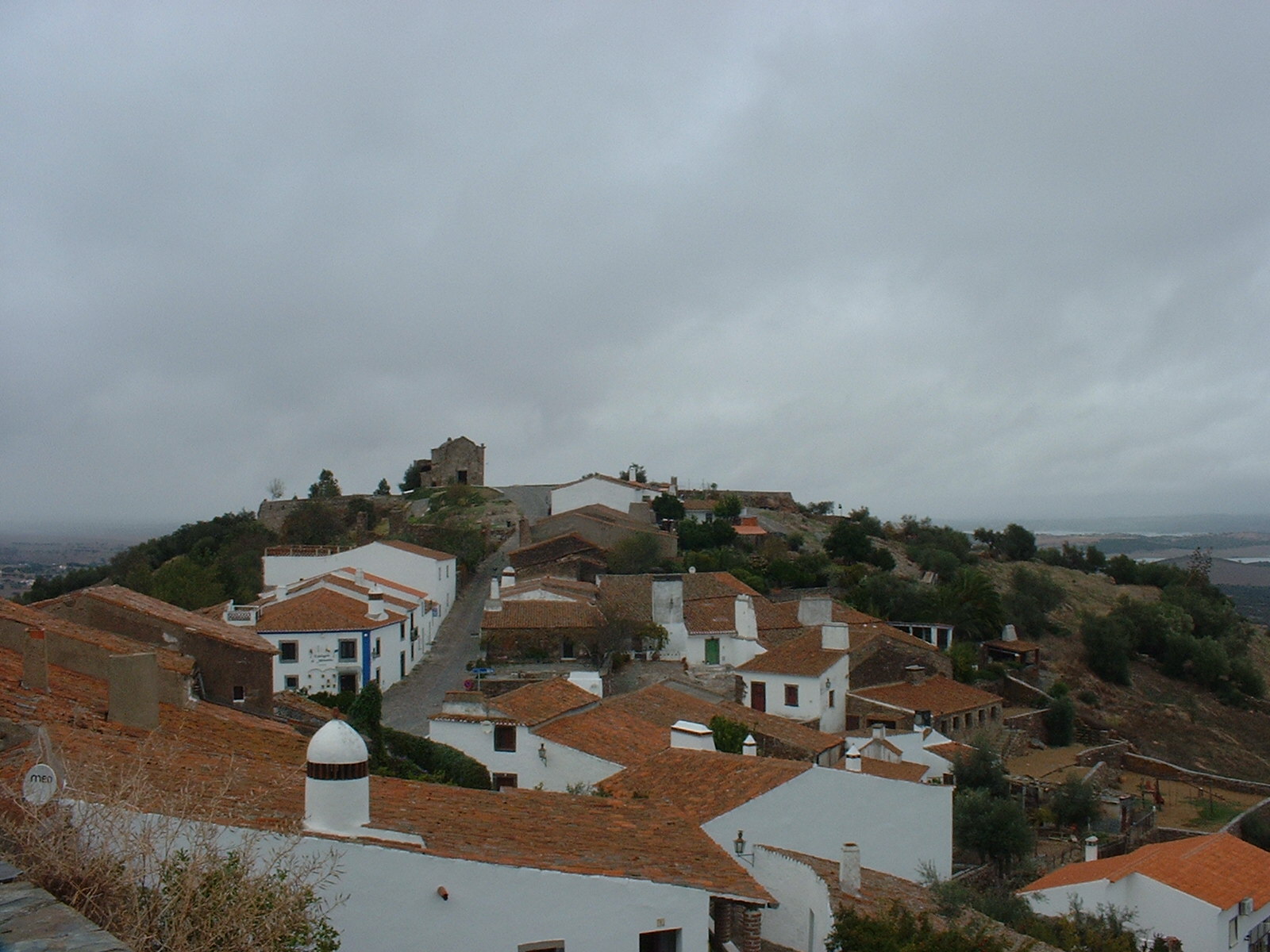
One of the best vantage points for viewing this vast expanse of water is the tiny hilltop village of Monsaraz.  It has to be one of the most charismatic places I’ve found in Portugal, and believe me, I’ve found a few.  Within its fortress walls there is essentially just one street, Rua Direita, with a village square, two churches and a castle, topped by the Torre das Feiticeiras (witches tower).  Following Moorish occupation, it became a stronghold of the Knights Templar.  Strangely the fort now contains a small bullring, which comes into its own for the annual village celebrations.  The festive fireworks must be visible for miles.

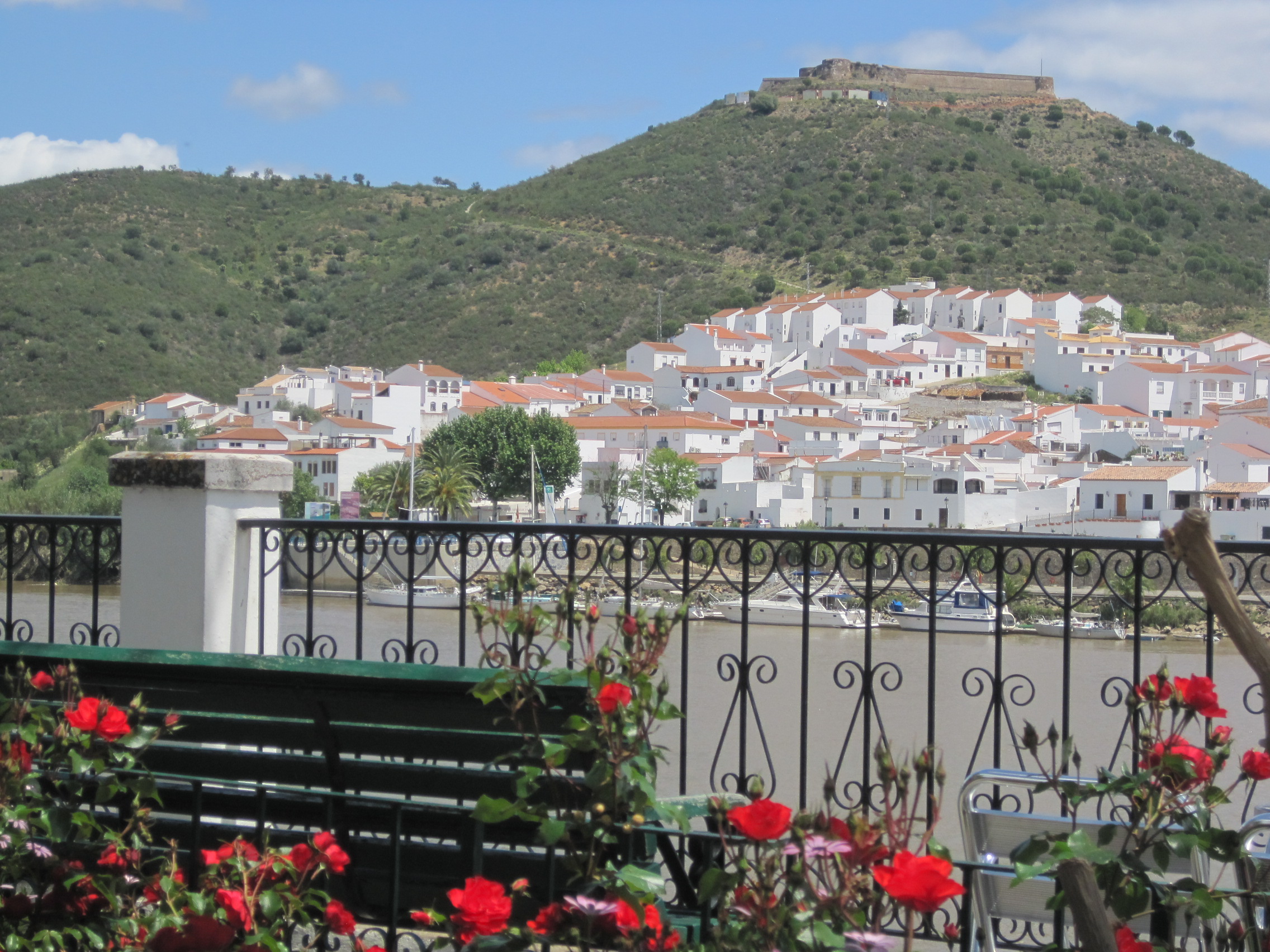
The Guadiana from Monsaraz

Monsaraz, remote and interesting on a grey November day

From here the Guadiana continues north, swinging a right into Spain, through Badajoz and Merida, and is, sadly, lost to me.  This is, after all, my A-Z of Portugal.

If you would like to join Julie Dawn Fox’s My personal A-Z challenge, just follow the link or click on the banner below.  It doesn’t have to be about travel.  If your passion is food or books you can still join in.  We have an A-Z of Art on Alyson Sheldrake’s The Thought Palette and and lately an A-Z of Films by DML Designs.  Be as creative as you like.  Read my posts on my A-Z pages.  Hope you’ll enjoy!

F is for Fonte (fountain or spring)

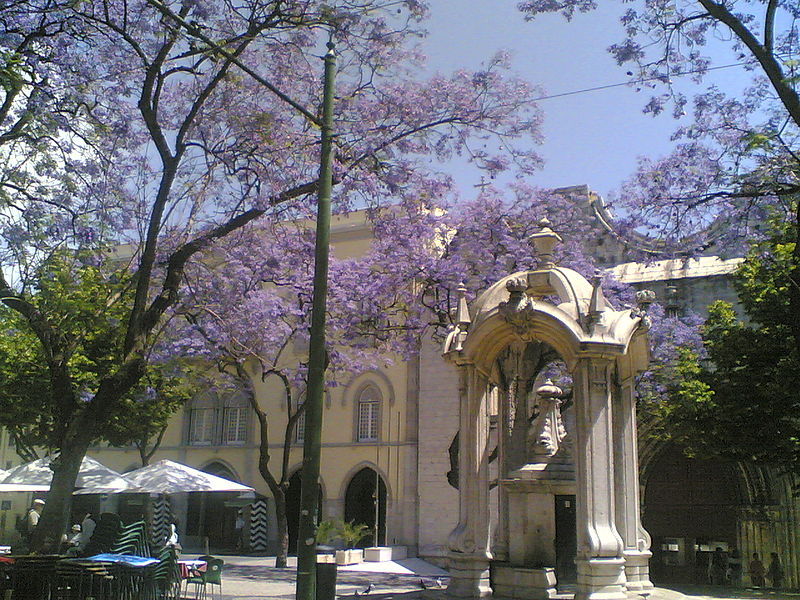
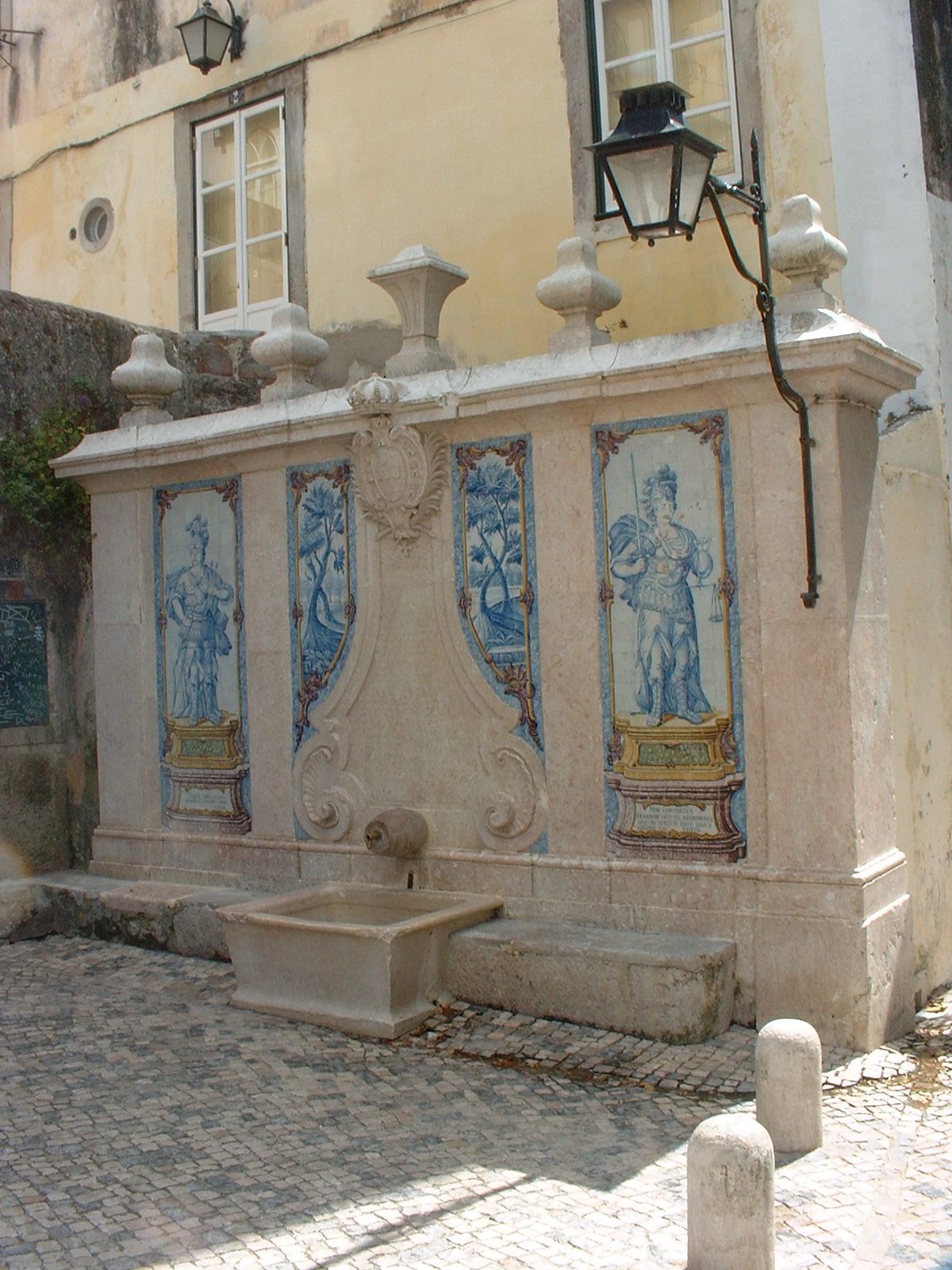
Fonte in Largo do Carmo, Lisbon- from Wikipedia, by Rui Pedro Carvalho

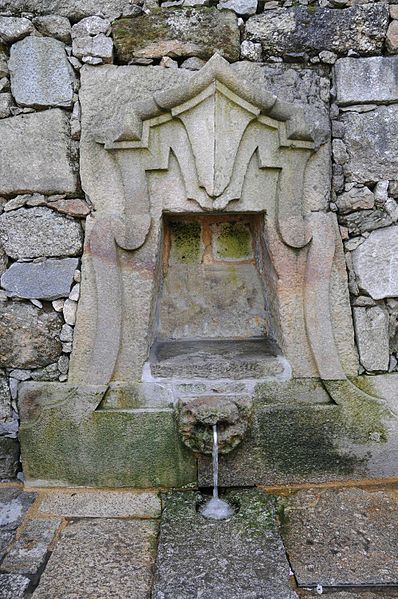
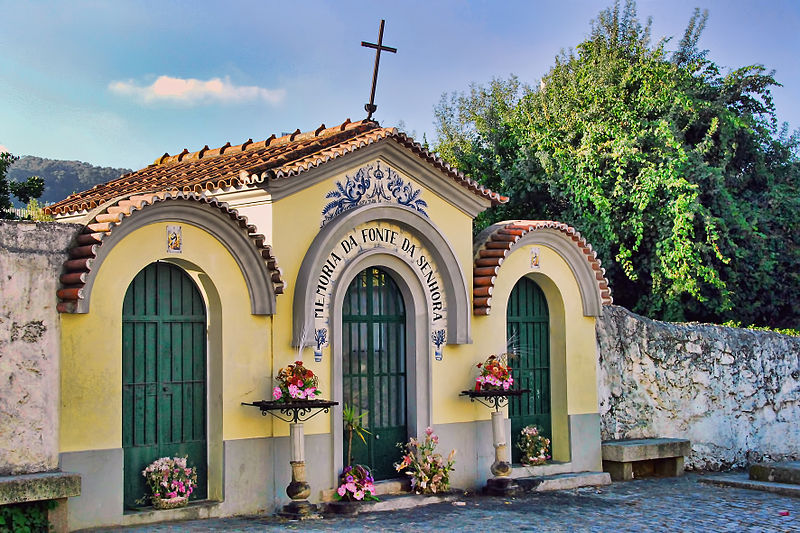
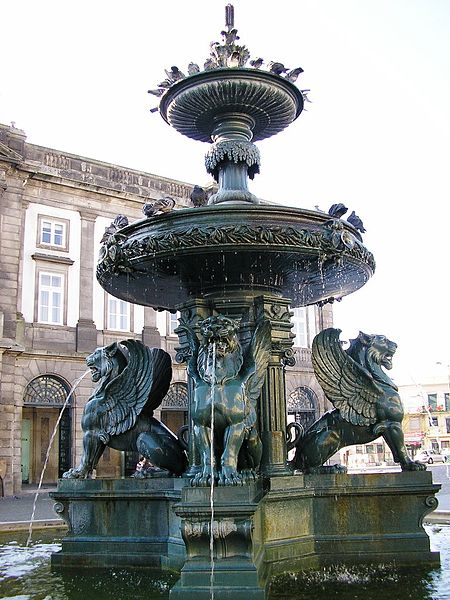
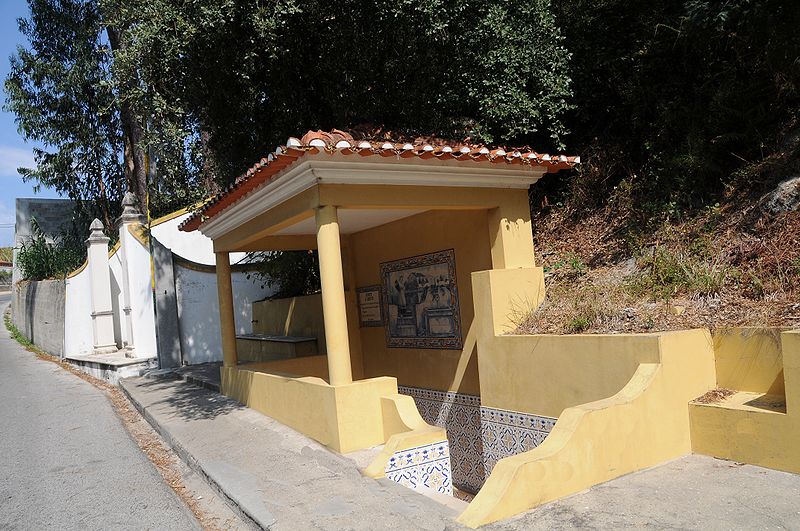
There is an astonishing array of beautiful fountains adorning Portuguese towns and villages. Here are just a few I can’t resist sharing.

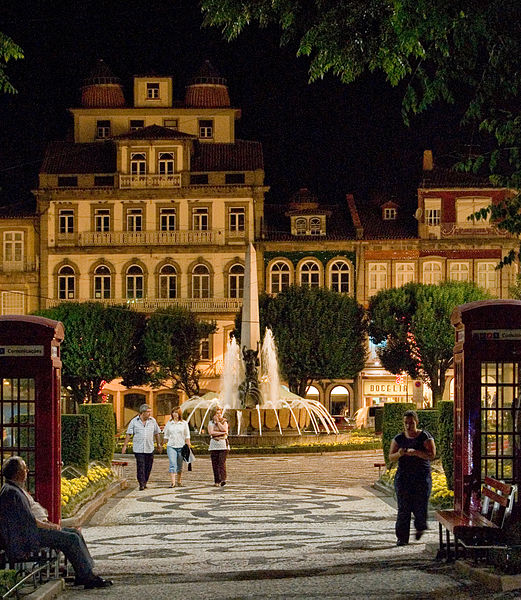
Fonte de Toural, Guimaraes- from Wikipedia,

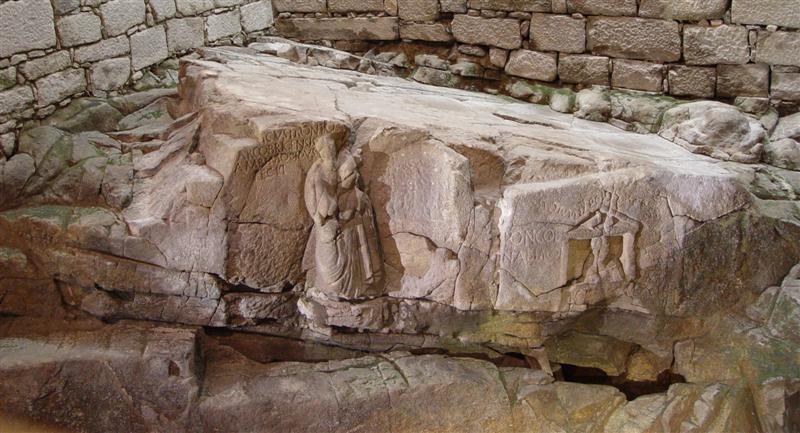
Fonte do Idolo, Braga- Nabia, goddess of rivers and water- from Wikipedia

Fonte de Agua Ferreas, Braga- from Wikipedia

Fonte da Rua de Bonjoia- from Wikipedia, by Antonio Amen

Fonte de Leoes (lions), Porto- from Wikipedia, by da Sousa

Fonte de Sao Bento, Corticeiro de Carapelhos, Mira- from Wikipedia, by Jose Olgon

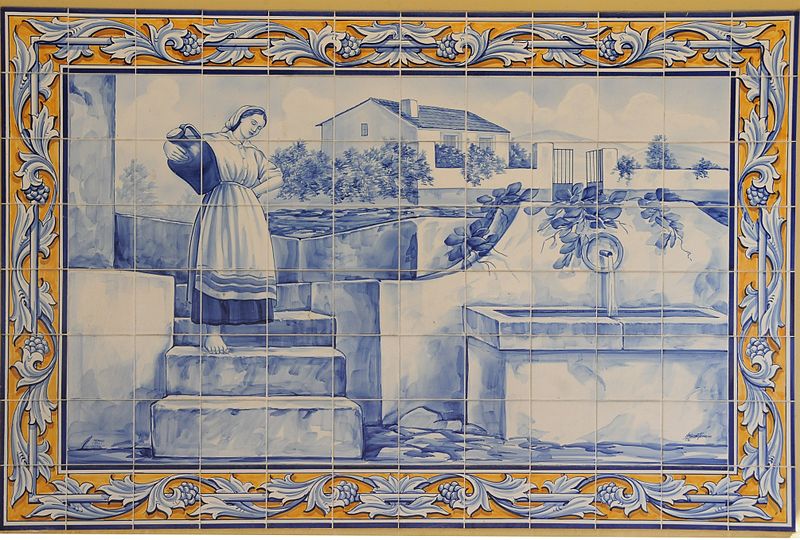
Azulejo, Fonte de Sao Bento

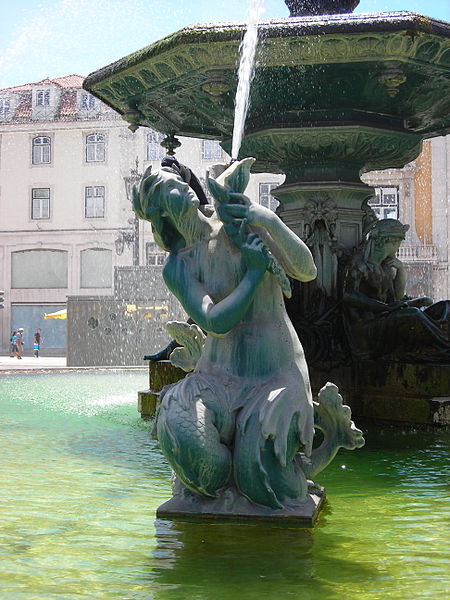
Fonte do Rossio, Lisbon- Creative Commons

Varied aren’t they?  There are hundreds I could have shared.  Do you have a favourite?  I think probably the last one’s mine, but I love Nabia too.  I also came across the term “chafariz” in relation to fountains and am not sure if this refers to a specific type.  Maybe my Portuguese friends can help me out with this?

The word “fonte” appears in many place names in Portugal.  In fact, when we’re directing people to our home in Tavira, we tell them to turn off the E125 at the roundabout signed Fonte Salgada.  In this sense it relates to a natural spring.

Fonte Pequena, Alte

My first sighting of natural springs here in Portugal was in the village of Alte.  Fonte Pequena (little spring) and then Fonte Grande (large spring) and the surrounding lush greenery came as a complete surprise.  It seemed a world away from the Algarve to which I was used.  Alte is described in detail in my Personal A-Z of Portugal, but I came across a lovely snippet of the poetry of Cândido Guerreiro, born in the village in 1871 and commemorated at the fontes:

“As the place where I was born lies encircled by four hills

Through which waters run singing

The songs of fountains and mills,

Waters taught me to speak.”

(Porque nasci ao pé de quatro montes

Por onde as águas passam a cantar

As canções dos moinhos e das fontes,

Ensinaram-me as águas a falar.)

I often go out with a walking group in the Algarve, or rely on a map and my husband, to find local beauty spots.  We found Fonte de Benemola, the Eternal Spring, one February day with the help of Julie Statham’s book, “Algarve-Let’s walk”.   The white faced cistus I love wasn’t yet in bloom and the valley was peaceful as can be, the fonte rippling silently in its depths.  On our way back to the car we spotted the solitary basket weaver, his wares strung along a reed fence.  He rather charmingly demonstrated his whistles and we purchased a small bowl.  A slightly wonky fruit bowl now sits on top of my fridge!

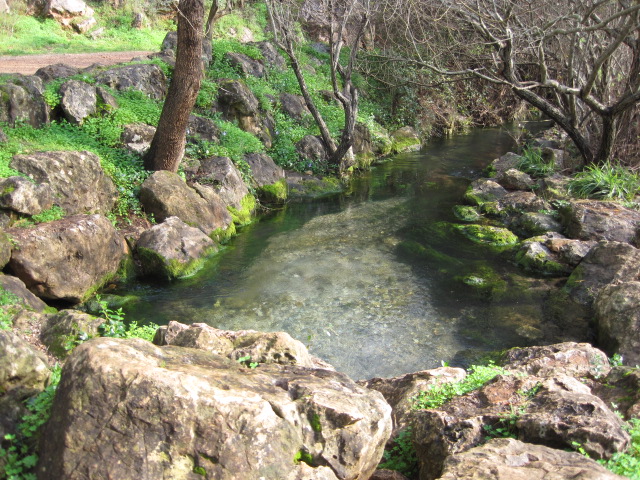
Fonte de Benemola, near Querenca

There is a wealth of natural springs in Portugal, some of which have been developed into health resorts.  The term “caldas” refers to thermal springs, as in Caldas de Monchique in the Algarve.  Further north, Caldas da Rainha (Queen’s hot springs) has had a thermal hospital since 1488, when Queen Leonor discovered the curative power of the waters.  Beautiful Sintra was also a spa.

Fonte in the back streets of Sintra

Spring water is a popular source for drinking water because of its relative purity and high mineral content, believed by many to have health benefits.  Just north of Coimbra, the small town of Luso is home to one of the most famous bottled waters in Portugal.  I seldom go walking without a bottle.

This post is part of my Personal A-Z of Portugal.  I’ve been following Julie Dawn Fox’s challenge for a while now.  If you’d like a look at what’s gone before, and maybe to join in with an A-Z of your own, please follow the links.  I need to catch up with my personal A-Z of Poland next.  See you next time.

E is for Elvas, and Evora, of course

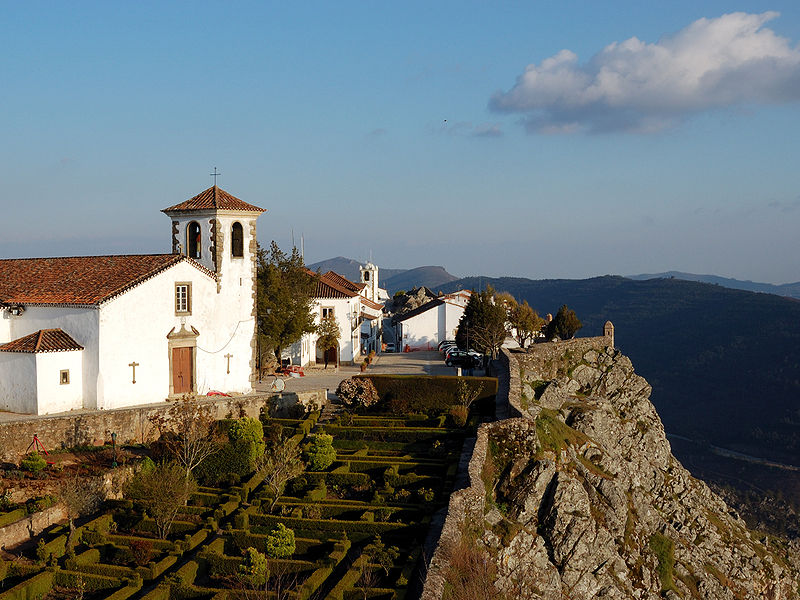
For the whole length of the River Guadiana and beyond, you can see the mighty fortresses that bear witness to Portugal’s struggles over the years with neighbouring Spain.  From Castro Marim and Alcoutim in the Algarve, on across the Alentejan plains, past Beja, to my tiny favourite Monsaraz, and dramatic Marvao, the evidence rolls on.  The border towns have seen more than their share of strife.

Marvao by Rosini for Wikipedia

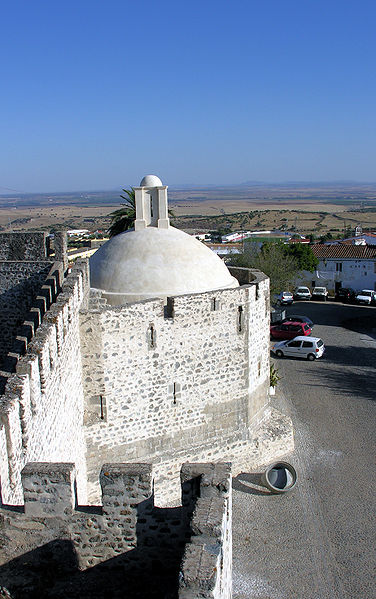
None has a more embattled history than Elvas.  Just 12km from the Spanish border and a Moorish stronghold for 500 years, it has some of the best preserved fortifications in Europe. It was of great strategic importance during the wars of independence with Spain, in mid-17th century, and later became Wellington’s base to besiege Badajoz, across the Guadiana.  Walking around the castle ramparts above the town you cannot fail to be impressed with the scale of the star-shaped bastions.  Or with the views, which are endless.
Elvas from the castle walls

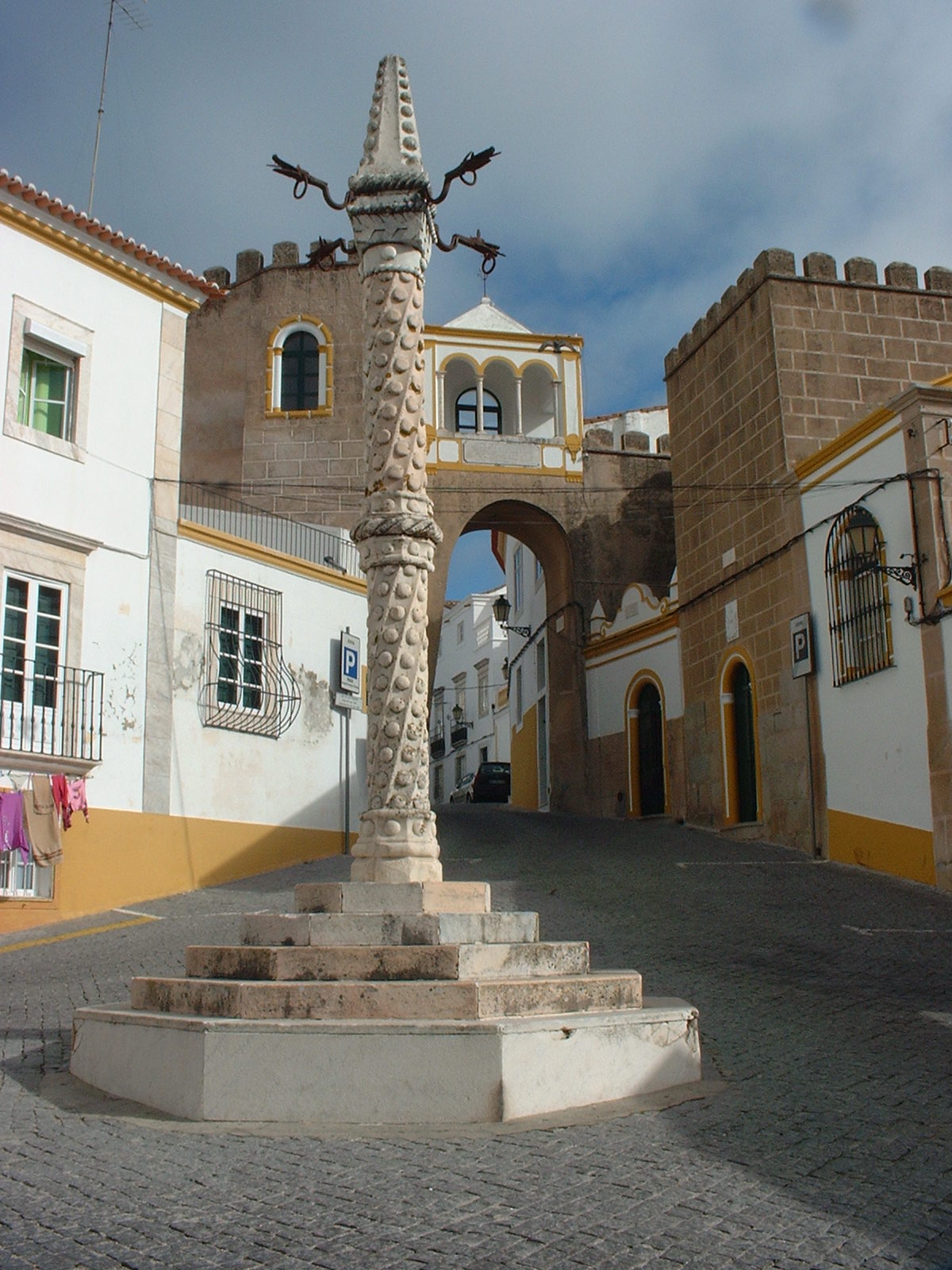
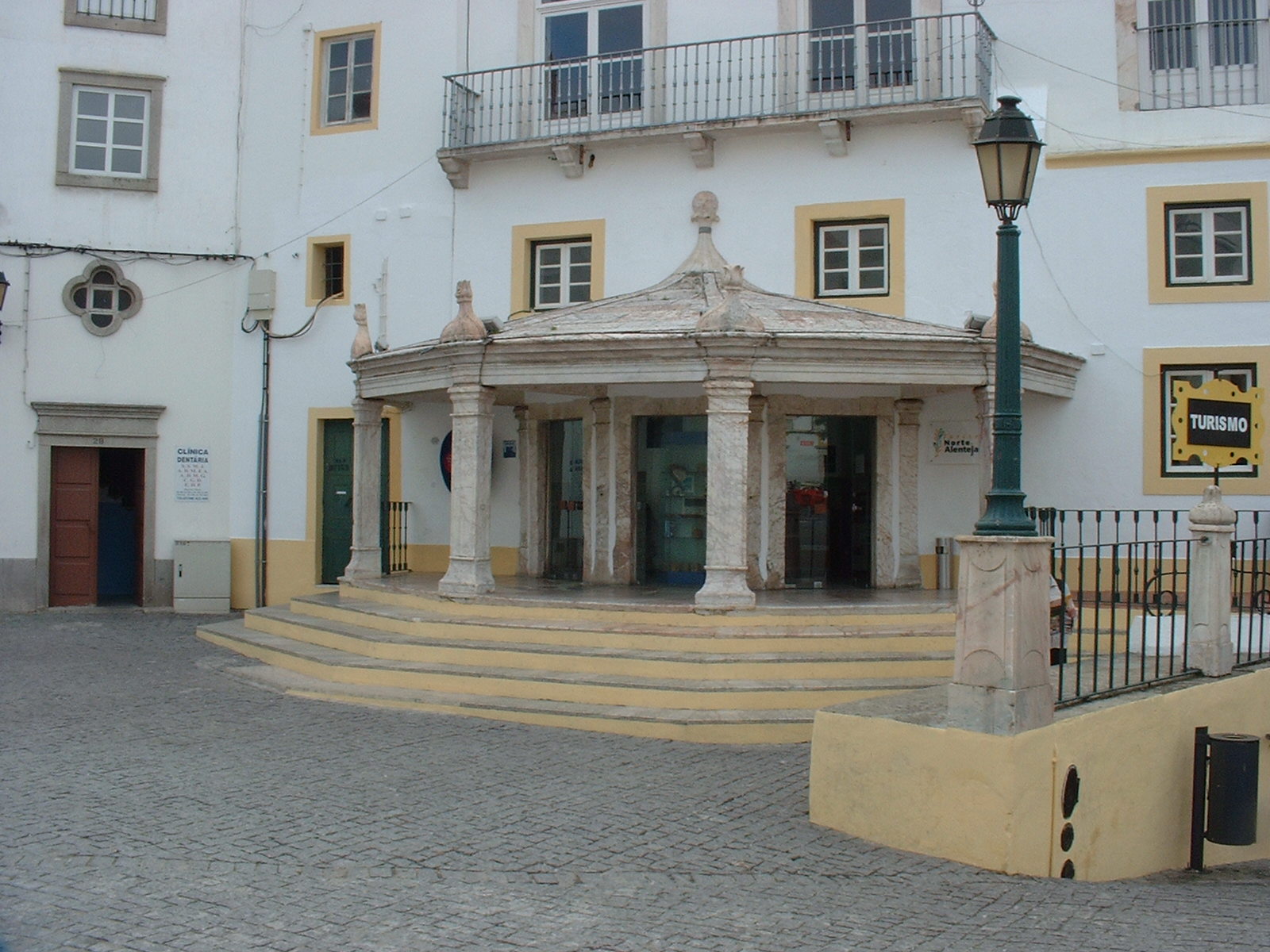
The only sign of violence on the slumbering streets of Elvas today is the pelourinho.  The ornate pillory makes such an artistic photograph that you tend to forget its original purpose, to shackle prisoners.  Elvas is one of many small Portuguese towns that repay a little browsing.  Nossa Senhora da Annuncao on the main square is hard to miss, but the dilapidated white walls of Nossa Senora dos Aflitos behind it hide a small but achingly lovely interior.  Marble columns and glorious azulejos reach high into the cupola.  The elegant TI on Praca da Republica can supply a town map, but basically the castle walls are top of the town and everything else falls away below.

Pelhourinho or pillory

The Turismo (TI) in Elvas

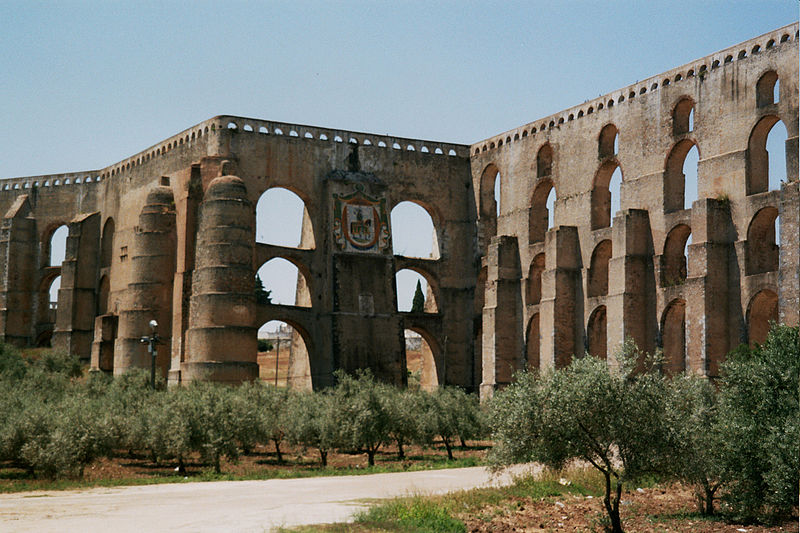
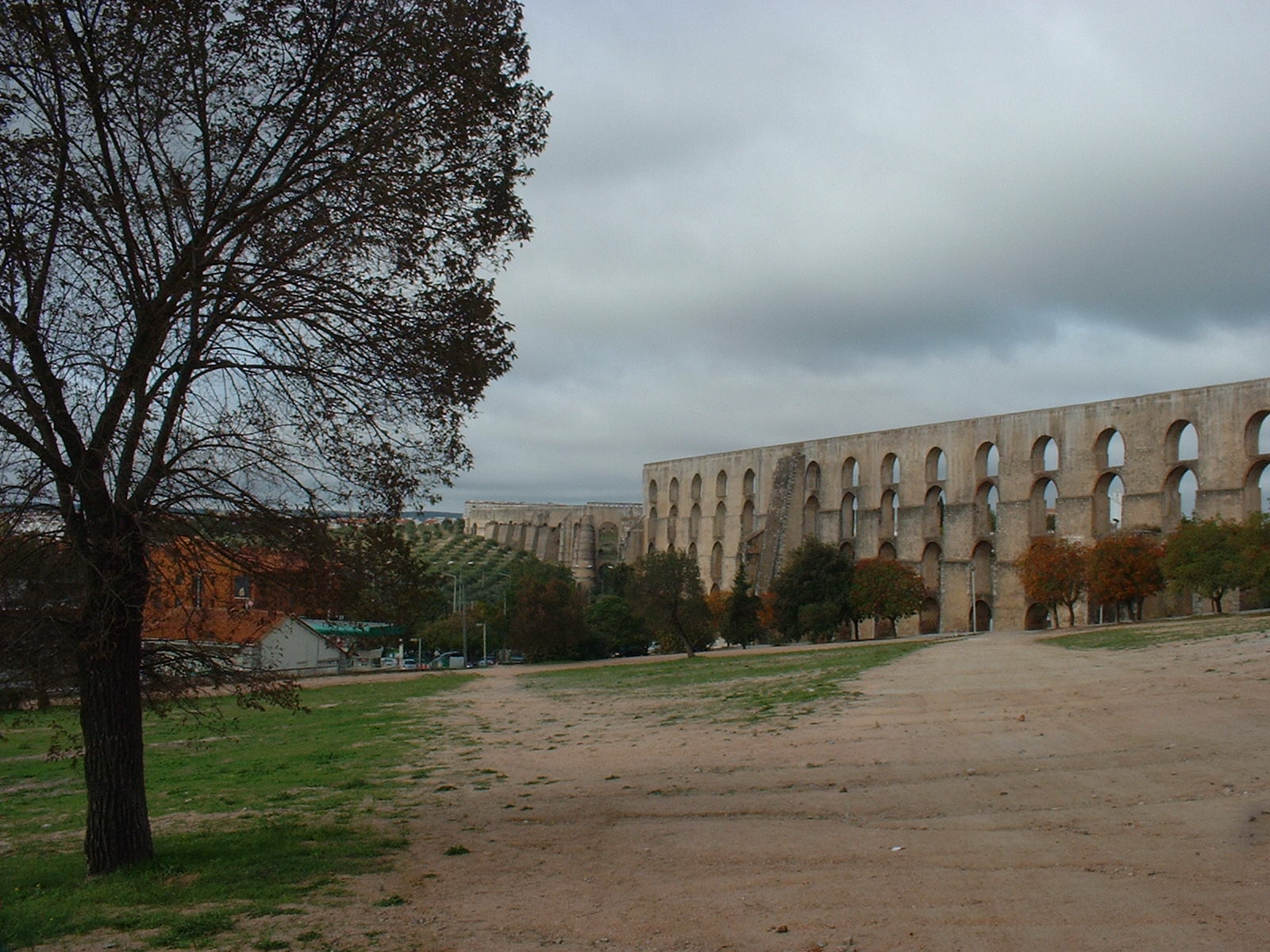
Approaching Elvas you are sure to have seen the staggeringly high Aqueduto da Amoreira.  With 843 arches and up to five tiers, it still delivers water 5 miles across the valley to the fountain in Largo da Misericordia.  You can park on the patchy ground overlooking it to explore the town.  Sample the delicious preserved plums sold locally- they are thought to be the original sugar plums after which the Nutcracker Fairy was named.

Aqueduto da Amoreira, by Acaro for Wikipedia

Most people drawn to this part of the world are attracted here by Evora– an atmospheric walled city of Roman origin, with deserved UNESCO status.  I was no exception.  I visited in November as a birthday treat so the skies were a bit leaden and the air fresh.  Knowing the heat that can envelop the Alentejo in the summer months, I felt this was no bad thing.

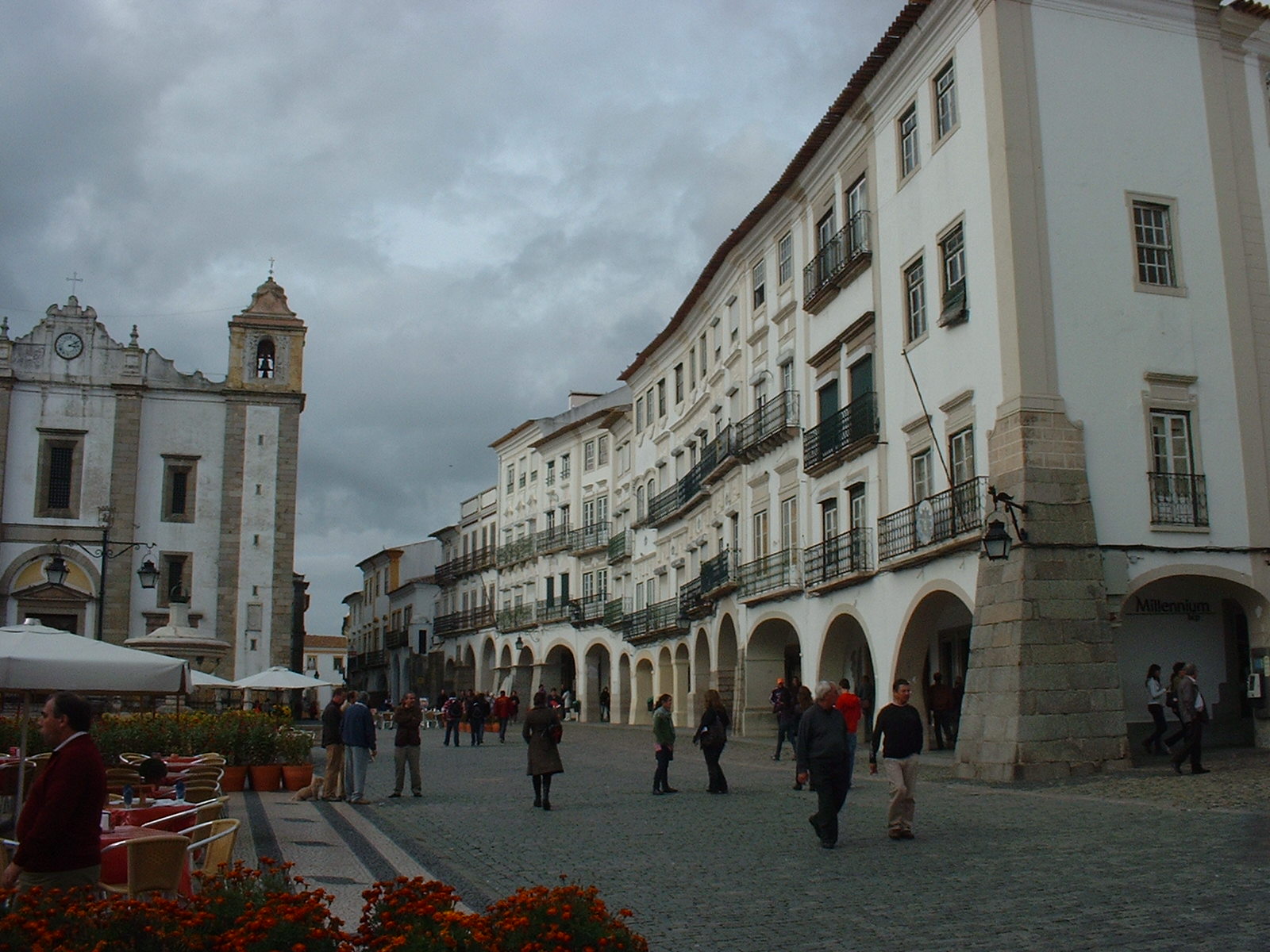
Praca do Giraldo, Evora

As soon as I saw the Praca do Giraldo I felt that bubble of excitement I sometimes have in a new and exciting place.  The Moorish arcades march away down the street.  Beneath them smart boutiques rub shoulders with more traditional stores.  Again I obtain a street map, from the TI on the Praca- more necessary here than Elvas, and a nice memento for my collection.

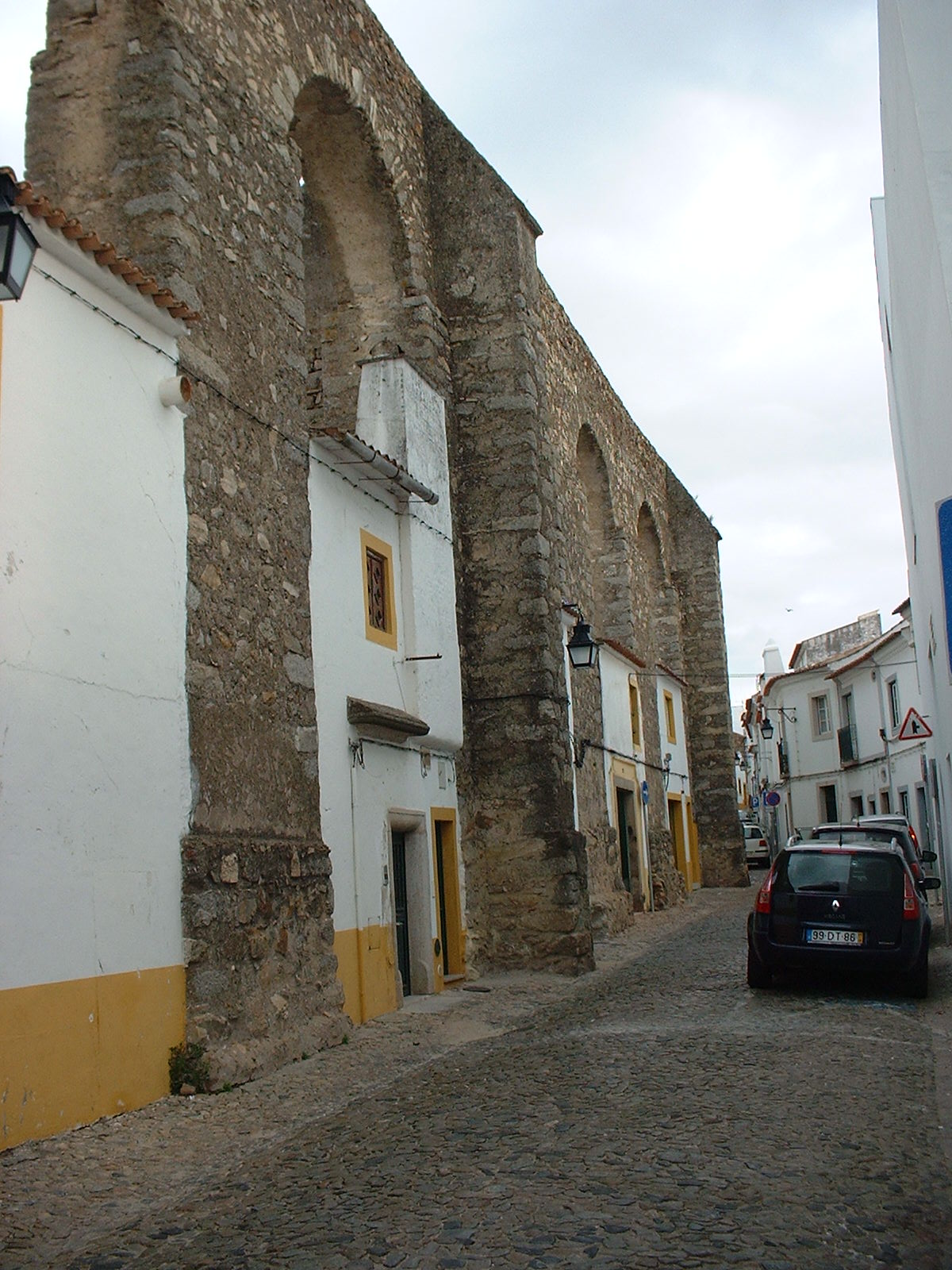
I did have a plan, but it was thrown to the winds as I delved deeper into the narrow streets, with their intriguing houses and artisans workshops built into the town walls, along with another ancient aqueduct, Agua de Prato (silver water).  Backtracking I make for the main sights.

Aqueduto de prato

Aqueduto de prato

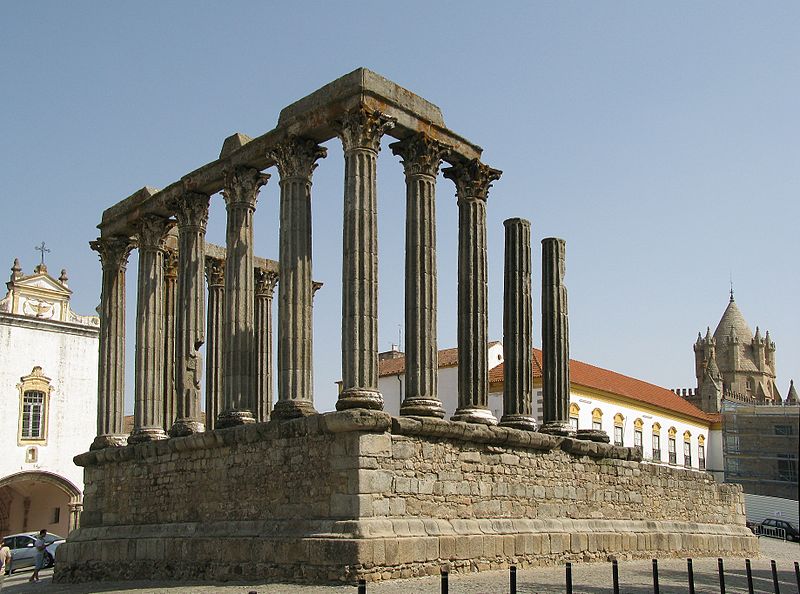
The dramatic ruins of the Templo Romana, commonly known as the Temple of Diana, date back to 2nd Century AD.  The oldest Roman remains on the Iberian peninsula, they survived because they were incorporated into a medieval fortress, and later, bizzarely, a slaughterhouse.  The façade and mosaic floor have disappeared completely but 14 Corinthian columns remain.  They present a lovely vista in Largo Conde Vila Flor, with the mismatched towers of the cathedral beyond.  The views in the opposite direction, equally compelling, look out over Evora and the wide open plains.  Quiosque Jardim Diana is a good place to linger, with icecream or coffee.

Templo Romano by Wikipedia

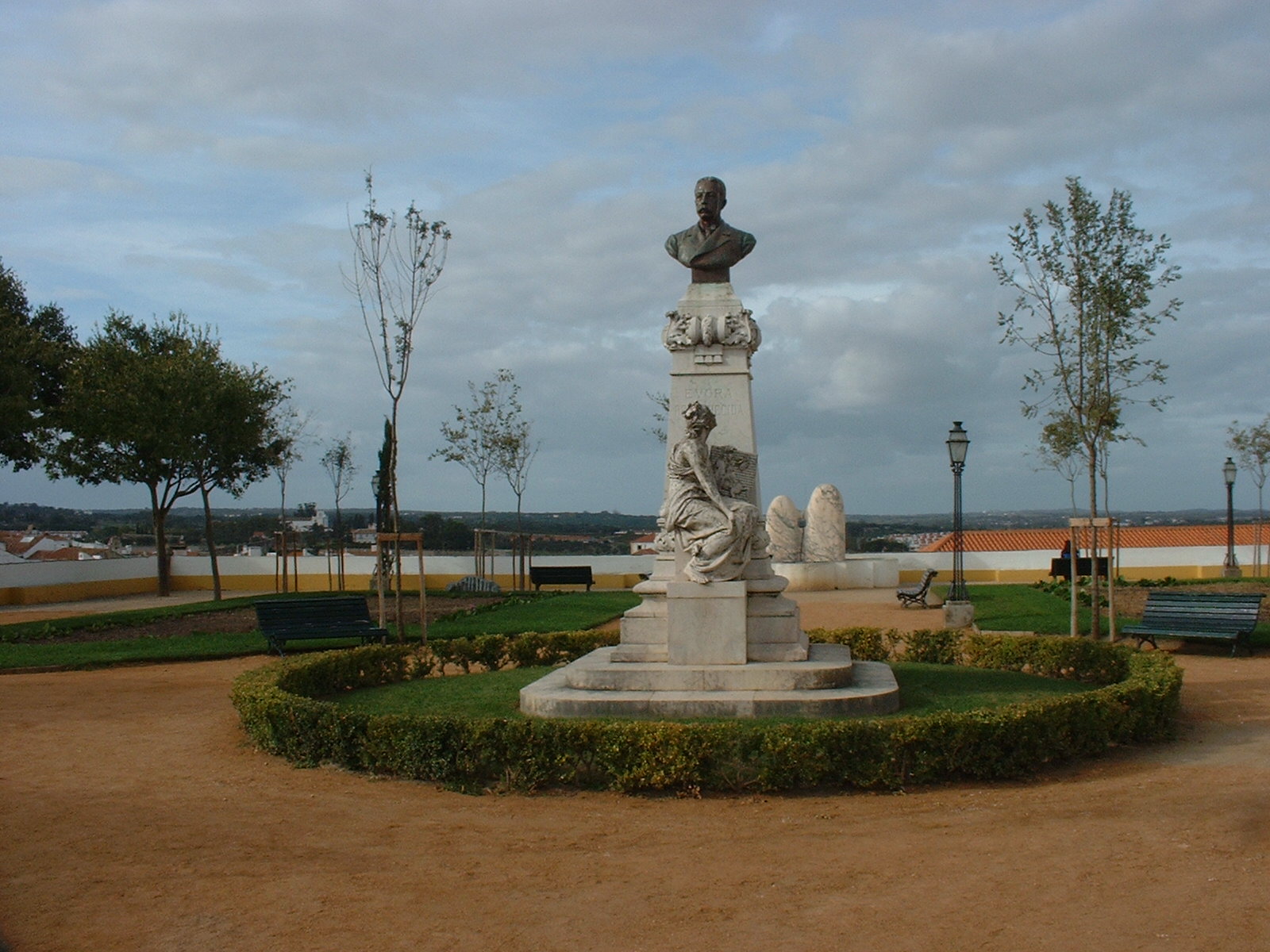
Largo Conde Vila Flor

I couldn’t resist a quick peak inside elegant Convento dos Loios.  This former monastery, now a pousada (state run hotel), has the most beautiful adjoining chapel, Sao Joao Evangelista.  You’d never guess what lies behind the uninviting curtained door.  It’s well worth a couple of euros to see.

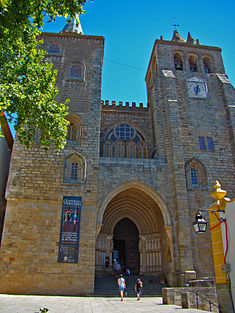
By contrast the 12th century Cathedral is a rather sombre experience, though striking in appearance, with its asymmetric towers.  The cloisters are grand but were outshone for me by those in the Jesuit University.  Downhill from the cathedral, the 16th century University stems from Evora’s heyday as a centre of learning and culture.  The blue and white azulejo tiled panels indicate the subject taught within each of the classrooms.  A hushed atmosphere prevails and I want to tiptoe down the corridor, satchel over my shoulder.

The Se or Cathedral by Lacobriga, Wikipedia

The Jesuit University

Follow your map down Rua da Republica to find Sao Francisco, the church of the “mother’s curse”.  The chapel, Casa dos Ossos (house of bones) is entirely lined with the bones of some 5000 people.  Less macabre, the chapterhouse is decorated with azulejos depicting scenes from the Passion and an “altar of promises”.  Wax effigies of parts of the body are placed there if prayers for a cure are successful.

Evora is full of graceful architecture.  Tradition has it that visiting dignitaries are welcomed by a display of vivid bedspreads hung from the wrought iron balconies.  Rua 5 de Outubro is certainly a colourful place to wander.  Squeezed into one of the tables at tiny VIPS café, my husband cannot believe that he acquires a samosa, huge slab of cake, glass of wine and coffee for 3 euros.  The food is for hearty appetites in the Alentejo.  Substantial amounts of black pork are consumed, interesting soups and a goat’s cheese I adore.

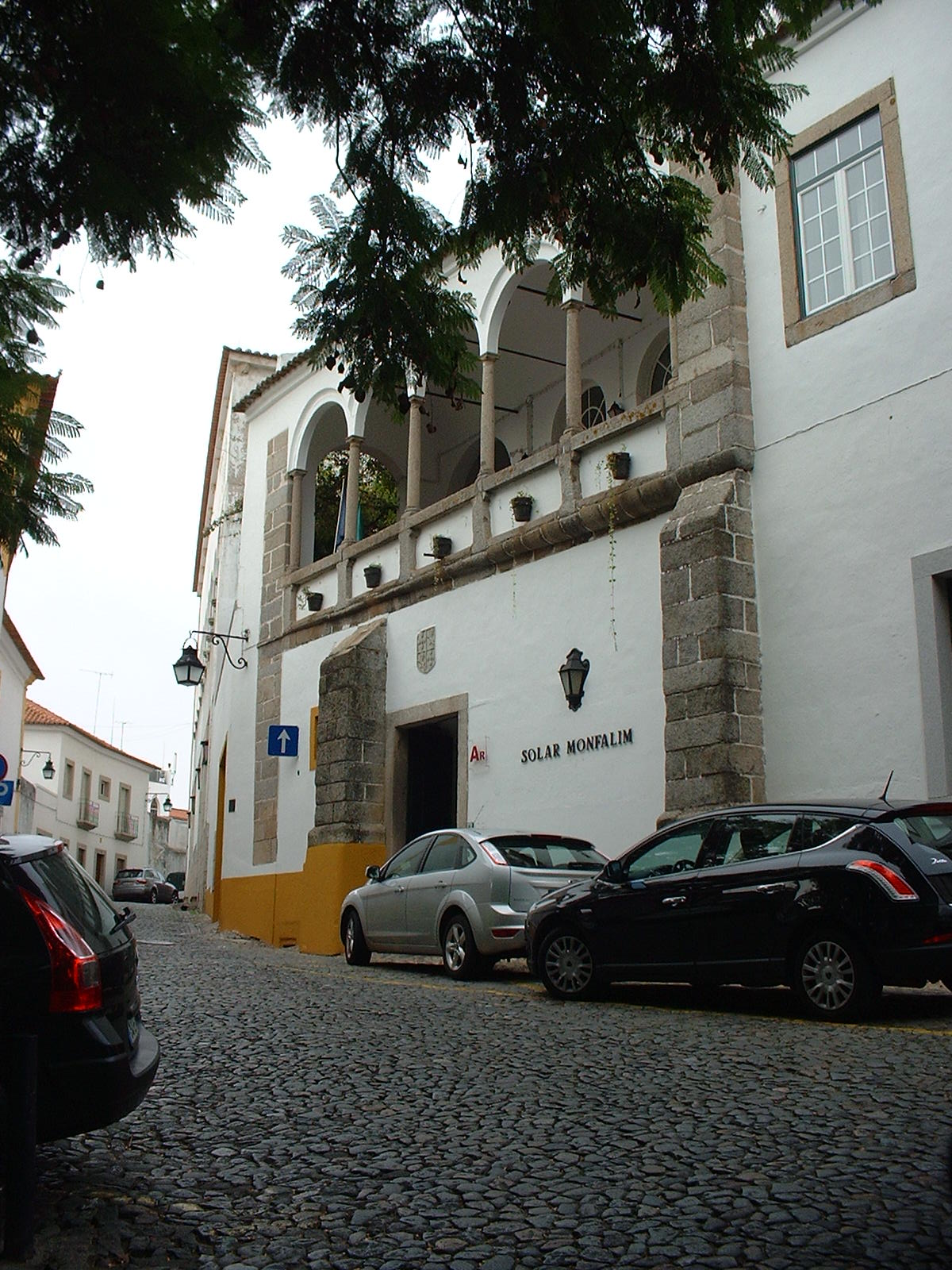
There’s a wide range in hotels too, but I opted for a former ducal palace, Albergaria Solar Monfalim, with its faded grandeur.  The solid stone staircase climbs to a lofty cloistered area overlooking the cobbled street. (Largo da Misericordia 1)

Evenings are wonderful in Evora, the Temple of Diana and Cathedral spectacularly staged with floodlight.  And afterwards a quiet glass of port in the hotel bar, filled with Evora’s past.

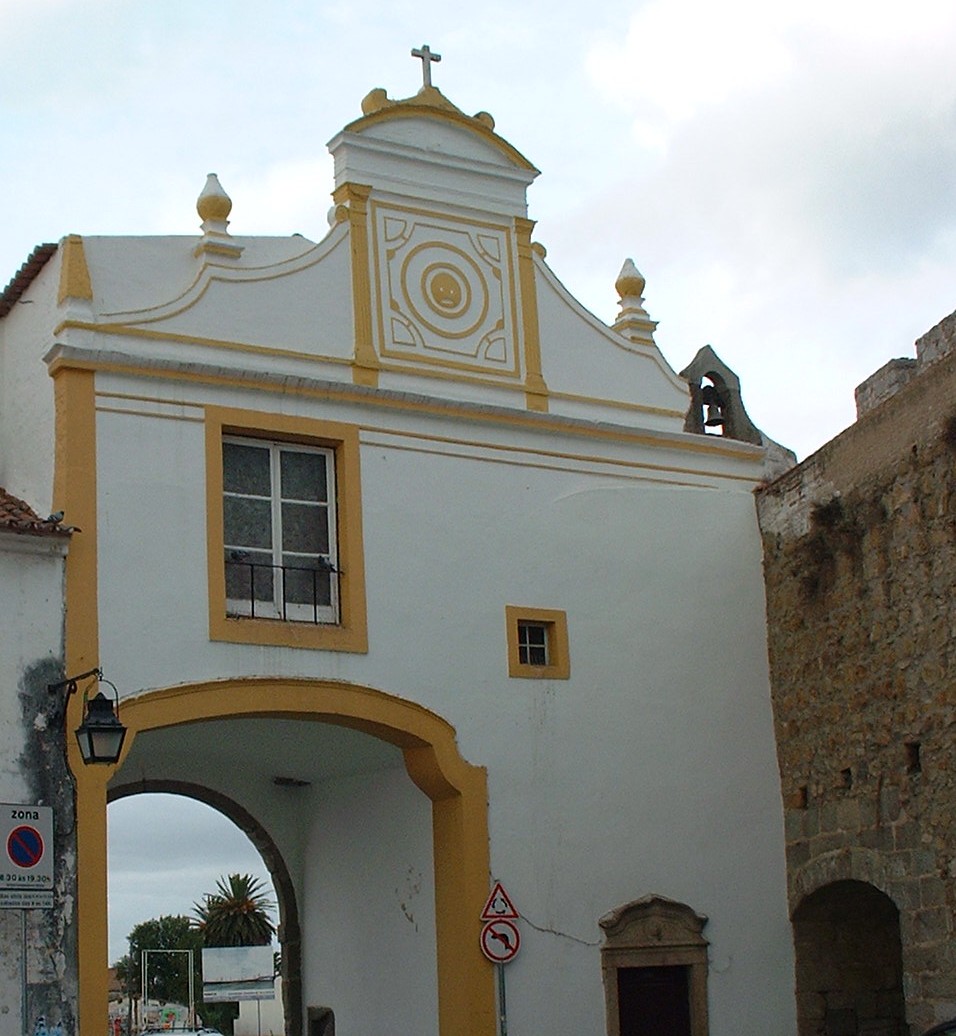
Parking is easy on the huge expanse of land outside the town walls, approaching from Lisbon, except maybe when the annual Feria takes place in June.  From there you’re through a gate onto Rua Serpa Pinto and history beckons.

While writing this post I discovered that the name Evora derives from the Latin ebora = of yew trees and has links with the city of York, not far from my UK home.  In Roman times, York was known as Eboracum, “place of yew trees“.  Isn’t life strange sometimes?

This post is part of my personal A-Z of Portugal, Julie Dawn Fox’s great idea.  Follow my journey through the header or logos, or even join in.  You’ll find some great stories.

Just an afterthought for anyone thinking of visiting in the summer.  Evora has good open air swimming pools so it is possible to cool off. http://www2.cm-evora.pt/piscinasmunicipais/condicoes_horarios_verao.htm  There’s a map on the site.

C is for Carnaval

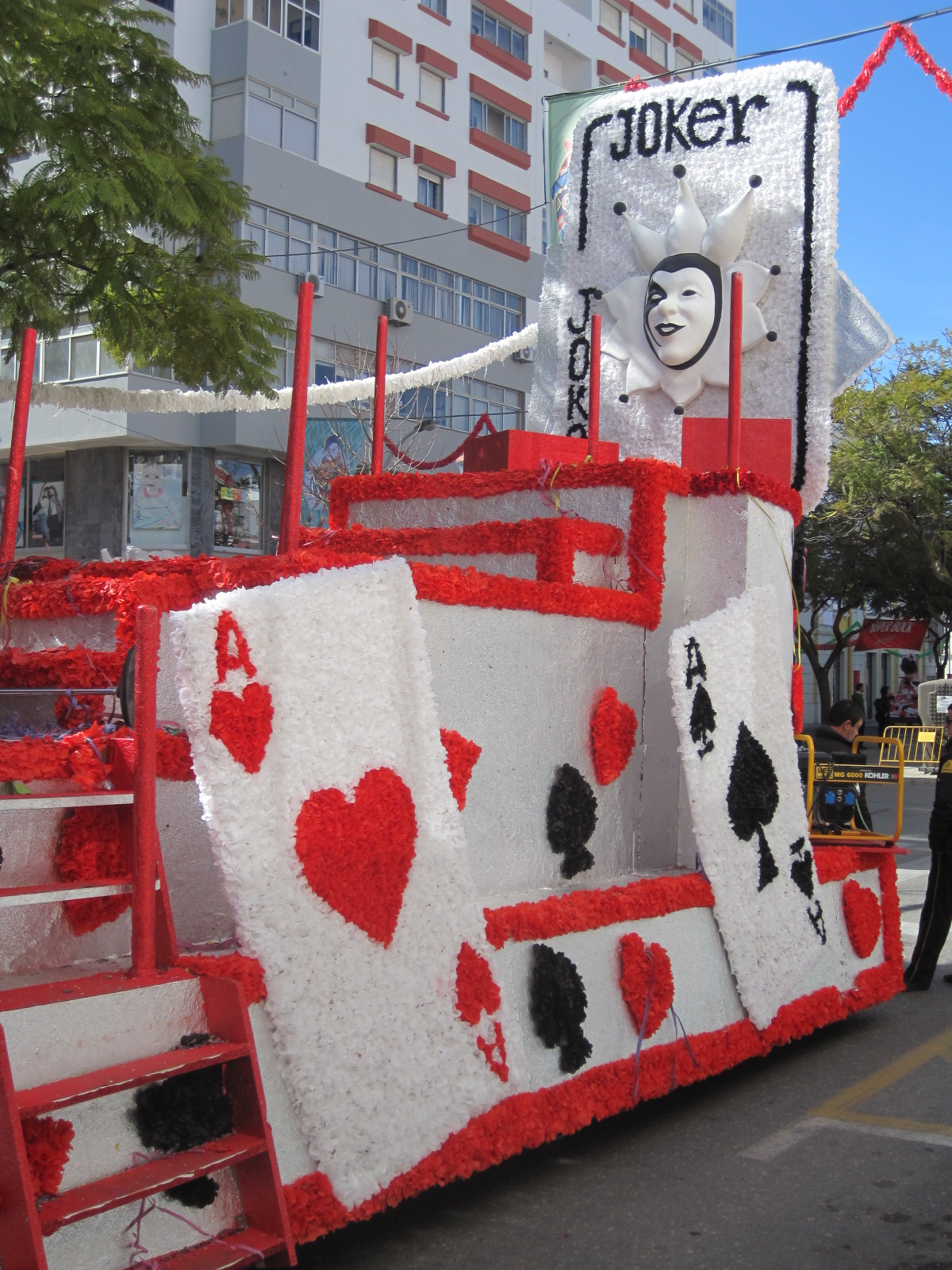
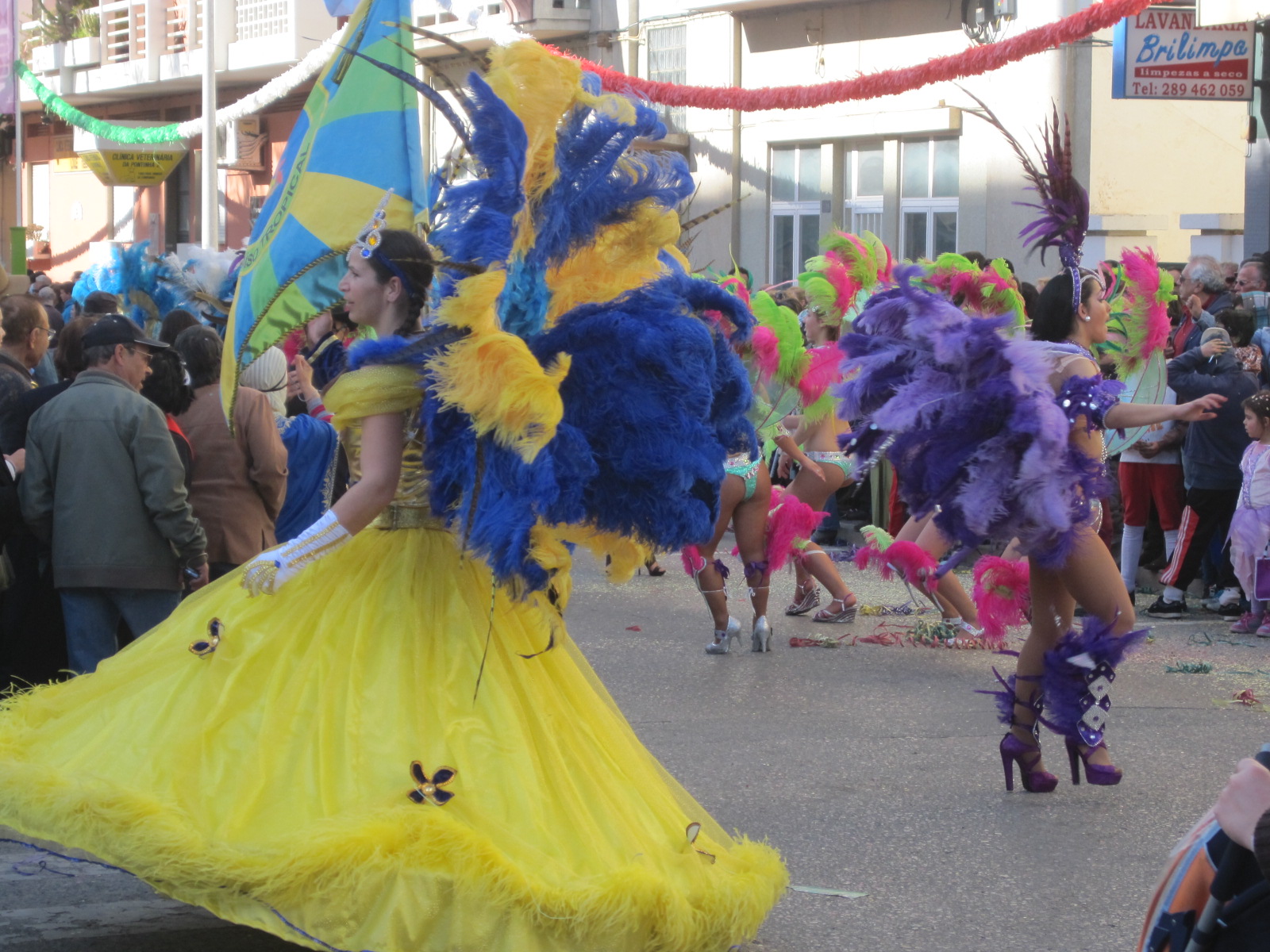
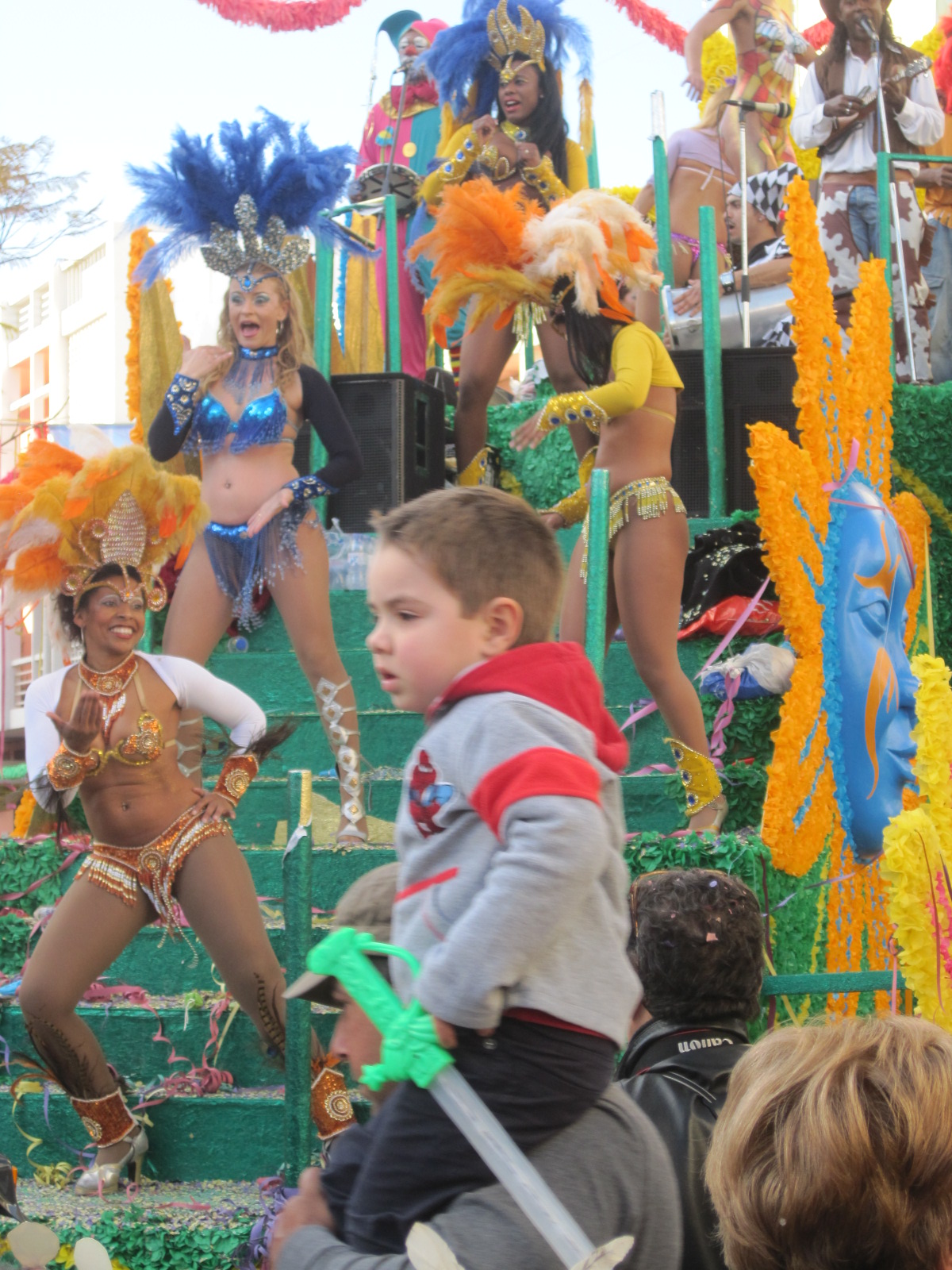
I fought long and hard to resist writing this, and then capitulated.  A bit like my husband when the dancing girls stopped in front of us and took each of us by the hand, to my expression of delight and his of abject dismay.  Happily for him, it was over in a flash and we were back in the crowd, minus my jester’s hat.  Shame!

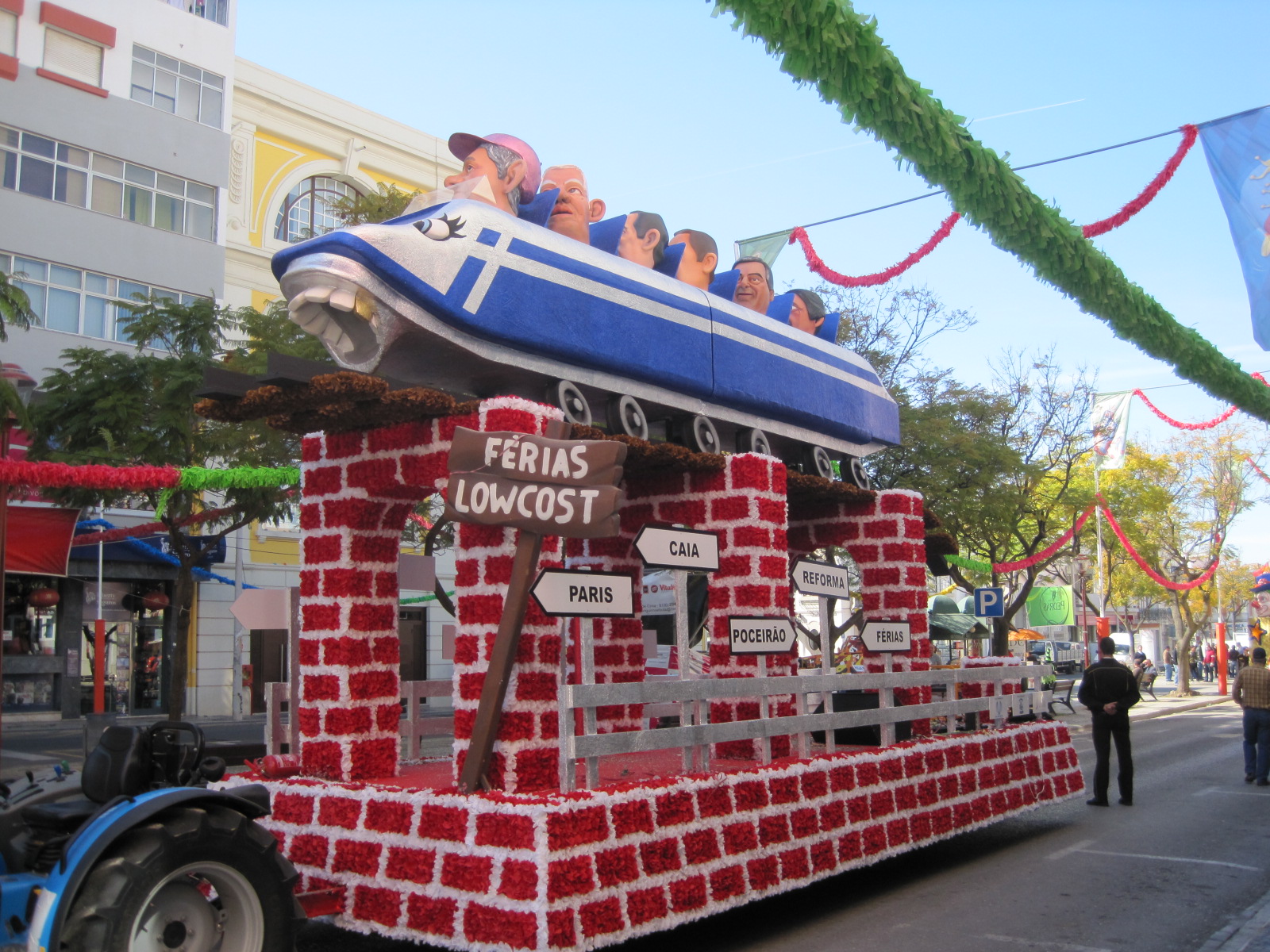
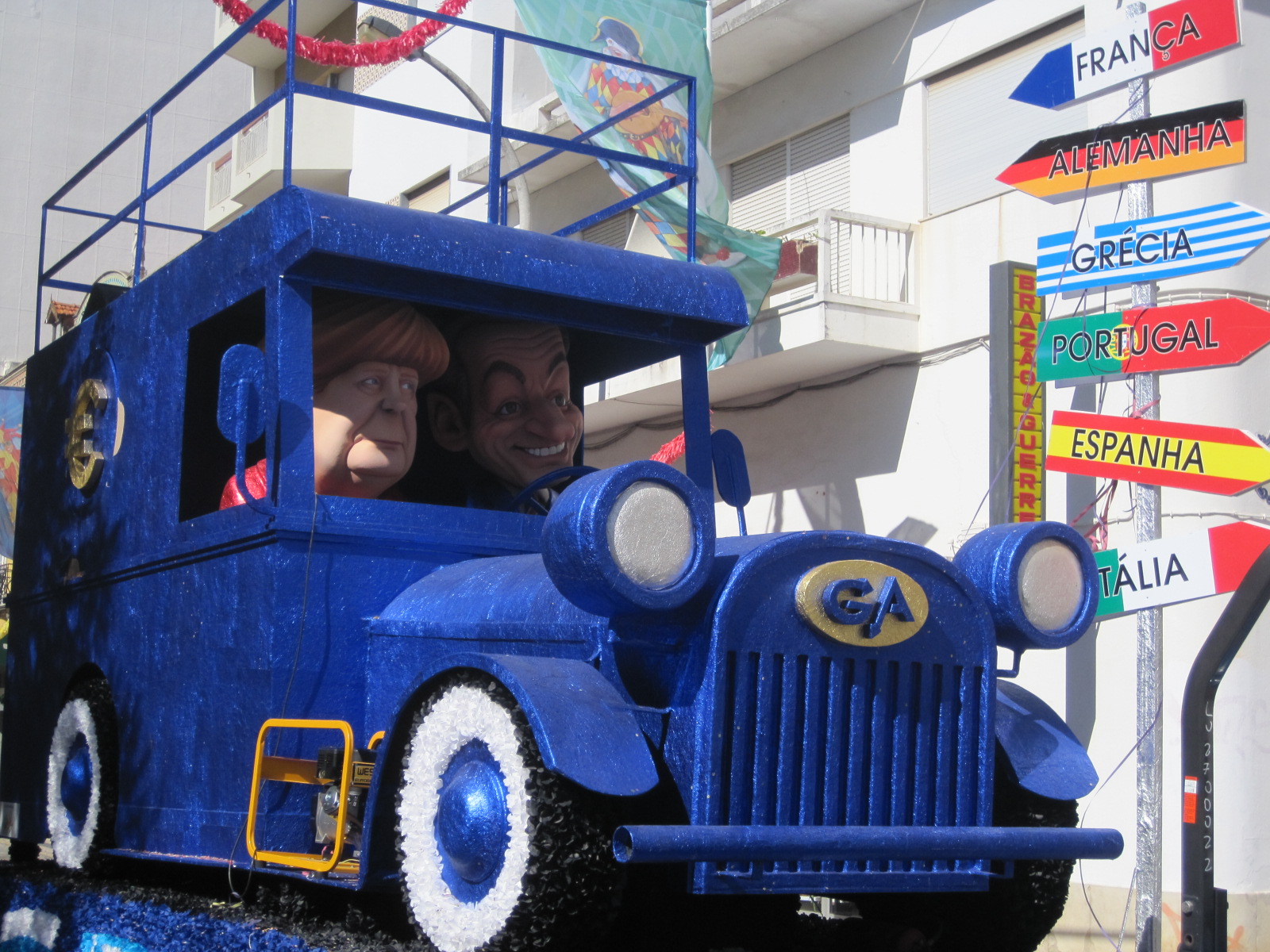
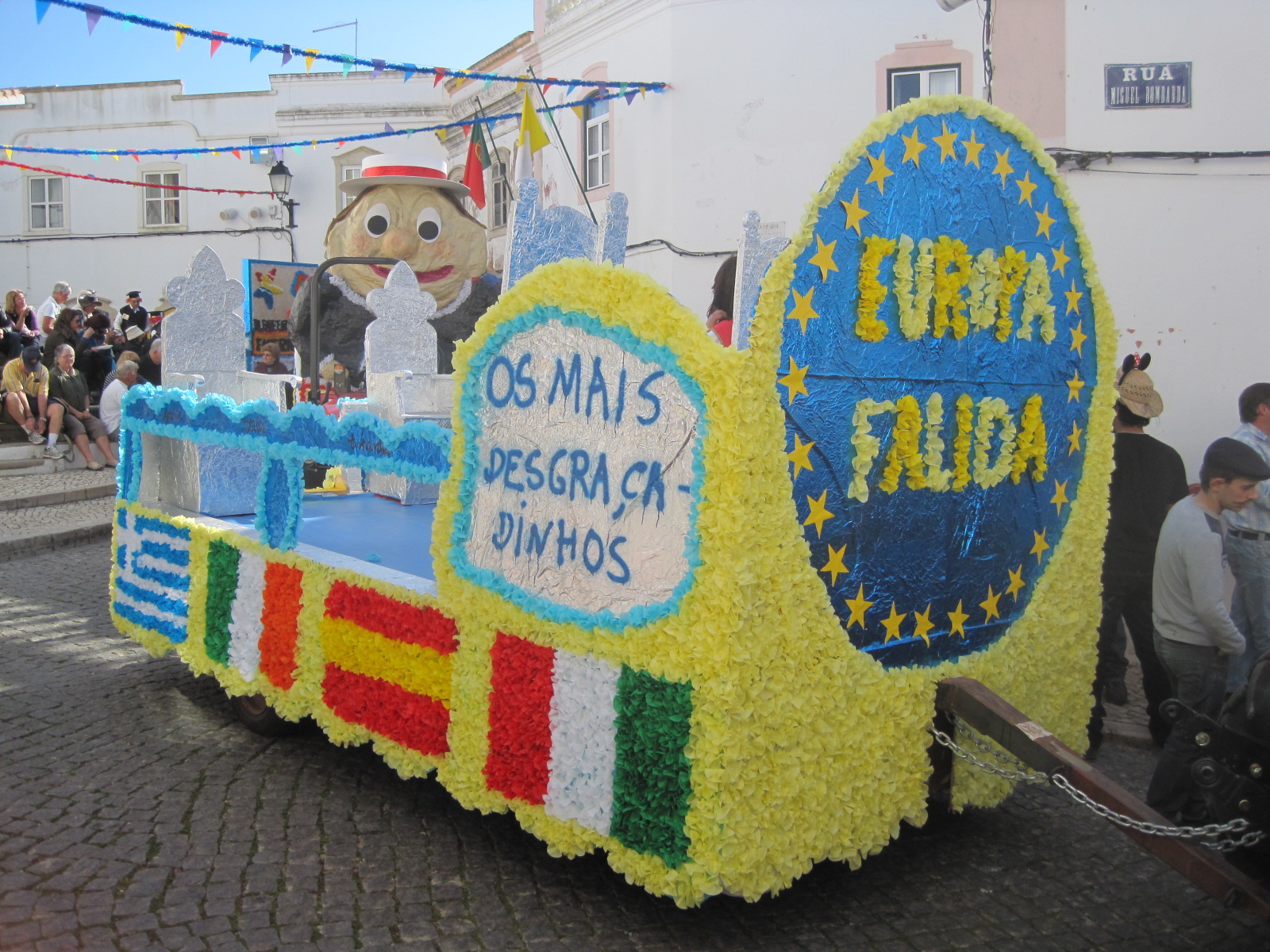
Financial crisis hits Loule Carnival

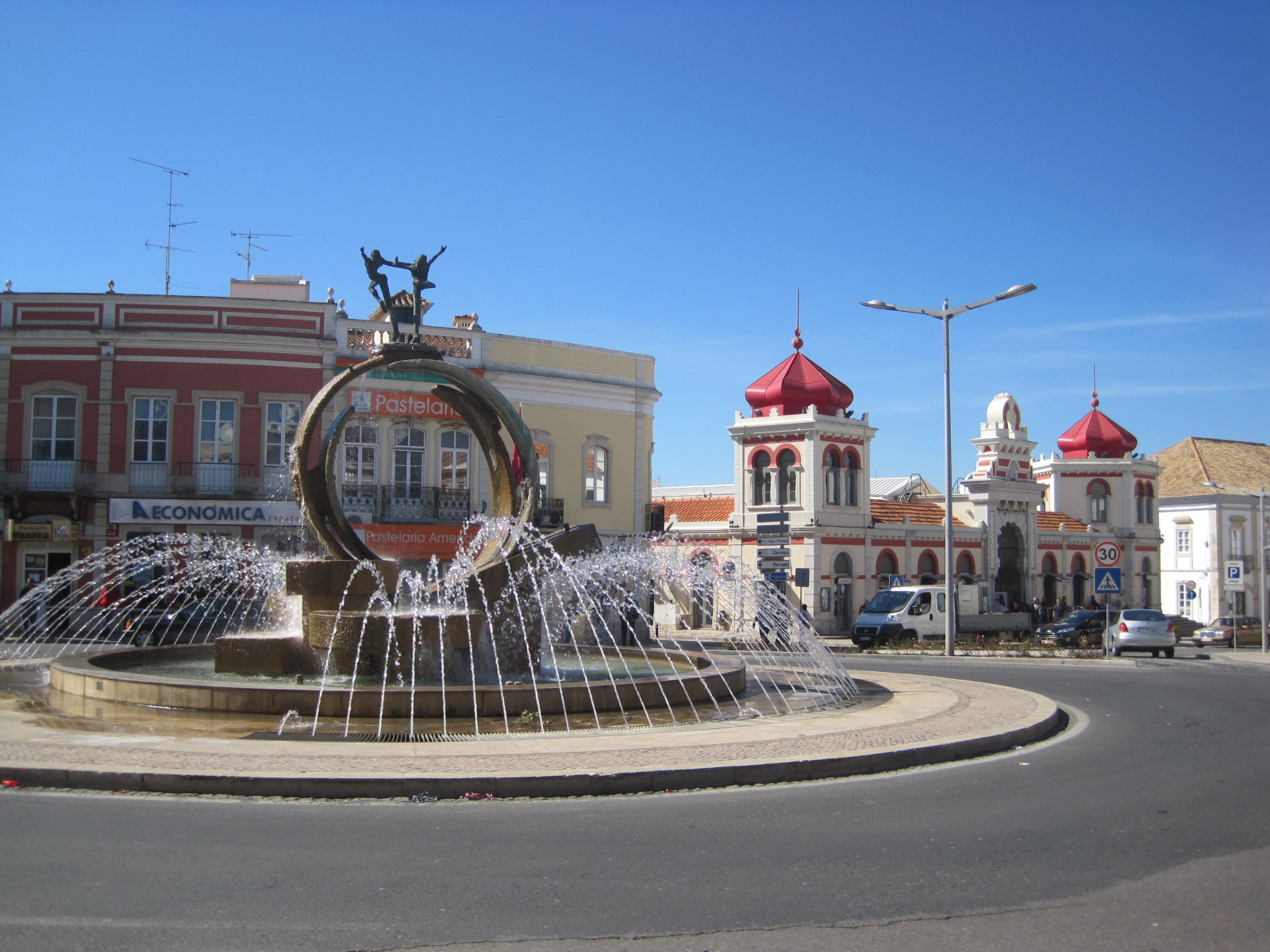
It was our first experience of the Loule Carnaval procession and it fully lived up to our expectations.  Loule is an interesting market town, 16km north of Faro in the Algarve.  The remains of the castle date back to the 12th century and the almedina, the old quarter, is a maze of streets lined with artisan shops and cafes.  The Arab style market hall on Praca da Republica is a focal point, and there’s a lively street market on Saturday mornings.

Fountain and the Arabian market, Loule

Much of Loule is a modern sprawl and we were uncertain about access to this, the Algarve’s biggest Carnaval celebration.  For once, it turned out well.  We approached the town on the N270 from Sao Bras de Alportel and at lunchtime traffic was minimal.  There was the distinct impression that the townsfolk were conserving their energy to party later.  Establishing where the barriers were on the main street, Avenida Jose da Costa Mealha, we parked a little way out on Rua Alfonso de Albuquerque and strolled back into town in pleasant sunshine.

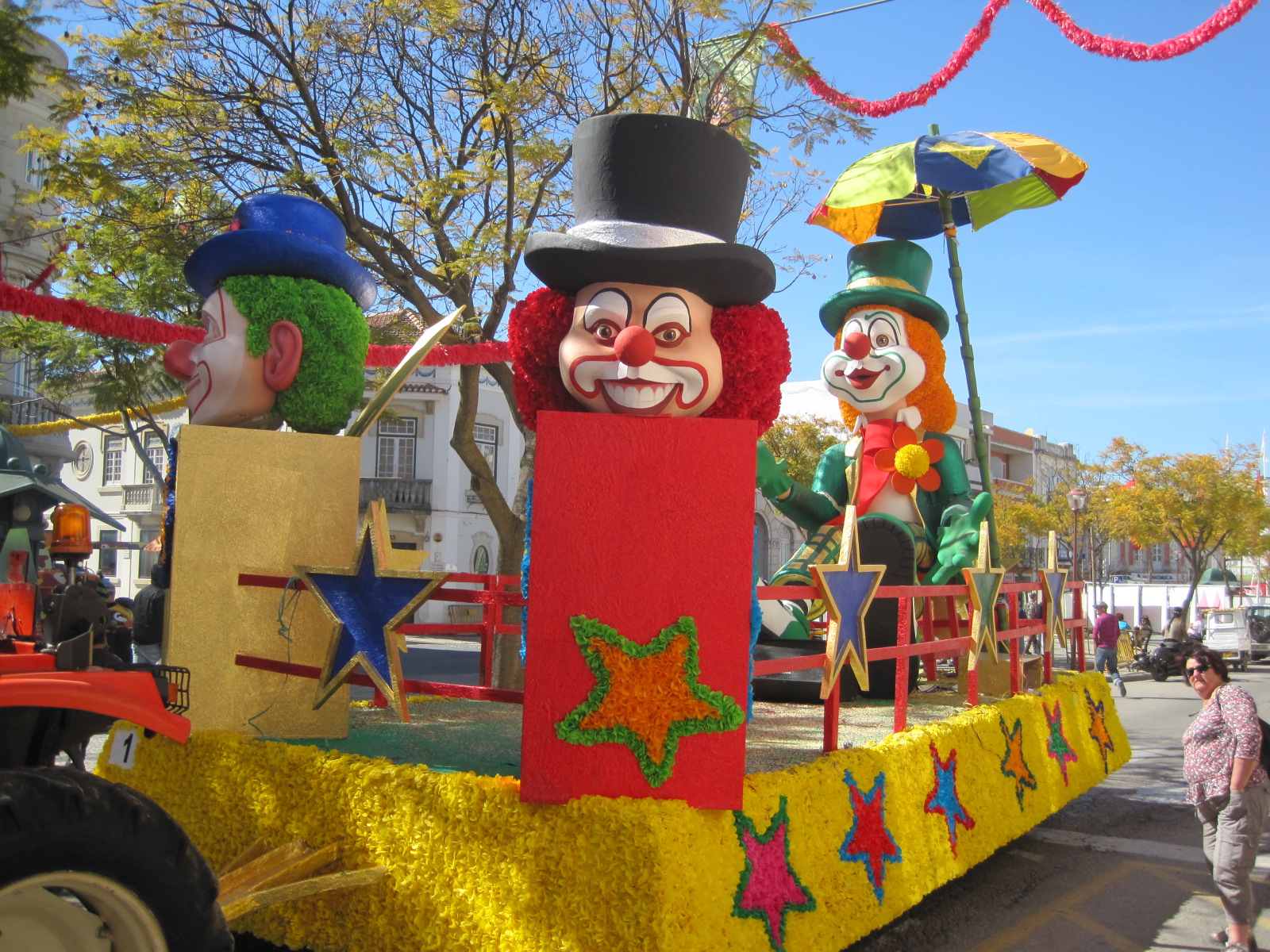
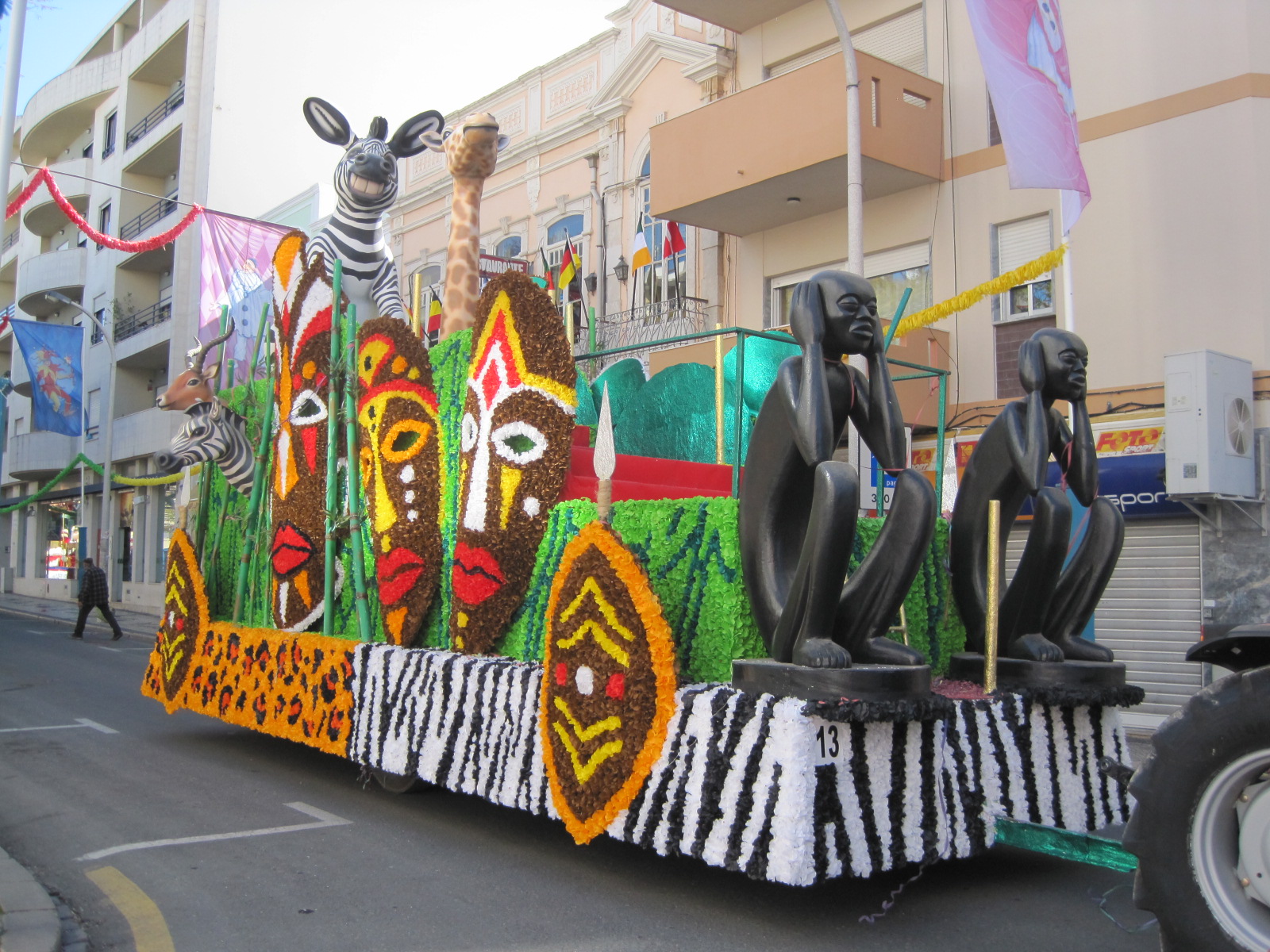
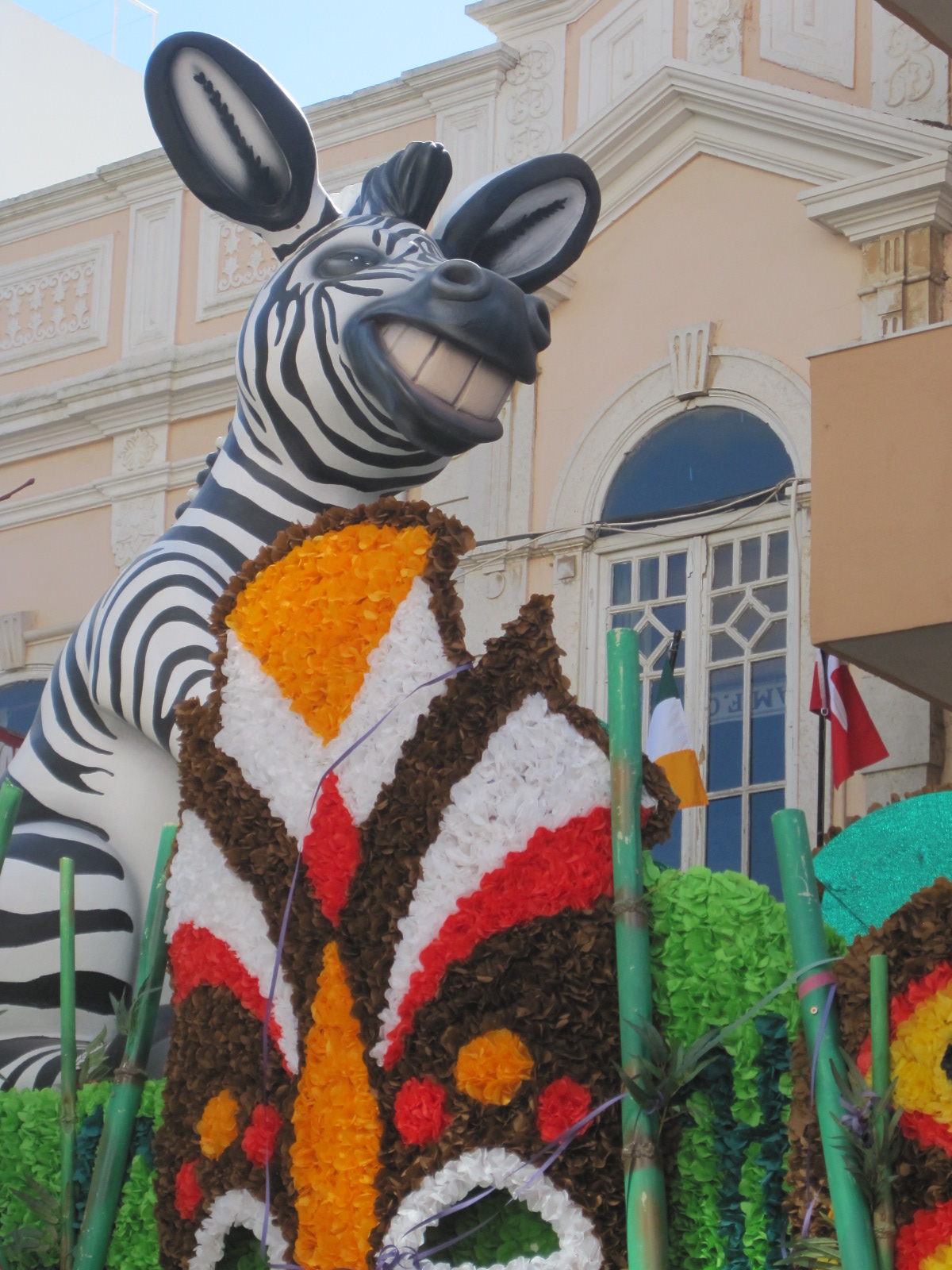
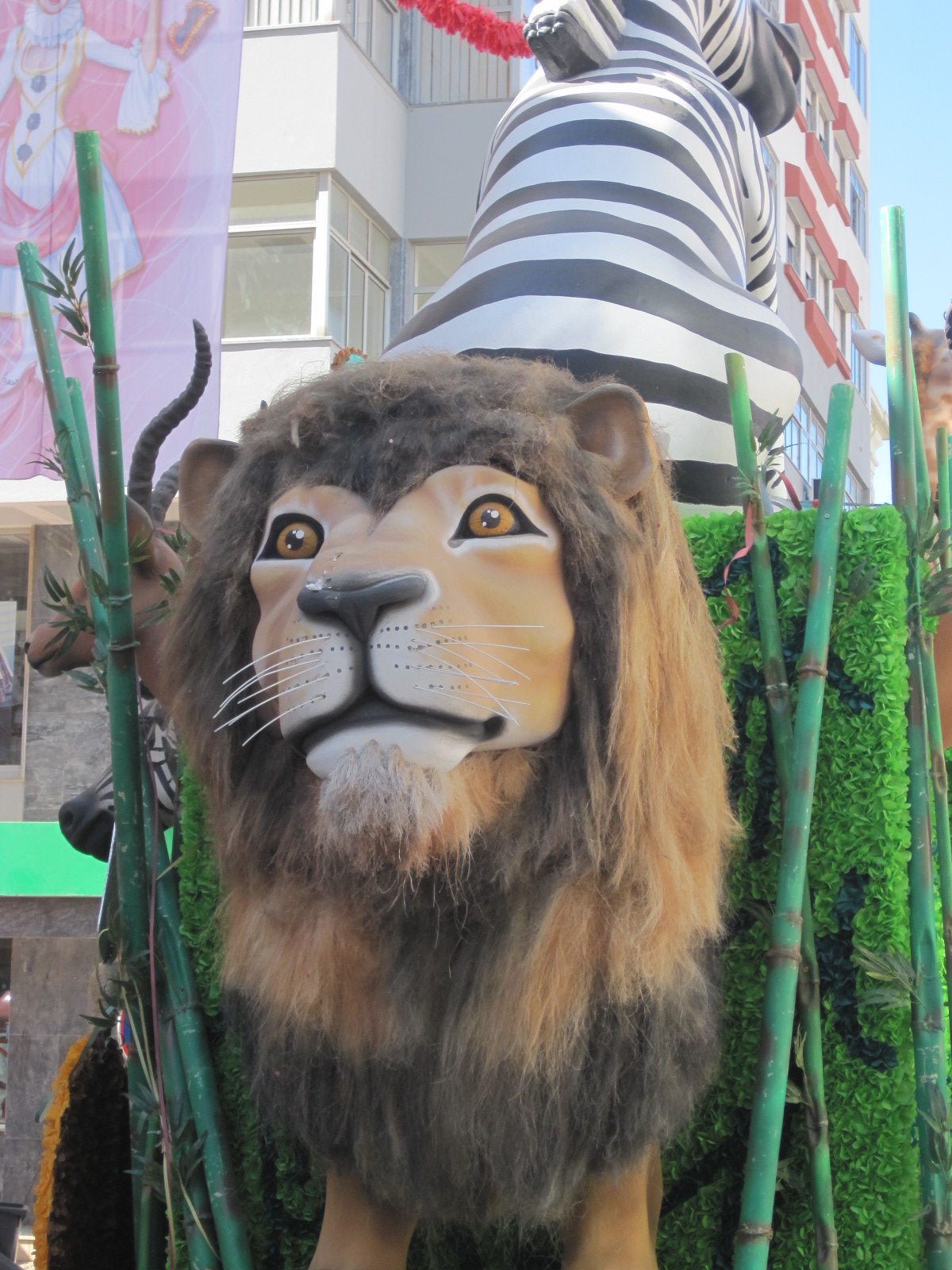
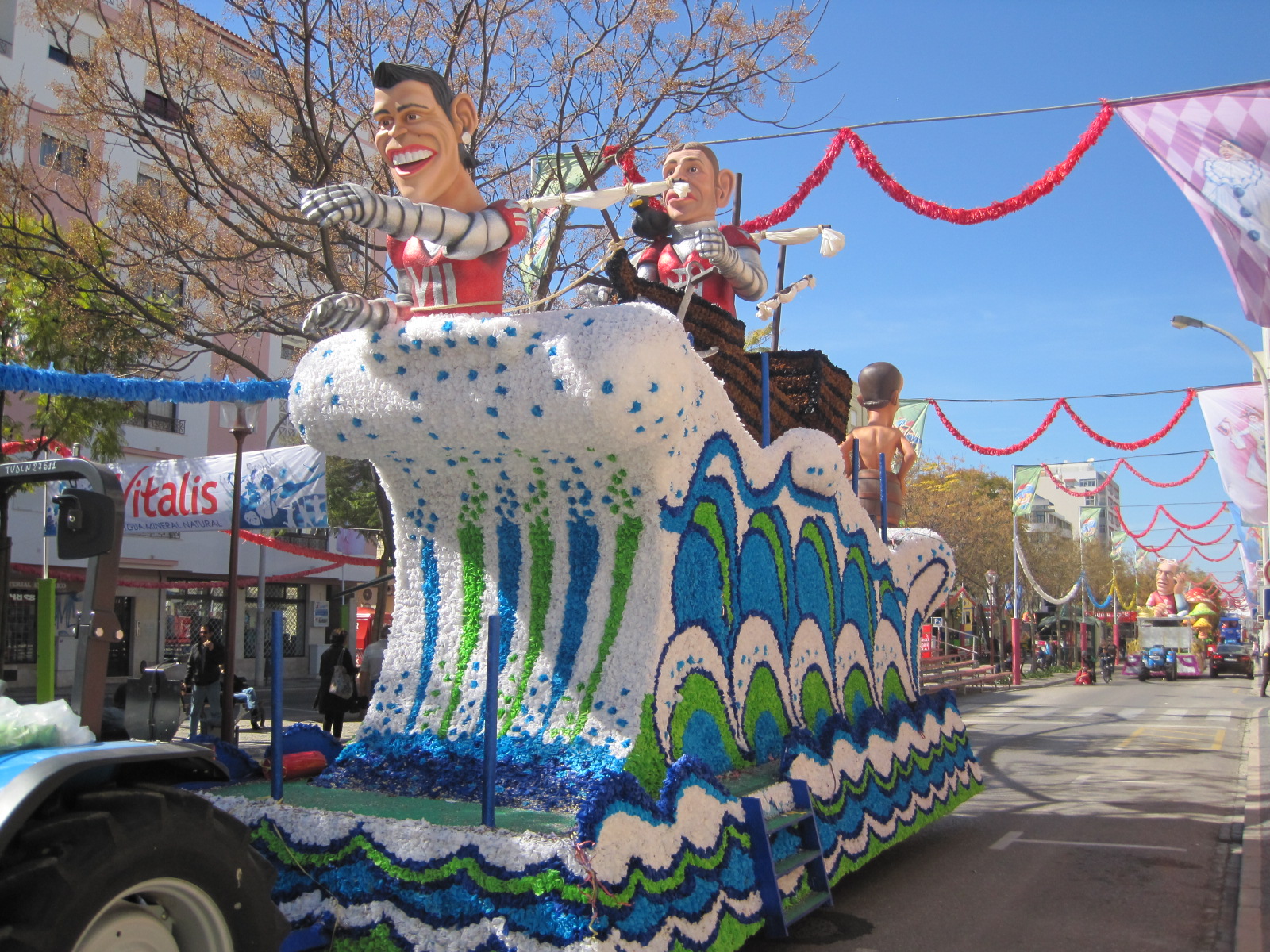
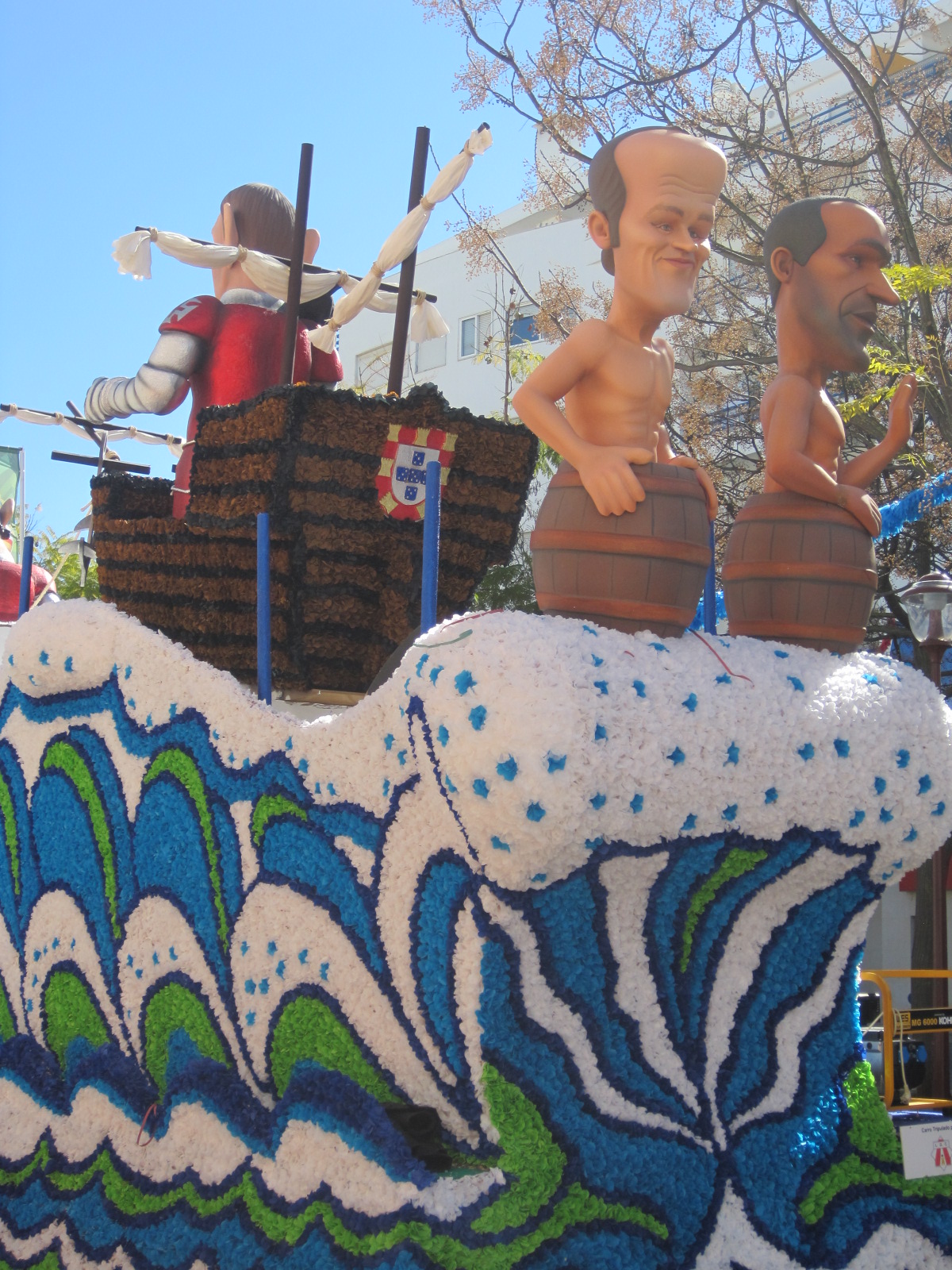
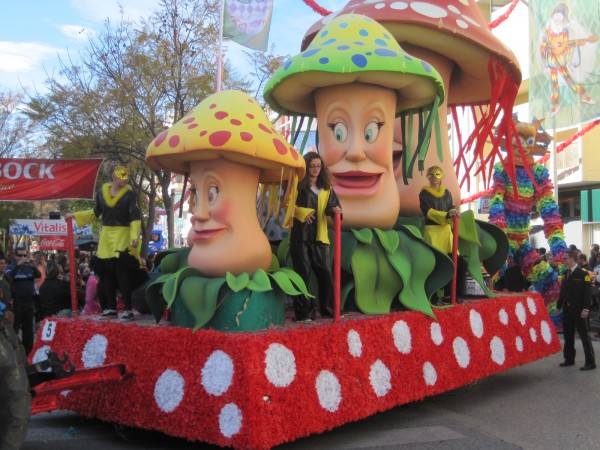
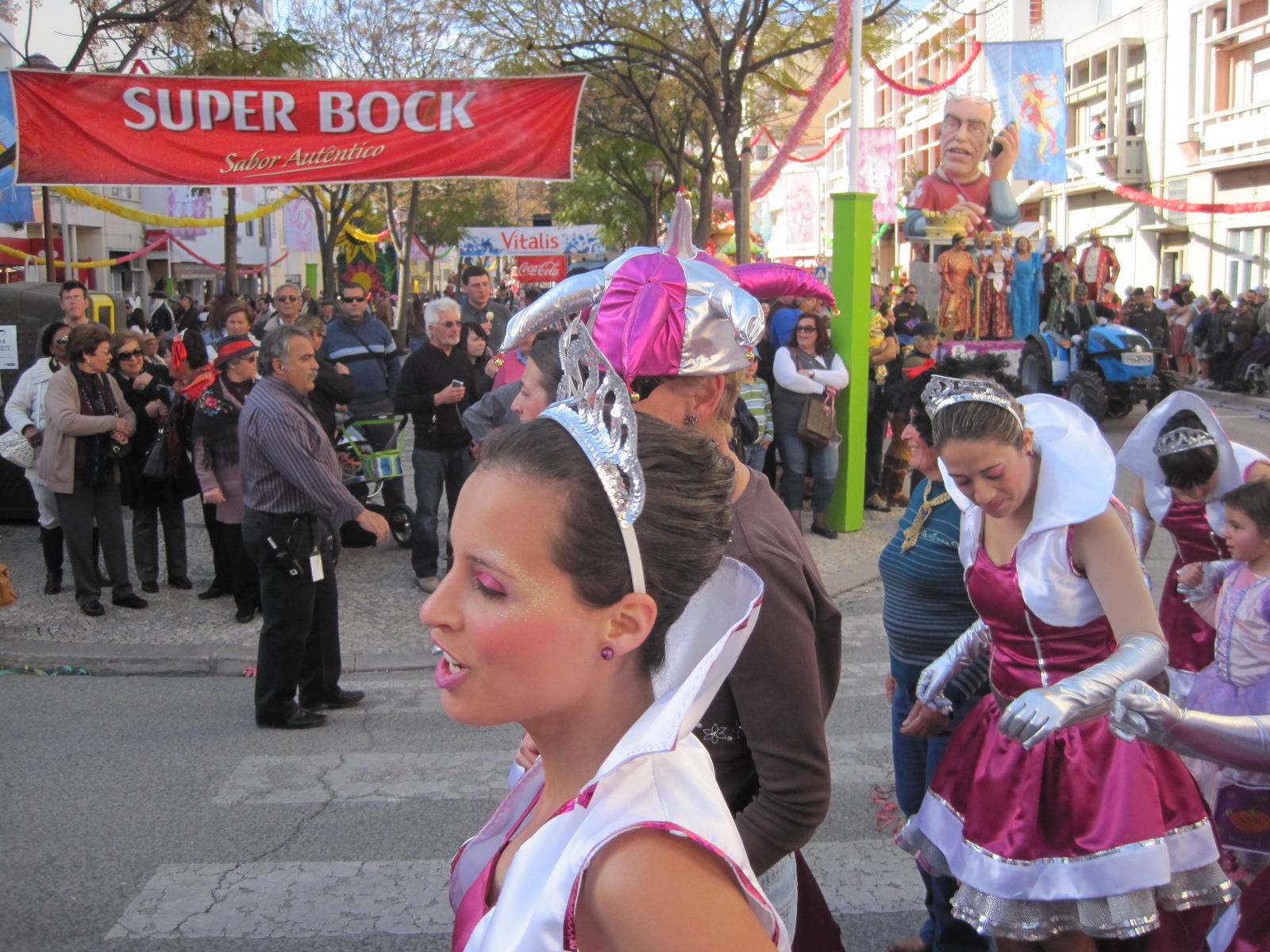
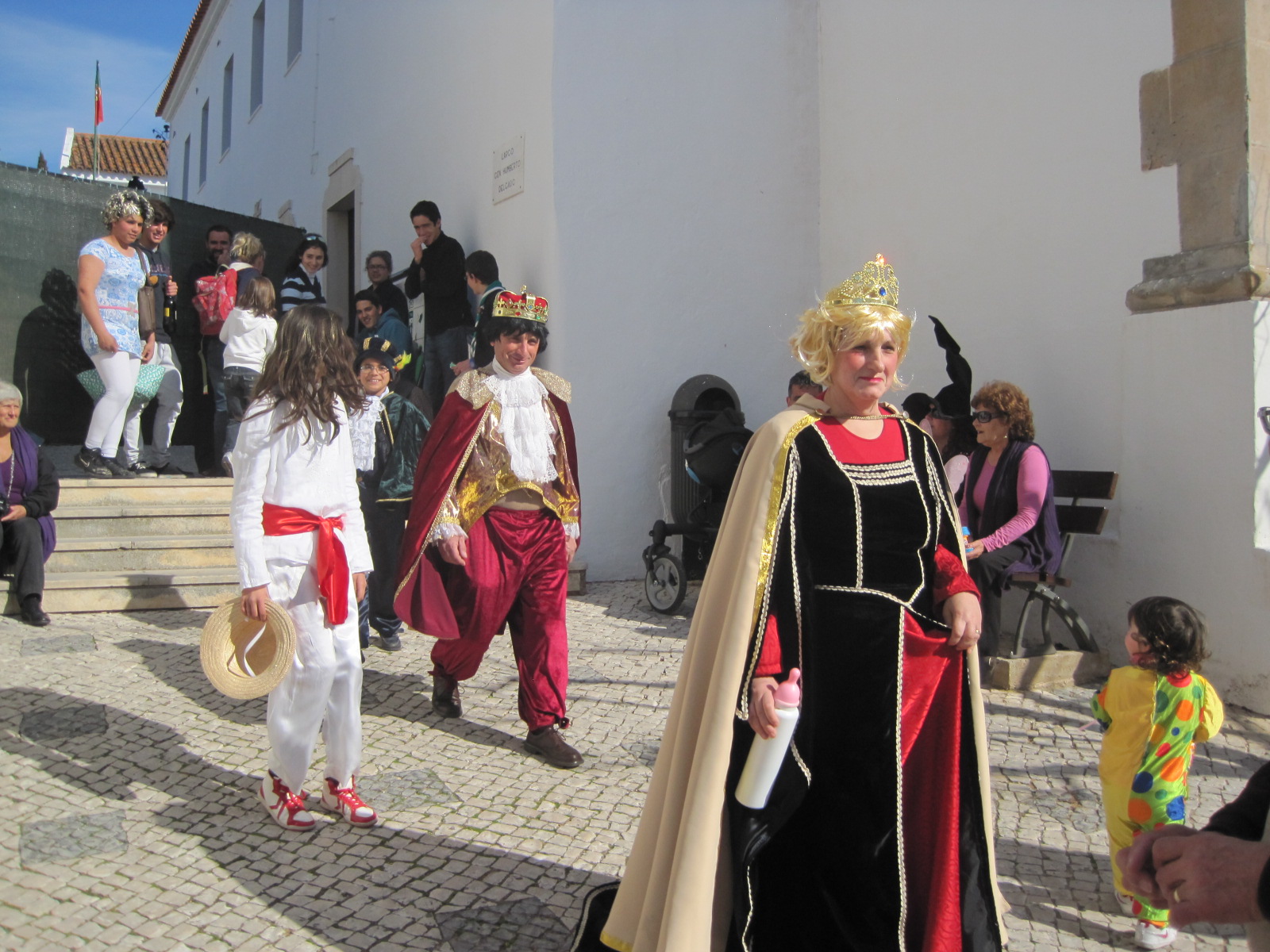
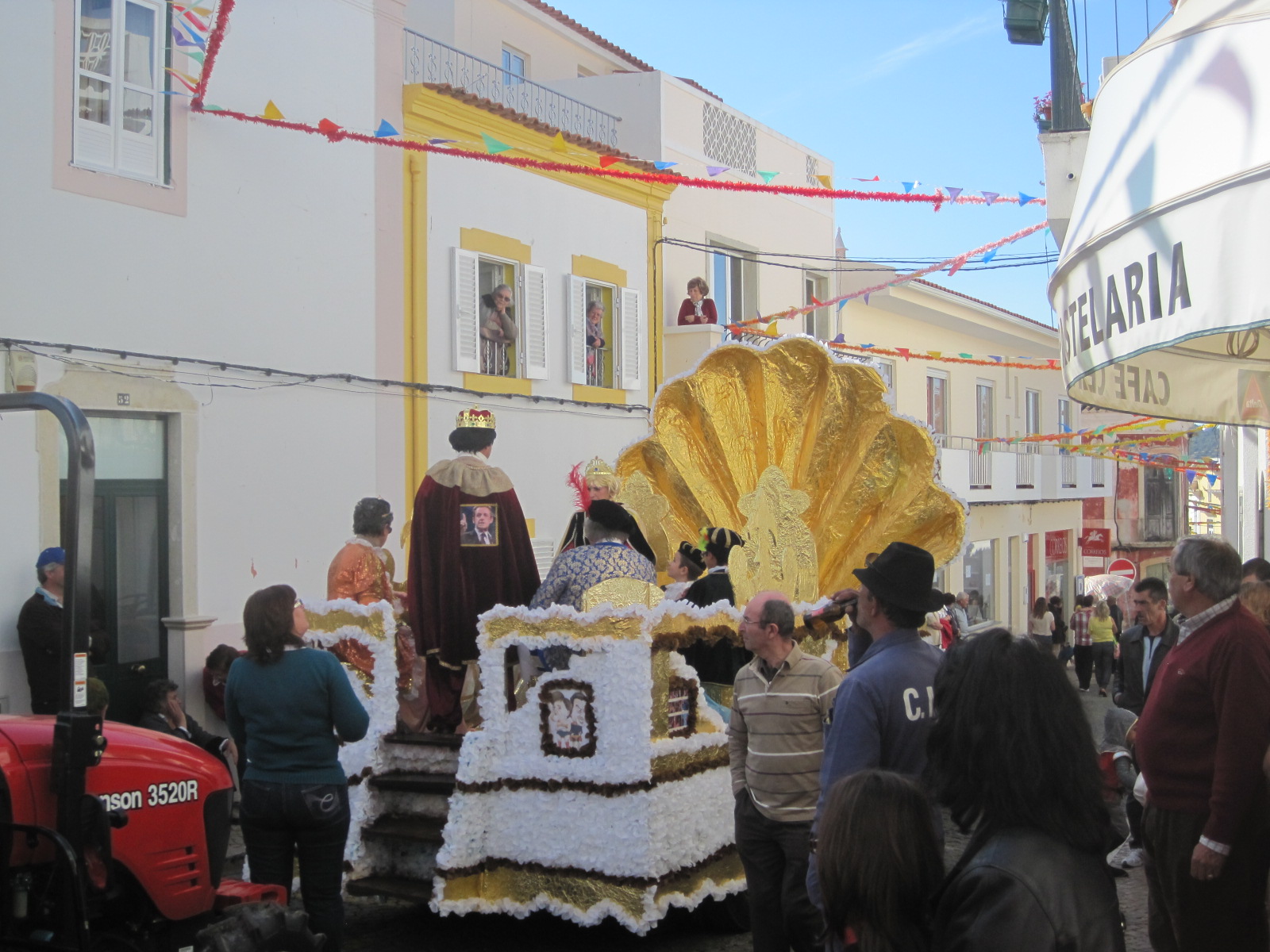
A pavement coffee and pastry to watch the excitement build was a good choice.  The 15 floats were towed gently into place and there was plenty of time to wander between them to admire and take photographs without the crowd.  Loudspeakers announced a 3pm start and it was time to seek out that good spot, having first paid your 2 euros at the kiosk.  It was entertainment in its highest form just watching the locals arriving, many of the children in costume and jiggling with excitement.  This year costume shops and stalls had been set up to encourage people to get into the spirit of Carnaval and shake off the doom and gloom.

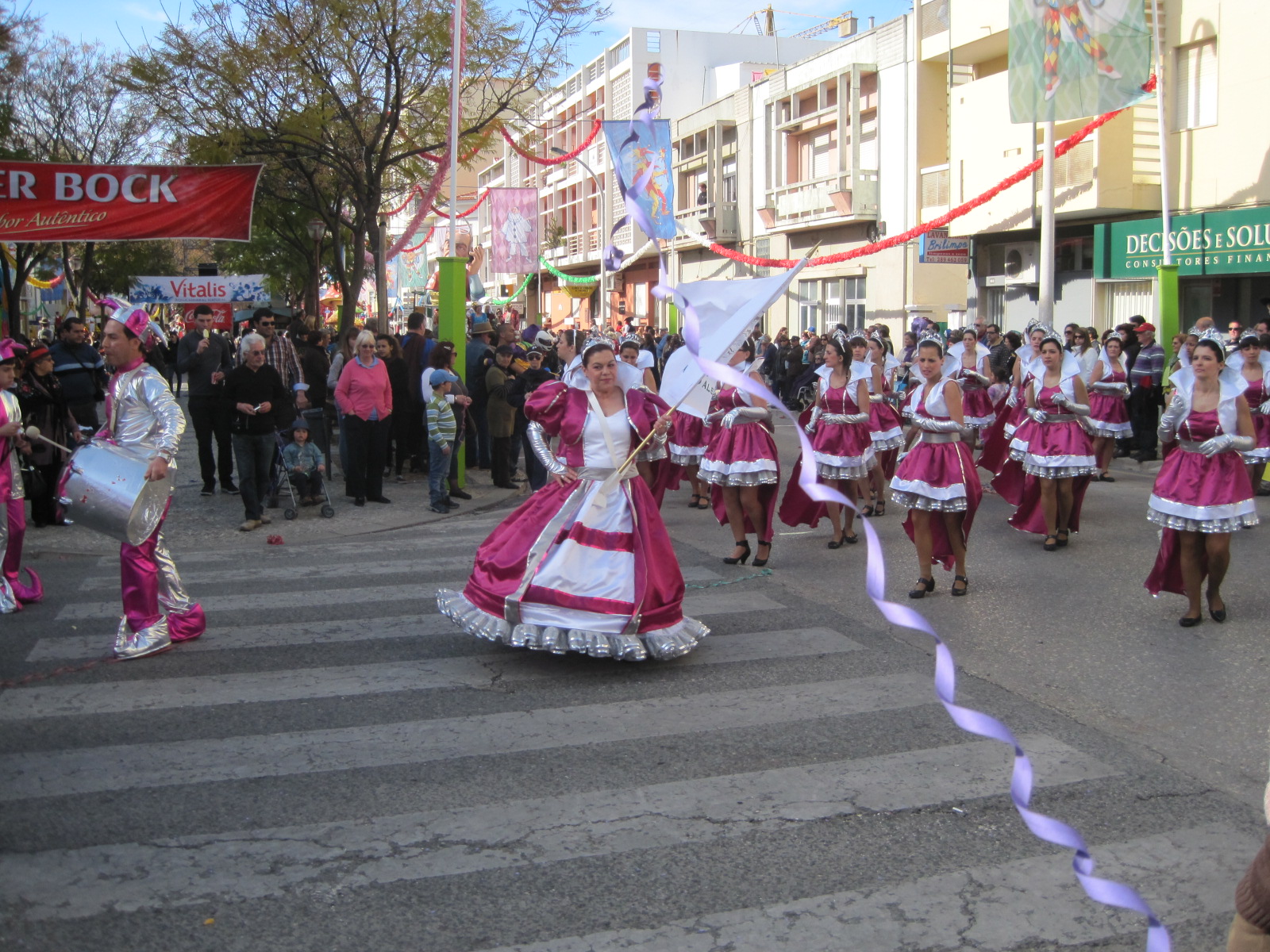
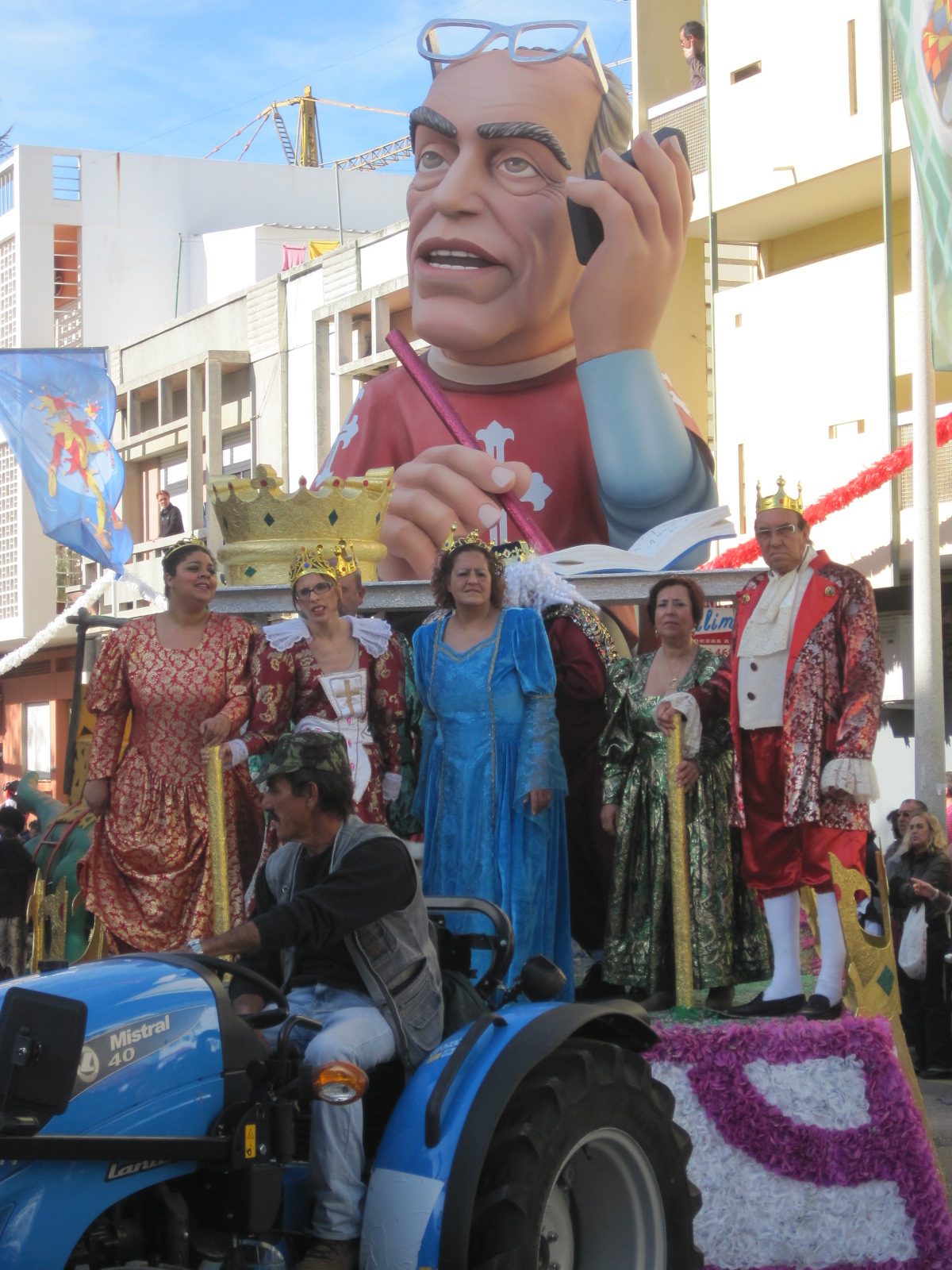
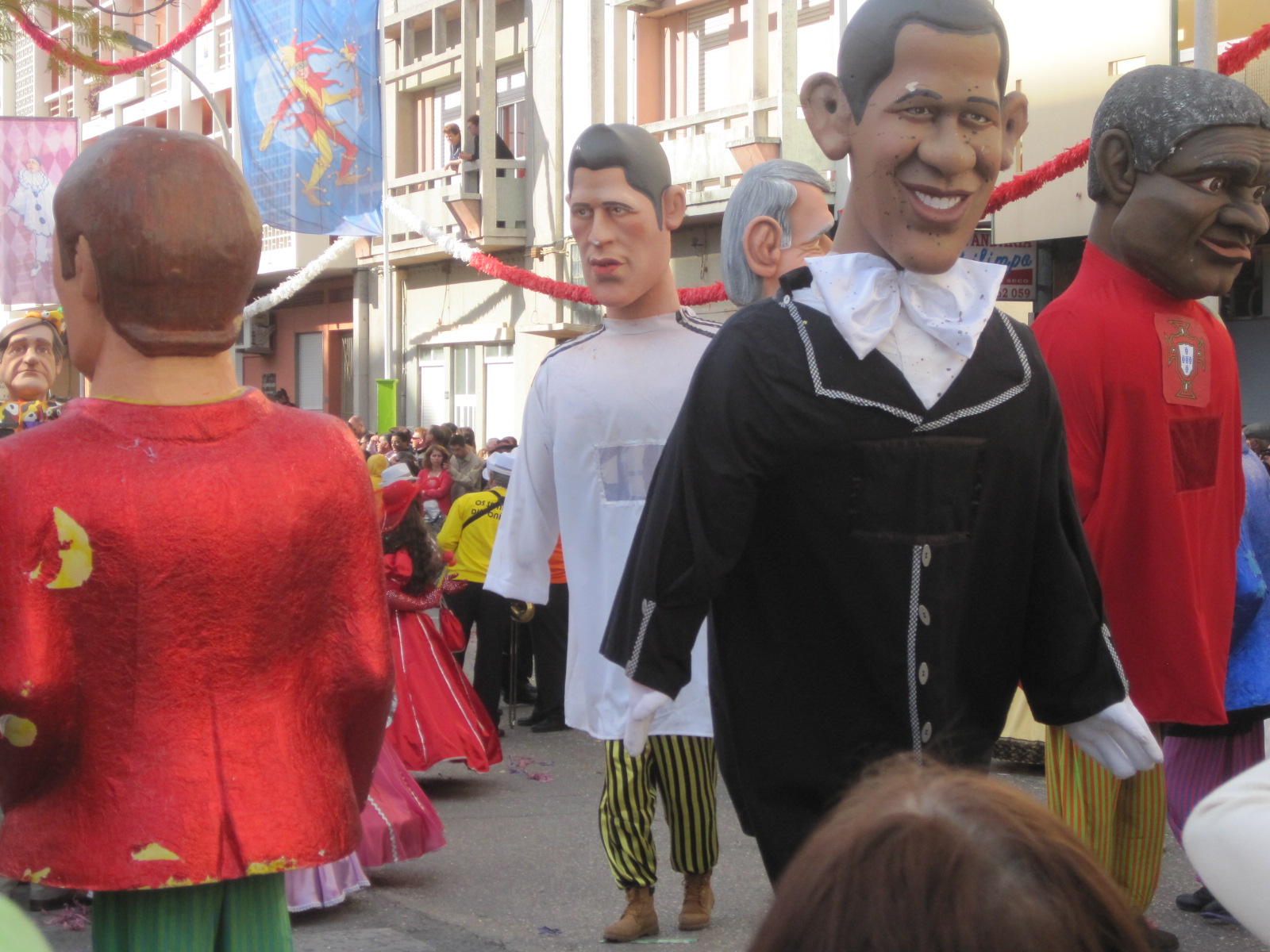
The Portuguese are very happy to poke fun at their leaders and celebrities and the Carnaval has a political theme.  Many of the floats produced wry smiles if not outright chuckles.

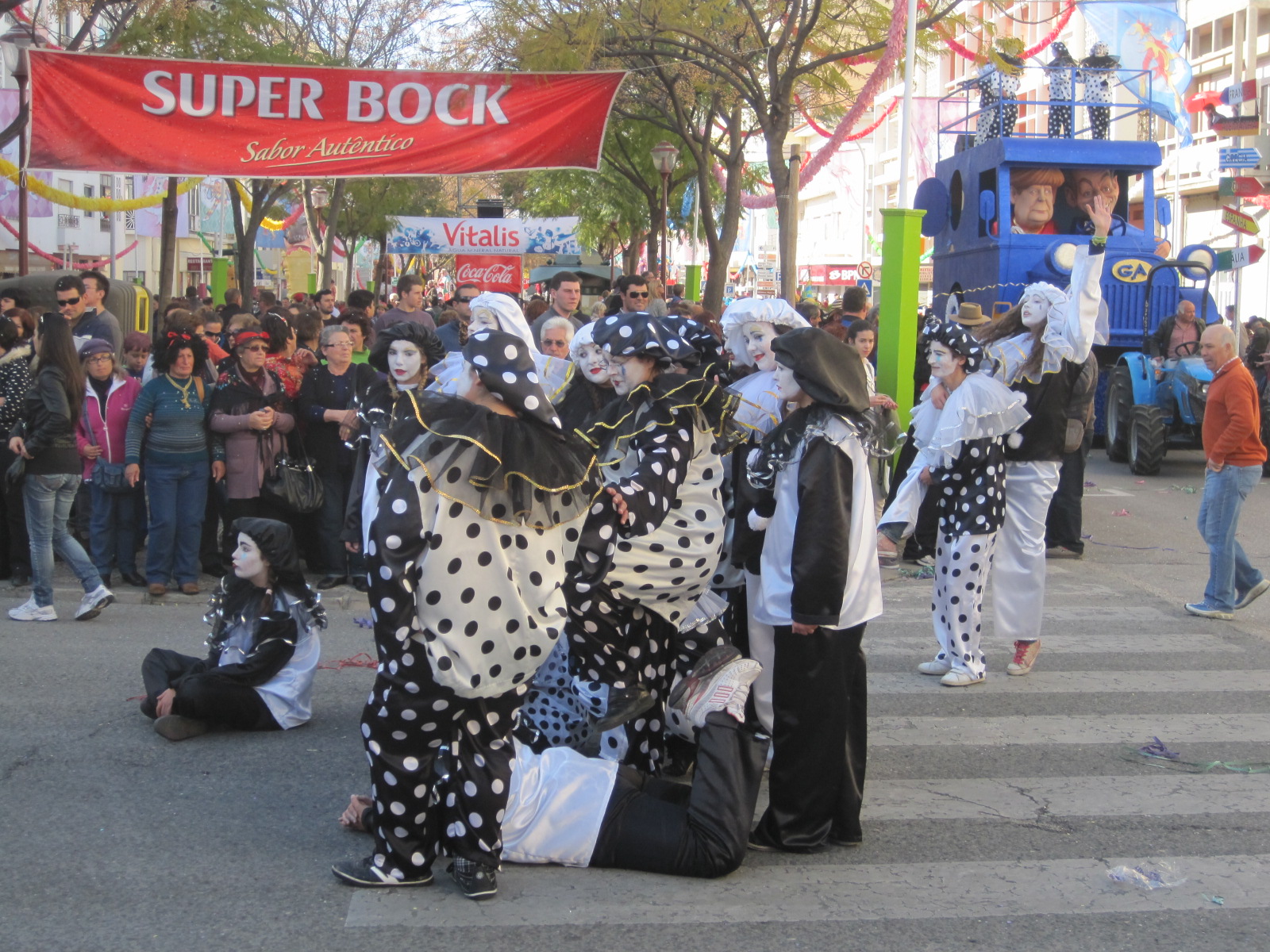
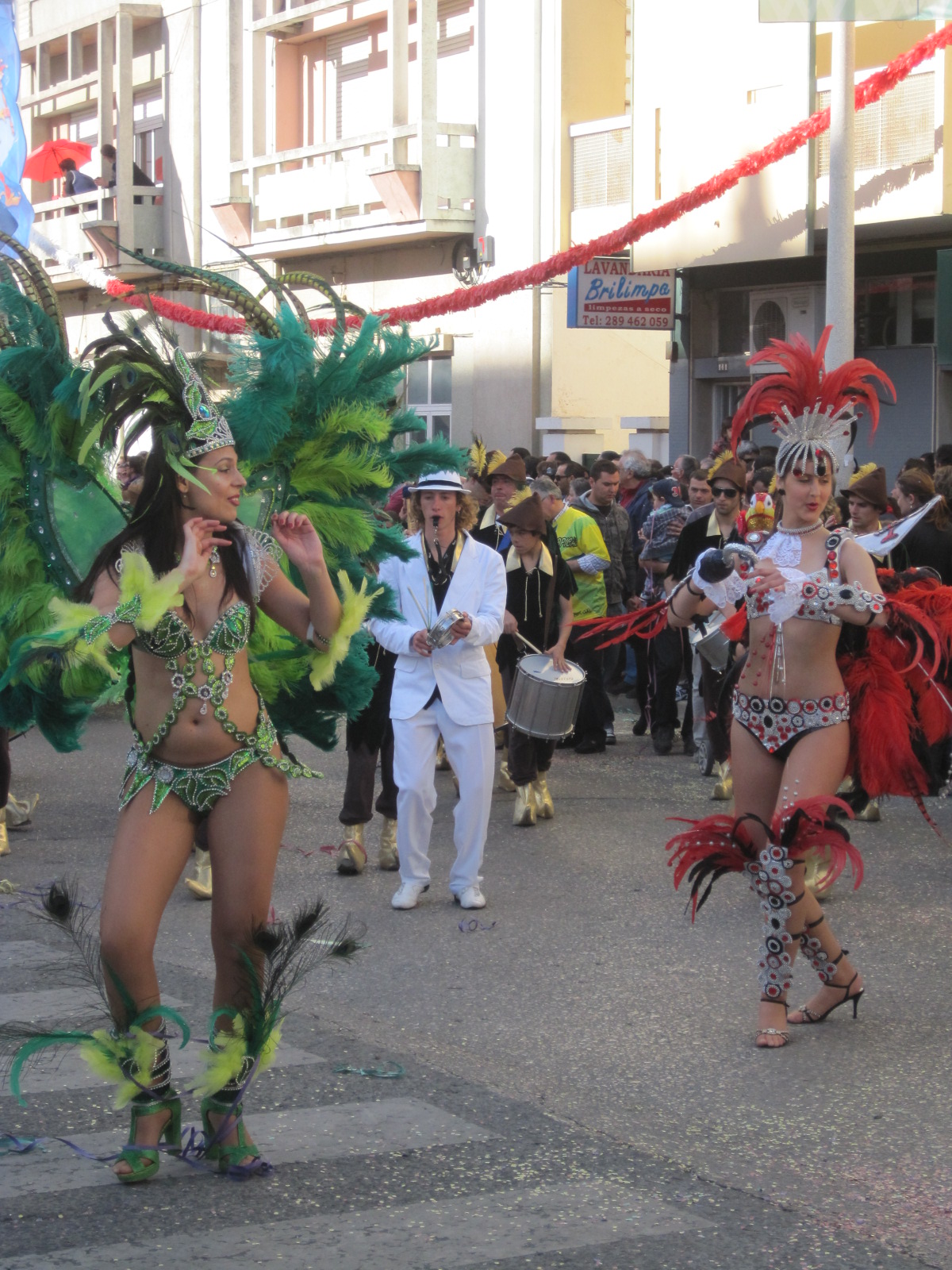
Just a bit more shuffling of feet and the parade was assembled and off.  It was everything you could have hoped for and more- strange characters on stilts, who bent down to engage with the children, dancers by the score, trick cyclists, pierrots, and of course the “Samba” ladies in their provocative outfits.  As each float pulled to a standstill hoards of paper streamers and tiny keepsakes were flung into the crowd.  As the sun sank behind the buildings I had to jiggle harder to the music to keep warm.  It took over an hour for all of the floats to pass by- 2 euros very well spent.

Our dancing ladies were just feet away when Michael decided that enough was enough- he wasn’t going to be involved in another round of embarrassment.

My all too brief moment of fame, then I had to give the hat back!

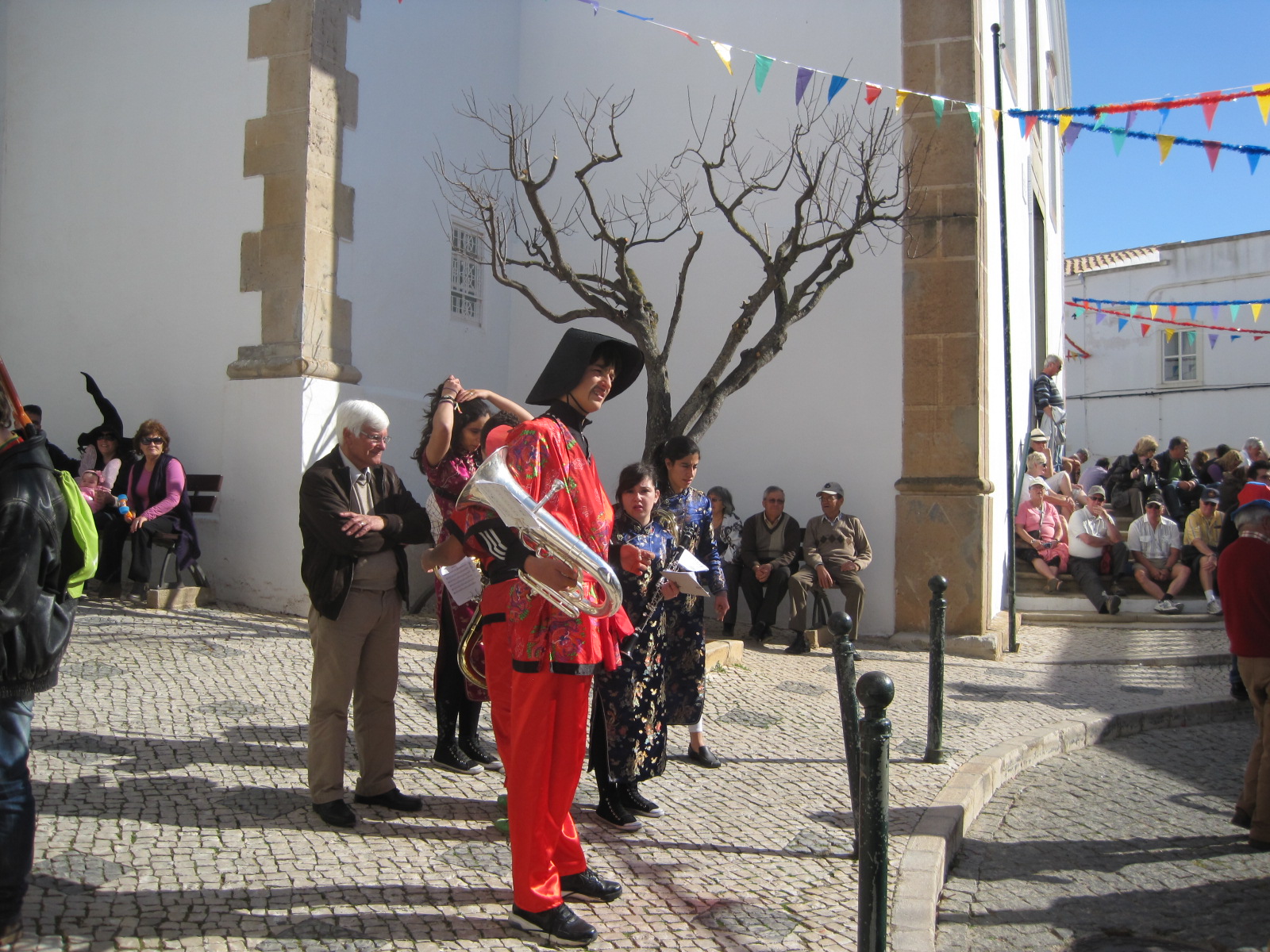
We really did have a great time, but it was in fact our second experience of Carnaval, Algarve-style.  The event runs for three days, culminating on Shrove Tuesday, and on the previous Sunday we had gone to a far more low key and traditional style of parade at Paderne, a small inland village.  We were familiar with the village having spent time there seeking out an exquisite art gallery, Corte Real, and on another occasion following a trail to Paderne Castle.

The church at Paderne

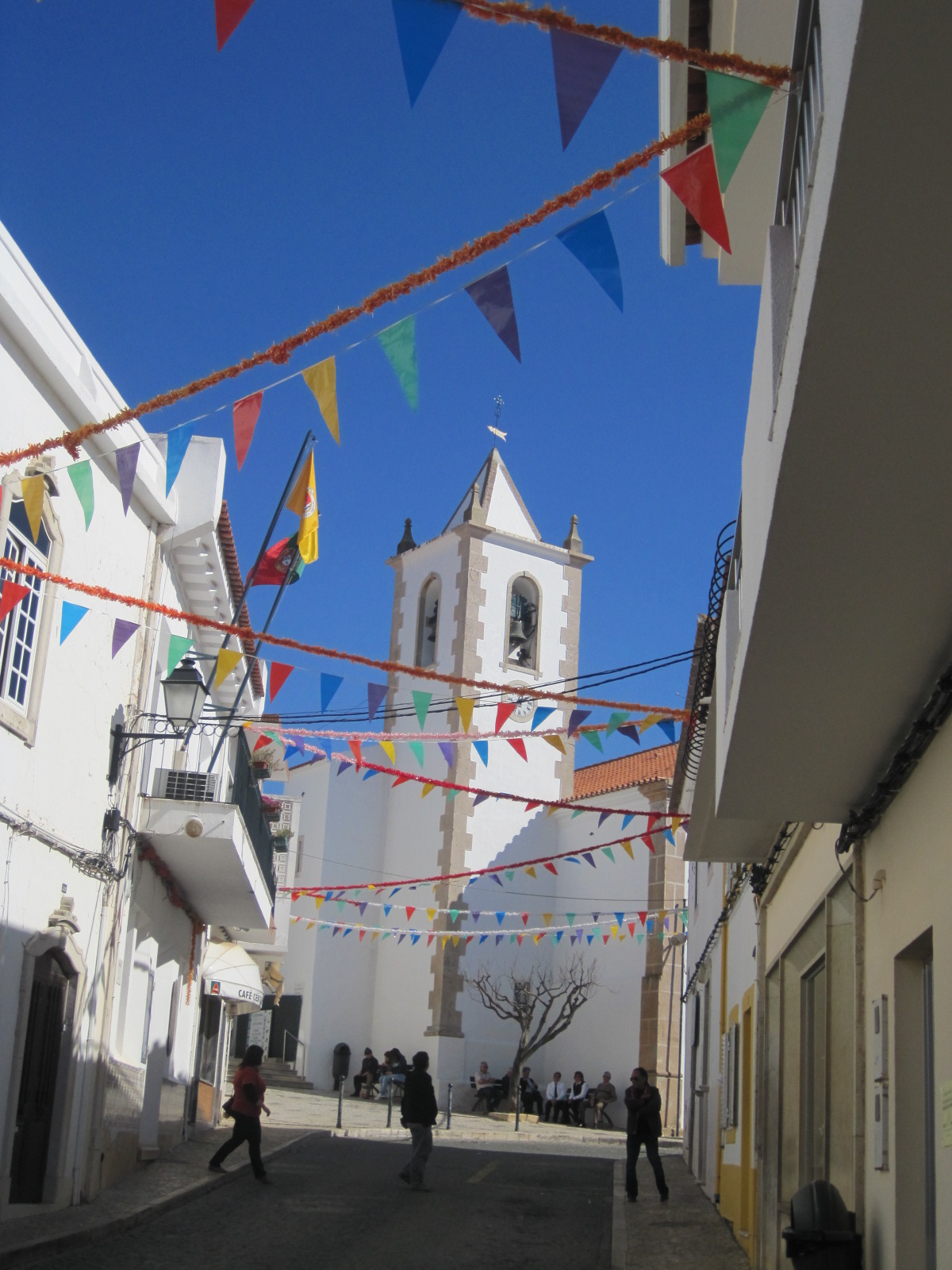
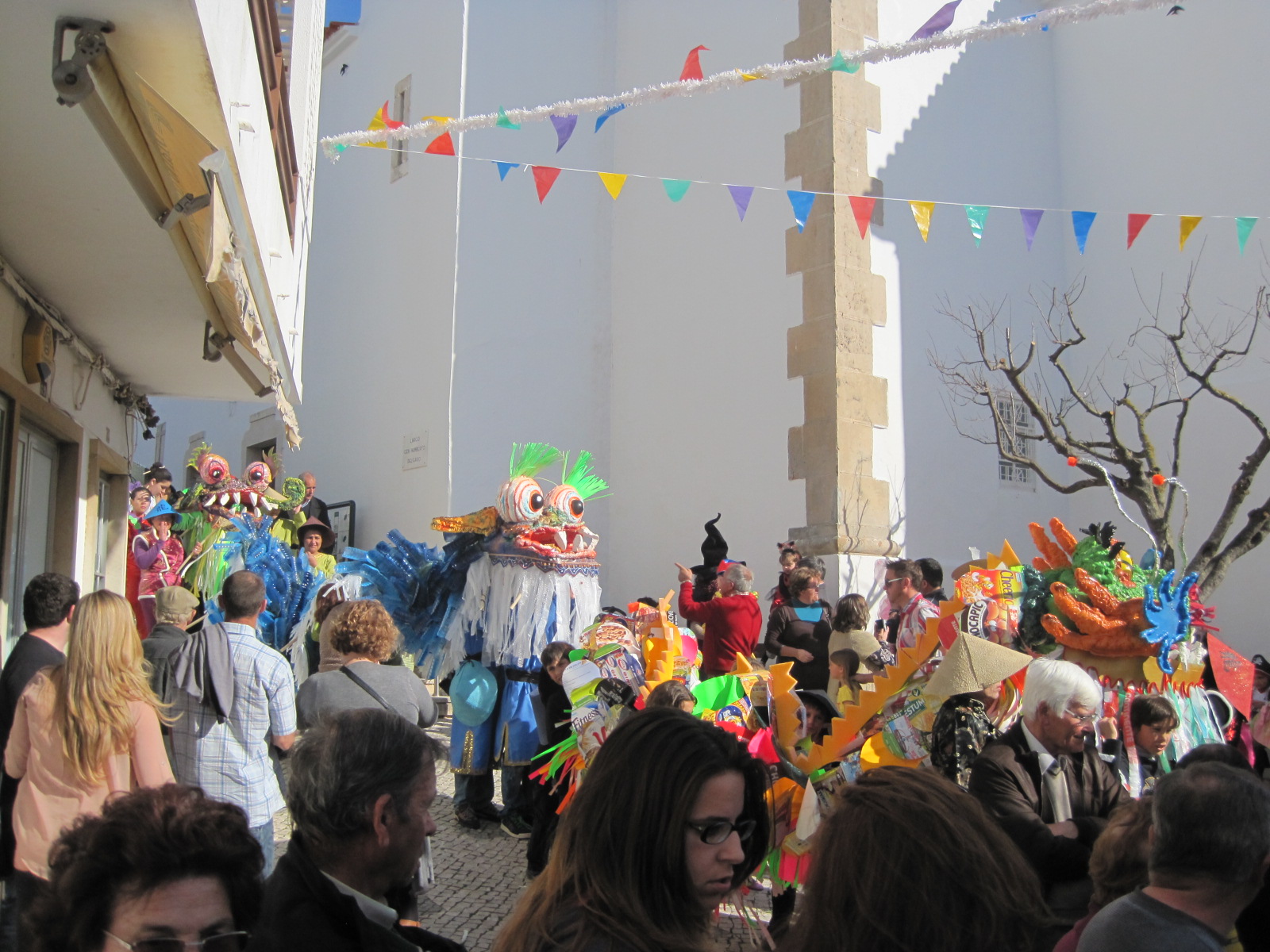
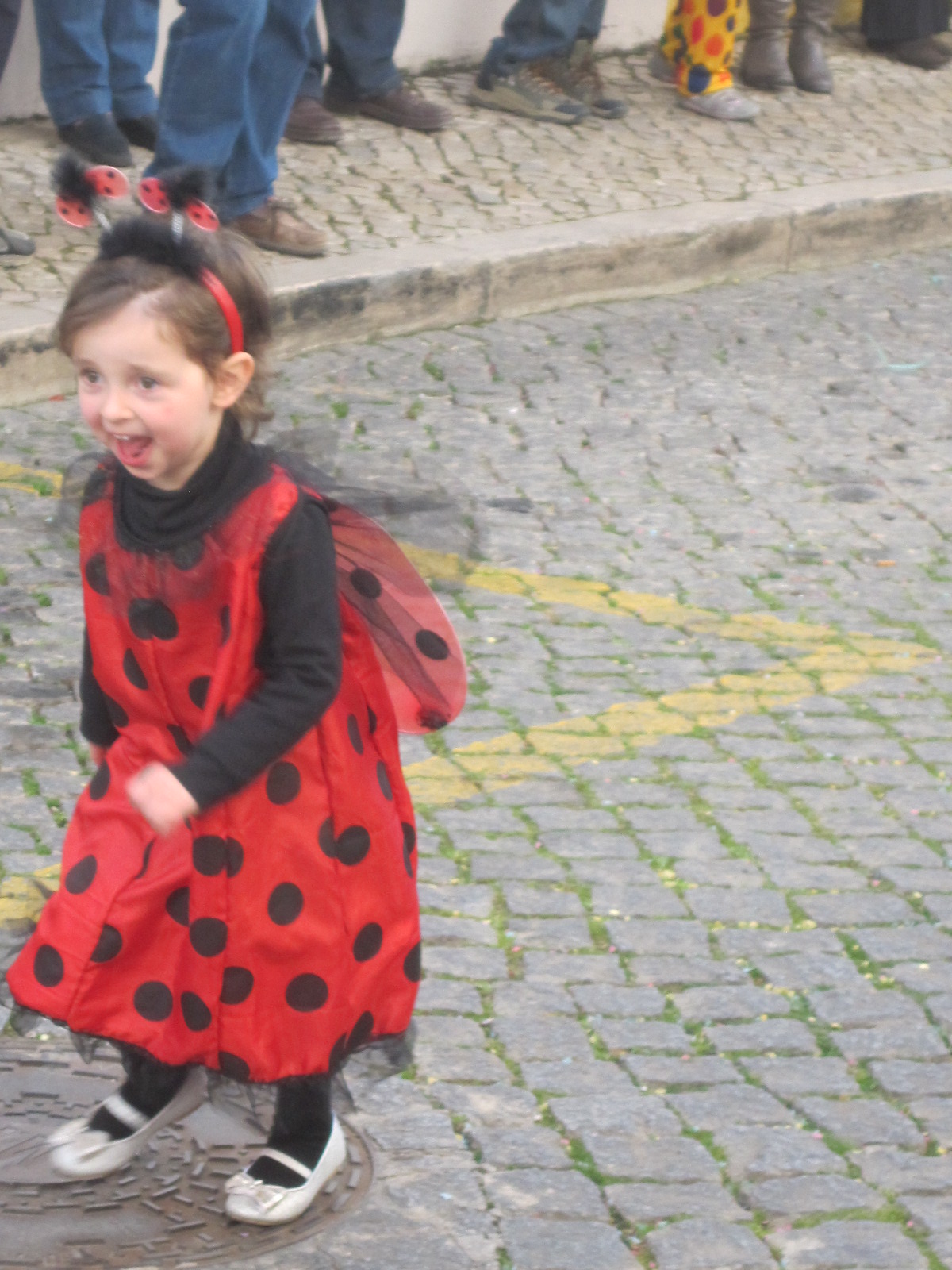
Paderne regularly fools us and this time was no different.  Apart from some streamers overhead there was little sign of life in the village so, assuming we’d got it wrong, we set off for a stroll in the sunshine, down to the Fonte, a rather intriguing spring.  Half an hour later the village had mobilised into action and suddenly we were in the thick of the preparations.  The excitement was tangible.  Mystified we retired to a tiny café where a captivating toddler, dressed as a fluffy yellow chicken, was passed around its adoring family.  When we poked our noses back out again the parade was about to begin.

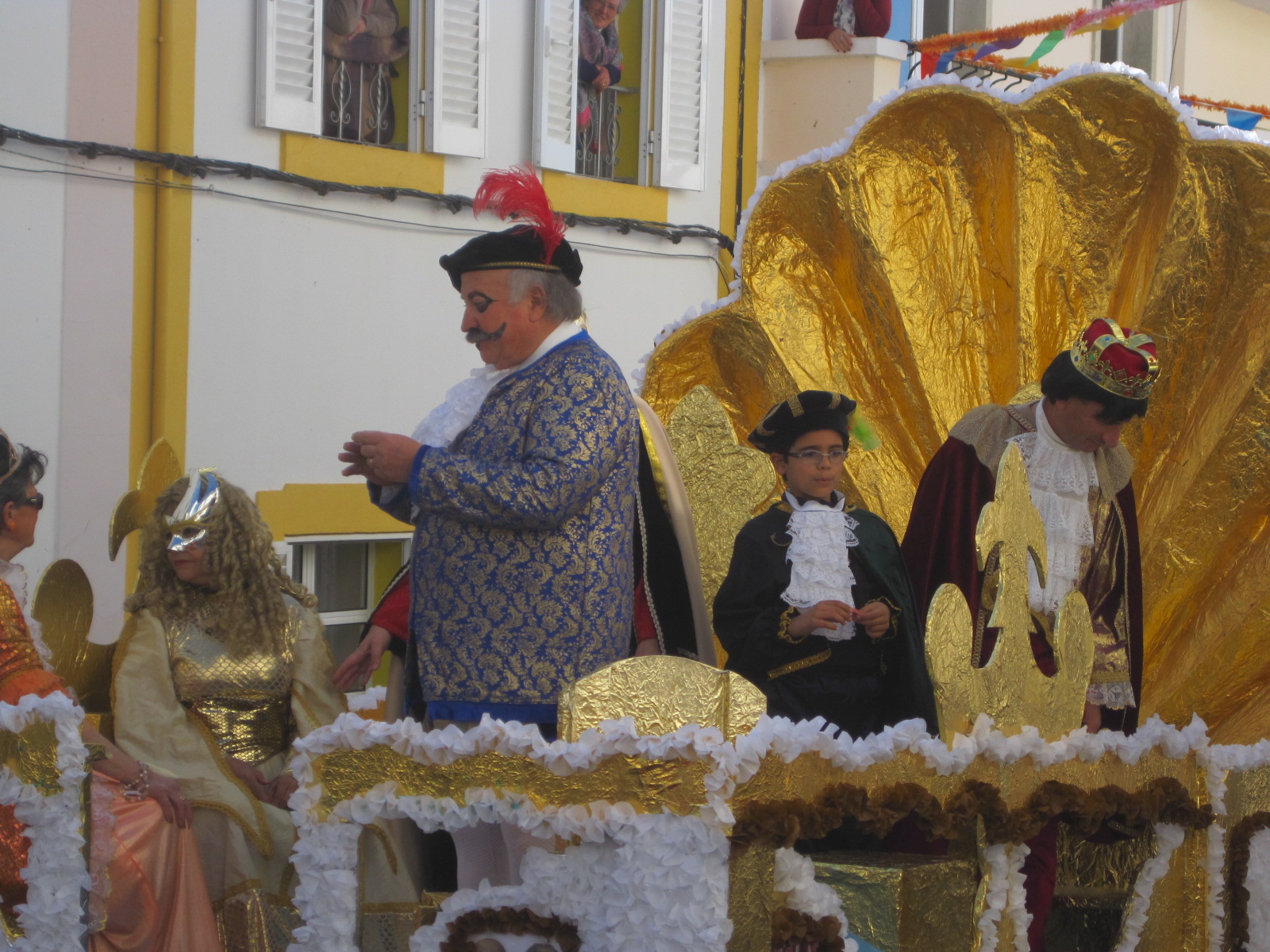
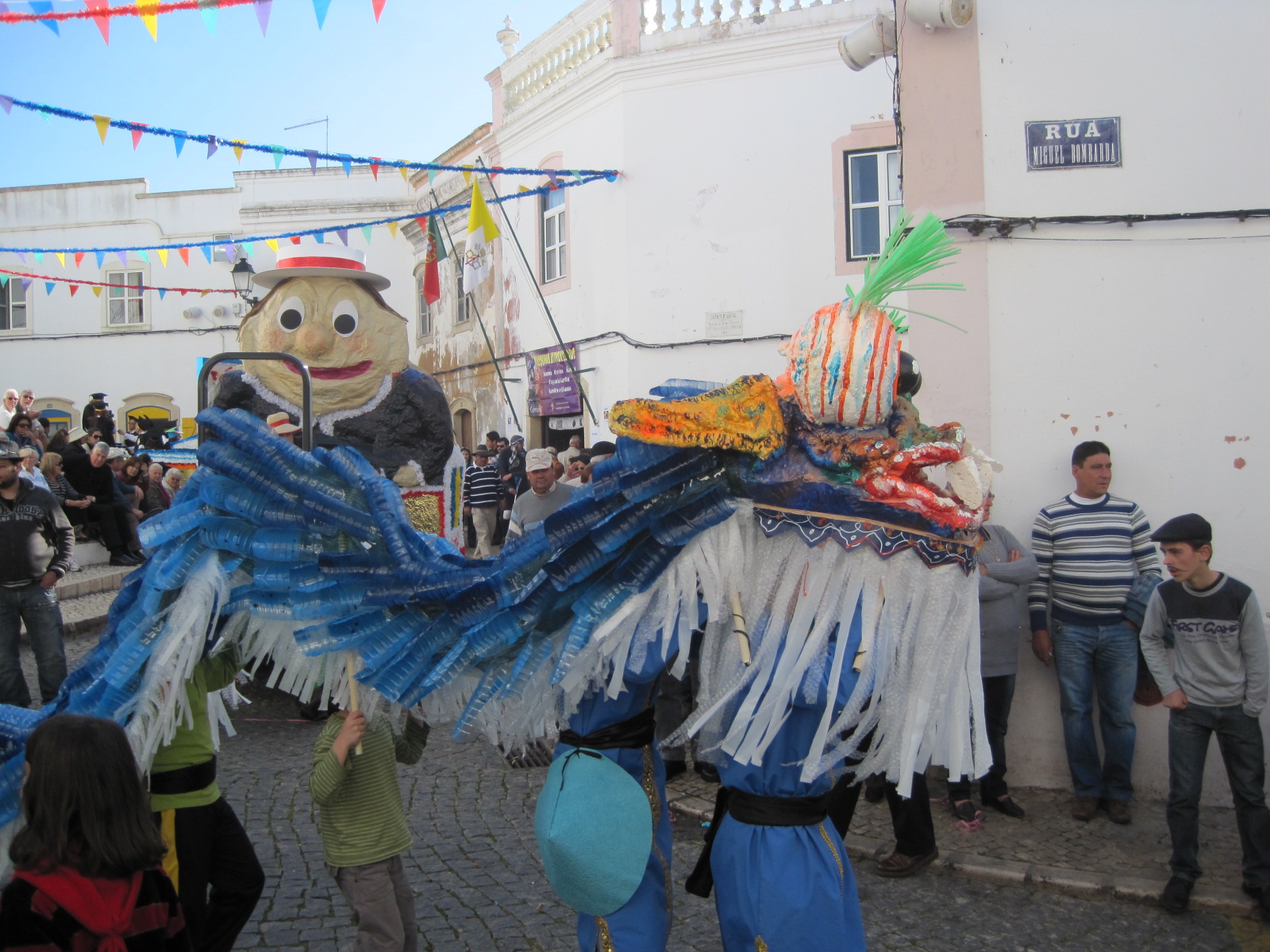
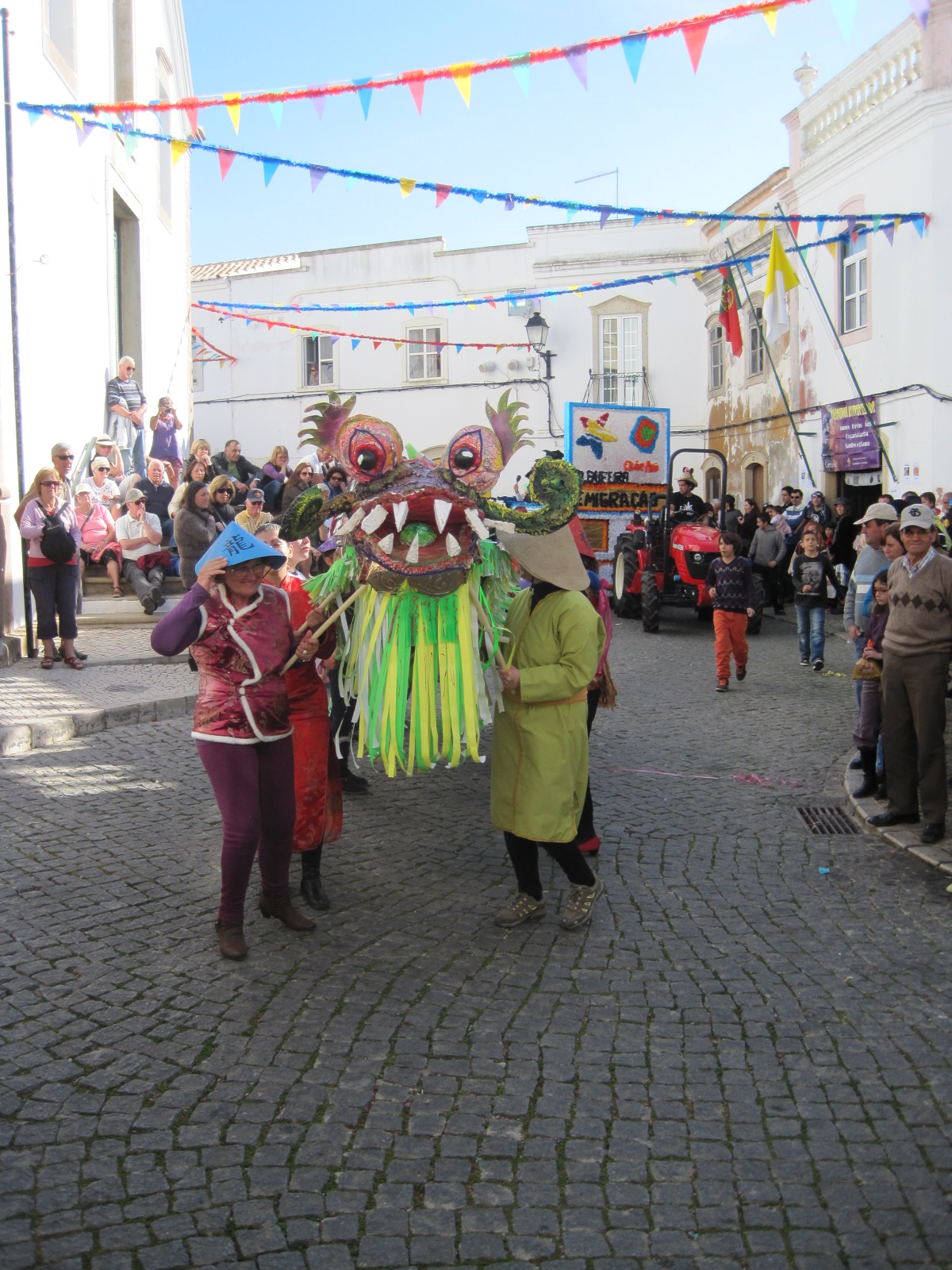
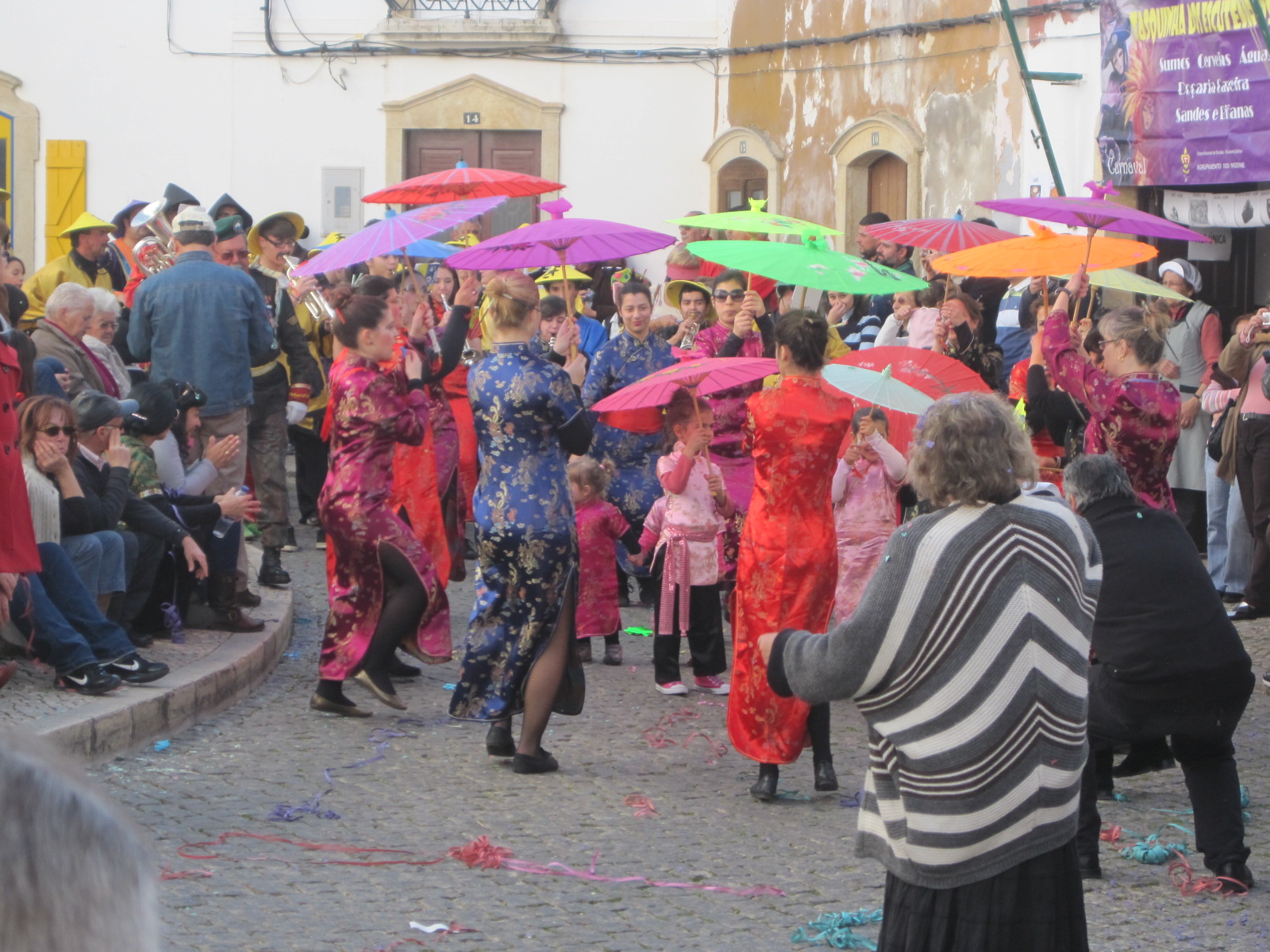
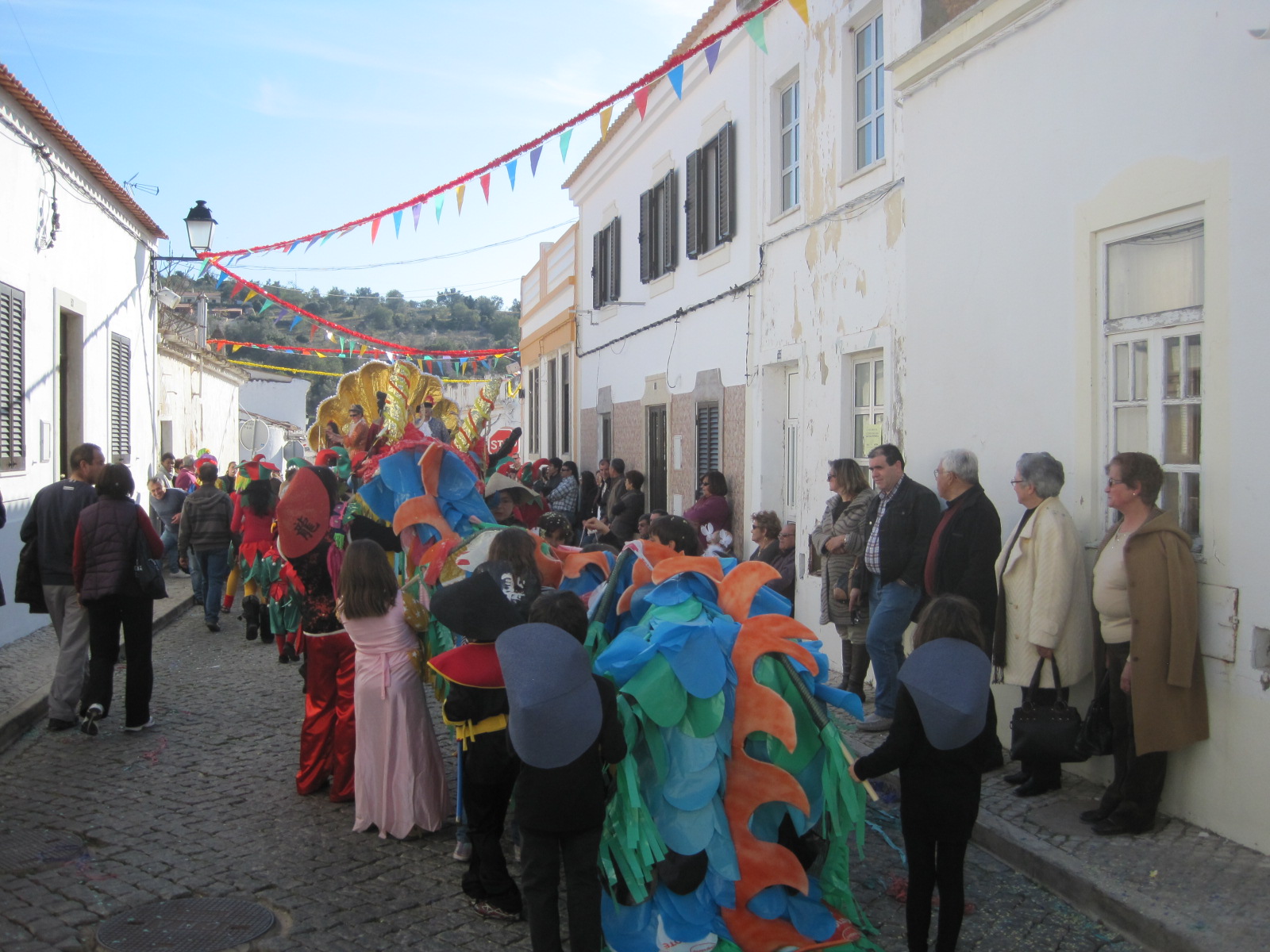
Although much smaller than its Loule counterpart, the procession was no less fun.  The setting was intimate, within just a few village streets, locals looking down from bedroom windows.  The lords and ladies mounted the floats and as they moved off four shimmering Chinese dragons manoeuvred into position.  I was delighted to observe that their scales had been constructed painstakingly from cartons.  The theme was Chinese business and a flutter of parasols and coolie hats took to the streets.

With enormous energy they paraded around and around, and as we made for home there were still queues at the kiosk.  We were left in no doubt that the Algarveans know how to party.

I’m entering this in the word a week photography challenge on celebrations as it just seems to fit so well.

D is for Douro

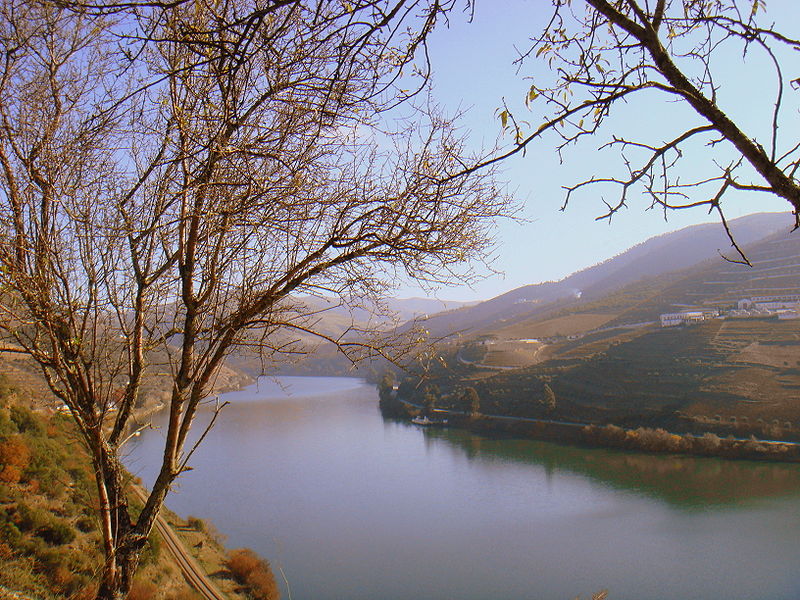
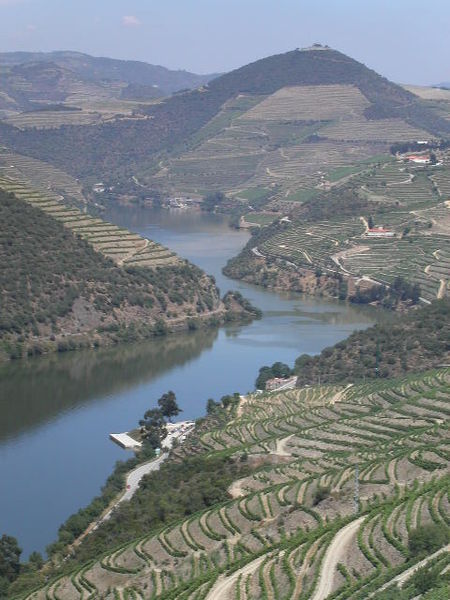
Rio Douro- the river of gold

This post is entirely aspirational.  I have long wanted to visit Porto and to cruise the Douro Valley.  So far we haven’t found a convenient flight from the UK and it’s quite a way north from the Algarve.  So permit me to dream a little.

Upper Douro by Gustavo Motta for Wikipedia

The River Douro rises in Spain and flows 897 km till it reaches the Atlantic at Porto.  Over 100 of these kilometres form the border with Spain in a series of narrow canyons- an effective barrier between two often warring nations.   The third largest river on the Iberian Peninsula, in recent times the river has been tamed by a series of locks and dams, making it navigable for all of its Portuguese length.  Looking down from the sky I always try to fathom whereabouts on the Douro we are crossing as we make our way back to Northern Europe.

Peso de Regua, by Husond for Wikipedia

The Douro is blessed with a microclimate which creates exceptional conditions for the cultivation of almonds, olives and grapes- in particular the variety of grape used in the production of port wine.  It’s no secret that I love to sit by the banks of a river with a glass or two of port.  Hopefully one day that river will be the Douro.   The region around Pinhao and Sao Joao de Pesquiera is known as vinhateiro, the centre of this liquid gold, and the quintas lining the riverbanks testify to the success of the enterprise.

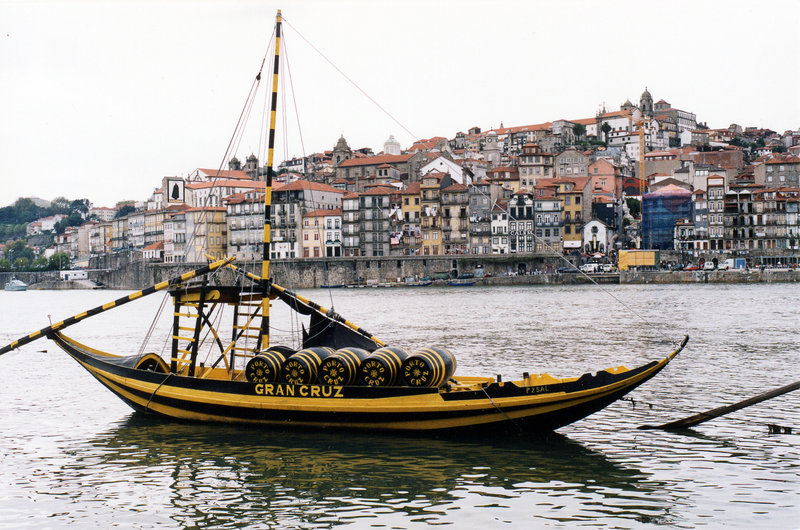
Barco rabelo by Thomas Seibel for Wikipedia

Traditionally the wine was transported down the river in flat-bottomed sailboats called barcos rabelos , some of which can still be seen today at the quayside in Vila Nova de Gaia, opposite Porto.  It was stored in oak barrels to mature in the cellars of numerous wine lodges.  After blending it would be bottled then stored again till reaching the level of maturation for that particular brand.  Names like Sandemans, Cockburns and Taylors are familiar friends.

A story goes that port was originally discovered by two English gentlemen, staying at a monastery in the Upper Douro.  They found that by adding a little brandy to the local sweet wine it would be better fortified to withstand the long sea journey home.  More probably, following a period of exceptionally warm weather in 1820 unusually sweet grapes were produced which was much to the taste of the British.  In order to capitalise on the British market the wine companies added aguardente or brandy to stop fermentation and fix the sugar content.

Vinhateiro

How am I going to get around so that I see the Douro from every angle?  There seem to be lots of choices.  One thing’s for sure, I will be visiting Sao Bento railway station in Porto, not just to see its magnificent azulejo tiles but to travel up the valley.  If I’m lucky I may even catch the Saturday steam train (May to October).  I know that the colour of the vines in Autumn is a spectacular red-gold, and that white blossom clothes the valley in Spring.

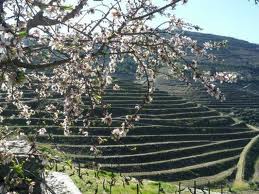
Blossom time in the Douro

The Dom Luis 1 Bridge leads over the river and into Vila Nova de Gaia and from here you can take a 50 minute trip beneath the bridges to admire Porto’s skyline.  This is just a taster.  The true beauty of the Douro reveals itself on a lengthier cruise up river.  How far you choose to go depends on how long you have available, and your tolerance for messing about in boats.  Mine is infinite, but if you’ve just come for peace and quiet you’ll be perfectly happy with a good book and the gentle slap of the water.

Vila Nova da Gaia,seen from Porto,by Jonik for Wikipedia

My impression is that the further you go up the river the wilder the scenery becomes, east of Pinhao with its beautiful railway station, the most spectacular.  I’m looking forward to the deep locks that have calmed the raging rapids.  You can combine a cruise with train journey for the best of all possible worlds, or to help shorten your trip. Peso de Regua is the collection point for the wine and from which it used to be shipped down river.  Less romantically these days transport is by tanker, but you can still see the sailboats in action at Porto on 24th June, the festival of Sao Joao.

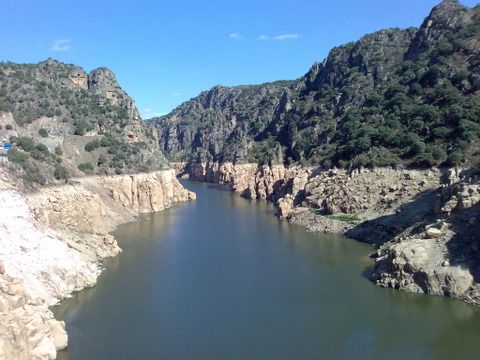
The Douro, near Miranda, from Wikipedia

You can drive up the valley for fine views but this is never much fun for the driver.  The train runs beside the Douro from Regua out towards the Spanish border, passing Pinhao and then crossing to the opposite bank all the way to Barca de Alva at the Spanish border.

Of course, you can also do the 5 star cruise from Porto all the way across into Spain, and take in the historic city of Salamanca.  This isn’t really my way (too easy! says husband Michael- and certainly not cheap).  I just know I’d want to linger somewhere that the boat didn’t, but I did say that I could dream and Salamanca does sound tempting.  Maybe for a special birthday?

http://www.portugaltravelguide.com/en/pinhao.htm will give you a flavour of the area.  Be sure to check out Amarante and Mesao Frio as well as Regua and Pinhao.

www.cp.pt/StaticFiles/CP/Imagens/PDF/Passageiros/horarios/regional/porto_regua_pocinho.pdf  provides basic rail information but you need to seek further for the steam train.  Now I’ve completed this I can’t wait to book!

My previous A-Z s of Portugal are:

a-is-for-alte/

b-is-for-beaches/

c-is-for-cacela-velha/

C is for Cacela Velha

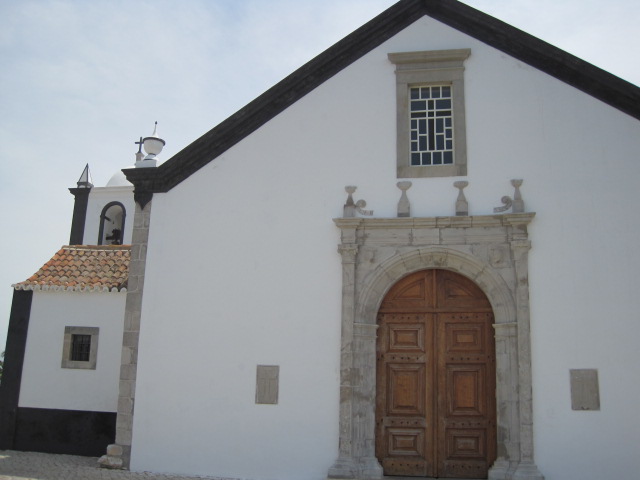
There are far more important C’s in all of Portugal than this tiny smudge on the map.  There’s Coimbra, Castelo Branco, or even famous Cascais on Lisbon’s doorstep.  I’d love to visit all of them, but for me this personal C has to be about Cacela Velha (Old Cacela).

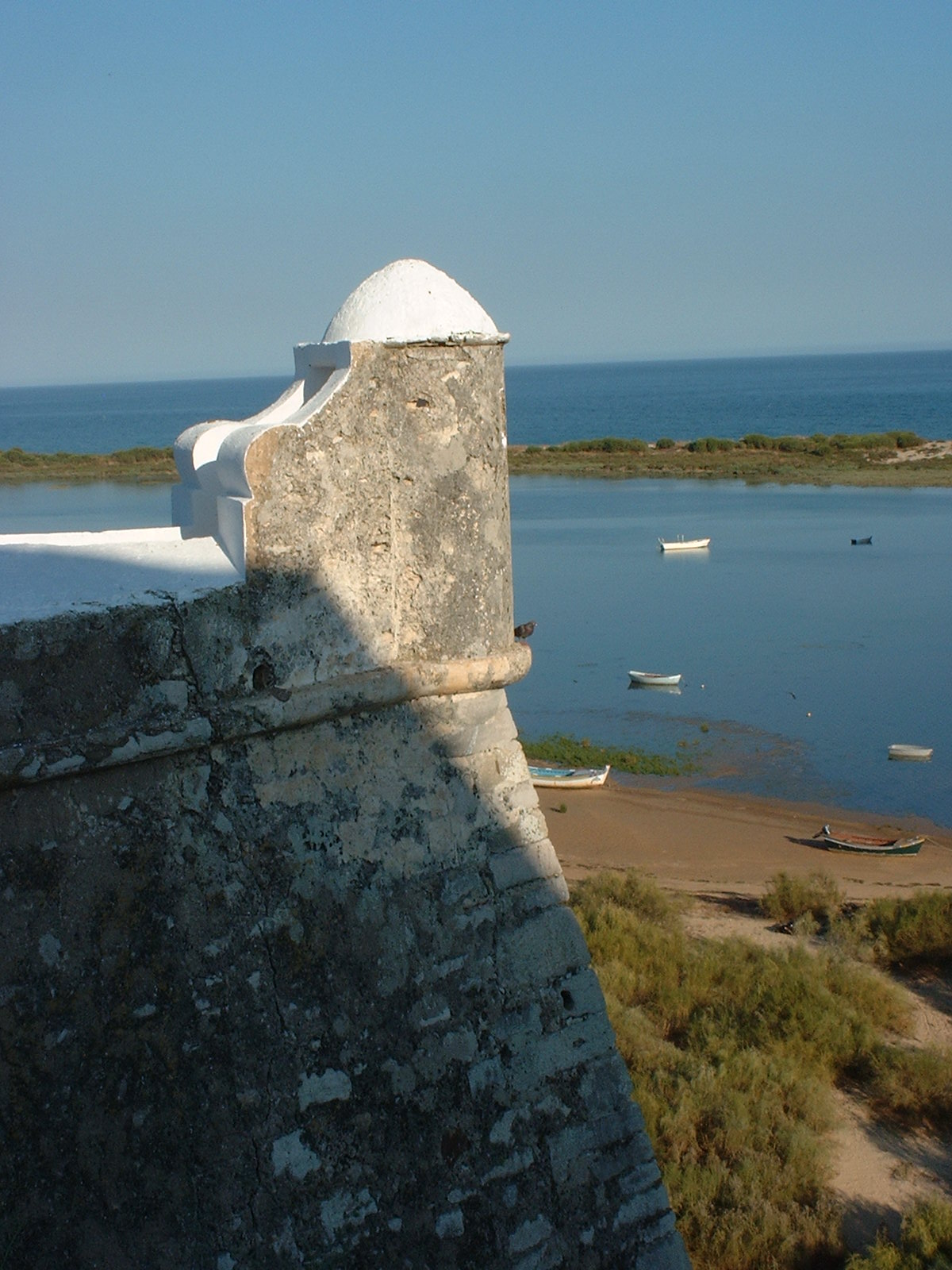
The fortress, Cacela Velha

How does a tiny village on the cliff edge of the Algarve, Portugal’s most touristy spot, cling on to the old days and keep faith with its roots?  I’m not sure that it can be done.

When we first came to the Algarve 8 years ago I had been avidly reading any and every book I could find to seek out the best places to visit.  The Rough Guide mentioned Cacela Velha, saying I should get there quickly before it was completely ruined.  I needed no second invitation.

The location has certainly helped to keep Cacela Velha unspoiled,although the bulldozers lumber not too far away.  The nearest bus stop is on the E125, the old road along the Algarve, and a couple of kilometres walk along a twisting narrow road.  In this era of the car that is very little deterrent.  It sits above a beach which by Algarve standards is woeful.  Still you only have to see it to fall in love.  It is a photographer’s dream.

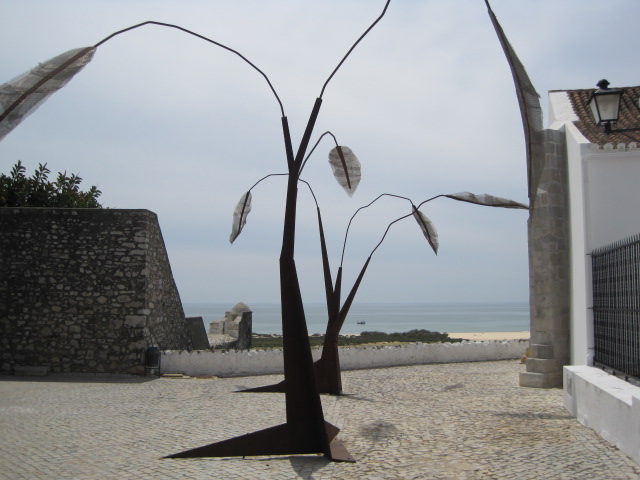
There is now proper parking where once there was scrubby grass, and a piece of “modern art” has appeared in the little square beside the castle walls.  I can live with this, but please, that’s enough!  It doesn’t need “fancification”.  It is truly beautiful in its own right.

New car park above and “artwork” below

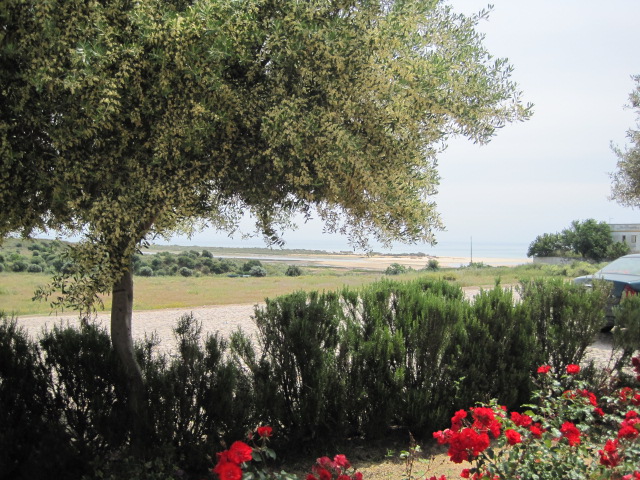
On a grey January English morning, I can picture it so vividly and feel the peace and calm of my first visit.  Just a church on a headland and the remains of a fortress- I suppose Praia da Rocha must have been like this once, though it’s hard to imagine.  A huddle of cottages snooze sleepily together, cats seeming to outnumber people.  An old well is the focal point of the village square, the church and cemetery majestically off to one side.  The magic is there already, but when you follow the path behind the church the vista that awaits you is spectacular.

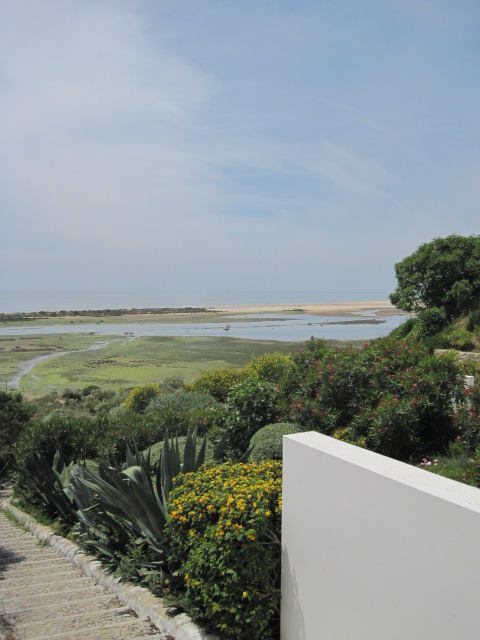
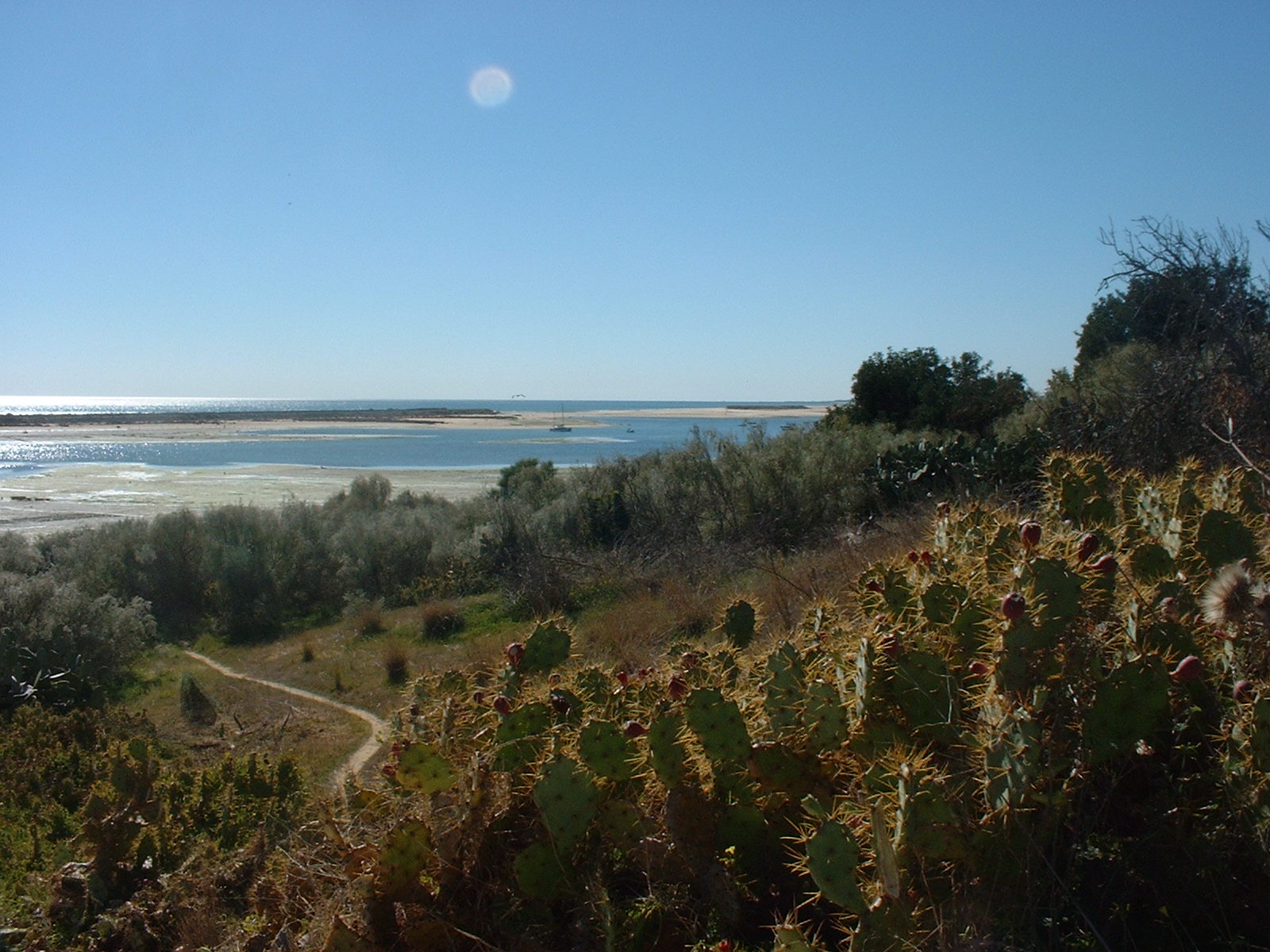
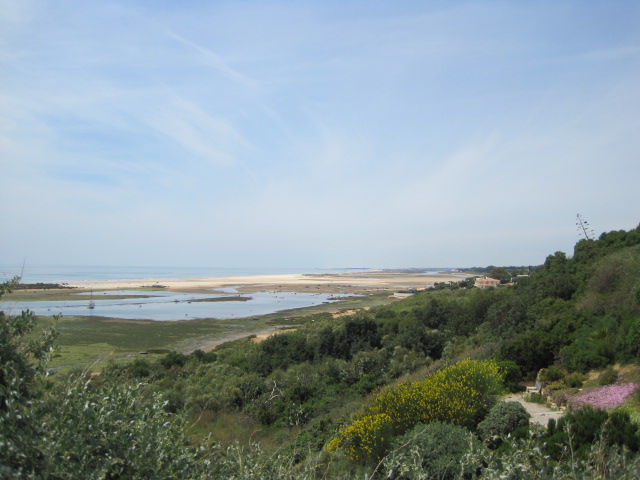
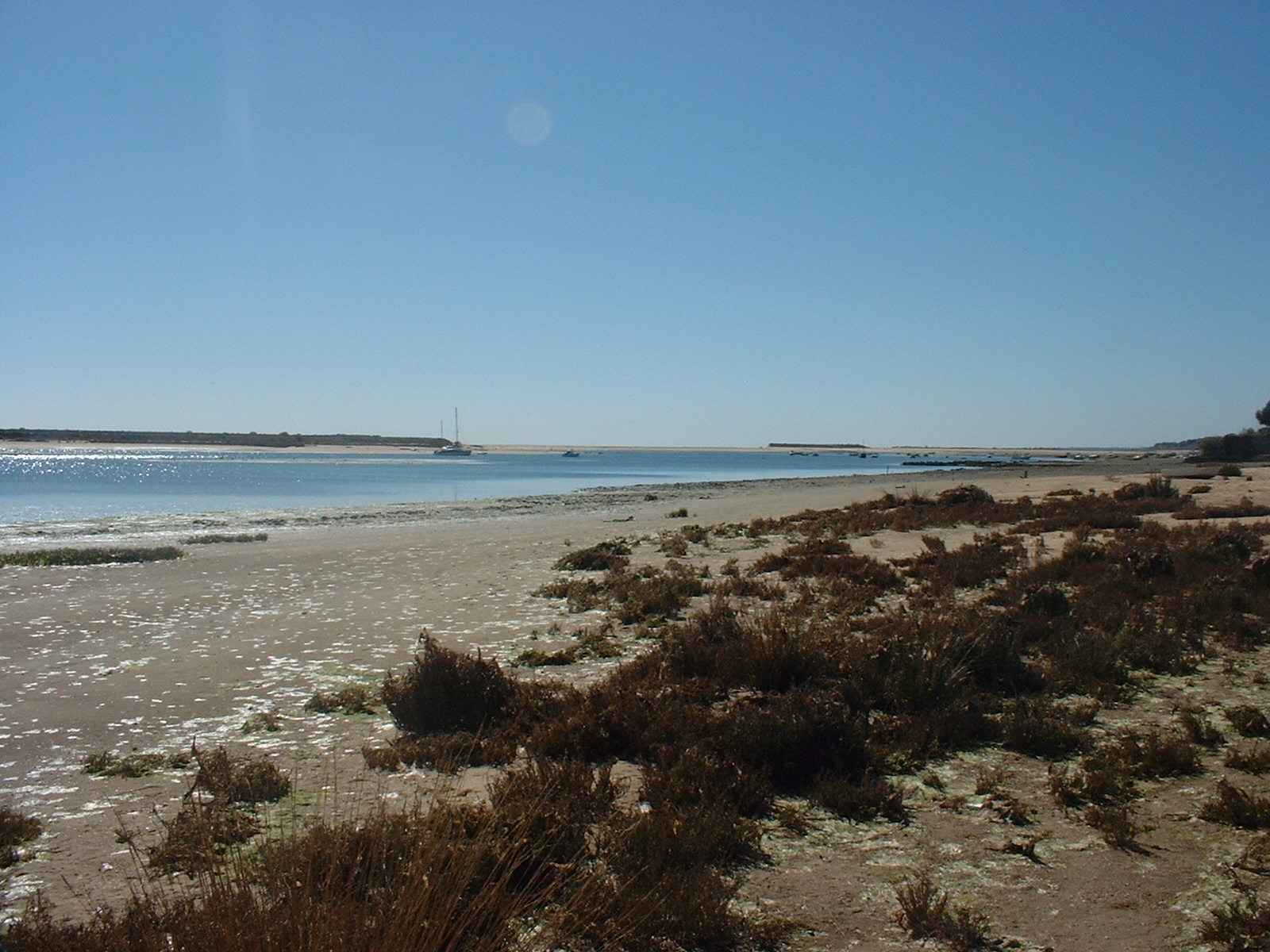
The shimmer of the water as it laps lazily at each sandspit stretches far into the distance, where sky meets sea.  A patchwork of gold and blue and green, I said that the beach is woeful but at this height it’s hard to tell.  You may be lured down the steps for a closer look and to take some photos from a different angle.  I can feel the photographers among you twitching to be there.

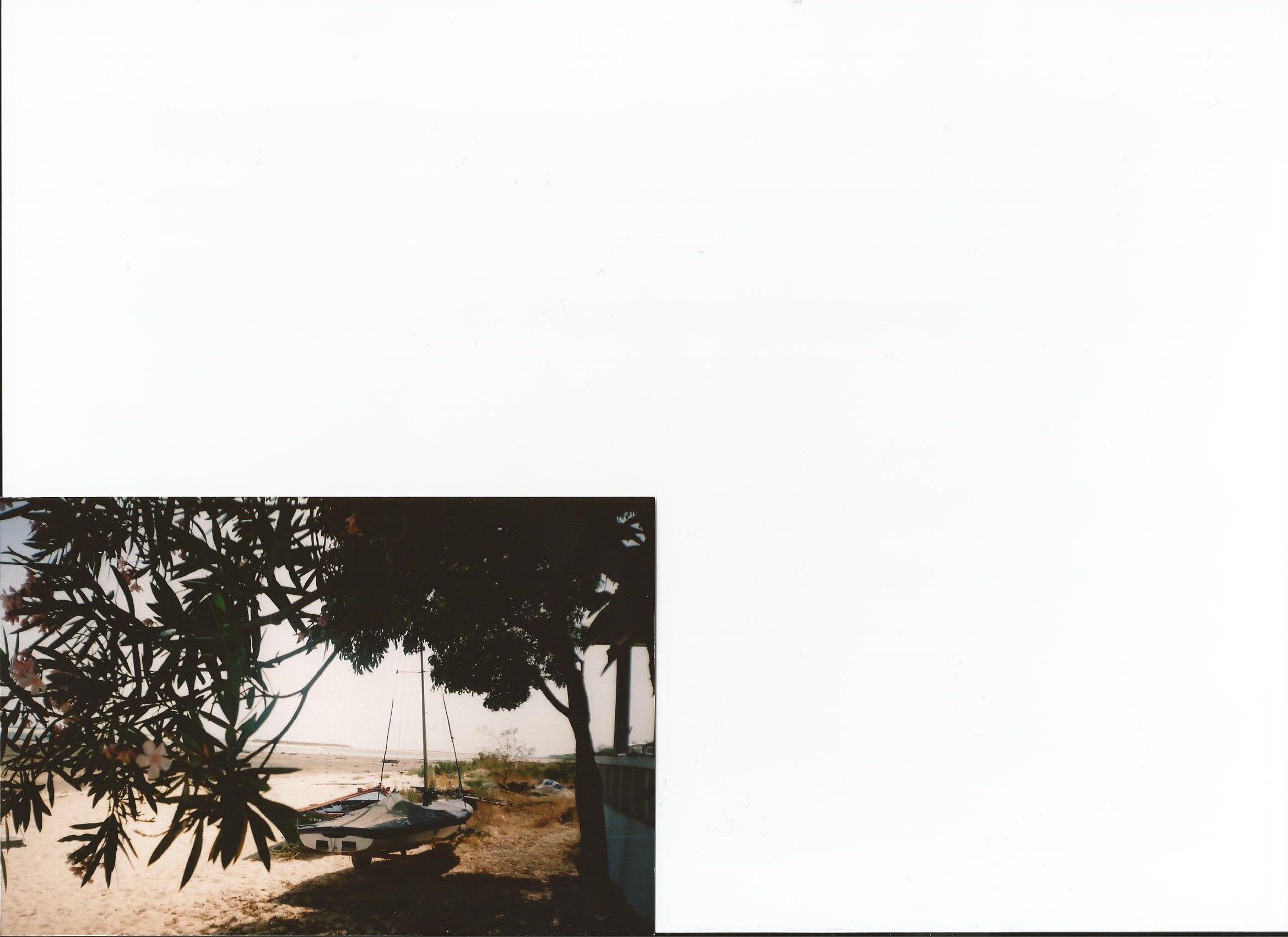
The beach isn’t up to much because it’s far back from the sea and you need to ferry across to Praia de Cabanas for the real thing.  I’ve never actually accomplished this as you need to catch the ferry from nearby Fabrica and parking there is increasingly difficult.  In any case, I’ve never needed to as I can more easily reach superb Cabanas beach from Cabanas itself.  If I then walk and walk and walk along the beach, in the direction of Spain, I come to a channel of water across which I can just make out the church, with fortress beyond, perched up on its cliff top.

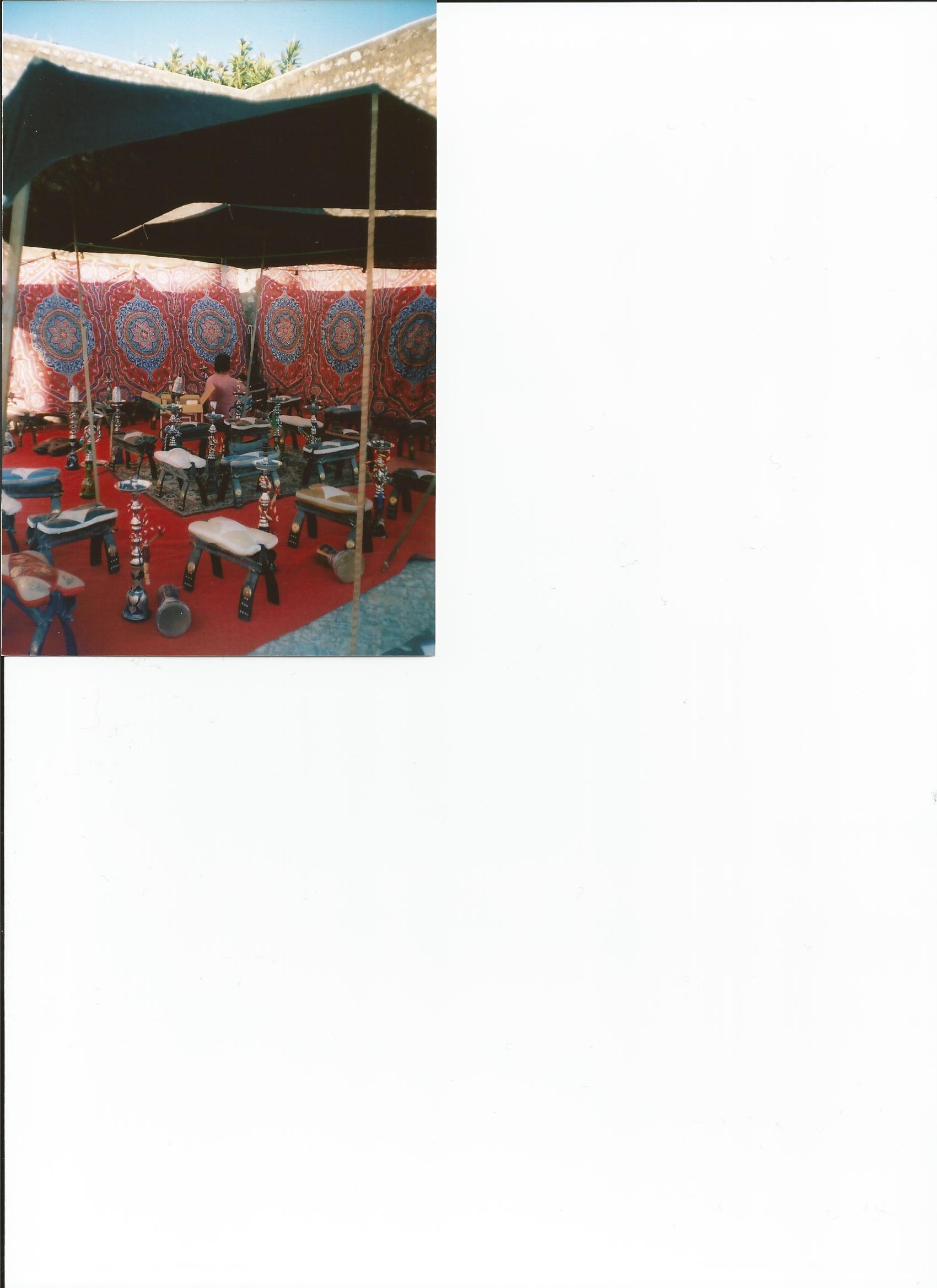
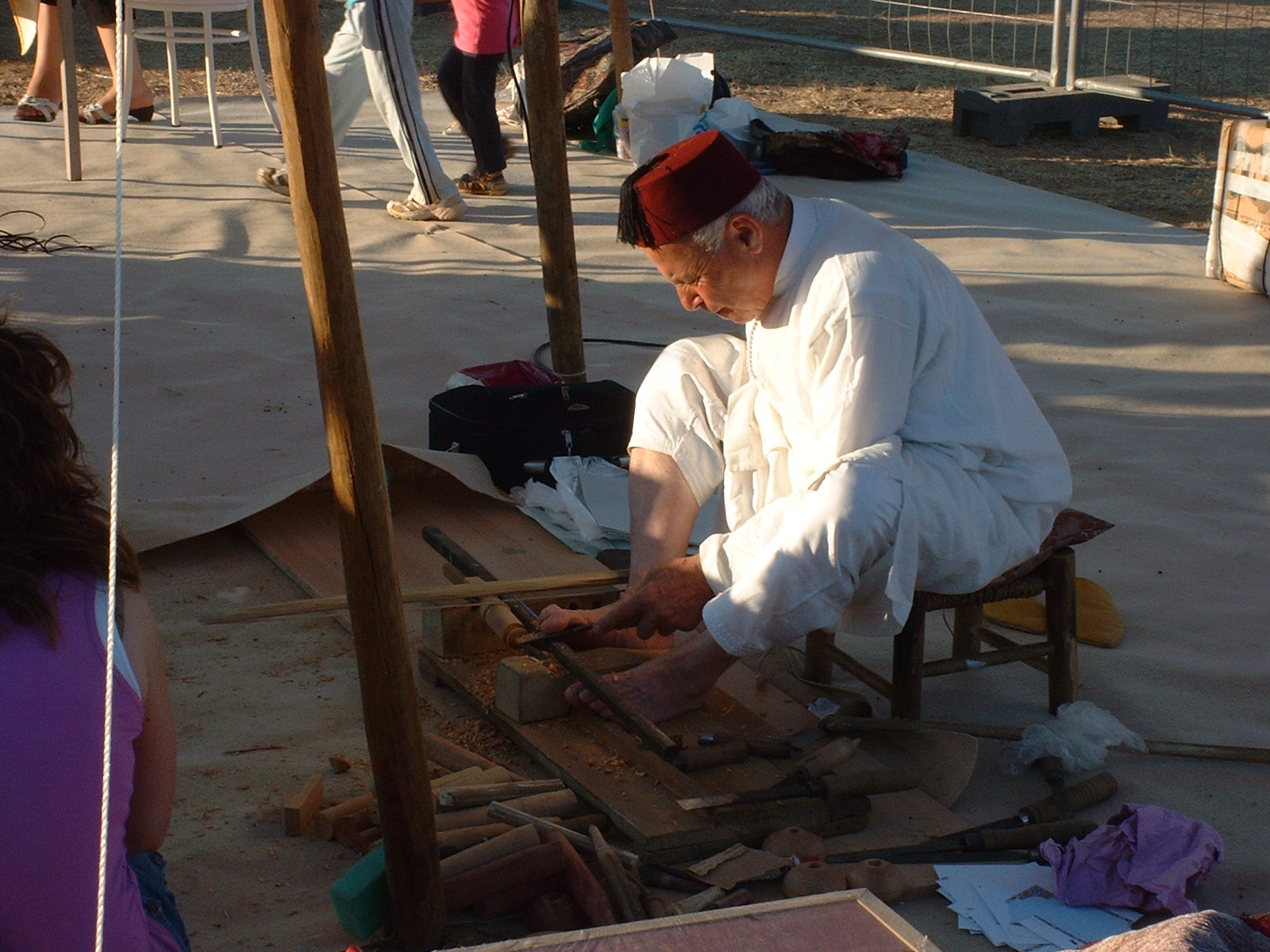
Cacela Velha was a stopover for traders in Phoenician times and in the 10th century was, in Arabic, Medina Qast’alla Daraj, so perhaps it is not surprising that the village comes alive in July to the Festival of Enchanted Nights, Noites da Moura Encantada.  Suddenly the place is transformed and vibrating with life.  Stalls full of trinkets, oriental lamps and elaborate mosaic tables fill the tiny square and spill over into the car park.  Stools, cushions, Berber rugs and hookahs appear, and mint tea is brewed, with an array of tantalising sweets and savouries.  Bizarre but somehow not really out of place, a belly dancer gyrates beneath the fortress walls.  Oriental music and aromas drift around the narrow corners.  A camel paws the ground, while a craftsman demonstrates with his wooden lathe.

But mostly the village is its peaceful self, and happy to be so.  The fortress which once warned of invaders from the sea is now home to the local branch of the National Guard.  A couple of restaurants have come and gone, and currently Casa Velha enjoys good popularity. Despite the proximity of two golf courses, Quinta da Ria and Quinta da Cima, the protection afforded by the conservation status of the Ria Formosa is holding back the tide.  Long may it continue to do so.

So that’s my ‘C’.  Just need to link to Julie Dawn Fox’s hubsite.  You coming along on the A-Z challenge?

A is for Alte

Why Alte?  It wasn’t an easy decision because here in the Algarve I also love the border town of Alcoutim, pretty Alvor with its wide estuary, and the lovely island of Armona.  I expect we’ll visit them later in this A-Z.  I’ll sneak them in somewhere.

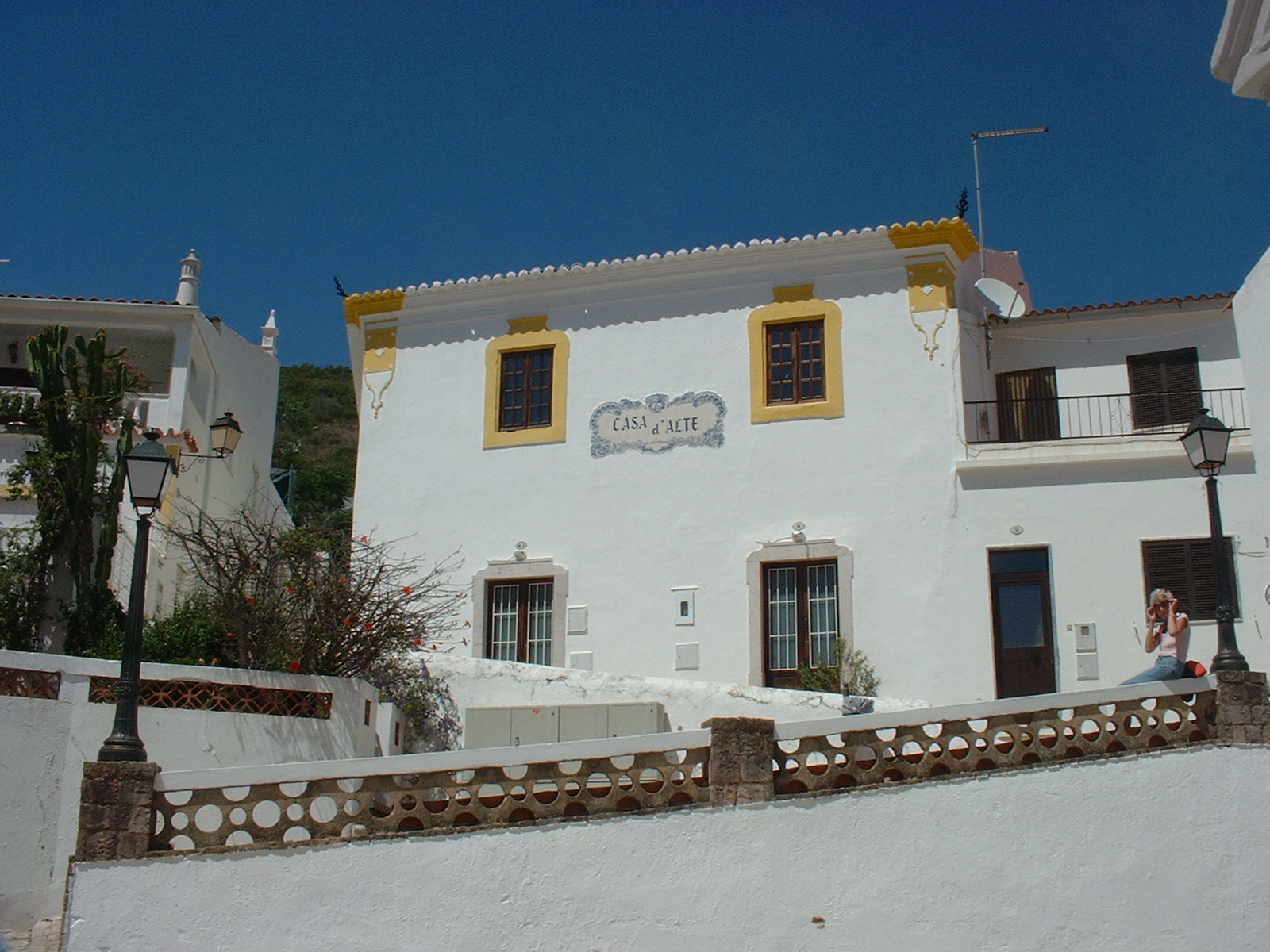
Casa d’Alte- sounds like home?

The images that you see everywhere of the Algarve are beaches (of course!), and golf courses, but there’s so much more to the Algarve.  Alte represents that other Algarve- the world away from the coasts, with natural springs and lush greenery.  I’ve heard Alte described as the prettiest village in the Algarve, and I wouldn’t disagree.

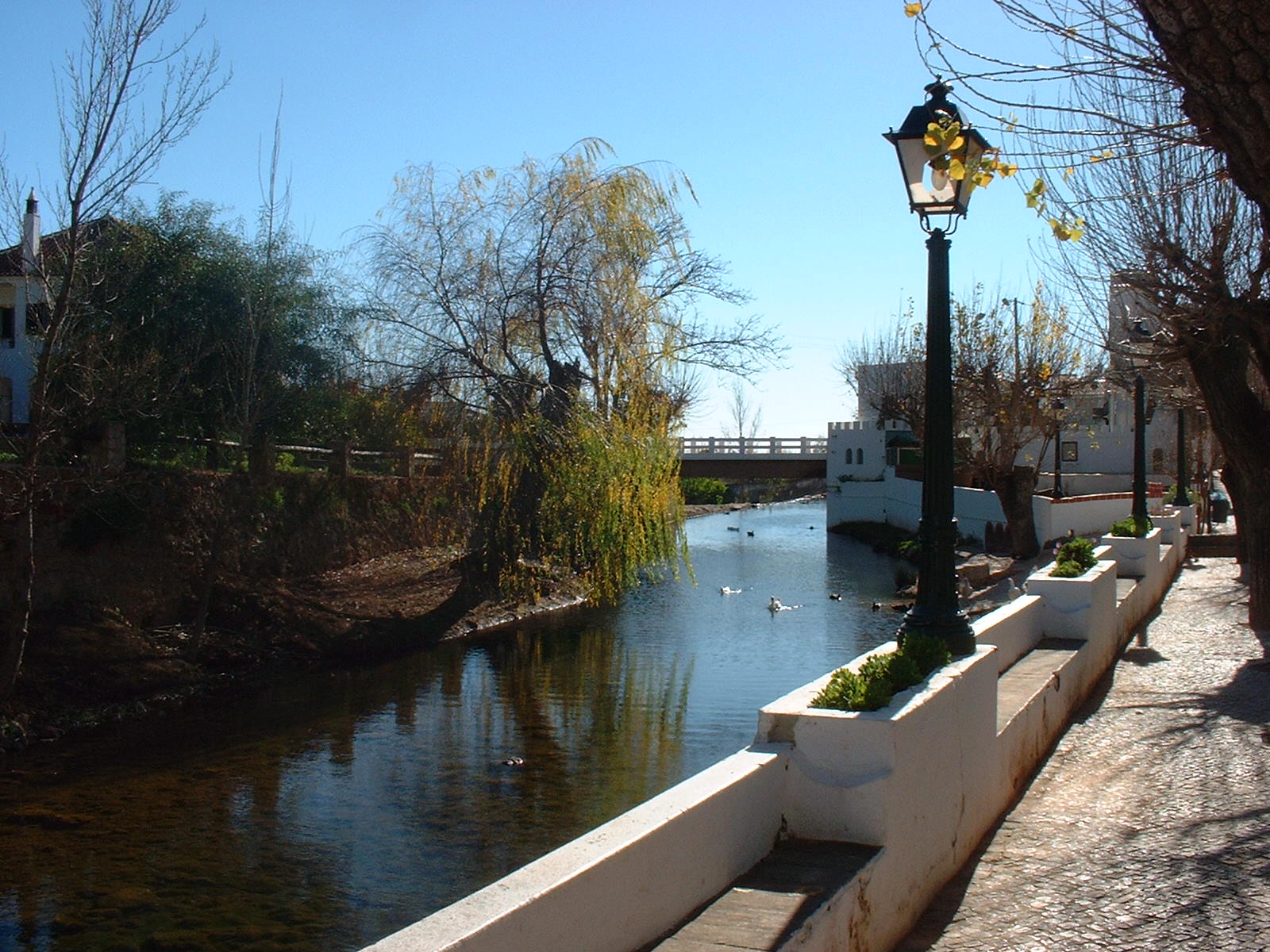
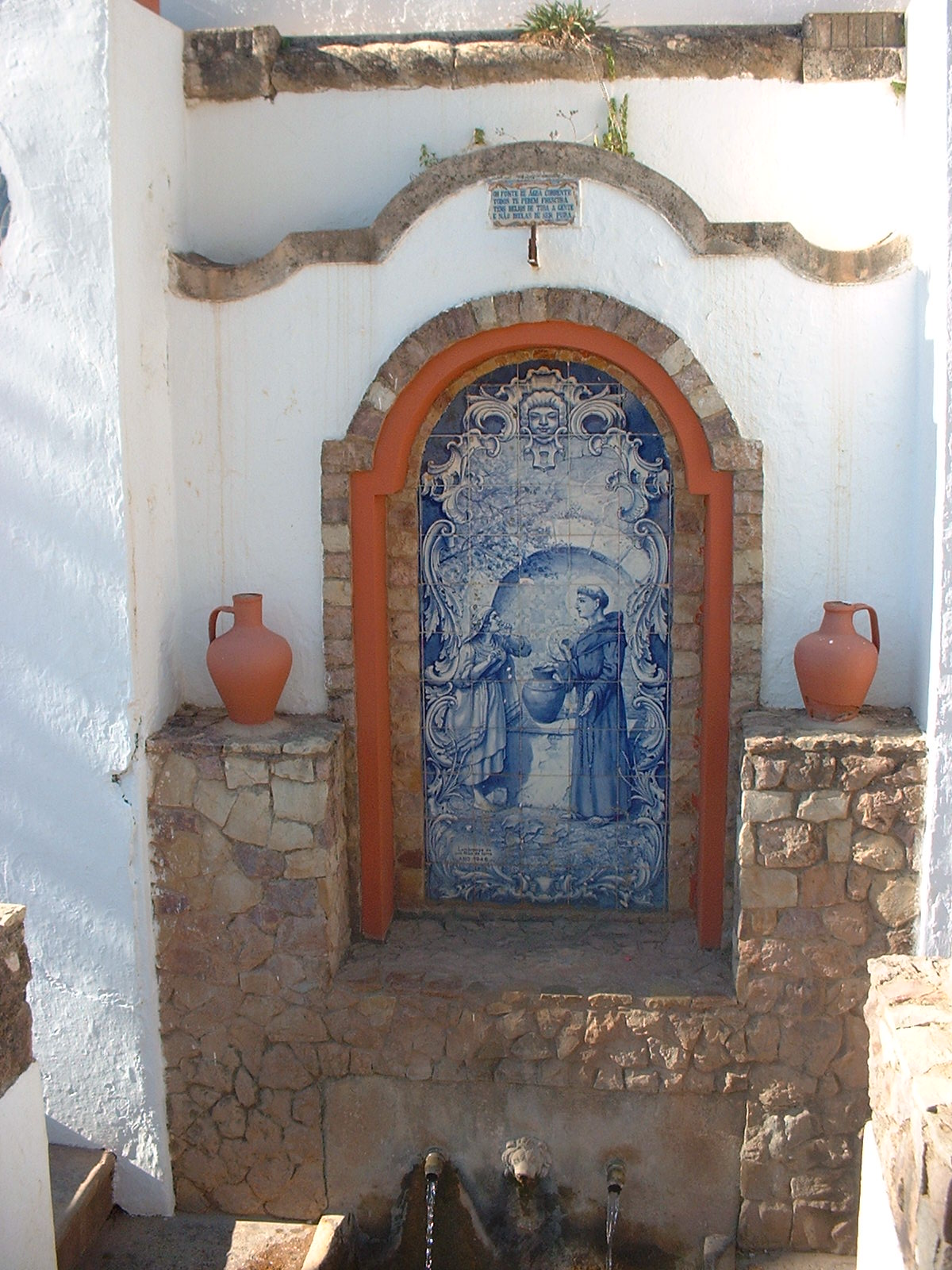
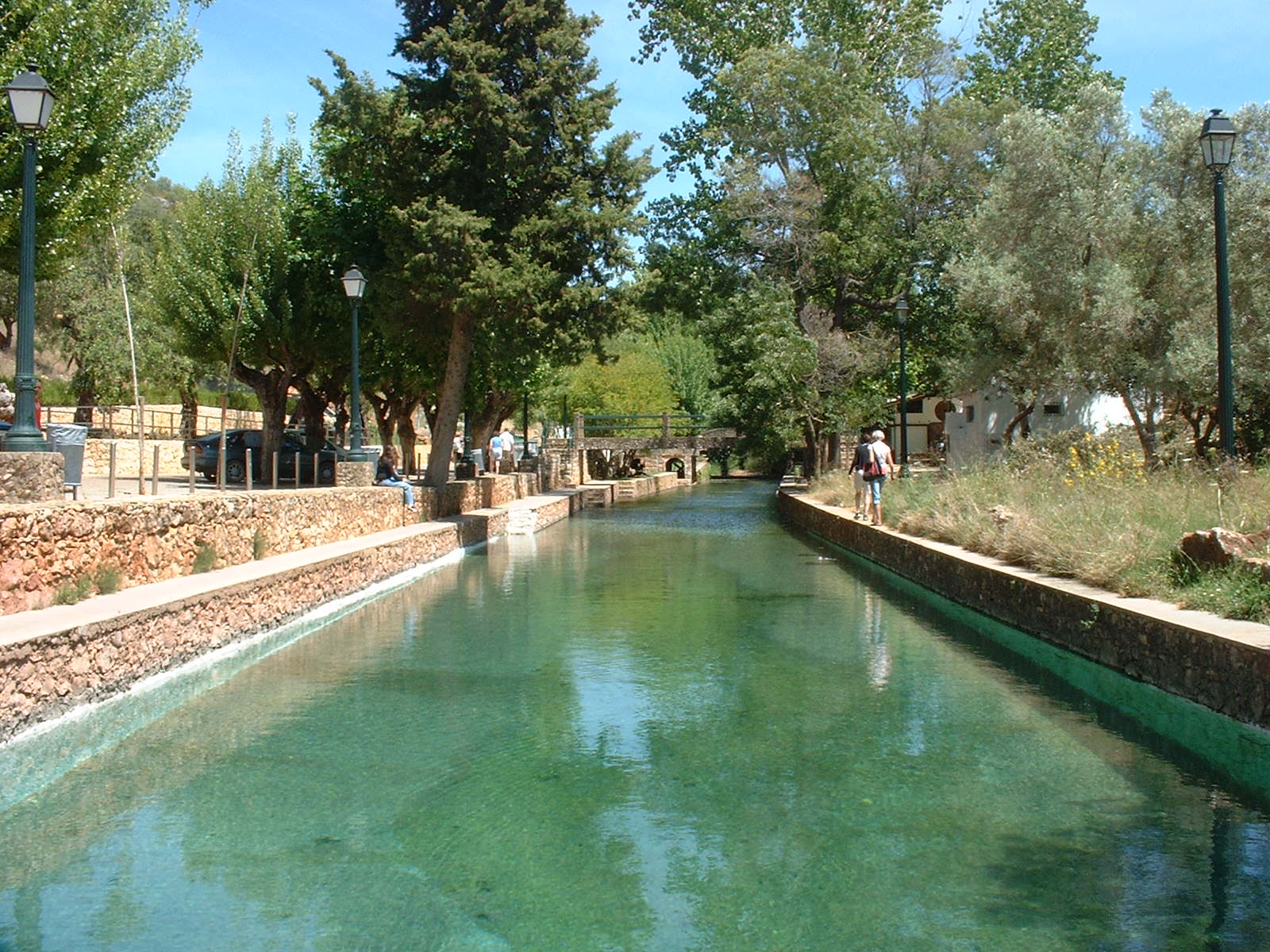
We first passed through en route for Monchique 7 years ago, and were charmed by the place.  Coming from the Eastern Algarve we had taken the scenic route along the N124, passing pretty Salir, the endless cork trees and imposing Rocha de Pena.  We were in search of the natural springs that we’d heard about, with very little idea of what that would entail.  On that occasion we saw just a fraction, but the idyll of ducks beneath the bridge, and the azulejo tiled pictures at Fonte Pequena (little spring) delighted us.  The gardens and nearby Fonte Pequena Inn are dedicated to local poet, Candido Guerreiro, whose work is displayed by the springs.

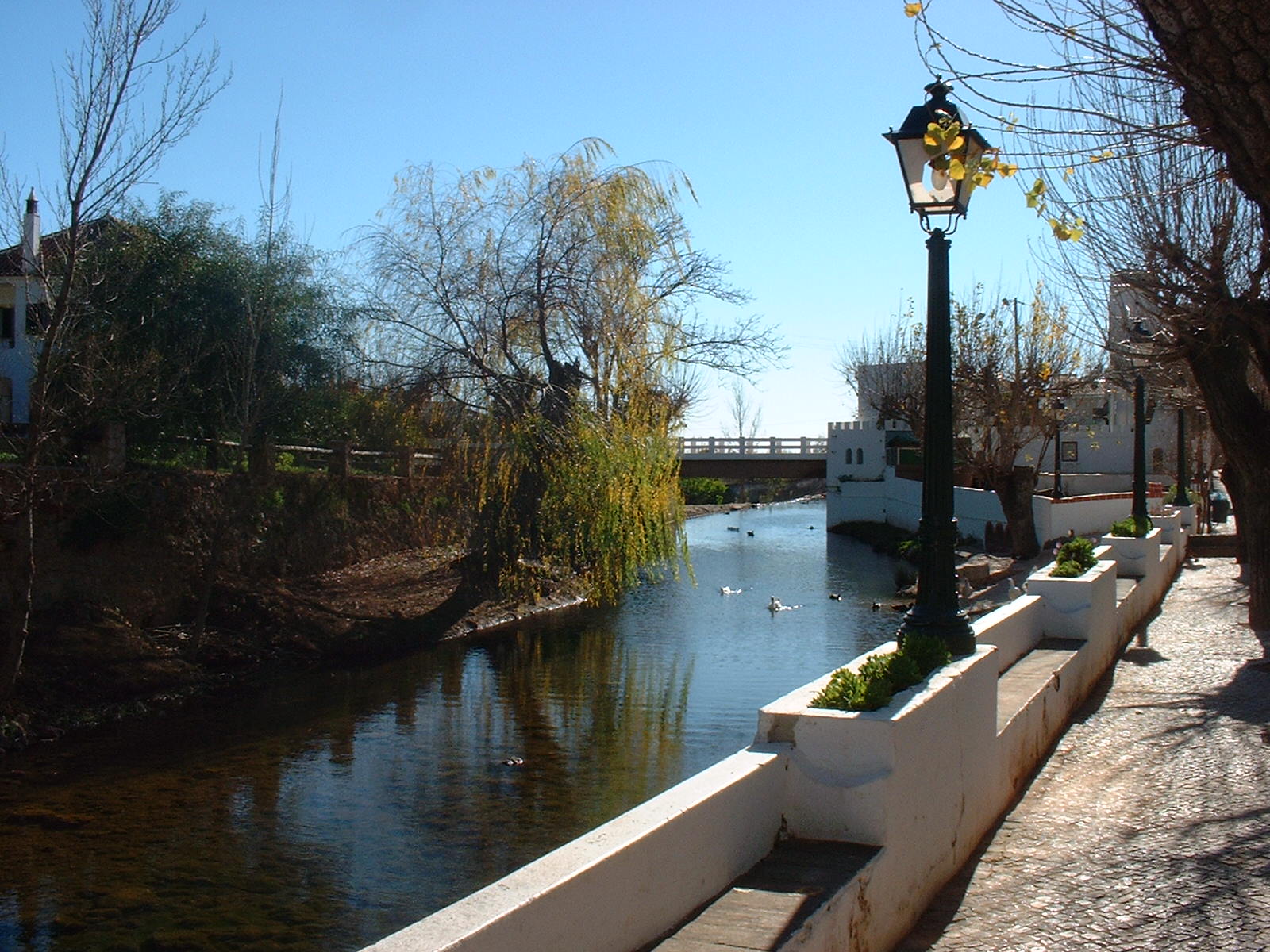
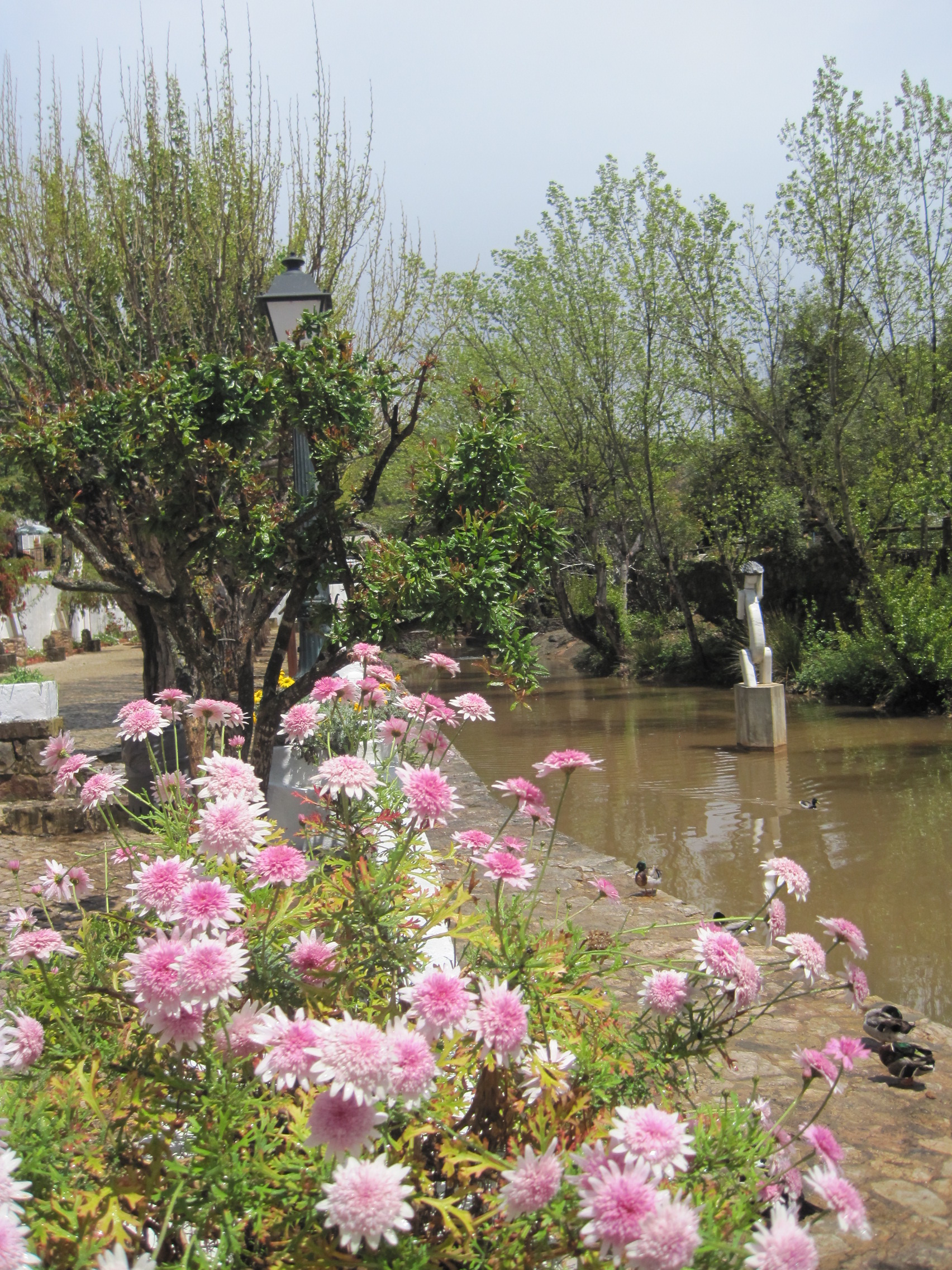
Tranquil Fonte Pequena

Azulejos decorate the springs at Fonte Pequenal

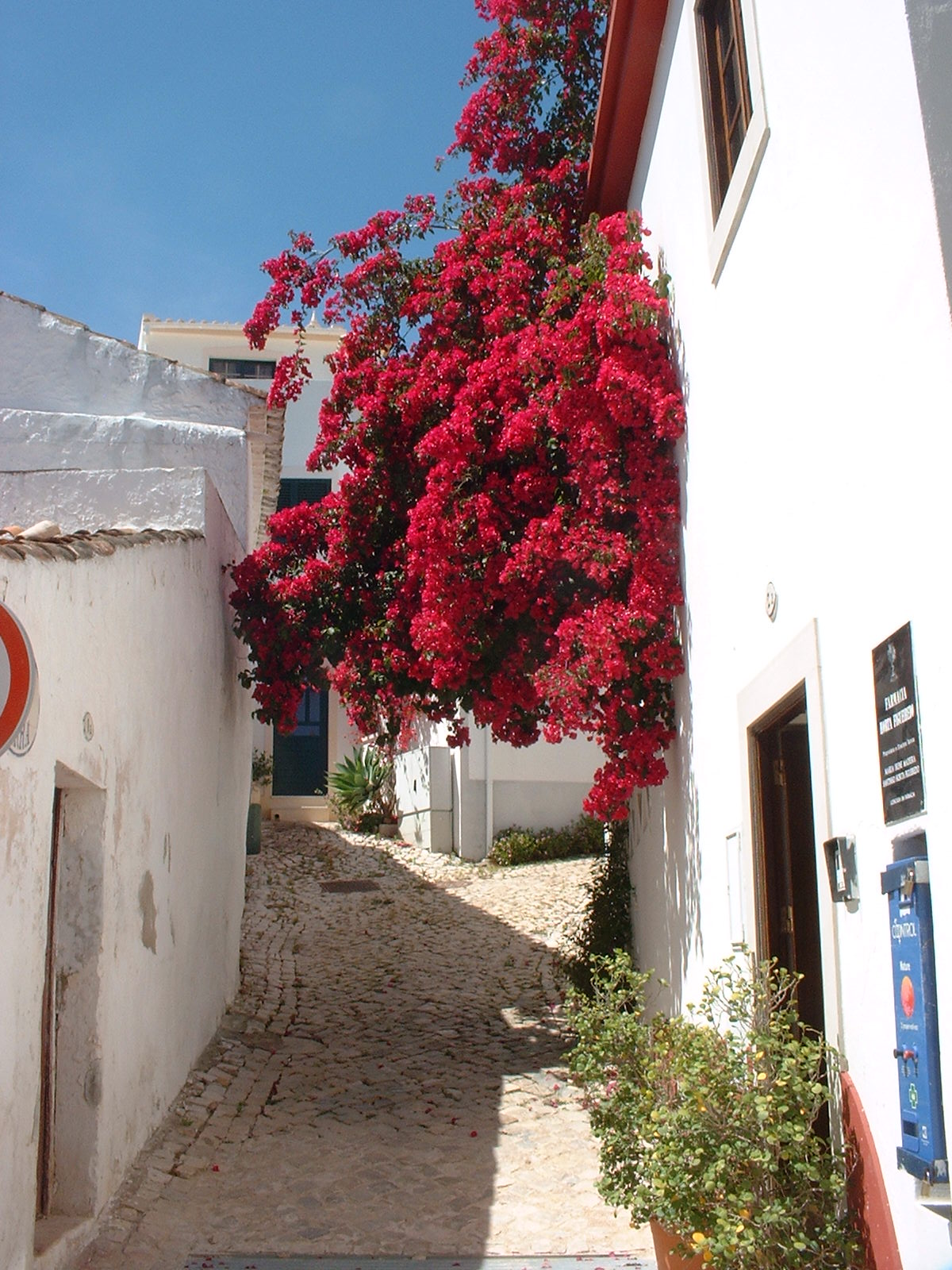
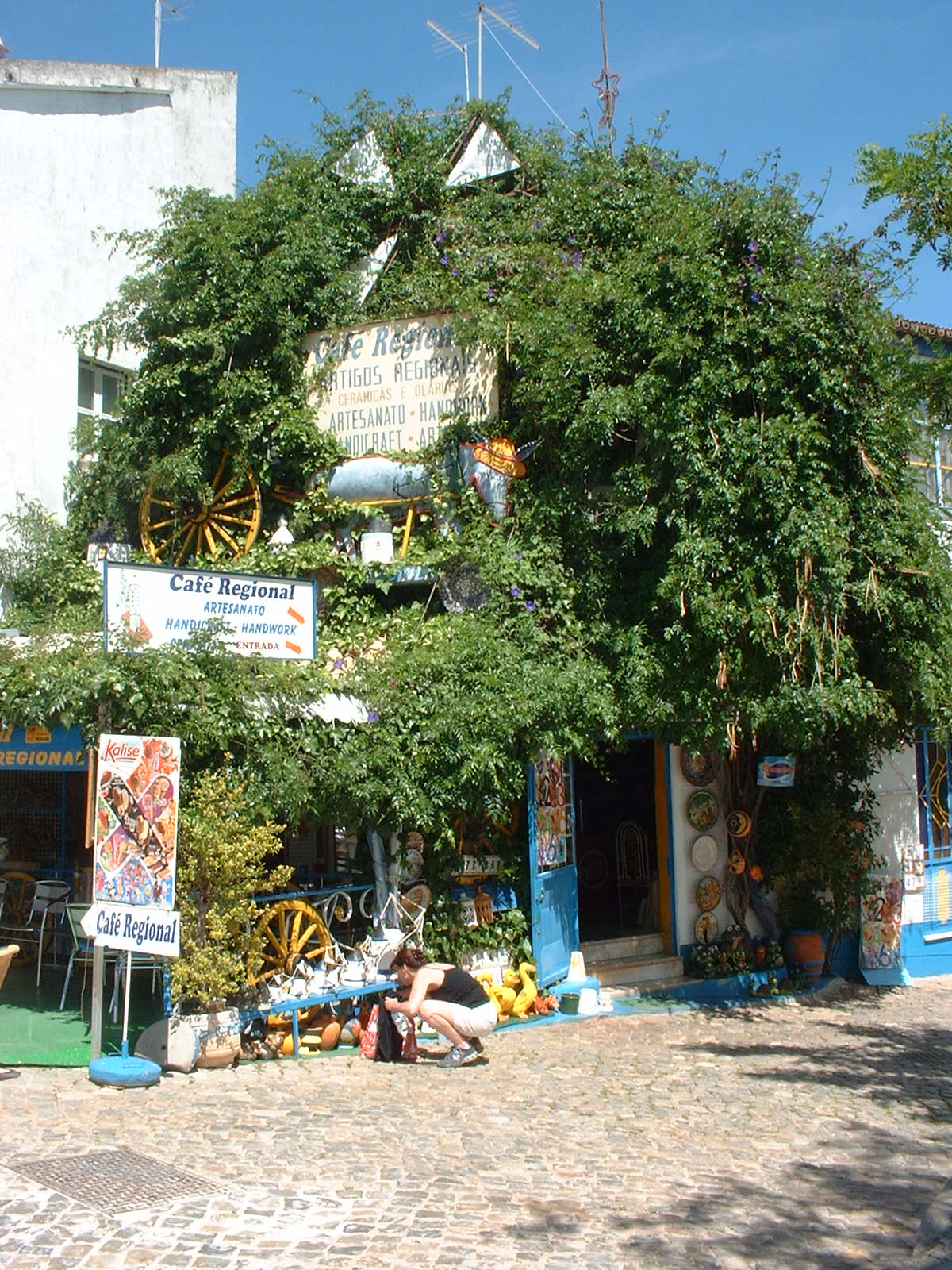
A return visit in May 2009 had us wishing we’d brought swimwear.  It was unseasonably warm and we were amazed at the volume of water in the “stream”.  A lovely area for picnics this.  And then there’s the village itself, with its winding cobbled streets, some of them quite steep.  Everywhere is whitewash and bougainvillea.  Shops and cafes are strewn about the village, a welcome source of browsing and shade in the Summer.

Bougainvilea rules!

Oh for a swimsuit! Too hot at Fonte Grande.

Can’t stay out here much longer!

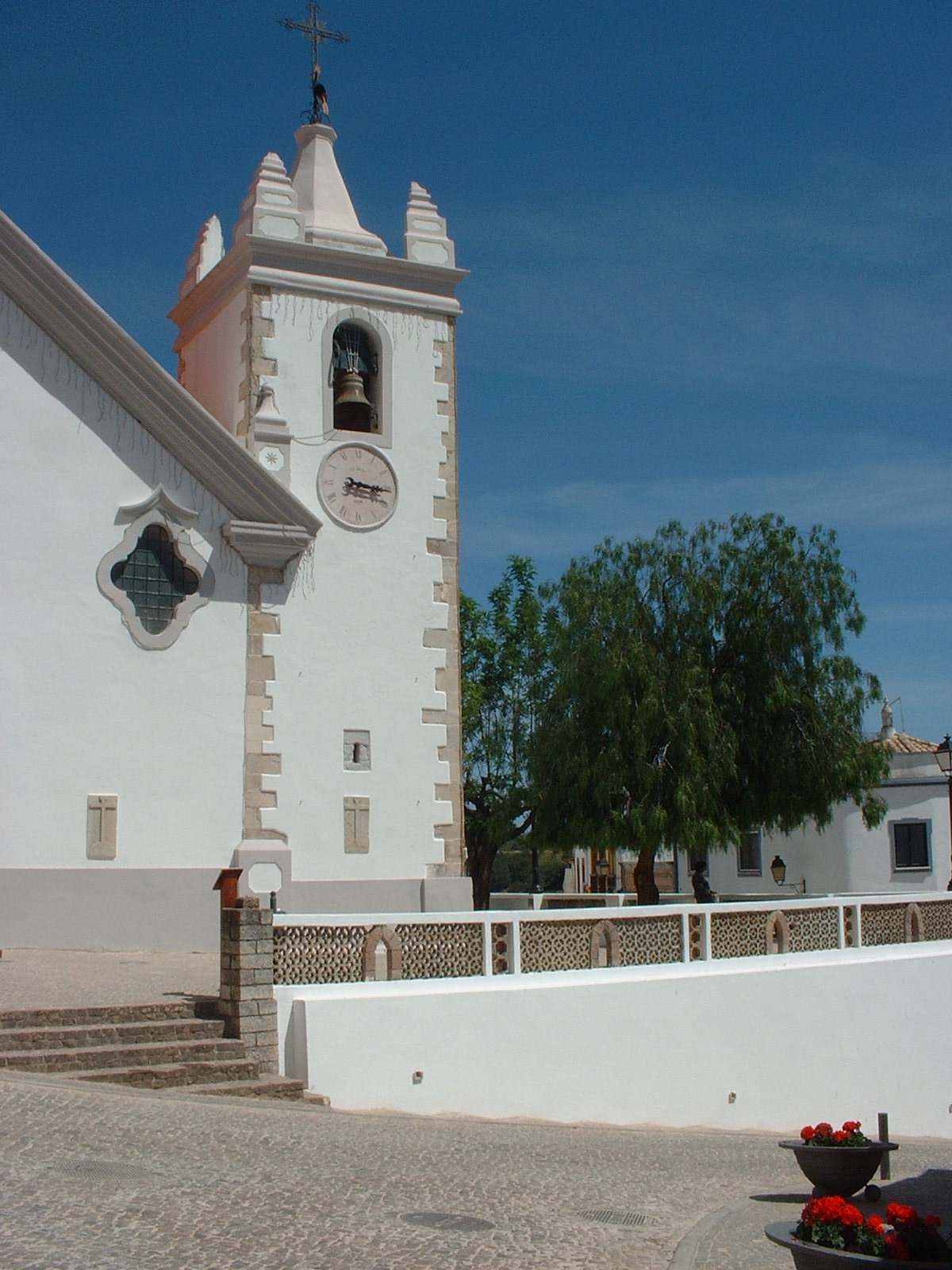
As with most Portuguese villages, the church lies at its heart.  Igreja Matriz de Alte, devoted to Our Lady of the Assumption, dates from the 13th century.  It was built at the direction of the wife of the Second Lord of Alte, to give thanks for his safe return from the Crusades.  The vault is sublimely decorated with azulejos.

Igreja Matriz

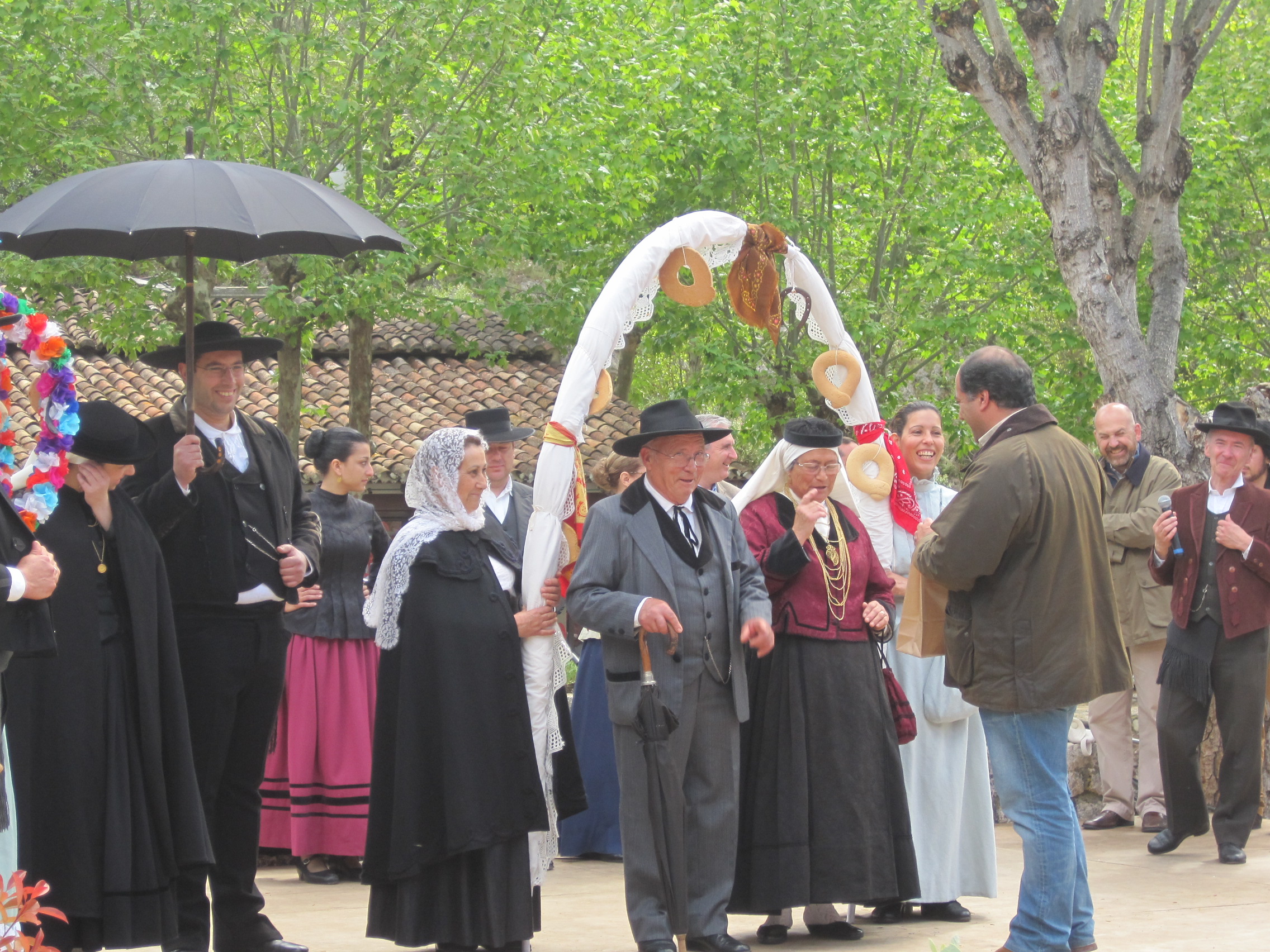
I’ve not yet had the privilege of attending the Folklore Festival and Wedding Ceremony for which Alte is most famous.  It takes place on the second Saturday in August.  Bridal Party and numerous folklore groups parade through the streets, culminating in a toast to the “happy couple” at Fonte Grande (large spring) and a traditional wedding feast.

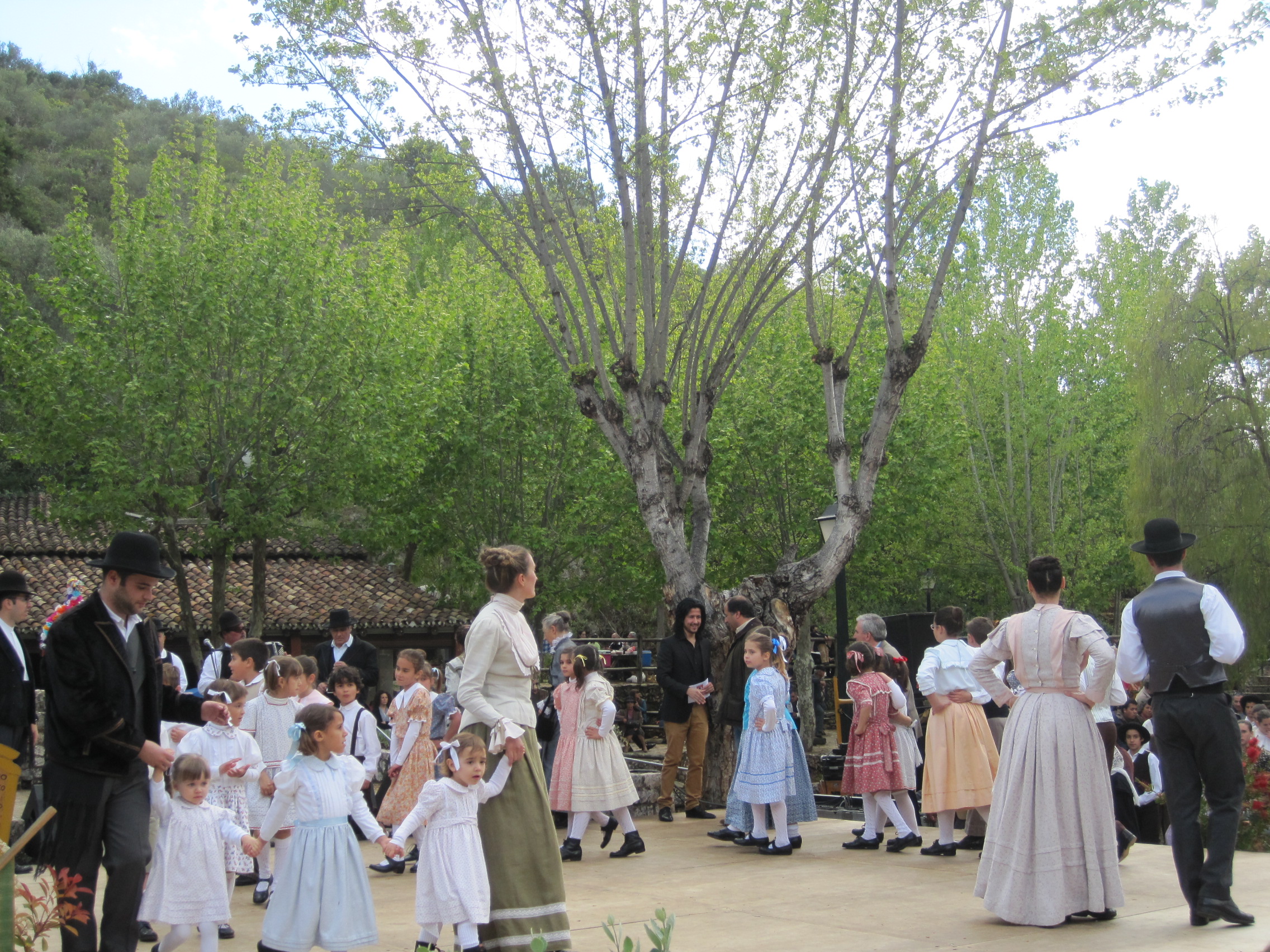
A Folklore Festival is also staged on May Day and in 2012 I managed to be there.  For a while I didn’t think it was going to happen- the skies opened and the rain bounced for almost an hour.  Patience paid off in the end, and the procession made their way across the lavender strewn cobbles to the stage at Fonte Grande.

Fonte Pequena in May

The littlest ones start the dancing off onstage at Fonte Grande

Then they were a little older

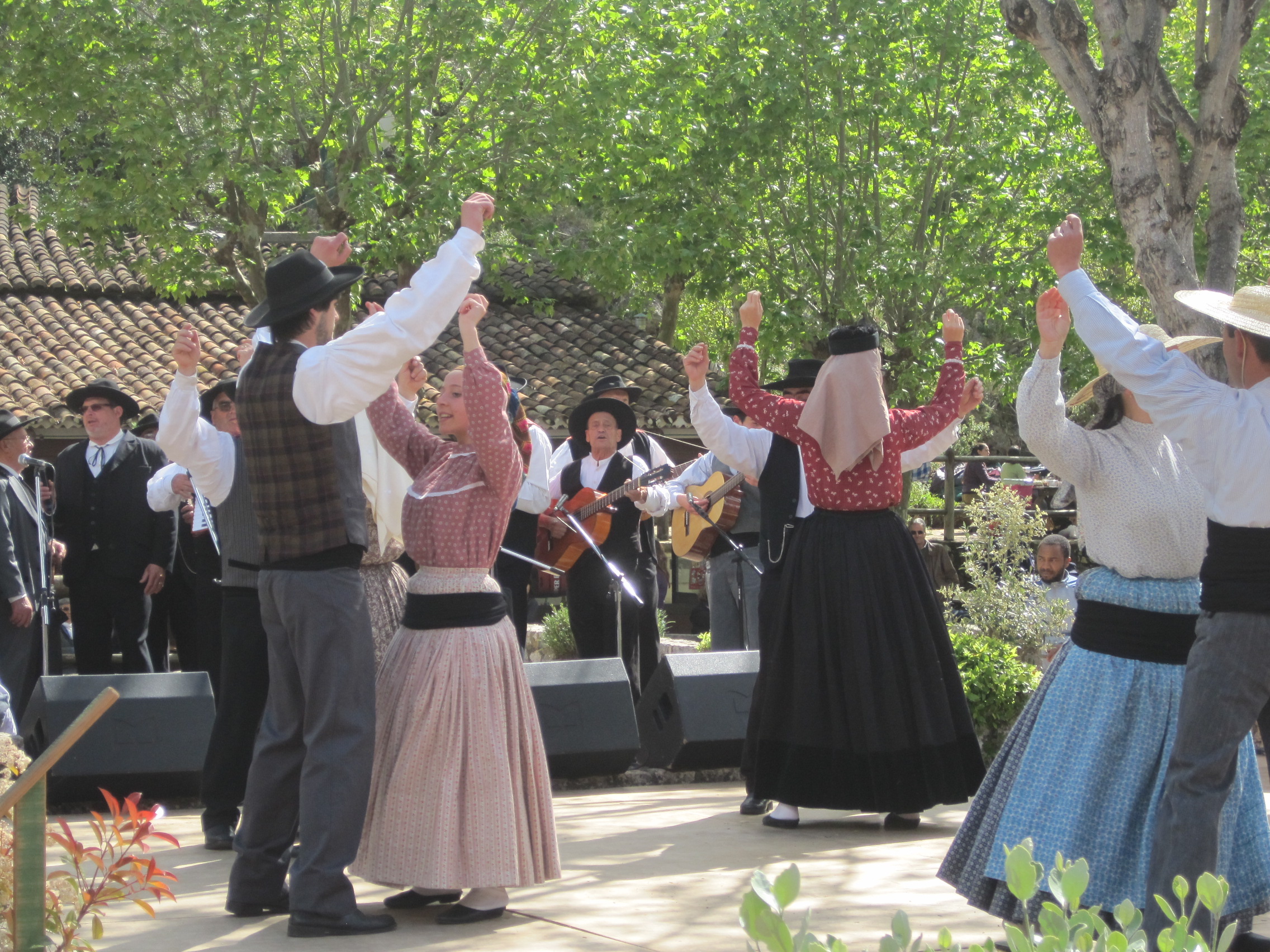
Skirts began to twirl, feet to stamp

Quickly, before it rains again!

Young and old combining expertise

Numerous other celebrations take place in Alte throughout the year, including Carnaval, this year on February 21st.  Confetti is available to throw at the passing floats.

A full list of events can be found on  http://www.alteuncovered.com/events.aspx  together with a lot of useful parking details and opening hours.

This is the first in a series of posts, related to Julie Dawn Fox’s Personal A-Z Challenge. There are links in the logo in this post and in the sidebar to take you to the main site, where you can happily read for hours.

Just to get you started, how about:

http://algarveblog.net/2012/01/12/a-is-for-the-algarve/

http://handsinportugal.wordpress.com/2012/01/12/personal-a-z-of-portugal-a-is-for-anniversary/

http://sami-colourfulworld.blogspot.com/2012/01/to-z-of-australia-is-for-australia.html

http://juliedawnfox.com/2012/01/12/b-is-for-beirao-licor-beirao/

My next task is to start my A-Z of Poland.  See you there!